
BuddhistCatholicContemplativeEvangelicalGeneral ChristianHinduJewishLatter-day SaintMuslimNew VisionsProgressive Christian
Beliefs
- Buddhist
- Catholic
- Contemplative
- Evangelical
- General Christian
- Hindu
- Jewish
- Latter-day Saint
- More Voices
- Muslim
- New Visions
- Pagan
- Progressive Christian
Topics
- Religion News
- Food and Religion
- Sports and Religion
- Religious Art
- Religious Music and Entertainment
- Religious Events
- History and Religion
- Style and Religion
- Politics and Religion
- Women in Religion
- Recreation Outdoors and Religion
- Business Finance and Religion
- Careers Workplace and Religion
- Education and Religion
- Family Parenting and Religion
- Health Fitness and Religion
- Home and Religion
- Relationships and Religion
- Technology and Religion
- Travel and Religion
Columnists
- Buddhist Columnists
- Business Finance and Religion Columnists
- Careers Workplace and Religion Columnists
- Catholic Columnists
- Contemplative Columnists
- Education and Religion Columnists
- Evangelists Columnists
- Family Parenting and Religion Columnists
- General Christian Columnists
- Health Fitness and Religion Columnists
- Hindu Columnists
- History and Religion Columnists
- Home and Religion Columnists
- Jewish Columnists
- More Voices Columnists
- Latter Day Columnists
- Muslim Columnists
- New Visions Columnists
- Nonreligious Columnists
- Pagan Columnists
- Politics and Religion Columnists
- Progressive Columnists
- Recreation Outdoors and Religion Columnists
- Relationships and Religion Columnists
- Religion News Columnists
- Religious Art Columnists
- Religious Events Columnists
- Religious Music and Entertainment Columnists
- Sports and Religion Columnists
- Style and Religion Columnists
- Technology and Religion Columnists
- Travel and Religion Columnists
- Women in Religion Columnists
Resource Library
- 2026 Calendar
- Library of World Religions
- The 100 Most Holy Places on Earth
- Patheos Answers
- Podcasts
- Videos
- Faith Leaders Database
- Anglican Episcopalian
- Bahai
- Baptist
- Buddhism
- Christianity
- Confucianism
- Eastern Orthodoxy
- Hinduism
- Holiness and Pentecostal
- ISKCON
- Islam
- Judaism
- Lutheran
- Methodist
- The Church of Jesus Christ of Latter-day Saints
- New Age
- Paganism
- Presbytarian and Reformed
- Protestantism
- Religion Behind the Scenes
- Roman Catholic
- Scientology
- Shia Islam
- Sikhism
- Sufism
- Sunni Islam
- Taoism
- Zen
- See all religions
Research Tools
 Ad-Free & Subscriber Log-In Subscription Support
Ad-Free & Subscriber Log-In Subscription Support
Follow Patheos 

- Trending:
- Forgiveness
- |
- Marriage
- |
- Consciousness
- |
- Death Penalty
- |
- Election
- |
- Halloween
 The Bite in the Apple
- Home
- Progressive Christian
- A Beautiful Thing
A Beautiful Thing
Last updated on: March 10, 2013 at 8:05 am by Nancy Rockwell
A Beautiful Thing 2013-03-10T08:05:55-04:00 Nancy Rockwell
Patheos Explore the world's faith through different perspectives on religion and spirituality! Patheos has the views of the prevalent religions and spiritualities of the world.
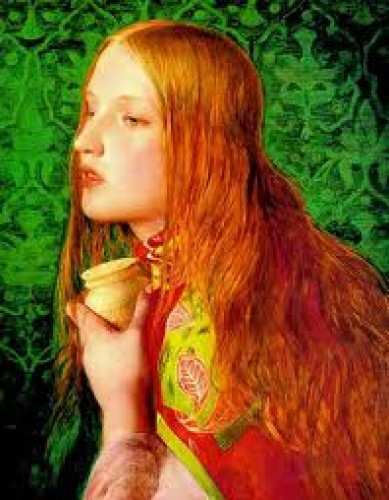 “. . . . once again they broke the Love Laws. That lay down who should be loved. And how.
And how much.”
― Arundhati Roy in
It’s a week before his death, and John has written that Mary, whom we already know loved Jesus intensely, is immersed in an ocean of feelings about his approaching doom. Jesus has come to her house for dinner, an intimate meal with her, her sister Martha and her brother Lazarus. Mary brings out a bottle of expensive, perfumed oil, pours it over Jesus feet, massages them lovingly, then gently caresses his skin with her long hair.
Jesus does not murmur in surprise. Neither is he embarrassed. He accepts this intimacy, this tenderness, with the pleasure it is meant to give. Nor do any of the others register surprise. The comfort they all feel with her touching him is evidence she has touched him before, that she and he are intimate beyond the rest.
In fact, John has written about other times Jesus visited this house, and each time there was an intimacy with Mary that set her apart from the rest. There was the time he brought all his disciples there, so we know the house was large, they all fit comfortably in the sitting room. Mary sat at his feet, in the circle of the men, and Martha, who wanted to bring them all food, fussed to Jesus that Mary should be in the kitchen with her. And Jesus defended Mary. She has chosen the good portion, and it is not to be taken away from her, he said. The good portion: being close to him; close enough to touch him. And being touched by him, in her mind, her heart. At least this. And maybe more.
 And then Lazarus, her brother, fell terribly ill. John writes that Martha and Mary nursed him as best they could, and sent for Jesus. But Jesus delayed setting out, and before he arrived, Lazarus died. Mary was beside herself with grief, and went a day’s journey on the road, meeting Jesus there. In anguish, in a tumult of tears, she accused him: if only, if only, if only, you had come, he would not have died!
Her sobbing affected him so that he also cried. Jesus wept. It stands as a verse, alone. Jesus wept. His heart awakened to her, and broke for her. In the strength of his own tears, which were brought forth by hers, in his grief that he had so disappointed her, he brought Lazarus out of his grave – for her.
And now they are all together again, eating Martha’s good cooking. Judas, it turns out, is also there that evening. And according to John he complains that the perfumed oil is too expensive, and the money should not have been so lavishly spent. Is he jealous of Mary’s place in Jesus’ affections? John accuses him of being a thief, but Jesus does not say that. He defends Mary, saying she bought this oil for his death. And that he will not be with them for long. He does always leap to defend Mary.
The story shifts, for John says a crowd arrived to see both Jesus and Lazarus, word having gotten out that Jesus was there. And John tells us the soldiers planned to kill Lazarus, too, because, like Jesus, his being alive was too powerful for them.
 Matthew and Luke also remember Mary’s caresses, writing of the perfumed oil being poured out on Jesus’ hair and neck, and then the caressing by a nameless and deeply tender woman, their gospels say. They put this moment at the Last Supper, which was also held in Martha and Mary’s house. So it isn’t odd to conclude the woman was Mary. Matthew and Luke write that Jesus defended her to Judas by saying ‘she has done a beautiful thing for me, and this story should be told endlessly, in memory of her.’
Nikos Kazantzakis, Greek literary lion, wrote in The Last Temptation of Christ, that on the cross the longing of Jesus’ heart was for Mary, and also for Mary Magdalene, that he spent his suffering hours passionately imagining the life he might have had with each of them, and then at the last knew that it was this bliss in life he was giving up in his death.
The most important work on this story has been written by Catholic theologian Elisabeth Schussler Fiorenza, in the book In Memory of Her. Fiorenza’s writings have changed the perspective of New Testament scholarship in regard to women, and have led to extensive re-examination of Jesus’ life, in canonical and non-canonical gospels. Much new material has been discovered and some old material about Jesus’ physicality that had been suppressed in favor of a non-sexual image of Jesus has been recovered. That Jesus was not sexual is official doctrine in Fiorenza’s own church, but all Christians are complicit in fostering this image.
In another week, as Holy Week begins, we will read of Judas betraying Jesus with a kiss. Yet perhaps we betray Jesus more by insisting on this pretense: that Jesus refrained from intimacy of the body and was only a friend in spirit to Mary and to Magdalene. We pretend that the man who gave the first cup of eternal life to a woman he knew had had five ‘husbands’, the man who protected a woman from being stoned for adultery, did not really experience desire, and did not himself indulge in it. In doing this, we forget the one moment in his life that Jesus named as beautiful, and the blessing he gave to Mary’s caresses, as part of . . .
. . . . the luminous sprawl of gifts,
the hospitality of the Lord, and my
inadequate answers as I row my beautiful, temporary body
through this water-lily world.
— Mary Oliver, in Six Recognitions of the Lord
____________________________________________
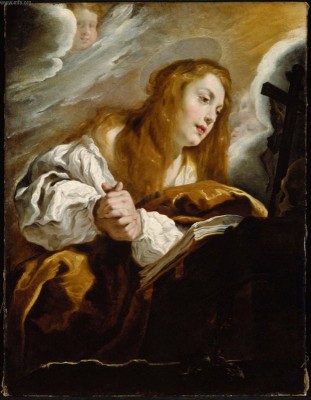
Illustrations: (over the centuries, many have thought the unnamed woman was Mary Magdalene, and much of the art of this event is named ‘Magdalene’. The iconographic tradition is to paint the woman with a jar (the perfumed oil) in her hands, and also to paint her red-headed, an attribute of passionate emotion ascribed to Magdalene in the Middle Ages.)
1. Mary Magdalene, Anthony Frederick Augustus Sandys. . ca. 1860,
Vanderbilt Divinity School Library, Art in the Christian Tradition..
2. Saint Mary Magdalene Penitent. 1615 Fetti, Domenico. Museum of Fine Arts, Boston. Vanderbilt Divinity School Library, Art in the Christina Tradition.
3. Detail from The Feast of Simon the Pharisee, Peter Paul Rubens,
Vanderbilt Divinity School Library, Art in the Christian Tradition.
4. Mary Magdalene, c. 1524. Antonio Lombardo. Walters Art Museum, Baltimore. Vanderbilt Divinity School Library, Art in the Christian Tradition.
Previous Post

March 3, 2013
Lost
Next Post
March 16, 2013 Good Friday
Browse Our Archives
Select a Category Bites Uncategorized
Select a Month December 2017 November 2017 October 2017 September 2017 August 2017 July 2017 June 2017 May 2017 April 2017 March 2017 February 2017 January 2017 December 2016 November 2016 October 2016 September 2016 August 2016 July 2016 June 2016 May 2016 April 2016 March 2016 February 2016 January 2016 December 2015 November 2015 October 2015 September 2015 August 2015 July 2015 June 2015 May 2015 April 2015 March 2015 February 2015 January 2015 December 2014 November 2014 October 2014 September 2014 August 2014 July 2014 June 2014 May 2014 April 2014 March 2014 February 2014 January 2014 December 2013 November 2013 October 2013 September 2013 August 2013 July 2013 June 2013 May 2013 April 2013 March 2013 February 2013 January 2013 December 2012
Follow Us!
TAKE THE
Religious Wisdom Quiz
Who became David's closest friend, even though he was Saul's son?
Select your answer to see how you score.
Shimei Abner Jonathan Ish-bosheth
Related posts from The Bite in the Apple




TRENDING AT PATHEOS Progressive Christian

Why Christians Have a Sacred Duty to Vote:...
The Bible offers strong support for the sacred duty to vote. Here...

What Being a Modern-Day Apostle Means to Me
In my last column, I discussed the ins and outs of modern-day...

Did Ancient China Once Worship the God of...
Across human history, a common thread weaves through the origins of the...

Love Your Neighbor – Including Earth-Kin: Lev. 19,...
God’s command to love your neighbor means acting in an ethical and...

Lead a Church Study of “Jesus and Lao...
Guest writer Jack Thomas (The Irreverent Reverend) reflects on leading his church...

Principles for Understanding the Apostolic Ministry Today
Whenever people discover that my formal ministry title is "apostle," as in...
view all Progressive Christian blogs
Ad-Free & Subscriber Log-In Subscription Support
- About Us
- 2026 Calendar
- Videos
- Podcasts
- Library of World Religions
- Faith In Media Tracker
- Advertise With Us
- Write for Us
- Privacy Policy
- Terms of Service
- Do Not Sell My Data
- Contact Us
- Radiant Digital
- Manage Newsletter Subscriptions
- Unsubscribe From Notifications
- Sitemap
Copyright 2008-2026, Patheos. All rights reserved.
Subscription Support Ad-Free & Subscriber Log-In
Follow Patheos