
BuddhistCatholicContemplativeEvangelicalGeneral ChristianHinduJewishLatter-day SaintMuslimNew VisionsProgressive Christian
Beliefs
- Buddhist
- Catholic
- Contemplative
- Evangelical
- General Christian
- Hindu
- Jewish
- Latter-day Saint
- More Voices
- Muslim
- New Visions
- Pagan
- Progressive Christian
Topics
- Religion News
- Food and Religion
- Sports and Religion
- Religious Art
- Religious Music and Entertainment
- Religious Events
- History and Religion
- Style and Religion
- Politics and Religion
- Women in Religion
- Recreation Outdoors and Religion
- Business Finance and Religion
- Careers Workplace and Religion
- Education and Religion
- Family Parenting and Religion
- Health Fitness and Religion
- Home and Religion
- Relationships and Religion
- Technology and Religion
- Travel and Religion
Columnists
- Buddhist Columnists
- Business Finance and Religion Columnists
- Careers Workplace and Religion Columnists
- Catholic Columnists
- Contemplative Columnists
- Education and Religion Columnists
- Evangelists Columnists
- Family Parenting and Religion Columnists
- General Christian Columnists
- Health Fitness and Religion Columnists
- Hindu Columnists
- History and Religion Columnists
- Home and Religion Columnists
- Jewish Columnists
- More Voices Columnists
- Latter Day Columnists
- Muslim Columnists
- New Visions Columnists
- Nonreligious Columnists
- Pagan Columnists
- Politics and Religion Columnists
- Progressive Columnists
- Recreation Outdoors and Religion Columnists
- Relationships and Religion Columnists
- Religion News Columnists
- Religious Art Columnists
- Religious Events Columnists
- Religious Music and Entertainment Columnists
- Sports and Religion Columnists
- Style and Religion Columnists
- Technology and Religion Columnists
- Travel and Religion Columnists
- Women in Religion Columnists
Resource Library
- 2026 Calendar
- Library of World Religions
- The 100 Most Holy Places on Earth
- Patheos Answers
- Podcasts
- Videos
- Faith Leaders Database
- Anglican Episcopalian
- Bahai
- Baptist
- Buddhism
- Christianity
- Confucianism
- Eastern Orthodoxy
- Hinduism
- Holiness and Pentecostal
- ISKCON
- Islam
- Judaism
- Lutheran
- Methodist
- The Church of Jesus Christ of Latter-day Saints
- New Age
- Paganism
- Presbytarian and Reformed
- Protestantism
- Religion Behind the Scenes
- Roman Catholic
- Scientology
- Shia Islam
- Sikhism
- Sufism
- Sunni Islam
- Taoism
- Zen
- See all religions
Research Tools
 Ad-Free & Subscriber Log-In Subscription Support
Ad-Free & Subscriber Log-In Subscription Support
Follow Patheos 

- Trending:
- Forgiveness
- |
- Marriage
- |
- Consciousness
- |
- Death Penalty
- |
- Election
- |
- Halloween

- Home
- Catholic
- History and Religion
- Did a Church Father Deny Christ’s Real Presence at Mass?
Did a Church Father Deny Christ’s Real Presence at Mass?
Last updated on: August 6, 2026 at 1:49 pm by Billy Kangas
Did a Church Father Deny Christ’s Real Presence at Mass? 2026-08-06T13:49:19-04:00 Billy Kangas
Patheos Explore the world's faith through different perspectives on religion and spirituality! Patheos has the views of the prevalent religions and spiritualities of the world.
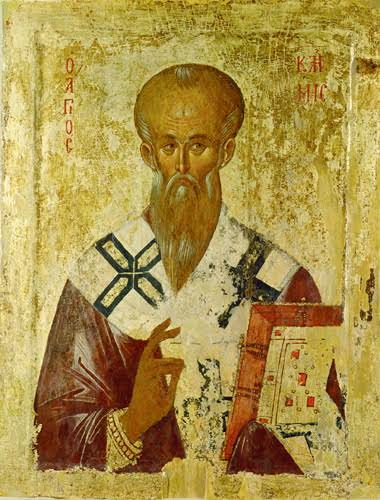
Clement uses symbolic language and the liturgy uses memorial language. But in the Jewish and early Christian worldview, these words point to real participation, not mere metaphor. | Image courtesy of See page for author, Public domain, via Wikimedia Commons.

Over the past week, a lively debate has been unfolding online about whether any of the early Church Fathers denied the Real Presence in the Eucharist. One comment in particular caught my attention because it raised thoughtful questions about symbolism, metaphor, and the meaning of “memorial” in early Christian worship. The commenter quotes Clement of Alexandria:
“Elsewhere, the Lord, in the gospel according to John, brought this out by SYMBOLS, when he said: ‘Eat ye my flesh, and drink my blood,’ describing distinctly by METAPHOR…”
— Clement of Alexandria, The Instructor 1.6
They also pointed to the Liturgy of St. James, which speaks of the Eucharist as “an everlasting memorial.”
Let’s get into it a little.
To begin with, I don’t think they quoted Clement in the proper context.
What is this chapter really about?
This chapter isn’t a treatise on the nature of the Eucharist at all. It’s Clement’s answer to critics (likely proto-Gnostic Christians) who mocked ordinary baptized believers as mere “children” and “infants,” implying they’d received only elementary teaching while a spiritual elite possessed deeper, hidden knowledge. Clement’s central argument is that baptism confers complete salvation instantly and equally to everyone who receives it. There is no tier of “milk-fed” beginners and a separate tier of “meat-eating” advanced Gnostics, because milk and meat are, in his reading of Paul, the very same substance (Christ himself) offered in full to every believer regardless of how long they’ve been in the faith.
So why is he talking about the Bread of Life discourse at all?
Clement gets there through his running argument about “milk vs. meat” in 1 Corinthians 3. He’s just spent a stretch insisting that milk and meat aren’t two different grades of teaching but one and the same substance, Christ, taken in different forms depending on what the recipient can handle. To back that up, he needs to show that “milk” itself can mean something as weighty and total as the “meat” his opponents think is reserved for advanced believers.
So he reaches for a second scriptural image of nourishment: Jesus in John’s Gospel saying “eat my flesh, drink my blood.” Clement’s move is to point out that even this most solid, substantial image of food carries a deeper meaning beyond the literal act of eating it signifies the very realities that hold the Church together as one body. This isn’t a denial that the Eucharist truly is Christ’s flesh and blood; Clement, like other Fathers of his era, can affirm a reality and draw out its symbolic significance in the same breath. His point here is simply that the nourishment Christ gives, whether described as milk, meat, bread, wine, or flesh and blood, is always one and the same gift: Christ himself, given whole, not doled out in lesser and greater portions to different classes of believer. John 6 gets folded into that argument as one more link in the chain, not as a place where Clement stops to settle the question of eucharistic presence for its own sake.
That’s also why the move feels sudden if you’re reading specifically for eucharistic theology. Clement isn’t pausing to explain the Eucharist; he’s using the “eat my flesh” line as leverage in his larger anti-elitist point, then immediately continuing into the blood-becomes-milk physiology to keep building that same case.
Clement is explaining the mode of Christ’s teaching, i.e., the metaphorical language of John 6, not denying the sacramental reality. He’s attacking a Gnostic argument that promotes a spiritual elitism, not talking about the physical reality of the sacraments. If you look at the rest of this work as well as in the Stromata, I think you would be hard-pressed to argue (in spite of his love of spiritualization and symbol) that he did not believe in the true presence of Christ in the Eucharist. This is commentary on a different topic, and applying it to eucharistic theology is a stretch. There are many Christians throughout the history of the Church who recognize the true presence of Christ in the Eucharist and still see the Bread of Life discourse (given before the institution of the Eucharist) as full of symbolic meaning.
Clement makes an interesting point, and I’m not sure I agree with him completely, but in no way is he offering a commentary on Eucharistic theology.
What about “Memorial Language”
This brings us to the Liturgy of St. James, which calls the Eucharist “an everlasting memorial.” That phrase can sound like “mere remembrance” to modern ears, but in Scripture and Jewish worship, “memorial” (anamnesis in the LXX) never means simple recollection. It means making the saving act of God present.
In the original language of the liturgy, the phrase is ““…τὴν μυστικὴν ταύτην καὶ φρικτὴν θυσίαν, εἰς ἀνάμνησιν αἰώνιον…”
In English this is: “…this mystical and awe-inspiring sacrifice, as an everlasting memorial…”
Memorial is ἀνάμνησιν – anamnēsin – from anamnesis. This is a word that has a meaning in context that is very different from what we think of when we hear it translated into English.
In the Old Testament, Passover is called a “memorial”:
“This day shall be a memorial for you…” (Exodus 12:14)
But Israel didn’t merely remember the Exodus; they participated in it liturgically. The Septuagint uses anamnesis for sacrificial offerings: “He shall burn it on the altar as a memorial (anamnesis) offering.” (Leviticus 2:2 LXX)
This “memorial offering” is not symbolic in the modern sense. It is the actual presentation of the sacrifice before God.
The New Testament uses the same word: “There is a reminder (anamnesis) of sins every year.” (Hebrews 10:3)
Again, this is not mental recollection. It is the liturgical re‑presentation of the sacrifice.
So when Jesus says at the Last Supper, “Do this in anamnesis of me.” (Luke 22:19)
He is speaking in that Jewish sacrificial sense: not “think about me,” but “participate in my offering,” or perhaps “make present what I accomplished.”
The Catechism explains this directly:
“In the sense of Scripture, the memorial is not merely the recollection of past events but the proclamation of the mighty works wrought by God for men… these events become in a certain way present and real.” (CCC 1363)
And:
“The Eucharist is thus a memorial because it makes present the sacrifice of the cross.” (CCC 1364)
This is why Catholics can say the Eucharist is both symbolic and real. The symbolism is not a denial of the miracle; it is the very way the miracle is communicated.
So yes, Clement uses symbolic language and the liturgy uses memorial language. But in the Jewish and early Christian worldview, these words point to real participation, not mere metaphor. The sacraments are “smoke,” not “stop signs,” signs that reveal and communicate the reality they signify.
And all of this stands alongside the clear and repeated affirmations of the Real Presence found throughout the early Church. Take Ignatius of Antioch, Justin Martyr, Irenaeus of Lyons, Hippolytus, Cyprian, Athanasius, Cyril of Jerusalem, Basil the Great, Gregory of Nyssa, Ambrose of Milan, John Chrysostom, and Augustine, for starters. Each of them speaks of the Eucharist as the true Body and Blood of Christ. Even the Fathers most fond of figurative language, such as Tertullian and Origen, affirm that reality while drawing out its symbolic depth, which is precisely the pattern we have been describing. Place Clement’s language next to this witness and it becomes a losing argument to suggest the early Church understood the Eucharist as “mere symbol.” The record is simply overwhelming. When you place Clement’s symbolic language next to the innumerable explicit statements from these Fathers, it becomes a losing argument to suggest that the early Church understood the Eucharist as “mere symbol.” The Fathers were fully convinced that in the sacrament, under the signs of bread and wine, the faithful truly receive the Body and Blood of the Lord.
General Christian
History and Religion
Previous Post
July 24, 2026
When you hear the word "masculine" what images come to mind?
Next Post
September 1, 2026 May Wendell Berry Trouble Your Thoughts Today
Recent Comments
"hate disqualifies you totally. I became a Catholic because I saw too many like you. ..."
Porcine obtuseness Sniffer Dog
Controversial Celebrity Religious Conversions: Who Switched ..."
"'Stop hiding your gifts' is a productive invitation. Novices leave behind their loved ones and ..."
Stop Hiding Your Gifts: Lessons from ..."
"Bending low, he uplifted the lowly. Joseph Cafasso continues to inspire men and women of ..."
Not Grand, But Great: Legacy Through ..."
"Does Jesus dwell within you, or is it a comforting delusion?A new counter-apologetic method exposes ..."
Browse Our Archives
Select a Category Art Bible Books CCC Prayer Christmas Current Events Family Film Free Photo Fridays Humor hunger liturgical calendar liturgy Music Photos pope Prayer Prayerful Leader questions Quotes Review Saints Satire Scripture SYNOD SYNOD FOR THE FAMILY teaching Uncategorized video Weekly Round Up
Select a Month October 2026 September 2026 August 2026 July 2026 April 2026 February 2026 December 2025 November 2025 October 2025 September 2025 August 2025 July 2025 June 2025 May 2025 April 2025 February 2025 January 2025 September 2024 June 2024 May 2024 February 2024 December 2023 August 2023 May 2023 February 2023 November 2022 July 2022 June 2022 May 2022 March 2022 May 2021 April 2021 March 2021 February 2021 January 2021 September 2020 April 2020 March 2020 February 2020 January 2020 December 2019 November 2019 October 2019 August 2019 June 2019 May 2019 March 2019 January 2019 December 2018 August 2018 June 2018 April 2018 March 2018 February 2018 December 2017 November 2017 September 2017 August 2017 July 2017 June 2017 April 2017 March 2017 February 2017 December 2016 November 2016 February 2016 January 2016 November 2015 October 2015 August 2015 July 2015 June 2015 May 2015 April 2015 March 2015 February 2015 January 2015 December 2014 November 2014 October 2014 September 2014 August 2014 July 2014 June 2014 May 2014 April 2014 March 2014 February 2014 January 2014 December 2013 November 2013 October 2013 September 2013 August 2013 July 2013 June 2013 May 2013 April 2013 March 2013 February 2013 January 2013 December 2012 November 2012 October 2012 August 2012 July 2012 June 2012 May 2012 April 2012 March 2012 February 2012 January 2012 December 2011 November 2011 October 2011 September 2011 August 2011 July 2011 June 2011 May 2011 April 2011 March 2011 February 2011 January 2011 December 2010 November 2010 October 2010 September 2010 August 2010 July 2010 June 2010 May 2010 April 2010 March 2010 February 2010 January 2010 December 2009 November 2009 October 2009 September 2009 August 2009 July 2009 June 2009 April 2009 March 2009 February 2009 January 2009 October 2008 August 2008 June 2008 May 2008 April 2008 March 2008 February 2008 January 2008 December 2007 November 2007
Follow Us!
TAKE THE
Religious Wisdom Quiz
I am the final plague that caused Pharaoh to finally let the Israelites go. What am I?
Select your answer to see how you score.
The plague of darkness The plague of blood Death of the firstborn The plague of locusts
Related posts from The Orant
May Wendell Berry Trouble Your Thoughts Today
When you hear the word "masculine" what images...
TRENDING AT PATHEOS Catholic

The Sermon on the Mount, Part I: Matthew...
The Sermon on the Mount, Part I (Matthew 4:12-5:12) St. Matthew moves...

What's up from Crossway: Reviewing some of their latest A few weeks...

Janie Learns the Way of the Cross: A...
Teaching children about Jesus' Passion can be challenging. Many parents and educators...

Looking For Good Catholic Writing - October 2026
He alone extends the heavens, and he walks upon the waves of...

In "Irreplaceable," our book on vocation and technology, Trevor Sutton and I...

I was strolling through the top floor of the brand new Parthenon...
view all Catholic blogs
What Are Your Thoughts?leave a comment
Ad-Free & Subscriber Log-In Subscription Support
- About Us
- 2026 Calendar
- Videos
- Podcasts
- Library of World Religions
- Faith In Media Tracker
- Advertise With Us
- Write for Us
- Privacy Policy
- Terms of Service
- Do Not Sell My Data
- Contact Us
- Radiant Digital
- Manage Newsletter Subscriptions
- Unsubscribe From Notifications
- Sitemap
Copyright 2008-2026, Patheos. All rights reserved.
Subscription Support Ad-Free & Subscriber Log-In
Follow Patheos