
BuddhistCatholicContemplativeEvangelicalGeneral ChristianHinduJewishLatter-day SaintMuslimNew VisionsProgressive Christian
Beliefs
- Buddhist
- Catholic
- Contemplative
- Evangelical
- General Christian
- Hindu
- Jewish
- Latter-day Saint
- More Voices
- Muslim
- New Visions
- Pagan
- Progressive Christian
Topics
- Religion News
- Food and Religion
- Sports and Religion
- Religious Art
- Religious Music and Entertainment
- Religious Events
- History and Religion
- Style and Religion
- Politics and Religion
- Women in Religion
- Recreation Outdoors and Religion
- Business Finance and Religion
- Careers Workplace and Religion
- Education and Religion
- Family Parenting and Religion
- Health Fitness and Religion
- Home and Religion
- Relationships and Religion
- Technology and Religion
- Travel and Religion
Columnists
- Buddhist Columnists
- Business Finance and Religion Columnists
- Careers Workplace and Religion Columnists
- Catholic Columnists
- Contemplative Columnists
- Education and Religion Columnists
- Evangelists Columnists
- Family Parenting and Religion Columnists
- General Christian Columnists
- Health Fitness and Religion Columnists
- Hindu Columnists
- History and Religion Columnists
- Home and Religion Columnists
- Jewish Columnists
- More Voices Columnists
- Latter Day Columnists
- Muslim Columnists
- New Visions Columnists
- Nonreligious Columnists
- Pagan Columnists
- Politics and Religion Columnists
- Progressive Columnists
- Recreation Outdoors and Religion Columnists
- Relationships and Religion Columnists
- Religion News Columnists
- Religious Art Columnists
- Religious Events Columnists
- Religious Music and Entertainment Columnists
- Sports and Religion Columnists
- Style and Religion Columnists
- Technology and Religion Columnists
- Travel and Religion Columnists
- Women in Religion Columnists
Resource Library
- 2026 Calendar
- Library of World Religions
- The 100 Most Holy Places on Earth
- Patheos Answers
- Podcasts
- Videos
- Faith Leaders Database
- Anglican Episcopalian
- Bahai
- Baptist
- Buddhism
- Christianity
- Confucianism
- Eastern Orthodoxy
- Hinduism
- Holiness and Pentecostal
- ISKCON
- Islam
- Judaism
- Lutheran
- Methodist
- The Church of Jesus Christ of Latter-day Saints
- New Age
- Paganism
- Presbytarian and Reformed
- Protestantism
- Religion Behind the Scenes
- Roman Catholic
- Scientology
- Shia Islam
- Sikhism
- Sufism
- Sunni Islam
- Taoism
- Zen
- See all religions
Research Tools
 Ad-Free & Subscriber Log-In Subscription Support
Ad-Free & Subscriber Log-In Subscription Support
Follow Patheos 

- Trending:
- Forgiveness
- |
- Marriage
- |
- Consciousness
- |
- Death Penalty
- |
- Election
- |
- Halloween

- Home
- Catholic
- Religious Art
- Luke’s Portrait of the Compassionate Christ
Luke’s Portrait of the Compassionate Christ
Last updated on: October 17, 2025 at 8:00 am by Billy Kangas
Luke’s Portrait of the Compassionate Christ 2025-10-06T10:09:57-04:00 Billy Kangas
Patheos Explore the world's faith through different perspectives on religion and spirituality! Patheos has the views of the prevalent religions and spiritualities of the world.
Saint Luke is the evangelist whose Gospel pulses with compassion. He transmits many of Jesus’ most beloved stories, offering vivid portraits of mercy that continue to shape Christian imagination and pastoral practice. Consider the image of the prodigal son returning to his father’s embrace after years of wandering. Luke writes, “While he was still a long way off, his father saw him and was filled with compassion; he ran to his son, threw his arms around him and kissed him” (Luke 15:20). This moment, found only in Luke’s Gospel, reveals a God who moves toward us with mercy.
Another iconic scene is the parable of the Good Samaritan. A man is beaten and left for dead, and it is not the priest or Levite who stops, but a Samaritan—an outsider—who “went to him and bandaged his wounds, pouring on oil and wine” (Luke 10:34). Jesus concludes, “Go and do likewise” (Luke 10:37). Luke’s Gospel invites us to see mercy not as sentiment but as action, a movement toward the suffering.
This emphasis on mercy is more pronounced in Luke than in the other three evangelists. It raises a question worth exploring: why does Luke focus so intently on compassion? Scripture offers clues about Luke’s life and ministry that help us understand this distinctive lens.
Luke appears in his own writing in the book of Acts, where he shifts to first-person narration in several passages, indicating his presence alongside Paul. In Acts 16:10, he writes, “After Paul had seen the vision, we got ready at once to leave for Macedonia.” These “we” passages suggest that Luke witnessed both persecution and pastoral care firsthand. He was not a distant observer but a companion in mission.
Paul also refers to Luke in Colossians 4:14, calling him “the beloved physician.” This title is more than a profession—it points to a vocation of healing. Physicians in the ancient world were trained to observe suffering closely, to respond with care, and to walk patiently with the wounded. Luke’s Gospel reflects this attentiveness. He includes more healing stories than any other evangelist and often adds details that highlight the human experience of pain and restoration.
Scholars believe Luke was likely born in Antioch, a city known for its cultural diversity. He may have had a Gentile background, which would have shaped his sensitivity to exclusion and his appreciation for Jesus’ outreach to outsiders. This perspective is evident throughout his Gospel. Luke alone records Jesus’ visit to the widow of Nain, whose only son had died. “When the Lord saw her, his heart went out to her and he said, ‘Don’t cry’” (Luke 7:13). Jesus then raises the boy from the dead, restoring not just life but relationship.
Luke also preserves the story of the sinful woman who anoints Jesus’ feet. “Her many sins have been forgiven—as her great love has shown” (Luke 7:47). Mercy is not just extended; it is transformative. Zacchaeus, the tax collector, is another example. After encountering Jesus, he declares, “Look, Lord! Here and now I give half of my possessions to the poor” (Luke 19:8). Jesus responds, “Today salvation has come to this house” (Luke 19:9). Mercy leads to mission.
Luke’s Gospel is also rich in canticles—songs of mercy and hope. The Magnificat, spoken by Mary, proclaims, “His mercy extends to those who fear him, from generation to generation” (Luke 1:50). Zechariah’s Benedictus declares that God will “give his people the knowledge of salvation through the forgiveness of their sins” (Luke 1:77). Simeon’s canticle, the Nunc Dimittis, rejoices that God’s salvation has been “prepared in the sight of all nations” (Luke 2:31). These songs frame the Gospel with a theology of mercy that is both personal and cosmic.
Luke’s emphasis on mercy is not accidental. It flows from his identity as a healer, a missionary, and perhaps an outsider. His Gospel is a physician’s casebook of divine compassion, written by one who knew the ache of exclusion and the power of grace. He shows us a Christ who moves toward the broken, who lifts the lowly, and who calls us to do the same.
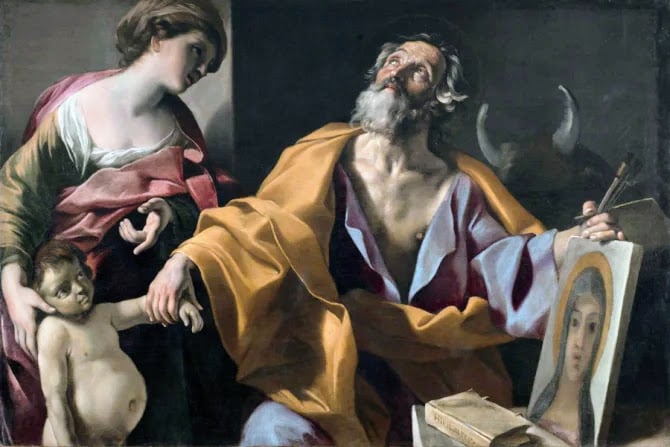 To accompany this reflection, I selected the painting St. Luke Healing the Dropsical Child by Giovanni Lanfranco, a Baroque artist renowned for his dramatic use of light and movement. Created around 1620, the painting depicts Saint Luke performing a healing miracle on a child suffering from dropsy, a condition marked by fluid retention and swelling. Although this specific miracle is not found in Scripture, Lanfranco’s portrayal draws from Luke’s traditional identity as “the beloved physician” (Colossians 4:14). The artist likely chose to emphasize Luke’s healing vocation because of the Gospel’s deep concern for the suffering and the marginalized. Lanfranco’s composition invites the viewer to see Luke not only as an evangelist but also as a compassionate caregiver. The child’s vulnerable posture and Luke’s gentle gesture evoke both medical tenderness and spiritual restoration. In this visual meditation, Luke becomes a bridge between the healing ministry of Christ and the ongoing mission of the Church. His Gospel continues to mend what has been wounded, offering mercy as nourishment for the journey.
General Christian
Religious Art
Previous Post
September 26, 2025
Week in Review: Saints, Books, and Lots of Prayer.
Next Post
November 21, 2025 From Mockery to Majesty - Christ the King
Recent Comments
"hate disqualifies you totally. I became a Catholic because I saw too many like you. ..."
Porcine obtuseness Sniffer Dog
Controversial Celebrity Religious Conversions: Who Switched ..."
"'Stop hiding your gifts' is a productive invitation. Novices leave behind their loved ones and ..."
Stop Hiding Your Gifts: Lessons from ..."
"Bending low, he uplifted the lowly. Joseph Cafasso continues to inspire men and women of ..."
Not Grand, But Great: Legacy Through ..."
"Does Jesus dwell within you, or is it a comforting delusion?A new counter-apologetic method exposes ..."
Browse Our Archives
Select a Category Art Bible Books CCC Prayer Christmas Current Events Family Film Free Photo Fridays Humor hunger liturgical calendar liturgy Music Photos pope Prayer Prayerful Leader questions Quotes Review Saints Satire Scripture SYNOD SYNOD FOR THE FAMILY teaching Uncategorized video Weekly Round Up
Select a Month October 2026 September 2026 August 2026 July 2026 April 2026 February 2026 December 2025 November 2025 October 2025 September 2025 August 2025 July 2025 June 2025 May 2025 April 2025 February 2025 January 2025 September 2024 June 2024 May 2024 February 2024 December 2023 August 2023 May 2023 February 2023 November 2022 July 2022 June 2022 May 2022 March 2022 May 2021 April 2021 March 2021 February 2021 January 2021 September 2020 April 2020 March 2020 February 2020 January 2020 December 2019 November 2019 October 2019 August 2019 June 2019 May 2019 March 2019 January 2019 December 2018 August 2018 June 2018 April 2018 March 2018 February 2018 December 2017 November 2017 September 2017 August 2017 July 2017 June 2017 April 2017 March 2017 February 2017 December 2016 November 2016 February 2016 January 2016 November 2015 October 2015 August 2015 July 2015 June 2015 May 2015 April 2015 March 2015 February 2015 January 2015 December 2014 November 2014 October 2014 September 2014 August 2014 July 2014 June 2014 May 2014 April 2014 March 2014 February 2014 January 2014 December 2013 November 2013 October 2013 September 2013 August 2013 July 2013 June 2013 May 2013 April 2013 March 2013 February 2013 January 2013 December 2012 November 2012 October 2012 August 2012 July 2012 June 2012 May 2012 April 2012 March 2012 February 2012 January 2012 December 2011 November 2011 October 2011 September 2011 August 2011 July 2011 June 2011 May 2011 April 2011 March 2011 February 2011 January 2011 December 2010 November 2010 October 2010 September 2010 August 2010 July 2010 June 2010 May 2010 April 2010 March 2010 February 2010 January 2010 December 2009 November 2009 October 2009 September 2009 August 2009 July 2009 June 2009 April 2009 March 2009 February 2009 January 2009 October 2008 August 2008 June 2008 May 2008 April 2008 March 2008 February 2008 January 2008 December 2007 November 2007
Follow Us!
TAKE THE
Religious Wisdom Quiz
Which disciple was known as "the beloved"?
Select your answer to see how you score.
Matthew John Andrew Peter
Related posts from The Orant

May Wendell Berry Trouble Your Thoughts Today

Weekly Roundup: Attentive to Grace

Weekly Round Up: Embracing Ordinary
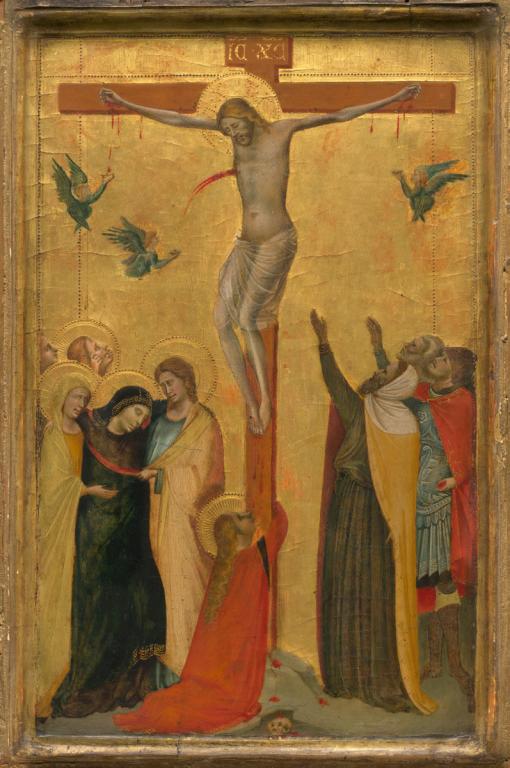
The Eschatological Crucifixion of Bernardo Daddi
TRENDING AT PATHEOS Catholic

Catholic Evangelization: Sharing Your Faith Every Day
Welcome back to the Graceful Awakening mini-series called, “From Faith to Mission.” ...

The Pillar of the Boatmen: the Ancient Monument...
The Pillar of the Boatmen is a Romano-Gaulish sculpture that dates from...

In one sense walking into Westminster Abbey is like walking down the...

'Super Scam Me' Exposes AI Jon Bon Jovi...
Leslie Pickett believed she was in a relationship with Jon Bon Jovi....

The Brazilian Remake of Kendricks' 'Flywheel' Opens in...
“Flywheel,” the story that launched the Kendrick Brothers’ filmmaking career is getting...

The Dangers of Gradual Accommodation (Winking at Sin)
Recently, the “law of gradualness” resurfaced during the opening of a weeklong,...
view all Catholic blogs
What Are Your Thoughts?leave a comment
Ad-Free & Subscriber Log-In Subscription Support
- About Us
- 2026 Calendar
- Videos
- Podcasts
- Library of World Religions
- Faith In Media Tracker
- Advertise With Us
- Write for Us
- Privacy Policy
- Terms of Service
- Do Not Sell My Data
- Contact Us
- Radiant Digital
- Manage Newsletter Subscriptions
- Unsubscribe From Notifications
- Sitemap
Copyright 2008-2026, Patheos. All rights reserved.
Subscription Support Ad-Free & Subscriber Log-In
Follow Patheos