
BuddhistCatholicContemplativeEvangelicalGeneral ChristianHinduJewishLatter-day SaintMuslimNew VisionsProgressive Christian
Beliefs
- Buddhist
- Catholic
- Contemplative
- Evangelical
- General Christian
- Hindu
- Jewish
- Latter-day Saint
- More Voices
- Muslim
- New Visions
- Pagan
- Progressive Christian
Topics
- Religion News
- Food and Religion
- Sports and Religion
- Religious Art
- Religious Music and Entertainment
- Religious Events
- History and Religion
- Style and Religion
- Politics and Religion
- Women in Religion
- Recreation Outdoors and Religion
- Business Finance and Religion
- Careers Workplace and Religion
- Education and Religion
- Family Parenting and Religion
- Health Fitness and Religion
- Home and Religion
- Relationships and Religion
- Technology and Religion
- Travel and Religion
Columnists
- Buddhist Columnists
- Business Finance and Religion Columnists
- Careers Workplace and Religion Columnists
- Catholic Columnists
- Contemplative Columnists
- Education and Religion Columnists
- Evangelists Columnists
- Family Parenting and Religion Columnists
- General Christian Columnists
- Health Fitness and Religion Columnists
- Hindu Columnists
- History and Religion Columnists
- Home and Religion Columnists
- Jewish Columnists
- More Voices Columnists
- Latter Day Columnists
- Muslim Columnists
- New Visions Columnists
- Nonreligious Columnists
- Pagan Columnists
- Politics and Religion Columnists
- Progressive Columnists
- Recreation Outdoors and Religion Columnists
- Relationships and Religion Columnists
- Religion News Columnists
- Religious Art Columnists
- Religious Events Columnists
- Religious Music and Entertainment Columnists
- Sports and Religion Columnists
- Style and Religion Columnists
- Technology and Religion Columnists
- Travel and Religion Columnists
- Women in Religion Columnists
Resource Library
- 2026 Calendar
- Library of World Religions
- The 100 Most Holy Places on Earth
- Patheos Answers
- Podcasts
- Videos
- Faith Leaders Database
- Anglican Episcopalian
- Bahai
- Baptist
- Buddhism
- Christianity
- Confucianism
- Eastern Orthodoxy
- Hinduism
- Holiness and Pentecostal
- ISKCON
- Islam
- Judaism
- Lutheran
- Methodist
- The Church of Jesus Christ of Latter-day Saints
- New Age
- Paganism
- Presbytarian and Reformed
- Protestantism
- Religion Behind the Scenes
- Roman Catholic
- Scientology
- Shia Islam
- Sikhism
- Sufism
- Sunni Islam
- Taoism
- Zen
- See all religions
Research Tools
 Ad-Free & Subscriber Log-In Subscription Support
Ad-Free & Subscriber Log-In Subscription Support
Follow Patheos 

- Trending:
- Forgiveness
- |
- Marriage
- |
- Consciousness
- |
- Death Penalty
- |
- Election
- |
- Halloween

- Home
- Catholic
- History and Religion
- Grace in the Wounds – St. Ignatius’s way of Leadership
Grace in the Wounds – St. Ignatius’s way of Leadership
Last updated on: August 1, 2025 at 10:44 am by Billy Kangas
Grace in the Wounds – St. Ignatius’s way of Leadership 2025-08-01T10:44:32-04:00 Billy Kangas
Patheos Explore the world's faith through different perspectives on religion and spirituality! Patheos has the views of the prevalent religions and spiritualities of the world.
What lessons did failure teach you that success never could?
Today, the Church celebrates one of the most influential figures in Catholic history: St. Ignatius of Loyola. Five hundred years ago, Ignatius was undergoing a personal transformation that would become a cornerstone for Catholic missions, spirituality, education, and service. His legacy has shaped countless lives—including my own.
When we consider the leadership lessons from Ignatius’s life, the examples are staggering. Yet one of his greatest gifts to us is the way his failures were woven into the fabric of his success. Ignatius didn’t become a saint in spite of his brokenness, but through it. And that truth offers profound hope to all who lead and struggle.
From Recklessness to Redemption
Ignatius began his life far from holiness. As a soldier enthralled by tales of chivalry and romantic valor, he chased glory on the battlefield—and it led to devastation. During a battle he insisted on fighting, against sound military strategy, a cannonball shattered his leg. The injury brought physical agony and spiritual desolation. Bones jutted from his side, his leg permanently shortened. His vanity—his longing to remain the gallant knight—led him to endure painful surgeries in the hopes of restoring his appearance.
But in that long season of convalescence, something remarkable occurred. At his sister-in-law’s home, with no romantic novels to read, he turned reluctantly to the lives of the saints. In that boredom and forced stillness, God began to rewire his heart. He didn’t lose his longing for heroic greatness—he simply redirected it. Ignatius began to imagine what it might look like to live with the sanctity of St. Francis or St. Dominic. The same passionate drive that once led him recklessly into danger now pointed him toward a reckless pursuit of holiness.
God said, “I’ll take that.” And he did.
Shaped by Limits
What inspires me most is how Ignatius allowed God to weave every piece of his brokenness into a path of transformation. As he moved from vanity to surrender, he let go of dreams shaped by worldly glory and took on new ones grounded in divine love. Rather than vigil for an unattainable lady, he kept vigil for Mary. Rather than seek nobility in battle, he committed to spiritual discipline and discernment in Manresa, where the Spiritual Exercises began to take form.
Ignatius dreamed of walking where Jesus walked and tried to join the Franciscans in Jerusalem—but they turned him away.
He returned to Spin and was silenced for four years. He wasn’t trained enough. He lacked credentials.
And yet, in that rejection, God redirected him. Through formal studies and newfound companions, Ignatius helped form what would become the Society of Jesus. The Franciscans’ “no” made room for a greater “yes.”
Leadership Rooted in Humility
Ignatius embodied boldness in everything he did. And when doors closed, he didn’t give up—he discerned again. His leadership wasn’t built on triumphs alone; it was shaped through trial, surrender, and reorientation. His desire for greatness became a desire for God’s greatness.
One of the most striking moments comes when the early Jesuits elected their first superior. Ignatius received all but one vote. The lone dissent? His own. And once the vote was finalized, Ignatius—now confirmed as the leader—chose to spend his first week on kitchen duty.
This wasn’t symbolic humility—it was real, gritty, and servant-hearted. Jesuit leadership didn’t begin at the head. It began at the margins. It began in vulnerability. It began in kitchen service.
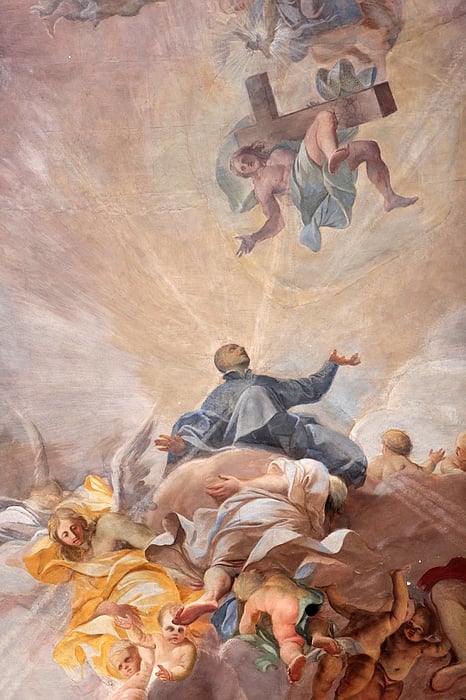
Apotheosis of Saint Ignatius (Detail) – Pozzo (1685)
Called to Be the Saint Only You Can Be
I often remind myself: I’m not meant to be a saint who already existed. I’m called to be the unique saint God has imagined for me. And so are you. God created you in this specific time and place, with your gifts, wounds, background, and longings. You’re meant to become who Jesus would be… if Jesus were you.
Nothing in us is wasted. Even the mess. Even the misguided dreams. God doesn’t delete our broken chapters—He redeems them. Discipleship means surrendering our story, letting Christ inhabit every line. And Ignatius shows us how God’s reckless love can take a reckless heart and shape it for eternal impact.
The Gift Hidden in the Wound
Your failures may not have sent you where you wanted to go, but they’ve almost certainly formed the kind of person who could carry the wisdom you now bear. The detours, embarrassments, and scars have a strange way of becoming lanterns—we walk into the future by the light of mistakes we never wanted to make.
Where success builds confidence, failure builds discernment. Where applause affirms identity, missteps demand self-awareness. Success might give momentum, but failure clarifies motivation.
Look at St. Ignatius. His shattered leg and reckless ambition didn’t merely redirect his path—they revealed who he was made to become. From courtly dreams to convalescent stillness, he discovered that holiness doesn’t require perfection. It requires surrender. And through each failed plan, he didn’t lose purpose—he refined it.
So ask yourself:
- What if that mistake you’re still regretting was actually a turning point?
- What if success hid your limitations, and failure gave you eyes to see?
Because the truth is, your missteps aren’t stains on your story. They’re brushstrokes in God’s masterpiece. And the world needs the kind of leader who’s been refined by both fire and grace.
Contemplative
History and Religion
Careers, Workplace and Religion
Previous Post

July 21, 2025
Reclaiming Love on the Jersey Shore
Next Post
August 1, 2025 Weekly Roundup: Attentive to Grace
Recent Comments
"hate disqualifies you totally. I became a Catholic because I saw too many like you. ..."
Porcine obtuseness Sniffer Dog
Controversial Celebrity Religious Conversions: Who Switched ..."
"'Stop hiding your gifts' is a productive invitation. Novices leave behind their loved ones and ..."
Stop Hiding Your Gifts: Lessons from ..."
"Bending low, he uplifted the lowly. Joseph Cafasso continues to inspire men and women of ..."
Not Grand, But Great: Legacy Through ..."
"Does Jesus dwell within you, or is it a comforting delusion?A new counter-apologetic method exposes ..."
Browse Our Archives
Select a Category Art Bible Books CCC Prayer Christmas Current Events Family Film Free Photo Fridays Humor hunger liturgical calendar liturgy Music Photos pope Prayer Prayerful Leader questions Quotes Review Saints Satire Scripture SYNOD SYNOD FOR THE FAMILY teaching Uncategorized video Weekly Round Up
Select a Month October 2026 September 2026 August 2026 July 2026 April 2026 February 2026 December 2025 November 2025 October 2025 September 2025 August 2025 July 2025 June 2025 May 2025 April 2025 February 2025 January 2025 September 2024 June 2024 May 2024 February 2024 December 2023 August 2023 May 2023 February 2023 November 2022 July 2022 June 2022 May 2022 March 2022 May 2021 April 2021 March 2021 February 2021 January 2021 September 2020 April 2020 March 2020 February 2020 January 2020 December 2019 November 2019 October 2019 August 2019 June 2019 May 2019 March 2019 January 2019 December 2018 August 2018 June 2018 April 2018 March 2018 February 2018 December 2017 November 2017 September 2017 August 2017 July 2017 June 2017 April 2017 March 2017 February 2017 December 2016 November 2016 February 2016 January 2016 November 2015 October 2015 August 2015 July 2015 June 2015 May 2015 April 2015 March 2015 February 2015 January 2015 December 2014 November 2014 October 2014 September 2014 August 2014 July 2014 June 2014 May 2014 April 2014 March 2014 February 2014 January 2014 December 2013 November 2013 October 2013 September 2013 August 2013 July 2013 June 2013 May 2013 April 2013 March 2013 February 2013 January 2013 December 2012 November 2012 October 2012 August 2012 July 2012 June 2012 May 2012 April 2012 March 2012 February 2012 January 2012 December 2011 November 2011 October 2011 September 2011 August 2011 July 2011 June 2011 May 2011 April 2011 March 2011 February 2011 January 2011 December 2010 November 2010 October 2010 September 2010 August 2010 July 2010 June 2010 May 2010 April 2010 March 2010 February 2010 January 2010 December 2009 November 2009 October 2009 September 2009 August 2009 July 2009 June 2009 April 2009 March 2009 February 2009 January 2009 October 2008 August 2008 June 2008 May 2008 April 2008 March 2008 February 2008 January 2008 December 2007 November 2007
Follow Us!
TAKE THE
Religious Wisdom Quiz
Which apostle did Jesus say, "Get thee behind me, Satan…"
Select your answer to see how you score.
John Judas James Peter
Related posts from The Orant
Not Grand, But Great: Legacy Through the Little...
Returning to the Foundations: Lessons from St. Norbert
Building a Mission That Lasts: Boniface's Cultural Strategy
Stop Hiding Your Gifts: Lessons from St. Bernardino
TRENDING AT PATHEOS Catholic

Emotion in Early Christianity by Andrew Crislip
Andrew Crislip’s Emotion in Early Christianity examines an often overlooked dimension of...

16 Spiritual Touchstones for a More Grounded Life
After decades of spiritual study, here are 16 principles I try...

Catholic Evangelization: Sharing Your Faith Every Day
Welcome back to the Graceful Awakening mini-series called, “From Faith to Mission.” ...

The Pillar of the Boatmen: the Ancient Monument...
The Pillar of the Boatmen is a Romano-Gaulish sculpture that dates from...

In one sense walking into Westminster Abbey is like walking down the...

'Super Scam Me' Exposes AI Jon Bon Jovi...
Leslie Pickett believed she was in a relationship with Jon Bon Jovi....
view all Catholic blogs
What Are Your Thoughts?leave a comment
Ad-Free & Subscriber Log-In Subscription Support
- About Us
- 2026 Calendar
- Videos
- Podcasts
- Library of World Religions
- Faith In Media Tracker
- Advertise With Us
- Write for Us
- Privacy Policy
- Terms of Service
- Do Not Sell My Data
- Contact Us
- Radiant Digital
- Manage Newsletter Subscriptions
- Unsubscribe From Notifications
- Sitemap
Copyright 2008-2026, Patheos. All rights reserved.
Subscription Support Ad-Free & Subscriber Log-In
Follow Patheos