
BuddhistCatholicContemplativeEvangelicalGeneral ChristianHinduJewishLatter-day SaintMuslimNew VisionsProgressive Christian
Beliefs
- Buddhist
- Catholic
- Contemplative
- Evangelical
- General Christian
- Hindu
- Jewish
- Latter-day Saint
- More Voices
- Muslim
- New Visions
- Pagan
- Progressive Christian
Topics
- Religion News
- Food and Religion
- Sports and Religion
- Religious Art
- Religious Music and Entertainment
- Religious Events
- History and Religion
- Style and Religion
- Politics and Religion
- Women in Religion
- Recreation Outdoors and Religion
- Business Finance and Religion
- Careers Workplace and Religion
- Education and Religion
- Family Parenting and Religion
- Health Fitness and Religion
- Home and Religion
- Relationships and Religion
- Technology and Religion
- Travel and Religion
Columnists
- Buddhist Columnists
- Business Finance and Religion Columnists
- Careers Workplace and Religion Columnists
- Catholic Columnists
- Contemplative Columnists
- Education and Religion Columnists
- Evangelists Columnists
- Family Parenting and Religion Columnists
- General Christian Columnists
- Health Fitness and Religion Columnists
- Hindu Columnists
- History and Religion Columnists
- Home and Religion Columnists
- Jewish Columnists
- More Voices Columnists
- Latter Day Columnists
- Muslim Columnists
- New Visions Columnists
- Nonreligious Columnists
- Pagan Columnists
- Politics and Religion Columnists
- Progressive Columnists
- Recreation Outdoors and Religion Columnists
- Relationships and Religion Columnists
- Religion News Columnists
- Religious Art Columnists
- Religious Events Columnists
- Religious Music and Entertainment Columnists
- Sports and Religion Columnists
- Style and Religion Columnists
- Technology and Religion Columnists
- Travel and Religion Columnists
- Women in Religion Columnists
Resource Library
- 2026 Calendar
- Library of World Religions
- The 100 Most Holy Places on Earth
- Patheos Answers
- Podcasts
- Videos
- Faith Leaders Database
- Anglican Episcopalian
- Bahai
- Baptist
- Buddhism
- Christianity
- Confucianism
- Eastern Orthodoxy
- Hinduism
- Holiness and Pentecostal
- ISKCON
- Islam
- Judaism
- Lutheran
- Methodist
- The Church of Jesus Christ of Latter-day Saints
- New Age
- Paganism
- Presbytarian and Reformed
- Protestantism
- Religion Behind the Scenes
- Roman Catholic
- Scientology
- Shia Islam
- Sikhism
- Sufism
- Sunni Islam
- Taoism
- Zen
- See all religions
Research Tools
 Ad-Free & Subscriber Log-In Subscription Support
Ad-Free & Subscriber Log-In Subscription Support
Follow Patheos 

- Trending:
- Forgiveness
- |
- Marriage
- |
- Consciousness
- |
- Death Penalty
- |
- Election
- |
- Halloween

- Home
- Catholic
- The Great Schism: Why the Catholic Church and the Orthodox Church Really Split
The Great Schism: Why the Catholic Church and the Orthodox Church Really Split
Last updated on: November 7, 2022 at 11:20 am by Billy Kangas
The Great Schism: Why the Catholic Church and the Orthodox Church Really Split 2022-11-07T11:20:22-04:00 Billy Kangas
Patheos Explore the world's faith through different perspectives on religion and spirituality! Patheos has the views of the prevalent religions and spiritualities of the world.
“Holy Father, keep [those you have given me] in thy name, which thou hast given me, that they may be one, even as we are one.”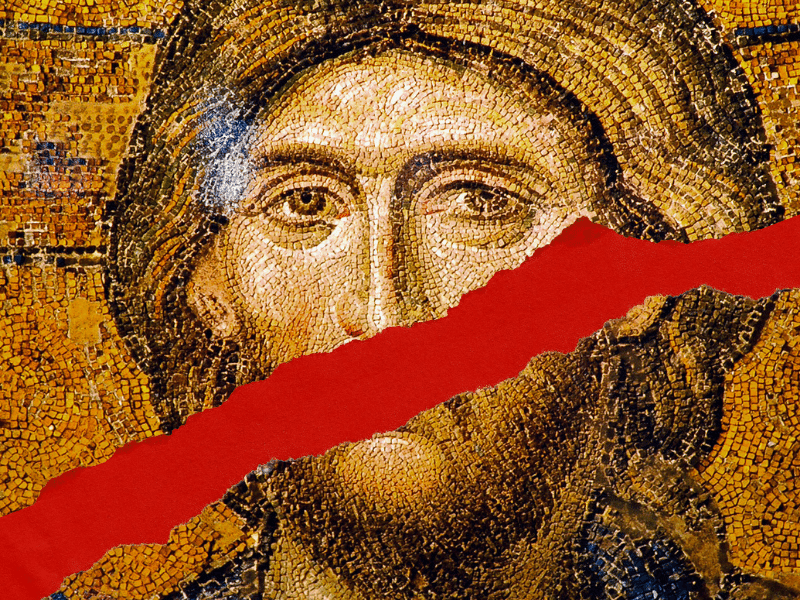
Jesus prayed the above prayer in John 17 on the night he was betrayed and since that first day until now it is a prayer that the Church has struggled to see perfectly fulfilled. On that night, Judas’ betrayal violated that unity. The New Testament documents other breakdowns in Church unity – Paul and Apollos, Jewish believers and Gentile believers, and wealth disparity among members of the church – to name a few. The history of the Church has continued to see the faithful suffer breakdowns in unity. Schisms and heresies have emerged from the first days until now.
There is arguably no schism quite as tragic as that between the Eastern Orthodox communion and the Catholic Church. For nearly a millennia much of the Eastern “lung” of the Church, as St. John Paul II referred to it has been separated from the western “lung.” The mystery of Christ is most richly and powerfully known when both lungs can breathe together and I personally find it heartbreaking that there continues to be this division in the body of Christ. It is my heartfelt prayer that the two lungs would be able to more fully breathe together and that Christ’s prayer for unity may more perfectly be fulfilled between these communions.
There are many obstacles toward unity today and many of them have deepened and evolved in the past 1000 years. However, it is perhaps a good first step to look at some of the root causes of the division. Below are a few of the critical issues.
- The filioque clause
Too often the reason for the split is oversimplified as a disagreement about one word in the Creed. The Western Church had added the word “filioque” to the creed and the East would not do so. The word means “and the son” and was placed within the article on the Holy Spirit. It added an affirmation that the spirit processes from both the Father and the son. The original Nicene-Constantinopolitan Creed only affirmed the procession of the Holy Spirit from the Father. There are many volumes written on the history of when and why and how this happened, what is critical to know is that it was added without the East’s consent or an Ecumenical council. The language that was not used in the liturgy of the East, was Latin. This brings us to another critical reason for the split: language. - Language
Language is tricky. It is a powerful tool to bring clarity to something when the words and their meanings between individuals or groups are the same. However, differences between words and meanings can cause tremendous conflict when there are differences between the words themselves or their meaning. This played a big role in the split. Latin had become the primary language of theology in the west while Greek remained central in the East. This resulted in a lot of potential areas of miscommunication and conflict. The controversy around the filioque clause gives a good example of how this worked. The word “proceeds” in the creed was originally the greek word ἐκπορευόμενον. It had been translated procedit into Latin. Although similar, these words are not identical. The Greek word has more of an emphasis on something’s origin and the Latin word has more of an emphasis on something’s path. Therefore the western church could see a passage like John 20:22, where the spirit clearly procedit through Jesus as he breathes on the disciples, but the East might argue that the example was not ἐκπορεύομαι. This is one example of many challenges. On top of that, Rome would send delegates who didn’t understand Greek to Constantinople. Misunderstanding and frustration, unsurprisingly, could ensue. - Authority
Perhaps the most important reason for the split was related to the question of authority and who had the final word in a disagreement. Controversies were solved in Ecumenical councils of Bishops, yet Patriarchs were looked to as the most important apostolic voice within these councils. The Pope of Rome was seen as the preeminent leader among the patriarchs and exercised the function as a decisive voice at times, most notably at the Council of Chalcedon. After the conversion of Constantine, the Church had a tenuous alliance with the Empire. Leaders, including the Pope, were confirmed by the Emperor and this was a practice that continued even after the Roman Empire of the West fell. Popes would still receive confirmation from the Eastern Roman emperor for centuries. However, as the East and the West became increasingly separated from one another culturally, linguistically, and politically this tenuous balance began to break down. The Pope no longer looked to Constantinople for confirmation, instead developing an alliance with the Carolingian Empire. Decisions also began to be made without consulting the Bishops of the East, including the addition of the Filioque. As Rome increasingly began to envision itself as having the ability to make decisions on faith, morals, and their own apostolic succession unilaterally the East became uneasy about their own disenfranchisement. - Islam
The expansion of Islam became a key issue as well. As Christian lands were conquered avenues of communication were disrupted and the belief in a unified Christian World became unraveled. The West became very wary of the influence of Isalm on the Eastern Roman Empire, particularly after the Iconoclastic Controversy in the 8th and 9th centuries. One of the reasons the Pope removed himself from the sphere of influence of the Empire of the East was because of pressures exerted by the Emperor to eliminate the veneration of images from worship. Although this iconoclasm was eventually overturned in the seventh ecumenical council, a century of iconoclasm in the East seriously eroded the willingness of the Western Church to give authority to the Eastern Empire. - Bad Actors
The schism was also caused by the sin, arrogance, pride, and confusion that were caused by humans making mistakes. There are high-profile examples of this like the events leading up to the excommunication of the Patriarch of Constantinople by Humbert of Silva Candidam, or of Crusaders sacking other Christian cities. However, there are, undoubably, countless other examples of human frailty pushing these communions apart from one another.
This simple list is by no means exhaustive, but it gives a sketch of some of the most salient historical reasons for the divide. As we pray that Christ’s prayer for unity might find greater fulfillment in our own time I pray we might draw wisdom from our past mistakes and seek a more perfect unity for the future. Make us one Lord!
Previous Post

July 8, 2022
What Bible do Catholics use?
Next Post
February 8, 2023 What resources should I use to pray the "Liturgy of the Hours?"
Browse Our Archives
Select a Category Art Bible Books CCC Prayer Christmas Current Events Family Film Free Photo Fridays Humor hunger liturgical calendar liturgy Music Photos pope Prayer Prayerful Leader questions Quotes Review Saints Satire Scripture SYNOD SYNOD FOR THE FAMILY teaching Uncategorized video Weekly Round Up
Select a Month October 2026 September 2026 August 2026 July 2026 April 2026 February 2026 December 2025 November 2025 October 2025 September 2025 August 2025 July 2025 June 2025 May 2025 April 2025 February 2025 January 2025 September 2024 June 2024 May 2024 February 2024 December 2023 August 2023 May 2023 February 2023 November 2022 July 2022 June 2022 May 2022 March 2022 May 2021 April 2021 March 2021 February 2021 January 2021 September 2020 April 2020 March 2020 February 2020 January 2020 December 2019 November 2019 October 2019 August 2019 June 2019 May 2019 March 2019 January 2019 December 2018 August 2018 June 2018 April 2018 March 2018 February 2018 December 2017 November 2017 September 2017 August 2017 July 2017 June 2017 April 2017 March 2017 February 2017 December 2016 November 2016 February 2016 January 2016 November 2015 October 2015 August 2015 July 2015 June 2015 May 2015 April 2015 March 2015 February 2015 January 2015 December 2014 November 2014 October 2014 September 2014 August 2014 July 2014 June 2014 May 2014 April 2014 March 2014 February 2014 January 2014 December 2013 November 2013 October 2013 September 2013 August 2013 July 2013 June 2013 May 2013 April 2013 March 2013 February 2013 January 2013 December 2012 November 2012 October 2012 August 2012 July 2012 June 2012 May 2012 April 2012 March 2012 February 2012 January 2012 December 2011 November 2011 October 2011 September 2011 August 2011 July 2011 June 2011 May 2011 April 2011 March 2011 February 2011 January 2011 December 2010 November 2010 October 2010 September 2010 August 2010 July 2010 June 2010 May 2010 April 2010 March 2010 February 2010 January 2010 December 2009 November 2009 October 2009 September 2009 August 2009 July 2009 June 2009 April 2009 March 2009 February 2009 January 2009 October 2008 August 2008 June 2008 May 2008 April 2008 March 2008 February 2008 January 2008 December 2007 November 2007
Follow Us!
TAKE THE
Religious Wisdom Quiz
What sound did God send to confuse Philistines when Israel was under attack?
Select your answer to see how you score.
Earthquake Singing Horses Thunder
Related posts from The Orant

What If You Are God’s Currency?
May Wendell Berry Trouble Your Thoughts Today
TRENDING AT PATHEOS Catholic

Emotion in Early Christianity by Andrew Crislip
Andrew Crislip’s Emotion in Early Christianity examines an often overlooked dimension of...

16 Spiritual Touchstones for a More Grounded Life
After decades of spiritual study, here are 16 principles I try...

Catholic Evangelization: Sharing Your Faith Every Day
Welcome back to the Graceful Awakening mini-series called, “From Faith to Mission.” ...

The Pillar of the Boatmen: the Ancient Monument...
The Pillar of the Boatmen is a Romano-Gaulish sculpture that dates from...

In one sense walking into Westminster Abbey is like walking down the...

'Super Scam Me' Exposes AI Jon Bon Jovi...
Leslie Pickett believed she was in a relationship with Jon Bon Jovi....
view all Catholic blogs
Ad-Free & Subscriber Log-In Subscription Support
- About Us
- 2026 Calendar
- Videos
- Podcasts
- Library of World Religions
- Faith In Media Tracker
- Advertise With Us
- Write for Us
- Privacy Policy
- Terms of Service
- Do Not Sell My Data
- Contact Us
- Radiant Digital
- Manage Newsletter Subscriptions
- Unsubscribe From Notifications
- Sitemap
Copyright 2008-2026, Patheos. All rights reserved.
Subscription Support Ad-Free & Subscriber Log-In
Follow Patheos