
BuddhistCatholicContemplativeEvangelicalGeneral ChristianHinduJewishLatter-day SaintMuslimNew VisionsProgressive Christian
Beliefs
- Buddhist
- Catholic
- Contemplative
- Evangelical
- General Christian
- Hindu
- Jewish
- Latter-day Saint
- More Voices
- Muslim
- New Visions
- Pagan
- Progressive Christian
Topics
- Religion News
- Food and Religion
- Sports and Religion
- Religious Art
- Religious Music and Entertainment
- Religious Events
- History and Religion
- Style and Religion
- Politics and Religion
- Women in Religion
- Recreation Outdoors and Religion
- Business Finance and Religion
- Careers Workplace and Religion
- Education and Religion
- Family Parenting and Religion
- Health Fitness and Religion
- Home and Religion
- Relationships and Religion
- Technology and Religion
- Travel and Religion
Columnists
- Buddhist Columnists
- Business Finance and Religion Columnists
- Careers Workplace and Religion Columnists
- Catholic Columnists
- Contemplative Columnists
- Education and Religion Columnists
- Evangelists Columnists
- Family Parenting and Religion Columnists
- General Christian Columnists
- Health Fitness and Religion Columnists
- Hindu Columnists
- History and Religion Columnists
- Home and Religion Columnists
- Jewish Columnists
- More Voices Columnists
- Latter Day Columnists
- Muslim Columnists
- New Visions Columnists
- Nonreligious Columnists
- Pagan Columnists
- Politics and Religion Columnists
- Progressive Columnists
- Recreation Outdoors and Religion Columnists
- Relationships and Religion Columnists
- Religion News Columnists
- Religious Art Columnists
- Religious Events Columnists
- Religious Music and Entertainment Columnists
- Sports and Religion Columnists
- Style and Religion Columnists
- Technology and Religion Columnists
- Travel and Religion Columnists
- Women in Religion Columnists
Resource Library
- 2026 Calendar
- Library of World Religions
- The 100 Most Holy Places on Earth
- Patheos Answers
- Podcasts
- Videos
- Faith Leaders Database
- Anglican Episcopalian
- Bahai
- Baptist
- Buddhism
- Christianity
- Confucianism
- Eastern Orthodoxy
- Hinduism
- Holiness and Pentecostal
- ISKCON
- Islam
- Judaism
- Lutheran
- Methodist
- The Church of Jesus Christ of Latter-day Saints
- New Age
- Paganism
- Presbytarian and Reformed
- Protestantism
- Religion Behind the Scenes
- Roman Catholic
- Scientology
- Shia Islam
- Sikhism
- Sufism
- Sunni Islam
- Taoism
- Zen
- See all religions
Research Tools
 Ad-Free & Subscriber Log-In Subscription Support
Ad-Free & Subscriber Log-In Subscription Support
Follow Patheos 

- Trending:
- Forgiveness
- |
- Marriage
- |
- Consciousness
- |
- Death Penalty
- |
- Election
- |
- Halloween

- Home
- Catholic
- Paradise within the Cave: Rublev’s Nativity
Paradise within the Cave: Rublev’s Nativity
Last updated on: December 20, 2014 at 11:15 pm by Billy Kangas
Paradise within the Cave: Rublev’s Nativity 2014-12-20T23:15:26-04:00 Billy Kangas
Patheos Explore the world's faith through different perspectives on religion and spirituality! Patheos has the views of the prevalent religions and spiritualities of the world.
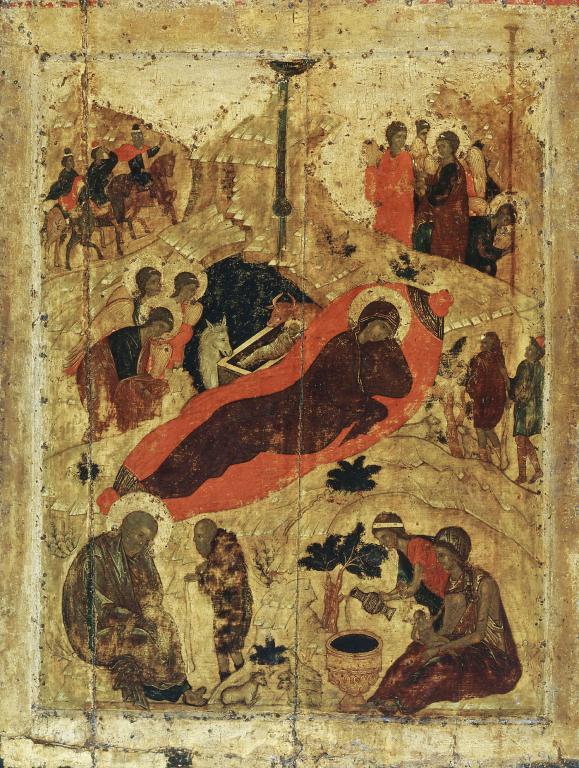
 Last week in my “Modern Magi on the Meaning of Christmas” conversation featuring with Scot McKnight, Nadia Bolz-Weber, and Kyle Roberts my conversation partners repeatedly brought up the importance of seeing Christmas as a lens through which we can see God’s action in a world of fear, murder, tragedy. The world is broken, and that’s an important part of the story. One of the things Nadia mentioned that really stuck with me was the idea that we have to keep “Herod in Christmas” We have to be reminded of the dark reality that God’s light is in-breaking into though Jesus. One of the ways that I have found I am reminded is through art. In our home my wife and I hang a print of one of Andre Rublov’s masterpieces, the nativity. This image has become a daily reminder to me of the dirty beauty of the incarnation. I thought I’d share a bit of my thoughts on it with you.
Rublev’s image of the nativity is a compilation of a number of the scenes of the gospel all in one panel. Unlike many paintings that synthesize the Gospel accounts into a single scene, Rublev spits the image into multiple scenes. This move underscores the eschatological understanding that was in the background of the observers. These events were not simply historical events, but live events that were participated in as the community celebrated the liturgy. The unifying theme was the liturgical event of the feast of the nativity which the community celebrated. Each of these scenes belonged in the image, because each of them contributed to the liturgical genius of their rites. We will evaluate each scene in turn.
The Center Cave
In the center of the image is a cave. At the opening of the cave Mary is pictured lying down. She has just given birth, but instead of facing her child, she turns away. This seems strange. There seems to already be a pain between mother and child. The key to understanding this placement of Mary can be found in the image of the child himself. He is wrapped in a cloth that resembles the burial clothes seen around Lazarus, just a few icons to the right.[1] He is also placed in a manger that looks much more like a burial box than a crib. Jesus’ death can already be felt. The incarnation was an acceptance of human mortality and frailness. Mary turns in sorrow from the death of her son. She faces here her own death as well. This is seen in how she is situated; she lies on a red bier, just as she does in the icon of her dormition seen on the other side of the iconostasis.
Around the manger are an ox and a donkey. Rublev has taken the theme of the manger in Luke’s gospel and connected it to the theme of the manger in Isaiah 1:3. The beasts remind us to recognize Jesus as our master. They also indicate the cosmic dimension of salvation. The whole world finds its hope in Christ, and all of Creation is groaning for His revelation.
The cave is black and shaped like a womb. Jesus is clothed in white. This stark contrast of color draws the observer to see Christ as the light of the world, incarnated into a cosmos in desperate need of illumination. This theme is deepened by the decent of divine life in a ray that moves through the center of the canvas. The ray of light splits midway to Christ, into three rays. This reminds the viewer that the incarnation was a Trinitarian action. They are reminded of the description of the angel in the annunciation of Jesus’ birth in Luke 1:35.
The Magi
After observing Mary and the child, the eye is free to begin to rove the rest of the image. At the top left corner we see the magi. Their gestures up into the sky tell us that they have not yet discovered the Christ child. The focus on the Magi in the Orthodox liturgy is not on their gift giving but in their discovery of the light of Christ through the light of the star. Their attention in this icon emphasizes this focus. These Magi are depicted as an old man, a young man, and a middle aged man. This emphasizes that they are symbols of all humanity being drawn into the dawning light of Christ. This hope must have been particularly strongly understood in Moscow, where the feast of the Nativity was being celebrated in the deep darkness of a northern winter.
The Shepherds
On the far right side we see shepherds. There is nothing remarkable about the shepherds in this image. This is perhaps the point. Rublev does not present the angelic declaration in this scene with the same flourish which Luke employees. Gone is the host, gone is the song, gone is the grand pronouncements of counter-propaganda seen in the evangelist’s account. This perhaps is because the empire against which these images were once so powerful is now gone. Moscow has begun to fashion itself as a kind of new Rome in the east. There is no room for anti-imperial sentiment in this icon located at the new center of Russian power.
The Washing of Jesus
In the bottom corner midwives wash the Christ child. This is done in a basin that looks very much like a baptismal font. This account does not appear in the scriptures but instead is inspired by the Protoevangelium of James. In this book a midwife is present at the birth and echoes her own version of the Magnificat at Christ’s birth, as a Sinai-like cloud descends upon the cave (19). The midwife then calls in another midwife by the name of Salome, who verifies that Mary was still a virgin even after the birth of Christ (19-20). These two women function as proto-John the Baptist figures in the icon, washing Christ. This image of the infant being washed would strike a note with the Orthodox community which has, at this point, moved toward nearly all baptisms being done with infants.[2]
The Distress of Joseph
Next to the midwives, in the bottom left corner, is Joseph. This depiction is inspired by the account in Matthew of Joseph’s struggle to remain committed to Mary in spite of his own fears and concerns. This image shows Joseph struggling with his doubts, which are personified by an old man. This man seems to be accusing Mary of infidelity. Joseph presents us with a unique image of faith. His rational mind still can’t understand the incarnation, but he move forward in faith and love. Baggley highlights that the liturgical forefeast of the nativity focuses on Joseph’s doubts and present a narritive of Joseph as a distressed husband over this difficulty and shame of the situation all the way until the Birth.[3]
The Angels
Rublev includes two sets of angels, the set on the left contains three angels, while the one on the right appears to have three but a fourth emerges between the halos of the two standing upright. This right set seems to have three standing upright and one bending down to speak to shepherds. This composition indicates two separate actions, one is the pronouncement to the shepherds the other three seem to be in conversation with one another. The three standing the angels on the left set seem to anticipate the angels that are seen in Rublev’s famous icon of the Old Testament Trinity. In this example there is one clothed red robe and blue robes of Christ, another clothed in a bright red, the same color as Mary’s couch, and which seem to follow through the fabrics seen throughout the festal icons in the iconostasis.[4] This red color represents the fire and energy of the Holy Spirit which is seen at work though God’s intervention throughout the festal cycle.[5] A final angel is hidden, indicating in incomprehensibility of God.[6] This is the same pattern used to present the three upright angels on the right side. In an image where the scale of the figures is clearly not a primary concern, Rublev takes special care to make sure all three figures in his sets are drawn with the same dimensions, showing the coequal dignity of the three persons. They underscore the Trinitarian orchestration of these events and offer a reminder of the divinity of Christ which is still maintained in spite of the lowliness of the incarnation. Their presence also reminds the viewer of the appearance of angels in the annunciations of both Jesus’ and John the Baptist’s birth, as well as their role in the prophetic promises of the Old Testament, from the promise made to Moses to their role in the visions of the prophets.
The Plants
Around the cave there is growth sprouting from the rocks. This is not coincidental. The liturgical apolytikion for the forefeast of the nativity states that the tree of life “has blossomed from the virgin in the cave” and those that eat of it “shall live.”[7] Sheep are pictured eating of the plant at the bottom of the icon. They don’t appear to be the sheep of the shepherds on the right. Instead these sheep seem to be the flock of the good shepherd, Christ. Another tree grows, seemingly, from the waters of the font. This is simultaneously the tree of life and the cross. The viewer is reminded of both the drowning and resurrection found in baptism.
Concluding Remarks
This icon of the Nativity is a remarkable work of exegesis. It closely reads the gospel accounts, and brings relevant themes and images to life. It is deeply rooted in the traditions of the Church, incorporating Old Testament imagery, liturgical hymns and prayers, and images from the broader interpretive tradition. It is also a composition rooted in the place and time of the author. Rublev lived in a time of Great trial.
He was born during a time of both religious persecution and revival. Russian territories had succumbed to the Mongols in the thirteenth century. Although the Mongol invaders were generally tolerant of the religions in the areas they conquered, the initial conquest had resulted in iconoclasm and persecution of Orthodox Christians throughout the regions that fell under the Mongol rule. The death and destruction that came with this conquest left an impression upon the Russian orthodox people of their great need to pray for the dead, and a constant fear of conquest by the foreign power. This image is came out of the ashes of persecution and helped ignite a new faith and hope. I pray we can find similar lamp-posts in our own lives this Christmas.
Notes:
[1] Rublev’s Nativity emerges out of a collaborative effort to paint the icons for the Annunciation Cathedral. Rublev appears to have been tasked with painting the left side of the Festival row of the iconostasis. It is believed he painted the Entry into Jerusalem, the Nativity of Christ, the Raising of Lazarus and the Transfiguration. See a reconstruction here.
[2] Baggley, Festival Icons for the Christian Year, 68.
[3] Ibid., 37.
[4] See Figure 1
[5] Solrunn Nes, The Mystical Language of Icons (Grand Rapids, MI: Wm. B. Eerdmans Publishing, 2005), 38–39. and Gregory Collins, The Glenstal Book of Icons: Praying with the Glenstal Icons (Collegeville, MN: Liturgical Press, 2002), 89.
[6] For more on the importance of these color’s in Rublev’s work see: Elizabeth Zelensky and Lela Gilbert, Windows to Heaven: Introducing Icons to Protestants and Catholics (Grand Rapids, MI: Brazos Press, 2005), 47–48.
[7] Andrew Louth, Introducing Eastern Orthodox Theology (Downers Grove IL: InterVarsity Press, 2013), 119.
Previous Post

December 18, 2014
The Hardest Bible Quiz You'll Ever Take (?)
Next Post
December 21, 2014 Veni Veni Emmanuel
Browse Our Archives
Select a Category Art Bible Books CCC Prayer Christmas Current Events Family Film Free Photo Fridays Humor hunger liturgical calendar liturgy Music Photos pope Prayer Prayerful Leader questions Quotes Review Saints Satire Scripture SYNOD SYNOD FOR THE FAMILY teaching Uncategorized video Weekly Round Up
Select a Month October 2026 September 2026 August 2026 July 2026 April 2026 February 2026 December 2025 November 2025 October 2025 September 2025 August 2025 July 2025 June 2025 May 2025 April 2025 February 2025 January 2025 September 2024 June 2024 May 2024 February 2024 December 2023 August 2023 May 2023 February 2023 November 2022 July 2022 June 2022 May 2022 March 2022 May 2021 April 2021 March 2021 February 2021 January 2021 September 2020 April 2020 March 2020 February 2020 January 2020 December 2019 November 2019 October 2019 August 2019 June 2019 May 2019 March 2019 January 2019 December 2018 August 2018 June 2018 April 2018 March 2018 February 2018 December 2017 November 2017 September 2017 August 2017 July 2017 June 2017 April 2017 March 2017 February 2017 December 2016 November 2016 February 2016 January 2016 November 2015 October 2015 August 2015 July 2015 June 2015 May 2015 April 2015 March 2015 February 2015 January 2015 December 2014 November 2014 October 2014 September 2014 August 2014 July 2014 June 2014 May 2014 April 2014 March 2014 February 2014 January 2014 December 2013 November 2013 October 2013 September 2013 August 2013 July 2013 June 2013 May 2013 April 2013 March 2013 February 2013 January 2013 December 2012 November 2012 October 2012 August 2012 July 2012 June 2012 May 2012 April 2012 March 2012 February 2012 January 2012 December 2011 November 2011 October 2011 September 2011 August 2011 July 2011 June 2011 May 2011 April 2011 March 2011 February 2011 January 2011 December 2010 November 2010 October 2010 September 2010 August 2010 July 2010 June 2010 May 2010 April 2010 March 2010 February 2010 January 2010 December 2009 November 2009 October 2009 September 2009 August 2009 July 2009 June 2009 April 2009 March 2009 February 2009 January 2009 October 2008 August 2008 June 2008 May 2008 April 2008 March 2008 February 2008 January 2008 December 2007 November 2007
Follow Us!
TAKE THE
Religious Wisdom Quiz
What did Jesus say to the storm on the Sea of Galilee?
Select your answer to see how you score.
"Depart from me!" "Peace, be still!" "Be gone!" "Let there be light!"
Related posts from The Orant

What If You Are God’s Currency?
May Wendell Berry Trouble Your Thoughts Today
TRENDING AT PATHEOS Catholic

Emotion in Early Christianity by Andrew Crislip
Andrew Crislip’s Emotion in Early Christianity examines an often overlooked dimension of...

16 Spiritual Touchstones for a More Grounded Life
After decades of spiritual study, here are 16 principles I try...

Catholic Evangelization: Sharing Your Faith Every Day
Welcome back to the Graceful Awakening mini-series called, “From Faith to Mission.” ...

The Pillar of the Boatmen: the Ancient Monument...
The Pillar of the Boatmen is a Romano-Gaulish sculpture that dates from...

In one sense walking into Westminster Abbey is like walking down the...

'Super Scam Me' Exposes AI Jon Bon Jovi...
Leslie Pickett believed she was in a relationship with Jon Bon Jovi....
view all Catholic blogs
Ad-Free & Subscriber Log-In Subscription Support
- About Us
- 2026 Calendar
- Videos
- Podcasts
- Library of World Religions
- Faith In Media Tracker
- Advertise With Us
- Write for Us
- Privacy Policy
- Terms of Service
- Do Not Sell My Data
- Contact Us
- Radiant Digital
- Manage Newsletter Subscriptions
- Unsubscribe From Notifications
- Sitemap
Copyright 2008-2026, Patheos. All rights reserved.
Subscription Support Ad-Free & Subscriber Log-In
Follow Patheos