
BuddhistCatholicContemplativeEvangelicalGeneral ChristianHinduJewishLatter-day SaintMuslimNew VisionsProgressive Christian
Beliefs
- Buddhist
- Catholic
- Contemplative
- Evangelical
- General Christian
- Hindu
- Jewish
- Latter-day Saint
- More Voices
- Muslim
- New Visions
- Pagan
- Progressive Christian
Topics
- Religion News
- Food and Religion
- Sports and Religion
- Religious Art
- Religious Music and Entertainment
- Religious Events
- History and Religion
- Style and Religion
- Politics and Religion
- Women in Religion
- Recreation Outdoors and Religion
- Business Finance and Religion
- Careers Workplace and Religion
- Education and Religion
- Family Parenting and Religion
- Health Fitness and Religion
- Home and Religion
- Relationships and Religion
- Technology and Religion
- Travel and Religion
Columnists
- Buddhist Columnists
- Business Finance and Religion Columnists
- Careers Workplace and Religion Columnists
- Catholic Columnists
- Contemplative Columnists
- Education and Religion Columnists
- Evangelists Columnists
- Family Parenting and Religion Columnists
- General Christian Columnists
- Health Fitness and Religion Columnists
- Hindu Columnists
- History and Religion Columnists
- Home and Religion Columnists
- Jewish Columnists
- More Voices Columnists
- Latter Day Columnists
- Muslim Columnists
- New Visions Columnists
- Nonreligious Columnists
- Pagan Columnists
- Politics and Religion Columnists
- Progressive Columnists
- Recreation Outdoors and Religion Columnists
- Relationships and Religion Columnists
- Religion News Columnists
- Religious Art Columnists
- Religious Events Columnists
- Religious Music and Entertainment Columnists
- Sports and Religion Columnists
- Style and Religion Columnists
- Technology and Religion Columnists
- Travel and Religion Columnists
- Women in Religion Columnists
Resource Library
- 2026 Calendar
- Library of World Religions
- The 100 Most Holy Places on Earth
- Patheos Answers
- Podcasts
- Videos
- Faith Leaders Database
- Anglican Episcopalian
- Bahai
- Baptist
- Buddhism
- Christianity
- Confucianism
- Eastern Orthodoxy
- Hinduism
- Holiness and Pentecostal
- ISKCON
- Islam
- Judaism
- Lutheran
- Methodist
- The Church of Jesus Christ of Latter-day Saints
- New Age
- Paganism
- Presbytarian and Reformed
- Protestantism
- Religion Behind the Scenes
- Roman Catholic
- Scientology
- Shia Islam
- Sikhism
- Sufism
- Sunni Islam
- Taoism
- Zen
- See all religions
Research Tools
 Ad-Free & Subscriber Log-In Subscription Support
Ad-Free & Subscriber Log-In Subscription Support
Follow Patheos 

- Trending:
- Forgiveness
- |
- Marriage
- |
- Consciousness
- |
- Death Penalty
- |
- Election
- |
- Halloween

- Home
- Catholic
- Who are the least in the Parable of the Sheep and the Goats?
Who are the least in the Parable of the Sheep and the Goats?
Last updated on: November 23, 2014 at 8:15 pm by Billy Kangas
Who are the least in the Parable of the Sheep and the Goats? 2014-11-23T20:15:49-04:00 Billy Kangas
Patheos Explore the world's faith through different perspectives on religion and spirituality! Patheos has the views of the prevalent religions and spiritualities of the world.
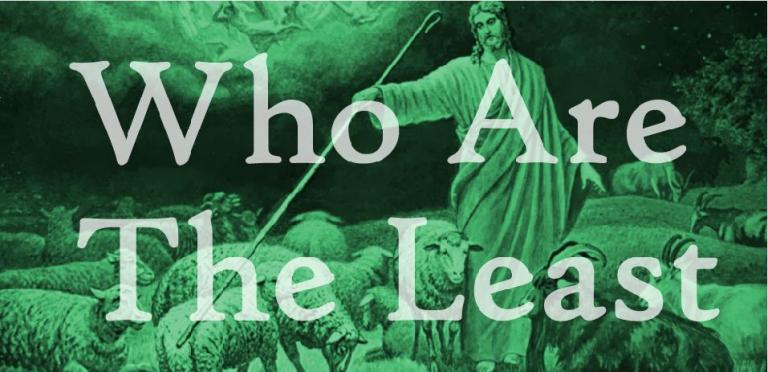
In this weeks Leactionary text from Matthew 25 we are presented with the last of Jesus eschatological teachings, known as the “parable of the sheep and the goats” or at times the “judgment of the Son of Man.” It seems to be a combination of a parable and an apocalypse. Jesus parables are stories that give a fictitious saying which conveys truth, offering hearers a handle through which to understand the kingdom of God.[1] Apocalypses are, at least within the Jewish tradition, accounts of an imminent end of the age including a final judgment and the establishment of God’s kingdom on earth.[2] This account merges these two genres together.[3]
In this text we are told of the Gathering of the nations and presented with an image of a man on a throne separating those destined for the kingdom of God and those destined for the satanic fire. The criteria for being included within the eternal kingdom seems to be the care of the hungry, the naked, the thirsty, and the imprisoned. In caring for these disparate groups of disenfranchised one is said to have encountered Christ himself, as the kingly Son of Man. As countless generations have struggled to apply these words to their own lives and faithful following of Jesus Christ, there has been much debate and discussion about who “the least” who are served actually are.
This article is concerned with exploring the sources and traditions that form a thematic background motifs and sumbols both within the text itself and within the broader Semitic and Greco/Roman culture. Finally I want argue that “the least” in Matthews gospel is best interpreted as the least of all people not simply those within the fold of Christianity or Judism as has been argued by some.
In what follows I will be briefly evaluating the discussion throughout history, presenting the accounts that would have had contemporary significance in the development of Matthews own language to describe eschatological judgment. I will be paying special attention to Matthew’s other pericopes on the subjects of Christ’s hidden presence and the cost of discipleship. In the end I will offer my own conclusion that the sources which help us understand the images and motifs employed in the account of the sheep and the goats are weighted heavily toward seeing this passage as a call, directed toward the hearer, to serve all people regardless of their religion or ethnic background.
The text itself in context: Matthew 25:31-46
The account of the Sheep and the Goats is the culminating account in a series of sayings by Jesus that are all related to eschatology and final judgment. Immediately before this pericope is the parable of the 10 talents (25:14-31), which is proceeded by the parable of the 10 virgins (25:1-13), which is in turn proceeded by an exhortation to be a faithful and wise servant who is vigilantly giving food to the master’s household at all times always ready for the return of their master (24:36-51). This is preceded by the lesson of the Fig tree (24:32-35), and the coming of the Son of Man (24:29-31). Before these is a section about how to deal with tribulation, false prophets and the coming of the Son of Man (24:3-28). All of these sayings are sparked in the narrative by a short encounter where the disciples point out the, surely impressive, spectacle of the temple complex (24:1-2).
Options for interpretation
This article seeks only to situate the account itself in its cultural context by reviewing significant texts that help us understand the symbols and motifs employed in the story. However, approaching the basic rationale and history surrounding the major interpretive traditions offers a framework through which to view the texts we will be examining. There has been a rich and diverse reception history of this text. Commentators have generally been most concerned with the question of who the “least of these” are, and after defining them determining if they too are required to serve others. Briefly examining the general arch of reception history will help us define the key question that we will seek to answer.
The history of interpretation is always an evolving field. What follows is a broad overview of the theories that have been influential in the Church and in academia. Luz divides the history of interpretation into three major approaches, each of which we will turn to in turn paying special attention to the rationale employed in order to come to the conclusions about the “criteria for inclusion” in the blessings. We will also briefly look at a fourth approach, known as the dispensationalist approach. There are some writers who employ more than one model in their writing depending on the context they are writing in, showing that this division is somewhat arbitrary, but I believe it helps frame the questions which will need to be addressed: “who are the least” and “who is called to serve.”
- The Universal Interpretive Model
This interpretive model sees the call to serve one’s neighbor as universal. All people in all places are called to serve their neighbor. Anyone who is hungry, thirsty, imprisoned, or naked can be a vessel through whom Christ can be encountered and served.
This interpretation has been taken up in various forms by not only scholars and church fathers, but has been the interpretive model in a number of works of literature. Luz calls this vision of Christianity as “nondogmatic and practical,” and highlights a story by Tolstoy that communicates this interpretation in literature:
[In]”Where Love Is, There Is God.” The shoemaker Martin Avdeitch grieves the death of his only child. Then he hears the voice of Christ, who promises that he will come to him the next day. On the next day Martin sits at the window the entire day and waits. Different people come past. First comes an old man who is exhausted from shoveling snow. Then comes the wife of a soldier with her tiny child, both of them on the point of freezing to death. The third visit comes from an old woman who is arguing with a street urchin over a stolen apple. Martin speaks with them and gives them something to eat and drink. These three people were Christ; but Martin does not know it. Only as he reads Matt 25:35, 40 that evening does he discover this[5].
The rationale behind this theory has been summarized by Luz. He gives the following reasons for it: 1. Jesus’ model of life and teaching reflect this ethic of love 2. There is a less dogmatic focus on the identity of God and less exclusivity for salvation 3. There is focus on love which is seen by universalist interpreters as the fundamental test by which interpretations should be weighed.[6]
This interpretation has been used throughout the history of the church, but was a rarer interpretation up until the 19th century. Because of this it is thought of as a characteristically modern interpretation. However, one of the key aspects of this theory, that all people are to be served has been taken up by many, at least at some point, including Jerome, Augustine, Chrysostom, Bonaventure, Erasmus, Zwingli, Matthew Henry, Bengel, Schlatter, J. Weiss, McNeile, Schniewind, Bornkamm, C. E. B. Cranfield, Bonnard, Kummel, Frankemolle, Beare, Catchpole, Gundry, Sand, Via, Schnackenburg, Hare, and Gnilka, K. Weber.[7]
In general the two questions are answered like this,
i) Who is served: the unfortunates of the world.[8]
ii) Who is called to serve: all people
- The Classical Interpretive Model
This is a model that was prevalent for much of church history. It simply deals with Christians serving Christians, and does not take other groups, like Jews or other non-Christians into account. This model is often also employed by those who occasionally employ the Universal interpretive model. Examples of this dual usage and be seen in Luther, Aquinas, and John Chrysostom. Luz summarizes this position saying “For the most part the interpreters understood “all nations” in a universal sense, such that the role of the non-Christians in the final judgment often remained unclear… For Christians the criterion used in the final judgment is the deeds of compassion which they have done or failed to do for their poor and suffering Christian brothers and sisters.” Those who employ this interpretation range from Origen to Aquinas to John Calvin. Luz highlights that Christian discussion of this passage in the post-Constantinian church often simply ignored the non-Christian element altogether.[9]
Using this model John Chrysostom challenges his flock to take better care of one another, particularly pointing out that the lapdogs of the wealthy are often treated better than the baptized poor in their own community.[10] Christians who fail to serve the very “brothers” of Christ are seen as deeply unrighteous. Although many of the reformed adopted this view, there was some concern that this passage could insinuate that salvation was achieved through meritorious action, but exploring the depths of this debate goes beyond the scope of this article. Those who interpret this passage as serving only Christians include Prosper of Aquitane, Caesarius of Aries, H. Grotius, H. A. W. Meyer, Plummer, Wellhausen, Maddox, V. P. Furnish, and U. Wilckens.[11]
In general the two questions are answered like this,
i) Who is served: Jesus’ Disciples / Christians.[12]
ii) Who is called to serve: Jesus’ Disciples / Christians
- The Exclusive Interpretive Model.
This is a model which has been only taken up by scholars within the last 250 years. This interpretation believes that the passage is referring to the judgment of the non-Christian nations who treat the messengers of the Church to their lands poorly. Those who are receptive to the message receive a reward, while those who reject the messengers are threatened with hell-fire. In this interpretation Matthew included the story in order to offer comfort to a Church that was increasingly suffering oppression. This view does not exclude the judgment of Christians in their treatment with one another, but adds a second judgment for the nations. This decision rest largely on the use of the word nations(ἔθνη) as describe who is gathered in Matt 25:32, the reference to Christ’s brothers (τῶν ἀδελφῶν) being interpreted as language of exclusivity and a couple of references to nations being judged in the Old Testament.[13]
In general the two questions are answered like this,
i) Who is served: a subgroup of Jesus’ disciples, namely his missionaries / Christians.[14]
ii) Who is called to serve: non-Christian nations
- The Dispensational Approach
This is a mode of interpretation that emerged in the Twentieth Century. Dispensationalists conclude that the Judgment of the Sheep and Goats is a separate occurrence from the Throne Judgment and will occur prior to a 1,000 year reign of Christ at the close of “the Great Tribulation.” This theory, as proposed by Eugene W. Pond believes Matt 25:31-46 must be reconciled to the book of Revelation, and sees “all the nations” in Matt 25:32 as referencing Gentiles who live through the Tribulation and who are evaluated for their treatment of the 144,000 Jewish witnesses seen in Rev 7 :l-8.[15] This approach relies on an unusual development in eschatology among some Protestants, particularly in the United States. In this framework there is a belief that there will be a 1000 year reign of the Jewish people on earth at the end of the world. Understanding exactly how this theory works requires an examination of dispensational eschatology that is beyond the scope of this article.
In general the two questions are answered like this,
i) Who is severed: The 144,000 Jewish Witnesses
ii) Who is called to serve: Gentiles who live through the tribulation
As we have seen these approaches to the text ask the question, “who is to serve” and “who is to be served.” This article seeks to help answer those two questions by examining the cultural and symbolic context in which it was written.[16] I believe that the cultural evidence supports a universal reading of the passage.[17] We now turn our attention to the examples of similar motifs and symbols in other ancient Mediterranean writings.
Narratives and images at play in the cultural milieu of first century Semitic culture
The story of the Sheep and the Goats is found only in Matthew. This could mean that Matthew himself was the original composer or recorder of the message, however this is not certain. There are certainly those who believe that Matthew was incorporating some kind of oral tradition within the church as a basis for what we have received within the Gospel text itself.[18] If there was such a tradition at some point is has long since passed away. What has not passed away, however, are the other textual and thematic parallels that were at work within the cultural milieu of the first century in ancient near-eastern Palestine and Syria. What follows are a few examples of literature that may have had some impact on Matthew.
Old Testament
The following Old Testament passages each contribute to the cultural imagination surrounding the symbols and motifs employed in the narrative of the sheep and the goats. Since Matthew is a text that repeatedly draws on passages from the Hebrew Bible and the Septuagint, seeing how the themes in the sheep and goats pericope find parallels in the Old Testament is of highest importance in evaluating how the audience of Matthew would have understood what Jesus is talking about. . We will be examining those passages that have a parallel in one or more of the following categories: 1) if the passage makes reference to a division of “blessed” and “cursed” in an eschatological judgment 2) if there is a reference to works of mercy being a way to serve God 3) if works of mercy are seen as the criteria for God’s approval.
- Job 31:16-23, 31-32 – In this passage Job is making an appeal for his own righteousness. What is listed is his care for the poor and widow (16,18), clothing the needy (19-20), and caring for the hungry (31) and sojourner (32). Why has he done these things? In verse 23 Job reveals that he has done these things because he fears that his failure to serve these vulnerable people would bring about divine judgment. Note that, particularly in verse 32, his care is not limited to those within his own tribe, but also the foreigner. This passage, at least, associates care for the “least” with people universally.
- Psalm 41:1 – This passage blesses those who care for the poor and sees that care as the criteria for the deliverance of the LORD.
- Proverbs 14:31; 19:17 – In the first proverb care for the poor is connected honoring God, and oppression of the poor is an affront to God. In the second proverb generosity to the poor is considered lending to God.
- Isaiah 58:7; 66:18 – In 58:7 the true fast acceptable to the LORD is feeding the hungry and bringing the poor into one’s home. In 66:18 there is a discussion of God’s gathering of the nations. In this passage all the nations are judged based on their מַעֲשֶׂה (works) and מַחֲשָׁבָה (thoughts) .
- Ezek 18:7,16;34:15-24- In 18:7 the righteous man is presented as one who gives bread to the hungry and clothes the naked. This is repeated in verse 16. In 34:15-24 Ezekiel takes on the voice of God, who identifies himself as a shepherd who gathers the scattered and lost. In the passage this divine shepherd judges sheep from sheep and rams from goats. Over them God places David the shepherd/king. In this passage it is the shepherd/king who feeds the flock.
- Daniel 7:13-14, 22;12:2 – In 7:13–14 the “son of man” language is used. One “like a son of man” is given dominion over all people and kingdoms. This is a universal reign, which will “never pass away.” This passage is arguably the inspiration for Jesus’ own usage of the term in his teaching, since many scholars believe this reference is the strongest parallel in the Old Testament to what Jesus is talking about in the Gospels.
- Joel 3:1-21 – In this passage Joel presents the words of the LORD in the first person. In this passage the LORD gathers all nations. The nations are judged in the vengeance of God. In this instance there does seem to be a judgment of the outsider for how they treated Israel. The book of Joel ends with a promise that Judah will be an everlasting kingdom, and the LORD will reign in Zion.
- Zephaniah 3:8,13 – This passage also talks about the judgment of the nations, and in this case the use of fire in the judgment is explicit.
- Sirach 7:32-36 – This passage offers wisdom that one should “stretch forth” ones hand toward the poor. Remembering the end of one’s life as a means to avoid sin.
- Tobit 1:16-17, 4:7; 4:16 – In 1:16-17 the virtue of Tobit’s life is testified to because he gave bread to the hungry, clothing to the naked, and buried the discarded dead. In 4:7 it states that if one doesn’t turn their face away from the poor God will not turn his face away from them. Finally 4:16 offers a moral code which consists of giving bread to the hungry, clothes to the naked, surplus to the poor, and to be generous in the giving of alms.
These passages demonstrate that the Hebrew Scriptures present a repeated call for the care of the poor as both a criteria for God’s judgment and something that is not limited to care of one’s neighbor alone. All people one comes into contact with should be fed and clothed. The only passages that seem to indicate that the treatment of Israelites, in particular, constitutes a criterion for judgment are related to the Lord’s dealing with nations rather than individual people.
In the Old Testament, in general, the two questions are answered like this,
i) Who is served: The one who has need, even strangers and immigrants
ii) Who is called to serve: The one who fears the Lord
New Testament
The New Testament is a valuable source for understanding how symbols and themes were at work within the earliest Christian communities. Examining how the themes of the Sheep and the Goats passage are reflected in other sections of scripture outside of Matthew can help develop a picture of the broader scope of what judgment, eschatology, and service of neighbor looked like among the first generations of Christians.
- Luke 16: 19-31 – In this passage a Rich Man is sent to a torment of flames. There is an indication that his fate may have been the result of his failure to serve the poor man outside his gate.
- John 5:27-29 – In this passage the judgment comes when those in the tombs come out, those who have ἀγαθὰ ποιήσαντες (practiced good) to ἀνάστασιν ζωῆς (a resurrection of life). Those who have φαῦλα πράξαντες (practiced what is bad/worthless)to ἀνάστασινκρίσεως (a resurrection of judgment). This passage seems to envision a general resurrection for all people with universal criteria of doing good verses doing evil.
- John 13:20 – In this passage Jesus argues that receiving the τινα πέμψω ἐμὲ (one sent by me) is sending him. Here John seems to have Jesus specify serving apostles, and perhaps other disciples, as particularly special way to serve Christ.
- Hebrews 13:2-3 – The author of Hebrews encourages Christians to show hospitality to strangers. In this example the Christians are clearly shown as the ones who are to do the serving, and outsiders are specified as the ones to be served. The hidden presence in this passage is angelic rather than divine.
- James 1:27 – James presents the image of true religion as serving those who are most vulnerable.
Although there is an example in John (13:20) where one receives Christ by receiving his disciple, this is balanced by another reference in the book (John 5:27-29) to a judgment based on the works done with no regard for the identity of the server or the served. The other passages make no distinction about serving those in the church and those outside of the church, once even explicitly mentioning serving strangers (Hebrews 12:2-3).
In the New Testament, in general, the two questions are answered like this,
i) Who is served: Both those who have been sent, and those who are in need
ii) Who is called to serve: Christians and others
Ancient Near Eastern Texts
-
Egyptian book of the Dead 125 – This account has a number of similar parallels. A person has dies, and they confess to Osiris the sins they have done and the sins they have not done. They also include a list of good deeds that they have preformed including giving bread to the hungry, water to the thirsty, clothes to the naked and ferrying those who have no ships. Although there is no way to know if Matthew had direct contact with this tradition the parallels are too striking to ignore. Here is the defense given:
- I have done that which men praise
and that whereof the gods rejoice,
I have satisfied God through that which he loves:
I have given bread to the hungry
and water to the thirsty
and clothes to the naked
and a ferry to those without ships[19]
- I have done that which men praise
- I Enoch 85- 90 – The Animal Apocalypse – In this popular pseudepigraphon there is a vision of the history of Israel as told through animals. Israel itself was represented by a sheep. In the vision the “Lord of the Sheep” punishes the other animals striking the earth and opening the books for judgment of the guilty shepherds and sheep which are thrown into a fiery abyss.
What is seen in these texts is a testimony that the images that were employed by Jesus in his own narrative were in all likelihood borrowed. Sheep were a common image used for Israel as the people of God, Jesus himself employs the language of sheep in Matthews Gospel nine times.[20] In nearly all of these he seems to identify himself with the shepherd. Goats were less of a common image and didn’t come with the same kind of automatic symbolic understanding. There is some background for Goats within the Old Testament, goats were a source of food, and sacrifice. They were also the subject to a deal made in Genesis 30:32 through which Jacob becomes wealthy at his father-in-law’s expense. Gundry cites a Palestinian practice where sheep and goats were separated in the evening for housing purposes, which would suggest that the goats were a convenient image for developing the cultural motif of sorting.[21] However Luz points out that this theory seems to be based on a miss reading of Dalman’s *Arbeit und Sitte in Palastina.*and proposes that Matthew was referring to a separating to the Goats away for a slaughter.[22] The exact meaning of Goats in Matthew 25 is somewhat uncertain, but use of Goats in the animal apocalypse clearly sets a cultural expectation of Sheep being the people of God.
- 1 Enoch 62-63- The Similitudes of Enoch- In this section of 1 Enoch there is a strikingly similar account of the judgment. A study by Catchpole highlights twelve similarities and only two differences.[23]
o Similarities: 1. The “throne of glory.” 2. Enthronement results in punishment.3. An assemblage of persons from all over the world. 4. The whole is divided into two groups—one labeled “the righteous.” 5. An eternal separation of the two groups. 6. The righteous will enjoy the Son of man’s heavenly presence. 7. The Son of man is the judge. 8. Still God is the ultimate judge (Son of man his agent.) 9. Angels are active. 10. Both scenes ‘hinge on the idea of recognition.’ 11. There is an equivalence of those who suffer and the one who judges. 12. The same criteria: the manner in which those being judged have treated those with whom the judge associates himself.”
o Differences: 1. 1 Enoch 62-63 is a judgment against “the kings and the mighty and the exalted and those who dwell on the earth.” Matthew’s judgment is against “all the nations.” 2. 1 Enoch’s judgment is against active and aggressive persecution, while Matthew’s is against the absence of active beneficence.
This remarkable parallel may be in fact due to influence directly by Mathew itself.
The date of this document is still very much an open question in scholarship today.[24] It remains difficult to say whether or not this passage was impacted by Matthew or if it relates a version of a tale that might have impacted Matthew.
In the Ancient near eastern texts, in general, the two questions don’t have a unified answer. What is offered in these passages is a repeated theme of judgment. Interestingly the Jewish sources seem to focus on particular accountability being demanded of those who have authority.
i) Who is served: In the book of the dead the needy, in The Animal Apocalypse the fathful
ii) Who is called to serve: The kings in the Similitudes of Enoch, shepherd leaders in the Animal apocalypse and all people in the Book of the Dead
Greco-Roman Texts
The Greek and Roman empires were great collectors of religions. They were syncretistic and had a wide reach. This meant that their traditions incorporated religious imagery from all over the Mediterranean world, for as they conquered they often assimilated the local religious traditions, cosmologies, symbols, and legends.[25] In Greco-Roman writings, therefore, we have a window into not only the religious traditions native to those within the respective centers of empire, but also throughout the Mediterranean world. An examination of some of the most influential texts shows that many of the images of judgment were not products of Jesus’ or Matthew’s thoughts or imaginings, and may not have been meant to convey a precise account of the eschatological judgment, but used borrowed imagery to convey their message. Here are a few key examples of passages which offer images, symbols, and motifs that are also found in “the Sheep and the Goats” pericope
- The Odyssey 11:567-71 – In this passage we see Minos, son of Zeus judging the dead from a seat.[26]
- Aeneid 6: 540-751 – In this passage there is a split road. To the right is a place for the good called Elysium and to the left there is a place of punishment for the wicked known as Tartarus.
- Plutarch : Moralia 167A – We learn that a popular belief was that the wicked would be punished by fire.
- Plato: Rebublic 10:614C-615D – This passage tells talks about a journey to the world of the dead. There are two openings recorded as leading into the earth and two are recorded as leading people to heaven. Between these openings there are judges who sit dividing the righteous toward the right and up to heaven from the unjust who are sent to the left and down into the earth.
- Lucian Menippus 10-15 – This passage offers a description of the place of the dead. In this vision there is a river of fire where tormenters punish those who have done evil in their lives.
- Lucain On Funerals 7-9 – Judgment is given and the righteous and the wicked are separated.
Although there is no singular unified vision in these texts, having been written across cultures and centuries, one can walk away with an appreciation for the motifs employed in Matthew 25. If one were to create an mosaic from these texts describing the how one is judged after death it would look like this: Judgment of all people is seen as being done before a throne, and at a separation, and on the basis of a persons justice. The just are sorted to the right and those condemned are sent to the left and into flames. This image mirrors very well the vision of judgment we have recorded in “the sheep and the goats” pericope.
This composite vision based on the Roman texts would, might answer the two questions as follows:
i) Who is served: Unspecified People
ii) Who is called to serve: All people
Non-biblical sources after the emergence of Christianity
There are a number of texts that emerged in the first centuries after the emergence of the Christian Church that connect to similar themes at play in the Sheep and the Goats passage. These texts give us a window into other elements of the thematic resonance at play in the first century near-eastern world. They are important, primarily, because they offer us interpretations of the symbols and motif near the time that Matthew was composed, and help us understand the thinking of the audiences for which the Gospel was inscribed.
- 4 Ezra 2:20-21 – This passage seems to be a later addition to 4 Ezra by Christians. It discusses serving the most vulnerable as a prescription for the faithful.
- 4 Ezra 2:34-41 – This passage emphasizes the image of God as a shepherd in the eschaton.
- Sentences of Sextus 378 – This passage states that refusing to give to the needy is refusing to give to God.
- Visions of Ezra 27-32 – This passage describes angels who place sinners in a fiery stream. Their offences include refusal to receive strangers and give to the poor.
- 2 Clement 17:4 – This passage describes those who are deemed unrighteous by their deeds being cast into an unquenchable fire.
- Testament of Issac 6:21 – This passage discusses the giving of cold water to another as grounds for life in the kingdom.
- Testament of Jacob 2:23; 7:25 – 2:23 blesses those who perform acts of mercy, visit the sick, and offer a drink to the thirsty. 7:25 talks about clothing the naked so that God might clothe you in glory.
- Sabuhragan – This Manichean text offers a unique perspective on the gospel imagery. As a self-acclaimed prophet, Mani did not interpret texts. He appropriated elements from them to be vehicles of his own teaching instead. Mani seems to have appropriated Matthew’s Judgment of the Sheep and Goats without directly citing it.[27] The Sabuhragan, mixes the images and scenes described in Matthew 24-25 with its own religious perspective to produce a Manichean version of the Judgment of the Sheep and Goats. Here the Zoroastrian god Xradesahr (“the god of the world of wisdom”) takes the role of “The son of Man” in the Gospels.[28] The substitution of Xradesahr would have made the judgment scene more palatable to one of Mani’s targeted audiences—the Iranian court which was still heavily influenced by Zoroastrianism. In the Sabuhragan, before the coming of Xradesahr, “a great sign will appear” on earth, in heaven, on the sun and moon and among the stars (Matt 24:3, 29-30). Xradesahr will stand up in the heavens accompanied by the praises of all the gods of the cosmos perhaps an illusion to the heavenly court of angels seen in Matt 25:31. The Sabuhragan adds a scene to assimilate his religion’s classification of people into three groups: the “religious” who fully separate themselves to practice the ascetic faith, the “auditors” or “helpers” who retain who offer material aid to the religious, and the “wicked ones” who do not follow the instructions of Mani.Xradesahr will send his messengers to gather the “religious” with their “helpers” as well as the “wicked ones” to Xradesahr (Matt 24:31).[29] Xradesahr puts the religious on his right so that they will be blessed with the gods. The evildoers are put on the left and cursed. The helpers of the religious on the right are given a blessing which is reminiscent of Matt 25:35-36, “And Xradesahr says to them [so], ‘That which you did [to] the religious that [service] you did for me. And I shall give you paradise as reward.’”[30]
Most of these texts, apart from Sabuhragan, offer a vision of the final judgment were the questions would be answered as follows:
i) Who is served: Any needy person
ii) Who is called to serve: All who seek to serve God
The Sabuhragan offers its own unique perspective insofar as it shows another tradition borrowing and reimagining the text. In this version the “religious” are the ones who are to be served, and those who do not serve them and follow the teachings of Mani are condemned. This account shows clear parallels but also offers a complete reorientation of the text to fit within the Manichean framework.
Related themes within Matthew’s Gospel
The gospel of Matthew itself offers a significant contribution to understanding the motifs that informed the composition of the “Sheep and the Goats” pericope. In this gospel, the author himself offers a number of keys to understanding the significance of the passage itself. Chief among these themes I believe are Christ’s promise of hidden presence, and the call for radical discipleship. We now turn our attention to these themes and their significance in developing an understanding of how the symbols and motifs employed by the author are meant to be understood.
Promises of hidden presence
The Gospel of Matthew it’s filled with a number of instances where Christ promises to be present under different circumstances. Examination of these texts in Matthew will help us better develop our understanding of what the thinking of Matthew was when he referred to future momenst of hidden presence. Identifying key characteristics that are shared by these moments help develop and contextualize how Matthew may have understood the text in his own context.
- The Great Commission (Matthew 28:20)
The great commission passage in Matthew 28 promises the presence of Christ with his apostles in their mission of making disciples. The main verb in the commission is (make diciples). How they are to make disciples is through baptizing and teaching them to obey all that Christ has commanded. In this instance the encounter with Jesus is made by the apostles, and presumably other members of the church who will participate in the making of disciples. - Where two or three are gathered (Matthew 18:20)
In this passage Jesus promises to send his presence to those who συνηγμένοι εἰς τὸ ἐμὸν ὄνομα (gather in my name). The context of this promise is fairly clear. Jesus explicitly mentions that this hidden presence would occur within the context of an ἐκκλησία (church) - Whoever receives a child (Matthew 18:5)
In this passage Jesus is revealed through serving a little child. A child is similar to the examples given in the Sheep and the Goats passage because all of these people are vulnerable. In this passage Jesus is specifically addressing his disciples. They seem to be the ones called to serve, and Christ makes no distinction between children within the church or Jewish community and children outside. If Child could be compared to least in this passage it would seem to support the universal interpretive model.
In all of these promises-of-presence Christ is offered to those who are disciples. If one were to apply this trend to the passage of the Sheep and the Goats it would follow that those who encounter Jesus in serving “the least” would also be in the church. This seems to run contrary to those who think that this is a passage meant to offer a condemnation to those who reject Christian missionaries and disciples. According to Luz, Matthew is not a book that offers a hope based on a revelation of God far into the future, but believes that the event of Christ in the Church is the initiation of the eschatological revelation of God in the world.[31] Luz believes Rahner describes the theological perspective well when he states,
“Christian eschatology is not anticipatory reportage of ‘later’ occurring events (the basic view of false apocalypticism. . .); it is the necessary looking ahead forpeople in their spiritual decision for freedom based on the salvation-history situation determined by the Christ event . . . a looking ahead to the final consummation… that makes possible their own illumined decision into the dark unknown.[32]
In other words in Jesus the eschaton was established and the apocalypse was begun. This hope for the future is in a consummation of what has already begun in Jesus. In the ministry of Church the faithful are incorporated more deeply into the eschaton. This seems to be epitomized in the Sheep and the Goats passage as the disciples are to commune with Christ through their ministry in solidarity with marginalized through acts of mercy. It has been argued by Theo Preiss that this is, in fact, the main point of the story, and calls the search to discover who the just and the unjust are as a secondary issue that has managed to hypnotize readers.[33]
Care for others in the call of discipleship
One theme that repeats throughout the Gospel of Matthew is the challenge to be a disciple. Over and over Jesus challenges those who would follow him to a more radical call of self-sacrifice and love. This is a clear theme throughout the gospel which has been explored fully by a number of scholars.[34] The consensus is that Matthew is presenting discipleship as something above and beyond traditional expectations of service. They are expected to take on a radical existence on the margins radically serving the marginal or as Carter put it:
The narrative seeks to identify disciples (and the audience) as “voluntary marginals” … a life of participation in society while taking up an alternative existence, Matthean discipleship is envisioned as liminal existence.[35]
This emphasis can be seen throughout the Gospel. You can see a few examples in:
- Matthew 20:27, where Jesus declares, “Whoever would be first among you must be your slave,”
- Matthew 19:21, where Jesus declares that to be perfect is to give the proceeds of ones possessions to the poor
- Matthew 4:22,24, where the disciples leave behind their careers and begin caring for the sick.
Given this general context it would be highly incongruous if Jesus suddenly presented a story that had the effect of giving the people of God the kind of self-satisfaction one finds in the exclusive interpretive model. On the contrary Grant Osborne argues that Hunger and thirst are the most frequently noted in acts of mercy in Scripture and the greatest need in the world.
Hospitality to strangers became a major sign of loving compassion for the early church and was a requirement for leaders in both the Old and New Testament (Rom 12:13; 1 Tim 3:2, 5:10; Titus 1:8; Heb 13:2; 1 Pet 4:9; cf. Judges 19:15; Job 31:32). Providing clothing for those who had none is noted in Deut 15:11; Ezek 18:7), and the wearing of extravagant clothing was a major sign of corruption in Rev 17:4; 18:16. Visiting and caring for the sick was a common theme in the ministry of Jesus’. Caring for the sick in the ancient near east carried great risk of infection. Visiting those imprisoned is mentioned in Col 4:18; Heb 10:34; 13:3. Prisons were scenes of filth and degradation. There arguably no better description one could give of radical discipleship in the first century Christian context, than what is listed in the “sheep and the goats” pericope.[36] It would seem consistent with the theme of radical discipleship to conclude that these acts or mercy are being enjoined upon the disciples of Christ and that they are to care for all who suffer.
Conclusion
This account is a mosaic. It does not limit itself to a single source of even genre to present the material in. The language employed draws imagery (either directly or indirectly) from a large number of sources both within the Jewish tradition and also throughout the Greco-Roman world. From these selected shards of poetry, prose, and cultural memory is we are able to craft a picture of the first century Mediterranean imagination from which the Gospel of Matthew emerged.
The passage itself is not revolutionary in who it presents as entering into eternal life or demonic fire, people were already inundated with a theme of final judgment being associated with a division based of works or mercy. In the cultural context of the ancient near-east it was common to articulate a final judgment narrative where the way one cares for hungry, thirsty and naked people determined the final destination of the soul. The radical discipleship of presented in Matthew’s gospel simply heightened this message calling disciples to love their neighbors as themselves. If Matthew intended this to be a message that limited the necessity to care for one’s neighbor to fellow believers he would have had to have made that message much more explicit given his own vision of discipleship and the overwhelming cultural import of service to one’s neighbors (including foreigners). Because of this I must conclude that the cultural evidence does not support the “classical” interpretive model.
The examples that point to the judgment being for how outsiders treated the chosen people come only from text that deal with either the prophetic vision for the nation of Israel, or come out of a highly the socially stratified personality cult in the case of Manichaeism. Neither of these views on final judgment are the dominant strain within either the Jewish or the broader Greco-Roman context. The passage itself would have had to be explicit in its intentions if it wanted hearers at that time to take understand the judgment as being against those who harmed the holy people of God, therefore the cultural evidence does not support the Exclusive Interpretive Model.
The eschatological world view required to believe the dispensationalist model is nowhere to be found in the parallel passages on last judgment that we have examined. This belief seems to impose a system on the text rather than deriving its theological interpretation from the text itself. Because of this it is unsurprising that the cultural evidence does not support the Dispensationalist Model.
What we do have in the parallel readings are consistent themes of caring for one’s neighbor, whoever they might be as a criterion for eternal life. We also repeatedly see the call for the saints and holy ones to be the leading examples of service rather than the primary beneficiaries of other’s good works. It seems unlikely that Matthew’s radical call for discipleship would have suddenly put limits on who to serve. It also seems unlikely that the theme of hidden presence, being consistently manifest in the ministry of the Church itself, would suddenly have shifted toward it being manifested in how others treat the Church. These themes make it most likely that the “universal model” is the best supported option for interpretation, based on cultural evidence.
[1] Klyne Snodgrass, Stories with Intent: A Comprehensive Guide to the Parables of Jesus (Grand Rapids, Mich: William B. Eerdmans Pub. Co, 2008), 8.
[2] C.H. Dodd, The Parables O F the Kingdom,, rev (Glasgow: Collins, 1961), 27–35.
[3] Gaylen P. Leverett, “Looking for the Least: An Analysis and Evaluation of Interpretive Issues Which Have Influenced the Interpretation of the Judgment of the Sheep and Goats (Matthew 25:31–46)” (Ph.D., Southeastern Baptist Theological Seminary, 2007), 166, http://search.proquest.com.proxycu.wrlc.org/pqdtft/docview/304720213/abstract/140E6A21CF66C574CB6/1?accountid=9940; S
[4] A few manuscripts explicitly name the “Father” as the one who “prepared” the eternal fire for the devil and his angels replacing ἡτοιμασμένον with ο ητοιμασεν ο πατηρ μου.
[5] Ulrich Luz, “The Final Judgment (Matt 25:31-46): An Exercise in ‘History of Influence’ Exegesis,” in Treasures New and Old: Recent Contributions to Matthean Studies, ed. David R. Bauer and Mark Allan Powell, Symposium Series no. 1 (Atlanta, Ga: Scholars Press, 1996), 274–275.
[6] Ibid., 308–309.
[7] William David Davies and Dale C. Allison, A Critical and Exegetical Commentary on the Gospel according to Saint Matthew, vol. 3, The International Critical Commentary on the Holy Scriptures of the Old and New Testaments (Edinburgh: T. & T. Clark, 1988), 422.
[8] Arland J. Hultgren, The Parables of Jesus: A Commentary (Grand Rapids: Eerdmans, 2000), 318–319.
[9] Luz, “The Final Judgment (Matt 25:31-46): An Exercise in ‘History of Influence’ Exegesis,” 280 n.37.
[10]John Chrysostom Act. Apost. horn. 45.4 found in PG 60.319
[11] Davies and Allison, A Critical and Exegetical Commentary on the Gospel according to Saint Matthew, 3:422.
[12] Hultgren, The Parables of Jesus: A Commentary, 318–319.
[13] Luz, “The Final Judgment (Matt 25:31-46): An Exercise in ‘History of Influence’ Exegesis,” 286. Zeph. 3:8; Joel 3:1-21
[14] Hultgren, The Parables of Jesus: A Commentary, 318–319.
[15] Eugene W. Pond, “Who Are ‘the Least’ of Jesus’ Brothers in Matthew 25:40?,” Bibliotheca Sacra 159 (2001): 436–438.
[16]There This range of possibilities is expanded by Davis and Allison that go beyond the simple 4 part division represented here. In their list they included the following categories: 1) All non-Jews: R. Walker (2) All non-Christians: John Heylyn, Alford, Olshausen, F. C. Burkitt, T. W. Manson, G. E. Ladd, Friedrich, Gray, Stanton (3) All non-Jews who are not Christians: B. Weiss, A. Loisy, J. Cope, Hare, Court, Lambrecht, Harrington (4) All Christians: Prosper of Aquitane, Caesarius of Aries, H. Grotius, H. A. W. Meyer, Plummer, Wellhausen, Maddox, V. P. Furnish, U. Wilckens (5) Christians alive when Christ returns: Daniel van Breen (6) All humanity: Jerome, Augustine, Chrysostom, Bonaventure, Erasmus, Zwingli, Matthew Henry, Bengel, Schlatter, J. Weiss, McNeile, Schniewind, Bornkamm, C. E. B. Cranfield, Bonnard, Kummel, Frankemolle, Beare, Catchpole, Gundry, Sand, Via, Schnackenburg, Hare, Gnilka, K. Weber Davies and Allison, A Critical and Exegetical Commentary on the Gospel according to Saint Matthew, 3:422.
[17] This is only one hermeneutic through which one must examine the text in order to come to a fully informed conclusion. For a more in depth perspective on the scholarship on this passage looking at the form, text criticism, the narrative and the a greater examination of reception history I recommend Davies and Allison, A Critical and Exegetical Commentary on the Gospel according to Saint Matthew; Luz, “The Final Judgment (Matt 25:31-46): An Exercise in ‘History of Influence’ Exegesis”; Ulrich Luz, Matthew: A Commentary, vol. 3, Hermeneia–a Critical and Historical Commentary on the Bible (Minneapolis, MN: Fortress Press, 2001); Hultgren, The Parables of Jesus: A Commentary; Dodd, The Parables O F the Kingdom,.
[18] Luz, Matthew, 3:266.
[19] George Raymond Beasley-Murray, Jesus and the Kingdom of God (Grand Rapids, Mich: W.B. Eerdmans Pub. Co, 1986), 308.
[20] Matthew 7:15; 9:36; 10:6; 12:11-12;15:24;18:12:25:32-33;26:31
[21] Robert H. Gundry, Matthew:A Commentary on His Literary and Theological Art (Grand Rapids: W.B. Eerdmans, 1982), 512.
[22] Luz, Matthew, 3:276.Gustaf Dalman, Arbeit Und Sitte in Palastina, vol. 6 (Gutersloh: Bertelsmann, 1928), 276.
[23]D.R. Catchpole,, “The Poor on Earth and the Son of Man in Heaven: A Reappraisal of Matthew 25:31-46,” BJRL 61 (1979): 355–97.
[24] M. Black, “The Messianism of the Parables of Enoch: Their Date and Contribution to Christological Origins,” in Messiah: Developments in Earliest Judaism and Christianity., ed. James H. Charlesworth (Minneapolis: Augsburg Fortress., 2010), 145–168.
[25] Helmut Koester, Introduction to the New Testament, 2nd ed. (Berlin: Walter de Gruyter, 1995), 155–158.
[27]Iain Gardner, “The Eschatology of Manichaeism as a Coherent Doctrine,” The Journal of Religious History 17 (1993): 257–273, 269, 273.
[28]Majella Franzmann, Jesus in the Manichaean Writings (New York: T. & T. Clark, 2003), 18–19.
[29] Leverett, “Looking for the Least,” 11–13.
[30] D.N. MacKenzie, “Mani’s Sabuhragan,” BSOAS 42, no. 3 (1979): 506.
[31] Luz, Matthew, 3:294.
[32] Ibid. Originally found in Karl Rahner, “Eschatologie, Theologisch-Wissenschaftstheoretisch,” LThK 3.1096 (1959).
[33] Theó Preiss, Life in Christ, Studies in Biblical Theology no. 13 (Naperville, Ill: A.R. Allenson, 1957), 51.
[34] Warren Carter, “Matthew 4:18-22 and Matthean Discipleship: An Audience-Oriented Perspective,” The Catholic Biblical Quarterly 59, no. 1 (January 1997): 58–75. Emmanuel M. Jacob, “Discipleship and Mission: A Perspective on the Gospel of Matthew,” International Review of Mission, January 2002. Stephen C. Barton, Discipleship and Family Ties in Mark and Matthew, Monograph Series / Society for New Testament Studies 80 (Cambridge ; New York: Cambridge University Press, 1994).
[35] Carter, “Matthew 4,” 74.
[36] Grant Osborn, Zondervan Exegetical Commentary on the New Testament (Grand Rapids: Zondervan, 2010), 963.
Previous Post

November 20, 2014
How to Define Holiness
Next Post
November 25, 2014 Caravaggio’s Invitation to Recognize Jesus
Browse Our Archives
Select a Category Art Bible Books CCC Prayer Christmas Current Events Family Film Free Photo Fridays Humor hunger liturgical calendar liturgy Music Photos pope Prayer Prayerful Leader questions Quotes Review Saints Satire Scripture SYNOD SYNOD FOR THE FAMILY teaching Uncategorized video Weekly Round Up
Select a Month October 2026 September 2026 August 2026 July 2026 April 2026 February 2026 December 2025 November 2025 October 2025 September 2025 August 2025 July 2025 June 2025 May 2025 April 2025 February 2025 January 2025 September 2024 June 2024 May 2024 February 2024 December 2023 August 2023 May 2023 February 2023 November 2022 July 2022 June 2022 May 2022 March 2022 May 2021 April 2021 March 2021 February 2021 January 2021 September 2020 April 2020 March 2020 February 2020 January 2020 December 2019 November 2019 October 2019 August 2019 June 2019 May 2019 March 2019 January 2019 December 2018 August 2018 June 2018 April 2018 March 2018 February 2018 December 2017 November 2017 September 2017 August 2017 July 2017 June 2017 April 2017 March 2017 February 2017 December 2016 November 2016 February 2016 January 2016 November 2015 October 2015 August 2015 July 2015 June 2015 May 2015 April 2015 March 2015 February 2015 January 2015 December 2014 November 2014 October 2014 September 2014 August 2014 July 2014 June 2014 May 2014 April 2014 March 2014 February 2014 January 2014 December 2013 November 2013 October 2013 September 2013 August 2013 July 2013 June 2013 May 2013 April 2013 March 2013 February 2013 January 2013 December 2012 November 2012 October 2012 August 2012 July 2012 June 2012 May 2012 April 2012 March 2012 February 2012 January 2012 December 2011 November 2011 October 2011 September 2011 August 2011 July 2011 June 2011 May 2011 April 2011 March 2011 February 2011 January 2011 December 2010 November 2010 October 2010 September 2010 August 2010 July 2010 June 2010 May 2010 April 2010 March 2010 February 2010 January 2010 December 2009 November 2009 October 2009 September 2009 August 2009 July 2009 June 2009 April 2009 March 2009 February 2009 January 2009 October 2008 August 2008 June 2008 May 2008 April 2008 March 2008 February 2008 January 2008 December 2007 November 2007
Follow Us!
TAKE THE
Religious Wisdom Quiz
What did Jesus do for Lazarus in Bethany?
Select your answer to see how you score.
Healed his blindness Raised him from the dead Fed him Turned him invisible
Related posts from The Orant

What If You Are God’s Currency?


May Wendell Berry Trouble Your Thoughts Today
TRENDING AT PATHEOS Catholic

Emotion in Early Christianity by Andrew Crislip
Andrew Crislip’s Emotion in Early Christianity examines an often overlooked dimension of...

16 Spiritual Touchstones for a More Grounded Life
After decades of spiritual study, here are 16 principles I try...

Catholic Evangelization: Sharing Your Faith Every Day
Welcome back to the Graceful Awakening mini-series called, “From Faith to Mission.” ...

The Pillar of the Boatmen: the Ancient Monument...
The Pillar of the Boatmen is a Romano-Gaulish sculpture that dates from...

In one sense walking into Westminster Abbey is like walking down the...

'Super Scam Me' Exposes AI Jon Bon Jovi...
Leslie Pickett believed she was in a relationship with Jon Bon Jovi....
view all Catholic blogs
Ad-Free & Subscriber Log-In Subscription Support
- About Us
- 2026 Calendar
- Videos
- Podcasts
- Library of World Religions
- Faith In Media Tracker
- Advertise With Us
- Write for Us
- Privacy Policy
- Terms of Service
- Do Not Sell My Data
- Contact Us
- Radiant Digital
- Manage Newsletter Subscriptions
- Unsubscribe From Notifications
- Sitemap
Copyright 2008-2026, Patheos. All rights reserved.
Subscription Support Ad-Free & Subscriber Log-In
Follow Patheos