
BuddhistCatholicContemplativeEvangelicalGeneral ChristianHinduJewishLatter-day SaintMuslimNew VisionsProgressive Christian
Beliefs
- Buddhist
- Catholic
- Contemplative
- Evangelical
- General Christian
- Hindu
- Jewish
- Latter-day Saint
- More Voices
- Muslim
- New Visions
- Pagan
- Progressive Christian
Topics
- Religion News
- Food and Religion
- Sports and Religion
- Religious Art
- Religious Music and Entertainment
- Religious Events
- History and Religion
- Style and Religion
- Politics and Religion
- Women in Religion
- Recreation Outdoors and Religion
- Business Finance and Religion
- Careers Workplace and Religion
- Education and Religion
- Family Parenting and Religion
- Health Fitness and Religion
- Home and Religion
- Relationships and Religion
- Technology and Religion
- Travel and Religion
Columnists
- Buddhist Columnists
- Business Finance and Religion Columnists
- Careers Workplace and Religion Columnists
- Catholic Columnists
- Contemplative Columnists
- Education and Religion Columnists
- Evangelists Columnists
- Family Parenting and Religion Columnists
- General Christian Columnists
- Health Fitness and Religion Columnists
- Hindu Columnists
- History and Religion Columnists
- Home and Religion Columnists
- Jewish Columnists
- More Voices Columnists
- Latter Day Columnists
- Muslim Columnists
- New Visions Columnists
- Nonreligious Columnists
- Pagan Columnists
- Politics and Religion Columnists
- Progressive Columnists
- Recreation Outdoors and Religion Columnists
- Relationships and Religion Columnists
- Religion News Columnists
- Religious Art Columnists
- Religious Events Columnists
- Religious Music and Entertainment Columnists
- Sports and Religion Columnists
- Style and Religion Columnists
- Technology and Religion Columnists
- Travel and Religion Columnists
- Women in Religion Columnists
Resource Library
- 2026 Calendar
- Library of World Religions
- The 100 Most Holy Places on Earth
- Patheos Answers
- Podcasts
- Videos
- Faith Leaders Database
- Anglican Episcopalian
- Bahai
- Baptist
- Buddhism
- Christianity
- Confucianism
- Eastern Orthodoxy
- Hinduism
- Holiness and Pentecostal
- ISKCON
- Islam
- Judaism
- Lutheran
- Methodist
- The Church of Jesus Christ of Latter-day Saints
- New Age
- Paganism
- Presbytarian and Reformed
- Protestantism
- Religion Behind the Scenes
- Roman Catholic
- Scientology
- Shia Islam
- Sikhism
- Sufism
- Sunni Islam
- Taoism
- Zen
- See all religions
Research Tools
 Ad-Free & Subscriber Log-In Subscription Support
Ad-Free & Subscriber Log-In Subscription Support
Follow Patheos 

- Trending:
- Forgiveness
- |
- Marriage
- |
- Consciousness
- |
- Death Penalty
- |
- Election
- |
- Halloween

- Home
- Catholic
- In Defense of Rubrics
In Defense of Rubrics
Last updated on: April 22, 2014 at 3:22 pm by Billy Kangas
In Defense of Rubrics 2014-04-22T15:22:17-04:00 Billy Kangas
Patheos Explore the world's faith through different perspectives on religion and spirituality! Patheos has the views of the prevalent religions and spiritualities of the world.
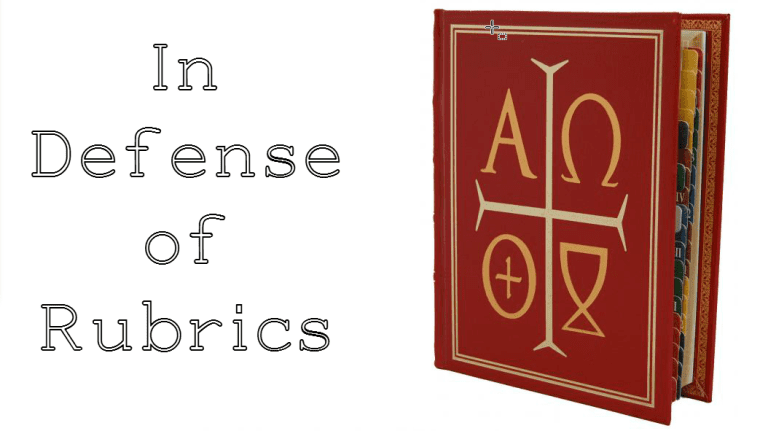
One of the main reasons I love to study liturgy is it equips me to do theology in the first person plural. Liturgy is a communal Theologica Prima. It is an ecclesial encounter of the I and Thou relationship of God and humanity. It is an expression of life with God that cascades across the communion of saints through every age. I love it. This is why I always find it interesting that so many people find what I study to be “boring” or “uninteresting.” They can’t imagine what could be fascinating about the liturgy. To them all they see is the study of old texts. They wonder why I would bother with such the cultic record of what they see as a superstitious backward Church. Why bother with other people’s prayers when one can pray in one’s own words today.
Although there is much more to liturgical theology than simply the study of texts, there is a great benefit to learning about the written prayers and directions in worship. This corpus, often referred to as the lex orandi opens new avenues for understanding and encountering God. Here are four of the reasons I think knowing the lex orandi of the church is useful for all people of faith.
- Texts dictate our acoustics: I am a musician, and as a musician I know that the first thing I need to do when I walk into a space I will be performing in is to clap. I clap because it allows me to hear how the space I am in treats sound. I listen for how the sound of my clap echoes of the surfaces around the room. The study of texts is like clapping in the sacred space of Christian Worship. It allows us to see and identify the language, often strange and different, that will echo and resound with our own praise. It has a literary character that offers windows into different worlds.
- Texts are our well: Unlike the vocabulary that dictates most everyday conversation, liturgical language has depth and life. Liturgical language brings out the tension of poetry. It incorporates symbols which are primordial and polyvalent. It communicates through flesh, blood, light, water, birth, death, eating, drinking, hunger and thirst. These symbols are not seeking to emulate the ephemeral but they encompass our entire existence. Too often if we were left with words of our own devising we would be unable communicate the depth of the mystery of Jesus’ life, death and resurrection. The church offers us a well of poetic language to draw into ourselves and open up windows to heaven.
- Texts are the Rules that allow us to play: I am not a jock, and never have been, but I absolutely love the game of Baseball. My love for the sport is deep and it grows every year. I love it because of the rules. There are strict rules and demarcations. These Rules allow for the game to function. Without strict adherence to the rules, the game would be chaos, players would get injured and tempers would undoubtable flair. The rules allow for constructive creativity, excitement and fun. Liturgy is similar. It gives guidelines in order that the assembly might be more free to love God and one another. To craft the texts of the liturgy with artistry is truly a task of inspiration. The texts are a way that the life of the Church is safeguarded and nourished.
- Texts are the clothes we grow into: I have a bin of clothes which are too big for my kids. It’s made up of gifts, hand-me-downs, and even a few mistaken purchases. I keep the bin because I have hope that my children will continue to grow, and that someday the clothes will fit them. Studying liturgical texts can often feel like trying on clothes that are too big. The words don’t seem to fit us, but the offer a hope that we will continue to live and grow. The power of studying the words is that in learning the words we are able to grow into them all the better.
Previous Post

April 10, 2014
The DNA of the Roman Rite
Next Post
April 23, 2014 Book giveaway: The Catholic Commentary on Holy Scripture
Browse Our Archives
Select a Category Art Bible Books CCC Prayer Christmas Current Events Family Film Free Photo Fridays Humor hunger liturgical calendar liturgy Music Photos pope Prayer Prayerful Leader questions Quotes Review Saints Satire Scripture SYNOD SYNOD FOR THE FAMILY teaching Uncategorized video Weekly Round Up
Select a Month October 2026 September 2026 August 2026 July 2026 April 2026 February 2026 December 2025 November 2025 October 2025 September 2025 August 2025 July 2025 June 2025 May 2025 April 2025 February 2025 January 2025 September 2024 June 2024 May 2024 February 2024 December 2023 August 2023 May 2023 February 2023 November 2022 July 2022 June 2022 May 2022 March 2022 May 2021 April 2021 March 2021 February 2021 January 2021 September 2020 April 2020 March 2020 February 2020 January 2020 December 2019 November 2019 October 2019 August 2019 June 2019 May 2019 March 2019 January 2019 December 2018 August 2018 June 2018 April 2018 March 2018 February 2018 December 2017 November 2017 September 2017 August 2017 July 2017 June 2017 April 2017 March 2017 February 2017 December 2016 November 2016 February 2016 January 2016 November 2015 October 2015 August 2015 July 2015 June 2015 May 2015 April 2015 March 2015 February 2015 January 2015 December 2014 November 2014 October 2014 September 2014 August 2014 July 2014 June 2014 May 2014 April 2014 March 2014 February 2014 January 2014 December 2013 November 2013 October 2013 September 2013 August 2013 July 2013 June 2013 May 2013 April 2013 March 2013 February 2013 January 2013 December 2012 November 2012 October 2012 August 2012 July 2012 June 2012 May 2012 April 2012 March 2012 February 2012 January 2012 December 2011 November 2011 October 2011 September 2011 August 2011 July 2011 June 2011 May 2011 April 2011 March 2011 February 2011 January 2011 December 2010 November 2010 October 2010 September 2010 August 2010 July 2010 June 2010 May 2010 April 2010 March 2010 February 2010 January 2010 December 2009 November 2009 October 2009 September 2009 August 2009 July 2009 June 2009 April 2009 March 2009 February 2009 January 2009 October 2008 August 2008 June 2008 May 2008 April 2008 March 2008 February 2008 January 2008 December 2007 November 2007
Follow Us!
TAKE THE
Religious Wisdom Quiz
Which apostle was known as the "apostle to the Gentiles"?
Select your answer to see how you score.
James John Peter Paul
Related posts from The Orant

What If You Are God’s Currency?


May Wendell Berry Trouble Your Thoughts Today
TRENDING AT PATHEOS Catholic

16 Spiritual Touchstones for a More Grounded Life
After decades of spiritual study, here are 16 principles I try...

Catholic Evangelization: Sharing Your Faith Every Day
Welcome back to the Graceful Awakening mini-series called, “From Faith to Mission.” ...

The Pillar of the Boatmen: the Ancient Monument...
The Pillar of the Boatmen is a Romano-Gaulish sculpture that dates from...

In one sense walking into Westminster Abbey is like walking down the...

'Super Scam Me' Exposes AI Jon Bon Jovi...
Leslie Pickett believed she was in a relationship with Jon Bon Jovi....

The Brazilian Remake of Kendricks' 'Flywheel' Opens in...
“Flywheel,” the story that launched the Kendrick Brothers’ filmmaking career is getting...
view all Catholic blogs
Ad-Free & Subscriber Log-In Subscription Support
- About Us
- 2026 Calendar
- Videos
- Podcasts
- Library of World Religions
- Faith In Media Tracker
- Advertise With Us
- Write for Us
- Privacy Policy
- Terms of Service
- Do Not Sell My Data
- Contact Us
- Radiant Digital
- Manage Newsletter Subscriptions
- Unsubscribe From Notifications
- Sitemap
Copyright 2008-2026, Patheos. All rights reserved.
Subscription Support Ad-Free & Subscriber Log-In
Follow Patheos