
BuddhistCatholicContemplativeEvangelicalGeneral ChristianHinduJewishLatter-day SaintMuslimNew VisionsProgressive Christian
Beliefs
- Buddhist
- Catholic
- Contemplative
- Evangelical
- General Christian
- Hindu
- Jewish
- Latter-day Saint
- More Voices
- Muslim
- New Visions
- Pagan
- Progressive Christian
Topics
- Religion News
- Food and Religion
- Sports and Religion
- Religious Art
- Religious Music and Entertainment
- Religious Events
- History and Religion
- Style and Religion
- Politics and Religion
- Women in Religion
- Recreation Outdoors and Religion
- Business Finance and Religion
- Careers Workplace and Religion
- Education and Religion
- Family Parenting and Religion
- Health Fitness and Religion
- Home and Religion
- Relationships and Religion
- Technology and Religion
- Travel and Religion
Columnists
- Buddhist Columnists
- Business Finance and Religion Columnists
- Careers Workplace and Religion Columnists
- Catholic Columnists
- Contemplative Columnists
- Education and Religion Columnists
- Evangelists Columnists
- Family Parenting and Religion Columnists
- General Christian Columnists
- Health Fitness and Religion Columnists
- Hindu Columnists
- History and Religion Columnists
- Home and Religion Columnists
- Jewish Columnists
- More Voices Columnists
- Latter Day Columnists
- Muslim Columnists
- New Visions Columnists
- Nonreligious Columnists
- Pagan Columnists
- Politics and Religion Columnists
- Progressive Columnists
- Recreation Outdoors and Religion Columnists
- Relationships and Religion Columnists
- Religion News Columnists
- Religious Art Columnists
- Religious Events Columnists
- Religious Music and Entertainment Columnists
- Sports and Religion Columnists
- Style and Religion Columnists
- Technology and Religion Columnists
- Travel and Religion Columnists
- Women in Religion Columnists
Resource Library
- 2026 Calendar
- Library of World Religions
- The 100 Most Holy Places on Earth
- Patheos Answers
- Podcasts
- Videos
- Faith Leaders Database
- Anglican Episcopalian
- Bahai
- Baptist
- Buddhism
- Christianity
- Confucianism
- Eastern Orthodoxy
- Hinduism
- Holiness and Pentecostal
- ISKCON
- Islam
- Judaism
- Lutheran
- Methodist
- The Church of Jesus Christ of Latter-day Saints
- New Age
- Paganism
- Presbytarian and Reformed
- Protestantism
- Religion Behind the Scenes
- Roman Catholic
- Scientology
- Shia Islam
- Sikhism
- Sufism
- Sunni Islam
- Taoism
- Zen
- See all religions
Research Tools
 Ad-Free & Subscriber Log-In Subscription Support
Ad-Free & Subscriber Log-In Subscription Support
Follow Patheos 

- Trending:
- Forgiveness
- |
- Marriage
- |
- Consciousness
- |
- Death Penalty
- |
- Election
- |
- Halloween

- Home
- Catholic
- Question: How do I get Baptized?
Question: How do I get Baptized?
Last updated on: March 17, 2014 at 5:39 pm by Billy Kangas
Question: How do I get Baptized? 2014-03-17T17:39:55-04:00 Billy Kangas
Patheos Explore the world's faith through different perspectives on religion and spirituality! Patheos has the views of the prevalent religions and spiritualities of the world.
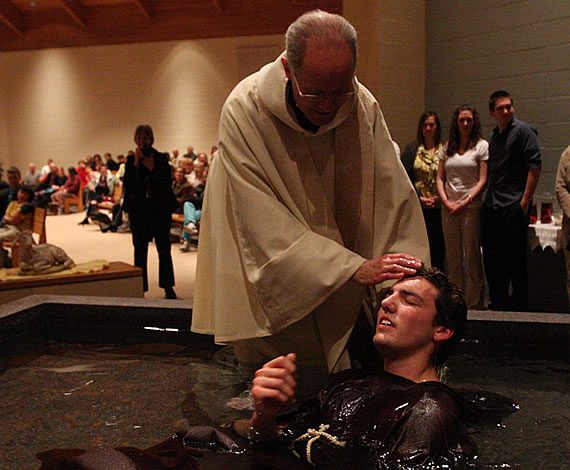
This week I was asked:
I would like to get Baptized, how do I do it?
In the Catholic Church we do it through a bit of a complicated process which we call the Rite of Christian Initiation of Adults.
You can break down the process into nine steps:
Step One: Go to your local Parish
Step Two: Find out when their next RCIA program starts
Step Three: Begin exploring the faith as you go through the period of evangelization
Step Four Go through the rite of Acceptance into the order of the catechumens
Step Five:Enter the Period of the catechumenate
Step Six Go through the Rite of the Enrollment of names
Step Seven Go through the period of purification and enlightenment
Step Eight Participate in the Celebration of the Sacraments of initiation (probably at next year’s Easter vigil)
Step Nine Go through the period of postbaptismal catechesis.
OR you can just go to a local mega Church Elevation Church and get it all done as part of the weekly performance. (NOT recommended)
So why is there such a difference between the way Catholics do it and the way some evangelicals do it?
According to the rite itself (From RCIA sections 4-9):
The initiation of catechumens is a gradual process that takes place within the community of the faithful. By joining the catechumens in reflecting on the value of the paschal mystery and by renewing their own conversion, the faithful provide an example that will help the catechumens to obey the Holy Spirit more generously. The rite of initiation is suited to a spiritual journey of adults that varies according to the many forms of God’s grace, the free cooperation of the individuals, the action of the Church, and the circumstances of time and place. This journey includes not only the periods for making inquiry and for maturing, but also the steps marking the catechumens’ progress, as they pass, so to speak, through another doorway or ascend to the next level.
- The first step: reaching the point of initial conversion and wishing to become Christians, they are accepted as catechumens by the Church.
- The second step: having progressed in faith and nearly completed the catechumenate, they are accepted into a more intense preparation for the sacraments of initiation.
- The third step: having completed their spiritual preparation, they receive the sacraments of Christian initiation.
These three steps are to be regarded as the major, more intense moments of initiation and are marked by three liturgical rites: the first by the rite of acceptance into the order of catechumens; the second by the rite of election or enrollment of names; and the third by the celebration of the sacraments of Christian initiation.
The (3) steps lead to (4) periods of inquiry and growth; alternatively the periods may also be seen as preparing for the ensuing step.
- The first period consists of inquiry on the part of the candidates and of evangelization and the precatechu-menate on the part of the Church. It ends with the rite of acceptance into the order of catechumens.
- The second period, which begins with the rite of acceptance into the order of catechumens and may last for several years, includes catechesis and the rites connected with catechesis. It comes to an end on the day of election.
- The third and much shorter period, which follows the rite of election, ordinarily coincides with the Lenten preparation for the Easter celebration and the sacraments of initiation. It is a time of purification and enlightenment and includes the celebration of the rites belonging to this period.
- The final period extends through the whole Easter season and is devoted to the postbaptismal catechesis or mystagogy. It is a time for deepening the Christian experience, for spiritual growth, and for entering more fully into the life and unity of the community.
Thus there are four continuous periods: the precatechumenate, the period for hearing the first preaching of the Gospel; the period of the catechumenate, set aside for a thorough catechesis and for the rites belonging to this period ; the period of purification and enlightenment (Lenten preparation), designed for a more intense spiritual preparation, which is assisted by the celebration of the scrutinies and presentations ; and the period of postbaptismal catechesis or mystagogy, marked by the new experience of sacraments and community.
The whole initiation must bear a markedly paschal character, since the initiation of Christians is the first sacramental sharing in Christ’s dying and rising and since, in addition, the period of purification and enlightenment ordinarily coincides with Lent and the period of postbaptismal catechesis or mystagogy with the Easter season. All the resources of Lent should be brought to bear as a more intense preparation of the elect and the Easter Vigil should be regarded as the proper time for the sacraments of initiation. Because of pastoral needs, however, the sacraments of initiation may be celebrated at other times
Previous Post

March 17, 2014
Lutheran Satire: St. Patrick's Bad analogies
Next Post
March 18, 2014 Review: God's Good World
Browse Our Archives
Select a Category Art Bible Books CCC Prayer Christmas Current Events Family Film Free Photo Fridays Humor hunger liturgical calendar liturgy Music Photos pope Prayer Prayerful Leader questions Quotes Review Saints Satire Scripture SYNOD SYNOD FOR THE FAMILY teaching Uncategorized video Weekly Round Up
Select a Month October 2026 September 2026 August 2026 July 2026 April 2026 February 2026 December 2025 November 2025 October 2025 September 2025 August 2025 July 2025 June 2025 May 2025 April 2025 February 2025 January 2025 September 2024 June 2024 May 2024 February 2024 December 2023 August 2023 May 2023 February 2023 November 2022 July 2022 June 2022 May 2022 March 2022 May 2021 April 2021 March 2021 February 2021 January 2021 September 2020 April 2020 March 2020 February 2020 January 2020 December 2019 November 2019 October 2019 August 2019 June 2019 May 2019 March 2019 January 2019 December 2018 August 2018 June 2018 April 2018 March 2018 February 2018 December 2017 November 2017 September 2017 August 2017 July 2017 June 2017 April 2017 March 2017 February 2017 December 2016 November 2016 February 2016 January 2016 November 2015 October 2015 August 2015 July 2015 June 2015 May 2015 April 2015 March 2015 February 2015 January 2015 December 2014 November 2014 October 2014 September 2014 August 2014 July 2014 June 2014 May 2014 April 2014 March 2014 February 2014 January 2014 December 2013 November 2013 October 2013 September 2013 August 2013 July 2013 June 2013 May 2013 April 2013 March 2013 February 2013 January 2013 December 2012 November 2012 October 2012 August 2012 July 2012 June 2012 May 2012 April 2012 March 2012 February 2012 January 2012 December 2011 November 2011 October 2011 September 2011 August 2011 July 2011 June 2011 May 2011 April 2011 March 2011 February 2011 January 2011 December 2010 November 2010 October 2010 September 2010 August 2010 July 2010 June 2010 May 2010 April 2010 March 2010 February 2010 January 2010 December 2009 November 2009 October 2009 September 2009 August 2009 July 2009 June 2009 April 2009 March 2009 February 2009 January 2009 October 2008 August 2008 June 2008 May 2008 April 2008 March 2008 February 2008 January 2008 December 2007 November 2007
Follow Us!
TAKE THE
Religious Wisdom Quiz
What is the name of the lake into which the beast and false prophet are thrown?
Select your answer to see how you score.
The lake of burning sulfur (lake of fire) The abyss Gehenna The outer darkness
Related posts from The Orant

What If You Are God’s Currency?
May Wendell Berry Trouble Your Thoughts Today
TRENDING AT PATHEOS Catholic

The Problem with False Prophets
Miller’s Station UMC| 10/18/26| Anchor Verse: Jeremiah 23: 1, 9-23 I...

Emotion in Early Christianity by Andrew Crislip
Andrew Crislip’s Emotion in Early Christianity examines an often overlooked dimension of...

16 Spiritual Touchstones for a More Grounded Life
After decades of spiritual study, here are 16 principles I try...

Catholic Evangelization: Sharing Your Faith Every Day
Welcome back to the Graceful Awakening mini-series called, “From Faith to Mission.” ...

The Pillar of the Boatmen: the Ancient Monument...
The Pillar of the Boatmen is a Romano-Gaulish sculpture that dates from...

In one sense walking into Westminster Abbey is like walking down the...
view all Catholic blogs
Ad-Free & Subscriber Log-In Subscription Support
- About Us
- 2026 Calendar
- Videos
- Podcasts
- Library of World Religions
- Faith In Media Tracker
- Advertise With Us
- Write for Us
- Privacy Policy
- Terms of Service
- Do Not Sell My Data
- Contact Us
- Radiant Digital
- Manage Newsletter Subscriptions
- Unsubscribe From Notifications
- Sitemap
Copyright 2008-2026, Patheos. All rights reserved.
Subscription Support Ad-Free & Subscriber Log-In
Follow Patheos