
BuddhistCatholicContemplativeEvangelicalGeneral ChristianHinduJewishLatter-day SaintMuslimNew VisionsProgressive Christian
Beliefs
- Buddhist
- Catholic
- Contemplative
- Evangelical
- General Christian
- Hindu
- Jewish
- Latter-day Saint
- More Voices
- Muslim
- New Visions
- Pagan
- Progressive Christian
Topics
- Religion News
- Food and Religion
- Sports and Religion
- Religious Art
- Religious Music and Entertainment
- Religious Events
- History and Religion
- Style and Religion
- Politics and Religion
- Women in Religion
- Recreation Outdoors and Religion
- Business Finance and Religion
- Careers Workplace and Religion
- Education and Religion
- Family Parenting and Religion
- Health Fitness and Religion
- Home and Religion
- Relationships and Religion
- Technology and Religion
- Travel and Religion
Columnists
- Buddhist Columnists
- Business Finance and Religion Columnists
- Careers Workplace and Religion Columnists
- Catholic Columnists
- Contemplative Columnists
- Education and Religion Columnists
- Evangelists Columnists
- Family Parenting and Religion Columnists
- General Christian Columnists
- Health Fitness and Religion Columnists
- Hindu Columnists
- History and Religion Columnists
- Home and Religion Columnists
- Jewish Columnists
- More Voices Columnists
- Latter Day Columnists
- Muslim Columnists
- New Visions Columnists
- Nonreligious Columnists
- Pagan Columnists
- Politics and Religion Columnists
- Progressive Columnists
- Recreation Outdoors and Religion Columnists
- Relationships and Religion Columnists
- Religion News Columnists
- Religious Art Columnists
- Religious Events Columnists
- Religious Music and Entertainment Columnists
- Sports and Religion Columnists
- Style and Religion Columnists
- Technology and Religion Columnists
- Travel and Religion Columnists
- Women in Religion Columnists
Resource Library
- 2026 Calendar
- Library of World Religions
- The 100 Most Holy Places on Earth
- Patheos Answers
- Podcasts
- Videos
- Faith Leaders Database
- Anglican Episcopalian
- Bahai
- Baptist
- Buddhism
- Christianity
- Confucianism
- Eastern Orthodoxy
- Hinduism
- Holiness and Pentecostal
- ISKCON
- Islam
- Judaism
- Lutheran
- Methodist
- The Church of Jesus Christ of Latter-day Saints
- New Age
- Paganism
- Presbytarian and Reformed
- Protestantism
- Religion Behind the Scenes
- Roman Catholic
- Scientology
- Shia Islam
- Sikhism
- Sufism
- Sunni Islam
- Taoism
- Zen
- See all religions
Research Tools
 Ad-Free & Subscriber Log-In Subscription Support
Ad-Free & Subscriber Log-In Subscription Support
Follow Patheos 

- Trending:
- Forgiveness
- |
- Marriage
- |
- Consciousness
- |
- Death Penalty
- |
- Election
- |
- Halloween

- Home
- Catholic
- Why the Huffington Post gets the Eucharist wrong
Why the Huffington Post gets the Eucharist wrong
Last updated on: December 17, 2013 at 8:59 pm by Billy Kangas
Why the Huffington Post gets the Eucharist wrong 2013-12-17T20:59:28-04:00 Billy Kangas
Patheos Explore the world's faith through different perspectives on religion and spirituality! Patheos has the views of the prevalent religions and spiritualities of the world.
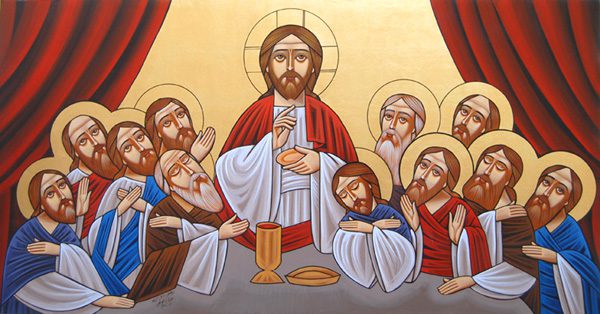 This week, Huffington Post writer James D. Tabor put out an article arguing that
It is inconceivable that Jesus would have had his followers drink a cup of wine, even symbolically, as a representation of his blood, or break bread to represent his body, sacrificed for their sins.
Since this touches a bit on a lot of my own research into the history of sacramental theology, and intertextuality within the New Testament I thought I would give the article a read and see what he had to say. It turns out his argument rests on a couple of assumptions.
1. He first interprets Paul’s transmission of the words of institution in 1 Corinthians 11:23-25 as an admission that he did not receive the words of institution from a historical source but through some kind of esoteric revelation. To which I ask, really? How do you know that? Is that really what the text says? Paul says he received the formulation “from the Lord,” is it not possible that this revelation was from the Lord through the transmission of oral tradition? Is it not also possible that he received a confirmation from the Lord of the historical transmission of the account from the apostles?
2. He them makes the formula which was received “from the Lord” was actually invented by Paul himself. It is, as he states, a revelation from “Paul alone.” To which I have to point out that it assumes that Paul did not have any historically relevant encounter with Jesus. As a Catholic I happen to believe that Jesus is risen, and I also happen to believe that it’s possible that Jesus made real living contact with the person of Paul. Even if Paul was basing the formulation only on an esoteric revelation (which I DO NOT accept) wouldn’t it still be possible that the esoteric revelation transmitted a historically accurate account?
3. The third assumption that is made is that Mark got his information from Paul. The words in Mark’s Gospel are strikingly similar to those in I Corinthians, but since Mark was written years after Paul had written his own letters Tabor assumes that Paul was the source for this tradition. To this point I have to ask, “how do you know?” Is it not possible that Mark knew these words because they were part of the life of his own community, or that he had access to an oral tradition that went back to Jesus’ life? Mark incorporates a great deal of material about Jesus’ life that is found nowhere in Paul’s letters, and is seen by most historians to be the most reliable source we have that records the life and saying of Jesus. You are willing to call that into question all because an earlier document corroborates it? This seems like a highly unstable foundation to build your argument upon.
4. A fourth assumption that is made is that Matthew and Luke all got their information from Mark. This is not a terrible assumption, most (but not all) scholars believe that Mark was used by both Matthew and Luke in the composition of their Gospels. I would highlight, however, that these were also accounts that were written within the context of a worshiping community that probably would have had their own traditions surrounding the gathering together and the breaking of bread that would have gone back to the earliest years of the Church. The way I see it is the use of this tradition is evidence that the Gospel writers and their communities had a similar tradition about this event and found that Mark corroborates closely with them.
5. The fifth assumption is made that since John didn’t include the Words of institution he didn’t believe the event actually happened. John had his own project that, in my opinion, was much less about preserving an accurate historical timeline and much more about presenting a theological framework within the structures of the Jewish festive cycle and a reimagining of God’s work of creation in light of the advent and resurrection of the Lord. There is a great deal that John does not include from the synoptics (Matthew, Mark, and Luke). Are we to allow this much later, and less historically focused project to govern our earlier sources? I hope not.
6. The sixth assumption that is made is that the Didache’s failure to include the Institution narrative in its anaphora means that the institution narrative never happened. There are liturgical formulations, even today, which do not contain the words of institution (Addai and Mari) but these communities affirm 100% that Jesus said the words as recoded in the gospels. This is another example of taking a later source, which in no way makes any claims about transmitting the life of Jesus, and using it to call into doubt earlier sources that explicitly claim to be transmissions of Jesus’ life.
7. He also assumes that Luke’s Cup-Bread-Cup pattern (rather than the Bread-Cup Pattern in Mark, Matthew, and 1 Corinthians) comes from 2 sources merged together. This is an odd assumption to make given that the ceremony that Jesus is said to be celebrating (the Passover) also has a Cup-Bread-Cup pattern. Might Luke have been adapting, or adding additional details? It’s certainly possible.
8. He assumes that the Cup-Bread-Cup pattern came from another source. This may or may not be true. It’s possible that Luke added this pattern on his own, or even changed things to fit the pattern that had emerged in his own community. There is no reason to be certain that this anomaly is from another source, or that if there was another source involved that it has any more historical reliability than what has actually been transmitted in the Gospels.
9. He assumes that Luke is being influenced by Q and that Q is a source with no influence by Paul, and it is a more accurate transmission of the saying of Jesus. That seems to assume a great deal given that Q is a purely hypothetical construction that is still highly controversial in the world of Biblical scholars.
10. He assumes that Luke’s hypothetical other source understood the last supper as a “Messianic Banquet” as described in the Dead sea Scrolls. The evidence for this is weak weak weak, and I don’t see a single citation. There are at least a dozen theories about what Jesus was doing here. The fact that Tabor picks this highly controversial source to describe a hypothetical document’s theological framework is such a stretch it boggles my mind. It demonstrates a sensationalist hermeneutic which undercuts the rest of the argument completely. Sloppy!
11. He assumes that Paul reimagined the Last supper through a Hellenistic cosmology. Seeing it modeled after the ritual participation with Osiris in a magical consecration of his blood to transmit the power of his love for Isis into the participant, turning the last supper into a new pagan mystery feast disconnected from the historical events of Jesus life. At this point in the article has officially jumped the shark. This is unadulterated speculation to the highest degree. There is little evidence for this that I am aware of.
12. He assumes that because the Israelites were forbidden in Torah to eat the blood of the animal that Jesus’ would not have had his followers drink his blood. The reason they were not to drink the blood was a belief that the life of the creature was in the blood (Leviticus 17:11). Is it possible that Jesus was actually using that tradition to help him communicate with His disciples the reality of his sacramental participation with them in the Eucharist? Perhaps not, but I like to think of it that way.
A final reflection:
The New Testament is a tricky document. It’s about a person who lived decades before most of the books themselves were written. It represents the perspectives from a number of various traditions and voices. Any close reflection on what the text is doing has to peel back layers of social context, cultural motifs, inherited assumptions, vague grammar, ambiguous redactional decisions, textual variances, structural frameworks, narrative constructions, theological principles, and their own social and cultural location. Scholars have sought repeatedly to peel back the layers of the text to get at the historical Jesus and I have found these quests to be fascinating and very useful personally. However, one must always be aware that these quests have always been tainted with an inescapable subjectivity. George Tyrell, put it well when he noted that each scholar who has sought to find the historical Jesus looked down the long well of history and saw his own face reflected at the bottom. In other words trying to get at the man behind the text seems to always reveal a man who looks and thinks a great deal like the one who seeks to uncover him. What we are left with is scripture and the Tradition of the Church. Both of these sources seem to testify that Jesus commanded his disciples to eat and drink his body and blood when they gathered and broke bread and drank wine. Perhaps I am just a man of simple faith, but I believe them.
Previous Post

December 13, 2013
Question Friday: What is the Best Bible Study program on the Market?
Next Post
December 17, 2013 An open letter to Radio Stations in December
Browse Our Archives
Select a Category Art Bible Books CCC Prayer Christmas Current Events Family Film Free Photo Fridays Humor hunger liturgical calendar liturgy Music Photos pope Prayer Prayerful Leader questions Quotes Review Saints Satire Scripture SYNOD SYNOD FOR THE FAMILY teaching Uncategorized video Weekly Round Up
Select a Month October 2026 September 2026 August 2026 July 2026 April 2026 February 2026 December 2025 November 2025 October 2025 September 2025 August 2025 July 2025 June 2025 May 2025 April 2025 February 2025 January 2025 September 2024 June 2024 May 2024 February 2024 December 2023 August 2023 May 2023 February 2023 November 2022 July 2022 June 2022 May 2022 March 2022 May 2021 April 2021 March 2021 February 2021 January 2021 September 2020 April 2020 March 2020 February 2020 January 2020 December 2019 November 2019 October 2019 August 2019 June 2019 May 2019 March 2019 January 2019 December 2018 August 2018 June 2018 April 2018 March 2018 February 2018 December 2017 November 2017 September 2017 August 2017 July 2017 June 2017 April 2017 March 2017 February 2017 December 2016 November 2016 February 2016 January 2016 November 2015 October 2015 August 2015 July 2015 June 2015 May 2015 April 2015 March 2015 February 2015 January 2015 December 2014 November 2014 October 2014 September 2014 August 2014 July 2014 June 2014 May 2014 April 2014 March 2014 February 2014 January 2014 December 2013 November 2013 October 2013 September 2013 August 2013 July 2013 June 2013 May 2013 April 2013 March 2013 February 2013 January 2013 December 2012 November 2012 October 2012 August 2012 July 2012 June 2012 May 2012 April 2012 March 2012 February 2012 January 2012 December 2011 November 2011 October 2011 September 2011 August 2011 July 2011 June 2011 May 2011 April 2011 March 2011 February 2011 January 2011 December 2010 November 2010 October 2010 September 2010 August 2010 July 2010 June 2010 May 2010 April 2010 March 2010 February 2010 January 2010 December 2009 November 2009 October 2009 September 2009 August 2009 July 2009 June 2009 April 2009 March 2009 February 2009 January 2009 October 2008 August 2008 June 2008 May 2008 April 2008 March 2008 February 2008 January 2008 December 2007 November 2007
Follow Us!
TAKE THE
Religious Wisdom Quiz
What is the largest Oriental Orthodox church by population?
Select your answer to see how you score.
Armenian Apostolic Ethiopian Orthodox Syriac Orthodox Coptic Orthodox
Related posts from The Orant

Embracing The Prayer Book of Jesus

Questions Friday: How do I read the Old...

What If You Are God’s Currency?
TRENDING AT PATHEOS Catholic

The Pillar of the Boatmen: the Ancient Monument...
The Pillar of the Boatmen is a Romano-Gaulish sculpture that dates from...

In one sense walking into Westminster Abbey is like walking down the...

'Super Scam Me' Exposes AI Jon Bon Jovi...
Leslie Pickett believed she was in a relationship with Jon Bon Jovi....

The Brazilian Remake of Kendricks' 'Flywheel' Opens in...
“Flywheel,” the story that launched the Kendrick Brothers’ filmmaking career is getting...

The Dangers of Gradual Accommodation (Winking at Sin)
Recently, the “law of gradualness” resurfaced during the opening of a weeklong,...

The Iron Gates and the Lion of the...
Yesterday, I didn't finish my report about, well, yesterday. So I'll...
view all Catholic blogs
Ad-Free & Subscriber Log-In Subscription Support
- About Us
- 2026 Calendar
- Videos
- Podcasts
- Library of World Religions
- Faith In Media Tracker
- Advertise With Us
- Write for Us
- Privacy Policy
- Terms of Service
- Do Not Sell My Data
- Contact Us
- Radiant Digital
- Manage Newsletter Subscriptions
- Unsubscribe From Notifications
- Sitemap
Copyright 2008-2026, Patheos. All rights reserved.
Subscription Support Ad-Free & Subscriber Log-In
Follow Patheos