
BuddhistCatholicContemplativeEvangelicalGeneral ChristianHinduJewishLatter-day SaintMuslimNew VisionsProgressive Christian
Beliefs
- Buddhist
- Catholic
- Contemplative
- Evangelical
- General Christian
- Hindu
- Jewish
- Latter-day Saint
- More Voices
- Muslim
- New Visions
- Pagan
- Progressive Christian
Topics
- Religion News
- Food and Religion
- Sports and Religion
- Religious Art
- Religious Music and Entertainment
- Religious Events
- History and Religion
- Style and Religion
- Politics and Religion
- Women in Religion
- Recreation Outdoors and Religion
- Business Finance and Religion
- Careers Workplace and Religion
- Education and Religion
- Family Parenting and Religion
- Health Fitness and Religion
- Home and Religion
- Relationships and Religion
- Technology and Religion
- Travel and Religion
Columnists
- Buddhist Columnists
- Business Finance and Religion Columnists
- Careers Workplace and Religion Columnists
- Catholic Columnists
- Contemplative Columnists
- Education and Religion Columnists
- Evangelists Columnists
- Family Parenting and Religion Columnists
- General Christian Columnists
- Health Fitness and Religion Columnists
- Hindu Columnists
- History and Religion Columnists
- Home and Religion Columnists
- Jewish Columnists
- More Voices Columnists
- Latter Day Columnists
- Muslim Columnists
- New Visions Columnists
- Nonreligious Columnists
- Pagan Columnists
- Politics and Religion Columnists
- Progressive Columnists
- Recreation Outdoors and Religion Columnists
- Relationships and Religion Columnists
- Religion News Columnists
- Religious Art Columnists
- Religious Events Columnists
- Religious Music and Entertainment Columnists
- Sports and Religion Columnists
- Style and Religion Columnists
- Technology and Religion Columnists
- Travel and Religion Columnists
- Women in Religion Columnists
Resource Library
- 2026 Calendar
- Library of World Religions
- The 100 Most Holy Places on Earth
- Patheos Answers
- Podcasts
- Videos
- Faith Leaders Database
- Anglican Episcopalian
- Bahai
- Baptist
- Buddhism
- Christianity
- Confucianism
- Eastern Orthodoxy
- Hinduism
- Holiness and Pentecostal
- ISKCON
- Islam
- Judaism
- Lutheran
- Methodist
- The Church of Jesus Christ of Latter-day Saints
- New Age
- Paganism
- Presbytarian and Reformed
- Protestantism
- Religion Behind the Scenes
- Roman Catholic
- Scientology
- Shia Islam
- Sikhism
- Sufism
- Sunni Islam
- Taoism
- Zen
- See all religions
Research Tools
 Ad-Free & Subscriber Log-In Subscription Support
Ad-Free & Subscriber Log-In Subscription Support
Follow Patheos 

- Trending:
- Forgiveness
- |
- Marriage
- |
- Consciousness
- |
- Death Penalty
- |
- Election
- |
- Halloween

- Home
- Evangelical
- Education and Religion
- Rethinking the Garden of Eden
Rethinking the Garden of Eden
Last updated on: August 30, 2026 at 1:32 am by Ben Witherington
Rethinking the Garden of Eden 2026-08-19T21:37:07-04:00 Ben Witherington
Patheos Explore the world's faith through different perspectives on religion and spirituality! Patheos has the views of the prevalent religions and spiritualities of the world.
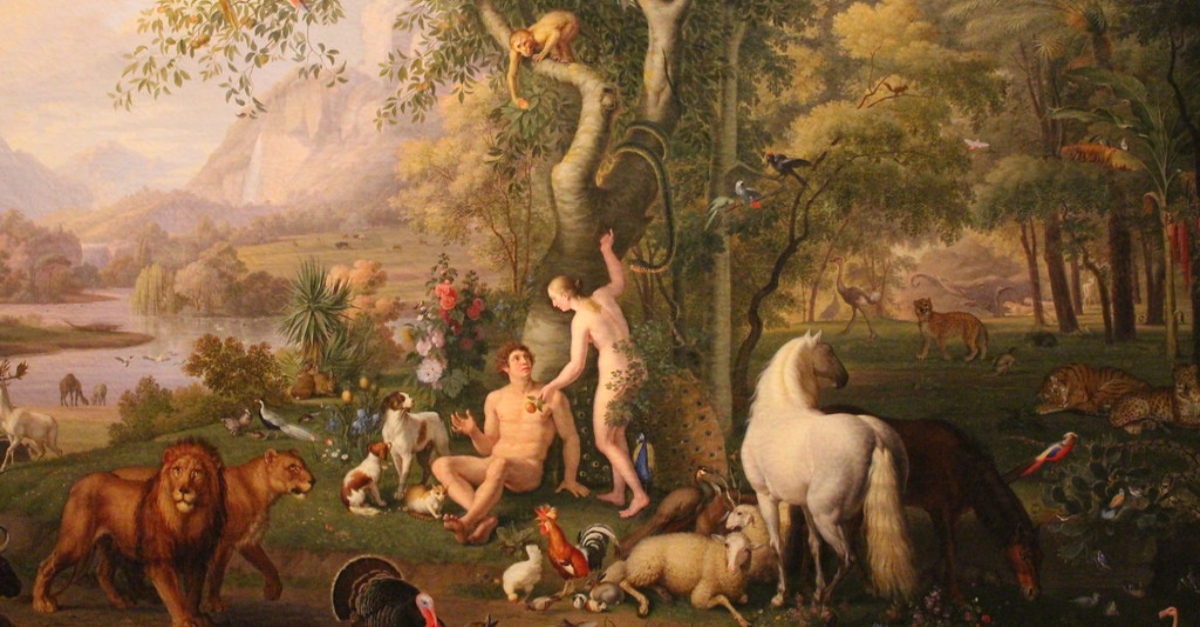
First things first— the Hebrew word גן means garden, and refers to a safe enclosure. Add the word עדן to it, and the overtone is of a pleasurable place, a garden of earthly delights—the garden of Eden. Now nothing at all in these words, nor in the story we are reflecting on in Gen. 2-3 suggests either the idea of a Temple, or the notion that Eden was a place where God took up residence. Nothing at all. The description of the place with its connection to four rivers, and the intimation it was a verdant place with trees bearing fruit, certainly suits the word garden… but not a temple, despite the recent popularity of talking about the garden also being a temple for God. Let’s take a moment and listen again to the old old story.
“Now the Lord God had planted a garden in the east, in Eden; and there he put the man he had formed. 9 The Lord God made all kinds of trees grow out of the ground—trees that were pleasing to the eye and good for food. In the middle of the garden were the tree of life and the tree of the knowledge of good and evil…. 15 The Lord God took the man and put him in the Garden of Eden to work it and take care of it. 16 And the Lord God commanded the man, “You are free to eat from any tree in the garden; 17 but you must not eat from the tree of the knowledge of good and evil, for when you eat from it you will certainly die.”
18 The Lord God said, “It is not good for the man to be alone. I will make a helper suitable for him.”
19 Now the Lord God had formed out of the ground all the wild animals and all the birds in the sky. He brought them to the man to see what he would name them; and whatever the man called each living creature, that was its name. 20 So the man gave names to all the livestock, the birds in the sky and all the wild animals.
But for Adam no suitable helper was found. 21 So the Lord God caused the man to fall into a deep sleep; and while he was sleeping, he took one of the man’s ribs[ and then closed up the place with flesh. 22 Then the Lord God made a woman from the rib he had taken out of the man, and he brought her to the man.
23 The man said,
“This is now bone of my bones
and flesh of my flesh;
she shall be called ‘woman,’
for she was taken out of man.”
24 That is why a man leaves his father and mother and is united to his wife, and they become one flesh.
25 Adam and his wife were both naked, and they felt no shame.”
The picture here is of a paradise of sorts, which God created for humans, and as the text says God deliberately put ‘the man’ in this garden to work it, and to take care of it. He is also given the job of naming the animals, which seems to be an act of his taking power or authority over them, and as commentators have suggested, Adam could not find a suitable mate among the animals, as they were different sorts of creatures, creatures not created in God’s image, and so God made a mate out of parts of the man himself. Only one commandment had been given to Adam (and notice Eve was not there when the commandment was given).
The story takes a negative turn in Gen. 3 as follows, and so far nothing in the story suggests Adam is being groomed to be a priest, rather he is being given the task of being a gardener, and perhaps a sort of park ranger where animals were, but mainly he was to work the garden. Here is the rest of this sad story….
Now the serpent was more crafty than any of the wild animals the LordGod had made. He said to the woman, “Did God really say, ‘You must not eat from any tree in the garden’?”
2 The woman said to the serpent, “We may eat fruit from the trees in the garden, 3 but God did say, ‘You must not eat fruit from the tree that is in the middle of the garden, and you must not touch it, or you will die.’”
4 “You will not certainly die,” the serpent said to the woman. 5 “For God knows that when you eat from it your eyes will be opened, and you will be like God, knowing good and evil.”
6 When the woman saw that the fruit of the tree was good for food and pleasing to the eye, and also desirable for gaining wisdom, she took some and ate it. She also gave some to her husband, who was with her, and he ate it. 7 Then the eyes of both of them were opened, and they realized they were naked; so they sewed fig leaves together and made coverings for themselves.
8 Then the man and his wife heard the sound of the Lord God as he was walking in the garden in the cool of the day, and they hid from the Lord God among the trees of the garden. 9 But the Lord God called to the man, “Where are you?”
10 He answered, “I heard you in the garden, and I was afraid because I was naked; so I hid.”
11 And he said, “Who told you that you were naked? Have you eaten from the tree that I commanded you not to eat from?”
12 The man said, “The woman you put here with me—she gave me some fruit from the tree, and I ate it.”
13 Then the Lord God said to the woman, “What is this you have done?”
The woman said, “The serpent deceived me, and I ate.”
14 So the Lord God said to the serpent, “Because you have done this,
“Cursed are you above all livestock
and all wild animals!
You will crawl on your belly
and you will eat dust
all the days of your life.
15 And I will put enmity
between you and the woman,
and between your offspring[a] and hers;
he will crush[b] your head,
and you will strike his heel.”
16 To the woman he said,
“I will make your pains in childbearing very severe;
with painful labor you will give birth to children.
Your desire will be for your husband,
and he will rule over you.”
17 To Adam he said, “Because you listened to your wife and ate fruit from the tree about which I commanded you, ‘You must not eat from it,’
“Cursed is the ground because of you;
through painful toil you will eat food from it
all the days of your life.
18 It will produce thorns and thistles for you,
and you will eat the plants of the field.
19 By the sweat of your brow
you will eat your food
until you return to the ground,
since from it you were taken;
for dust you are
and to dust you will return.”
20 Adam[c] named his wife Eve,[d] because she would become the mother of all the living.
21 The Lord God made garments of skin for Adam and his wife and clothed them. 22 And the Lord God said, “The man has now become like one of us, knowing good and evil. He must not be allowed to reach out his hand and take also from the tree of life and eat, and live forever.” 23 So the Lord God banished him from the Garden of Eden to work the ground from which he had been taken. 24 After he drove the man out, he placed on the east side[e]of the Garden of Eden cherubim and a flaming sword flashing back and forth to guard the way to the tree of life.”
Is there anything here which suggests the garden is a temple where God dwells? No indeed. God shows up in the garden to confront Adam and Eve after they have disobeyed, and severed their relationship. Adam and Eve become self-aware, self-conscious, self-centered, self-protective and ashamed, so ashamed they are running and hiding from God. One of the implicit aspects of the story is that Eve, not being present when the commandment was given by God, must have learned it from Adam, an Adam who was right there with her when the serpent tempted her, and could have corrected her misrepresentation which involves her saying if you touch the forbidden fruit you will die. Notice as well that there are three things Eve saw that she liked about the fruit— it was pleasing to the eye, it was desirable for food, and for gaining not merely knowledge but wisdom, and she wants these things. All is well at this juncture, until human desires come into the picture— we are told that Eve saw the forbidden fruit as pleasing to the eye, good for food, but more importantly ‘desirable’ for wisdom. Those who know their Hebrew know that the word ‘yada’ translated knowledge or know as a verb, can certainly mean ‘experience’—as in Adam knew Eve. It was the experience of good and evil that was the result of sin.
As I said, Adam was right there with his suitable helper and yet he says nothing, he does not correct her, nor does he turn down the fruit when she hands it to him— he too of his own volition eats of the fruit as well, ‘and their eyes were opened’. This is why in later tradition like in Rom. 5.12-21 Adam is mainly blamed for sin entering the world. He received the commandment and not only did he not correctly teach it and its implications to Eve, he did not put a stop of her giving in to temptation, he participated freely and willing to the tragedy. They gained knowledge alright but the wrong sort of knowledge, a self-centered -self-conscious sort of knowledge. Indeed, their hearts turned in upon themselves. And we learn that they must be expelled from the garden lest they eat of the tree of life and then live forever. Notice that they were not immortal before this juncture. Rather they were all too mortal, and the part of them that experiences death is not the physical self, but their spiritual life— spiritually they die. They are no longer in communion with God the very source of all life.
In the Genesis account in Gen. 1-3 no temple is mentioned, and at least before Adam and Eve sinned, there was no need for one. Humans were not yet sinners. Indeed, if we back up to the beginning of Gen. 1, God is depicted as dwelling somewhere entirely outside of the creation which he brings into being. Note that it is only after Adam and Eve sin that we hear about God’s voice in the garden and that the couple seeks to hide from God, as he is coming after them to confront them about their sin. They were right to be afraid, for God was indeed the Holy One, and they were not in a holy condition any more.
While it is certainly is true that temples were viewed in the ANE as the locus where there was the divine presence of a deity, it is also true that the function of having a designated set apart space for the deity, was precisely because God or a god was viewed ‘as holy other’ and considering the nature of humans, there was danger in coming to close to a deity. Remember poor Uzzah.
What about the notion that Adam and Eve were given priestly roles in Eden? Really? The command given them was to fill the earth and subdue it— that is like God they were to be mini-creators and mini-rulers of the earth. These are not the roles of priests. Ironically, we hear nothing about sacrifices until the humans have been expelled from the garden, and considerably later we hear the tale of Cain and Abel’s sacrifices seeking to honor or curry favor with God, an understandable exercise by someone who is alienated from God and seeking to get back in good standing.
What about the supposed similarity between this story and the story of the new creation, the new Jerusalem in Rev. 21-22? First of all note that in the new Jerusalem there is no temple, rather God the Father and the Son come to dwell with their people. There is no need for a temple there because there is no need to separate the holy from the unholy any more. The commandment ‘be ye holy as I am holy’ has been fulfilled in the new creation. Temples are meant to allow God to be near his sinful people, but also to protect them from the consequences of encountering the Holy One in a less than perfect human state.
In short there was no need for a temple in Eden or in the New Jerusalem, but as the creation story in Gen. 1 makes clear, the dwelling place of the Creator of all creation was outside the material universe to begin with, where God and his heavenly council dwelt, which is who ‘the us’ in the phrase ‘let us’ refers to. Enough said.
Education and Religion
History and Religion
Previous Post
August 24, 2026
Lazarus Come Forth
Next Post
September 2, 2026 Early Christian Theology. A History-- by J. Warren Smith
Browse Our Archives
Select a Category Uncategorized
Select a Month October 2026 September 2026 August 2026 July 2026 June 2026 May 2026 April 2026 March 2026 February 2026 January 2026 December 2025 November 2025 October 2025 September 2025 August 2025 July 2025 June 2025 May 2025 April 2025 March 2025 February 2025 January 2025 December 2024 November 2024 October 2024 September 2024 August 2024 July 2024 June 2024 May 2024 April 2024 March 2024 February 2024 January 2024 December 2023 November 2023 October 2023 September 2023 August 2023 July 2023 June 2023 May 2023 April 2023 March 2023 February 2023 January 2023 December 2022 November 2022 October 2022 September 2022 August 2022 July 2022 June 2022 May 2022 April 2022 March 2022 February 2022 January 2022 December 2021 November 2021 October 2021 September 2021 August 2021 July 2021 June 2021 May 2021 April 2021 March 2021 February 2021 January 2021 December 2020 November 2020 October 2020 September 2020 August 2020 July 2020 June 2020 May 2020 April 2020 March 2020 February 2020 January 2020 December 2019 November 2019 October 2019 September 2019 August 2019 July 2019 June 2019 May 2019 April 2019 March 2019 February 2019 January 2019 December 2018 November 2018 October 2018 September 2018 August 2018 July 2018 June 2018 May 2018 April 2018 March 2018 February 2018 January 2018 December 2017 November 2017 October 2017 September 2017 August 2017 July 2017 June 2017 May 2017 April 2017 March 2017 February 2017 January 2017 December 2016 November 2016 October 2016 September 2016 August 2016 July 2016 June 2016 May 2016 April 2016 March 2016 February 2016 January 2016 December 2015 November 2015 October 2015 September 2015 August 2015 July 2015 June 2015 May 2015 April 2015 March 2015 February 2015 January 2015 December 2014 November 2014 October 2014 September 2014 August 2014 July 2014 June 2014 May 2014 April 2014 March 2014 February 2014 January 2014 December 2013 November 2013 October 2013 September 2013 August 2013 July 2013 June 2013 May 2013 April 2013 March 2013 February 2013 January 2013 December 2012 November 2012 October 2012 September 2012 August 2012 July 2012 June 2012 May 2012 April 2012 March 2012 February 2012 January 2012 December 2011 November 2011 October 2011 September 2011 August 2011 July 2011 June 2011 May 2011 April 2011 March 2011 February 2011 January 2011
Follow Us!
TAKE THE
Religious Wisdom Quiz
I am an offering without defect, completely burned on the altar as a pleasing aroma to the Lord. What am I?
Select your answer to see how you score.
A grain offering A burnt offering A sin offering A peace offering
Books by This Author Books by Ben Witherington
Related posts from The Bible and Culture


The British Library-- Part Two
The British Library-- Part One
TRENDING AT PATHEOS Evangelical

I was strolling through the top floor of the brand new Parthenon...

What Does Gêvâh Mean For Kimberley Guifoyle &...
This week, a lot of the news is focused on Kimberly Guilfoyle....

INNER CIRCLE: Profound Mystery (Of Christ In All...
Ephesians 5:31-32 “For this reason, a man will leave his father and...

Do Not Rejoice When Your Enemy Falls: The...
Turning an execution into a public spectacle is a disturbing expression of...

'The Chosen' S6 Trailer: The Passion Gets Very...
Not many watching 'The Chosen' worry about spoilers, but just because they...

The purpose-driven labor priest
A labor activist reads Rick Warren and it gets me wondering about...
view all Evangelical blogs
Ad-Free & Subscriber Log-In Subscription Support
- About Us
- 2026 Calendar
- Videos
- Podcasts
- Library of World Religions
- Faith In Media Tracker
- Advertise With Us
- Write for Us
- Privacy Policy
- Terms of Service
- Do Not Sell My Data
- Contact Us
- Radiant Digital
- Manage Newsletter Subscriptions
- Unsubscribe From Notifications
- Sitemap
Copyright 2008-2026, Patheos. All rights reserved.
Subscription Support Ad-Free & Subscriber Log-In
Follow Patheos