
BuddhistCatholicContemplativeEvangelicalGeneral ChristianHinduJewishLatter-day SaintMuslimNew VisionsProgressive Christian
Beliefs
- Buddhist
- Catholic
- Contemplative
- Evangelical
- General Christian
- Hindu
- Jewish
- Latter-day Saint
- More Voices
- Muslim
- New Visions
- Pagan
- Progressive Christian
Topics
- Religion News
- Food and Religion
- Sports and Religion
- Religious Art
- Religious Music and Entertainment
- Religious Events
- History and Religion
- Style and Religion
- Politics and Religion
- Women in Religion
- Recreation Outdoors and Religion
- Business Finance and Religion
- Careers Workplace and Religion
- Education and Religion
- Family Parenting and Religion
- Health Fitness and Religion
- Home and Religion
- Relationships and Religion
- Technology and Religion
- Travel and Religion
Columnists
- Buddhist Columnists
- Business Finance and Religion Columnists
- Careers Workplace and Religion Columnists
- Catholic Columnists
- Contemplative Columnists
- Education and Religion Columnists
- Evangelists Columnists
- Family Parenting and Religion Columnists
- General Christian Columnists
- Health Fitness and Religion Columnists
- Hindu Columnists
- History and Religion Columnists
- Home and Religion Columnists
- Jewish Columnists
- More Voices Columnists
- Latter Day Columnists
- Muslim Columnists
- New Visions Columnists
- Nonreligious Columnists
- Pagan Columnists
- Politics and Religion Columnists
- Progressive Columnists
- Recreation Outdoors and Religion Columnists
- Relationships and Religion Columnists
- Religion News Columnists
- Religious Art Columnists
- Religious Events Columnists
- Religious Music and Entertainment Columnists
- Sports and Religion Columnists
- Style and Religion Columnists
- Technology and Religion Columnists
- Travel and Religion Columnists
- Women in Religion Columnists
Resource Library
- 2026 Calendar
- Library of World Religions
- The 100 Most Holy Places on Earth
- Patheos Answers
- Podcasts
- Videos
- Faith Leaders Database
- Anglican Episcopalian
- Bahai
- Baptist
- Buddhism
- Christianity
- Confucianism
- Eastern Orthodoxy
- Hinduism
- Holiness and Pentecostal
- ISKCON
- Islam
- Judaism
- Lutheran
- Methodist
- The Church of Jesus Christ of Latter-day Saints
- New Age
- Paganism
- Presbytarian and Reformed
- Protestantism
- Religion Behind the Scenes
- Roman Catholic
- Scientology
- Shia Islam
- Sikhism
- Sufism
- Sunni Islam
- Taoism
- Zen
- See all religions
Research Tools
 Ad-Free & Subscriber Log-In Subscription Support
Ad-Free & Subscriber Log-In Subscription Support
Follow Patheos 

- Trending:
- Forgiveness
- |
- Marriage
- |
- Consciousness
- |
- Death Penalty
- |
- Election
- |
- Halloween

- Home
- Evangelical
- Education and Religion
- New Article on the Dig at Colossae
New Article on the Dig at Colossae
Last updated on: July 13, 2026 at 1:04 am by Ben Witherington
New Article on the Dig at Colossae 2026-07-10T08:08:12-04:00 Ben Witherington
Patheos Explore the world's faith through different perspectives on religion and spirituality! Patheos has the views of the prevalent religions and spiritualities of the world.
[This article courtesy of BAR, whom I am a columnist for]
BIBLE HISTORY DAILY
Colossae: A Biblical City of the Classical World
BHD interviews excavation director Barış Yener
Lauren K. McCormick July 10, 2026 0 Comments 46 views Share

The mound of Colossae in the Lycus Valley of western Turkey. Photo courtesy Barış Yener.
Colossae is an ancient city in the Lycus Valley of western Turkey, near the modern town of Honaz and the ancient cities of Laodicea and Hierapolis. Together, the three cities form a distinct cluster of early Christian communities that appear repeatedly in Paul’s letters, for example in his letter to the Colossians. Herodotus describes Colossae as a great city in Phrygia, and Xenophon mentions it as large and prosperous. Despite its significance, Colossae remains one of the most under-excavated major sites in the New Testament world. Excavations are now underway under the direction of Barış Yener of Pamukkale University, bringing the promise of exciting finds from one of earliest Christianity’s most important communities.

Barış Yener, director of excavations at Colossae. Photo courtesy Barış Yener.
Where is Colossae and why is it important?
Yener: Colossae is located in modern western Turkey, in the ancient region of western Phrygia, positioned along the natural corridor that connects the central Anatolian plateau with the Aegean coast. The site lies near modern Honaz in Denizli Province and is situated within the same cultural and geographical landscape as major archaeological centers such as Hierapolis, Laodicea, Tripolis, and Aphrodisias. This strategic location made Colossae an important urban settlement embedded in long-standing networks of cultural exchange and economic interaction from the eighth century BCE to the 15th century CE.
Phrygia was one of the major cultural and political landscapes of inland Anatolia during the early first millennium BCE. Its best-known center was Gordion, the capital of the Phrygian kingdom and the city associated with the historical and legendary figure of King Midas. Archaeological research at Gordion has revealed monumental architecture, elite tumulus burials, fortifications, and a distinctive material culture that demonstrates the political and economic strength of Phrygian society, especially during the eighth century BCE. Phrygia was also renowned for its rock-cut sanctuaries and religious traditions connected with the mother goddess Matar, later widely associated with Cybele. Within this broader Phrygian milieu, Colossae occupied an important position in the Lycus Valley, where routes, resources, and traditions from central Anatolia and the Aegean world intersected over many centuries.
Colossae’s significance today derives from its exceptional state of preservation and its almost completely unexplored archaeological character. Because no large classical temple or other monumental structure survives above ground, the city did not attract systematic archaeological investigation for many decades. Aerial and satellite imagery reveal that the urban area is unusually free of dense vegetation and modern construction. The buildings are not visible above ground, but the buried remains are relatively easy to detect and excavate, making Colossae an ideal site for comprehensive archaeological work.
A new research initiative began in 2021 with the Colossae Archaeological Survey, which focused on mapping, remote sensing, geophysical prospection, the study of surface finds, and the development of a long-term conservation strategy. Building on the results of this survey, we have now begun full-scale excavations, opening an entirely new phase of scientific investigation at a site that has remained untouched for millennia.
For these reasons, Colossae represents one of the most promising archaeological resources in Anatolia—an exceptionally preserved ancient city whose systematic exploration has only just begun, offering the potential to transform our understanding of western Phrygian cultural history.
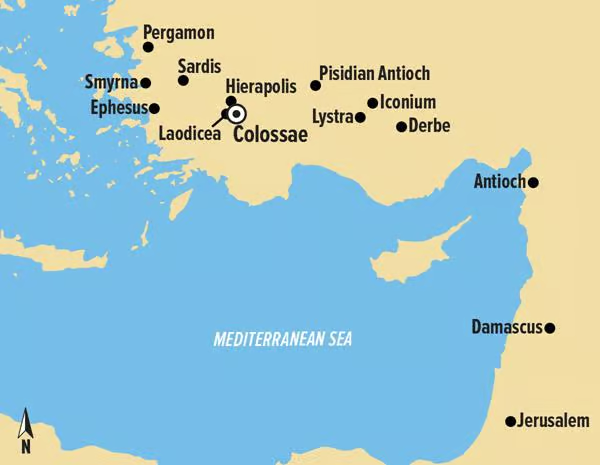
Map showing location of Colossae and other major sites of western Anatolia. Courtesy BAS.
Why has Colossae’s archaeology received so little attention?
Yener: Although interest in the site began in the early 19th century with the visits of European travelers, Colossae never developed into a sustained focus of archaeological research. For centuries the mound served largely as a convenient local quarry, and much of its stone was removed for construction, agriculture, or lime production. The studies that did take place—by William Calder in 1933, James Mellaart in the 1950s, Ebru Parman in the late 1990s, and the pottery survey of Duman and Konakçı in 2005—were all short, targeted inspections rather than comprehensive excavations.
In essence, Colossae was overshadowed by its neighbors. Archaeologists focused on the visually impressive centers of the Lycus Valley—Hierapolis, Laodicea, and Aphrodisias—where monumental architecture stands prominently above ground. Colossae, by contrast, presents no surviving classical temple, theater, or other large-scale structure to attract early attention. To many researchers, the site seemed unremarkable: a low, eroded mound without obvious architectural remains. As a result, Colossae remained on the periphery of academic interest despite its historical importance.
Why did you decide to begin excavating the site?
Yener: Precisely because it had been overlooked. Colossae represents one of the last major unexcavated ancient cities of western Anatolia, and this absence of prior disturbance provides an unparalleled scientific opportunity. Our survey work, begun in 2021, demonstrated that the site is exceptionally well preserved below the surface and largely untouched by modern construction. Remote sensing and detailed field observations revealed a dense pattern of subsurface structures, funerary zones, and extensive surface material that had never been documented systematically.
In addition, Colossae’s position in western Phrygia—a cultural borderland where Anatolian, Persian, Greek, Roman, Jewish, and early Christian traditions intersected—makes it uniquely valuable for understanding the social and religious history of the region. The chance to investigate a scientifically unexplored city mentioned in classical texts, Hellenistic geopolitical narratives, and New Testament writings, is extremely rare.
Our goal is to uncover the city’s urban layout, mortuary practices, and cultural dynamics and to integrate Colossae into the broader archaeological narrative of Anatolia, where it has long been absent.
What are some of the key research questions you’re hoping the excavations can address? What periods are you particularly interested in exploring?
Yener: Our excavation aims to answer several fundamental questions about the long-term history of Colossae, from its earliest occupation to its transformation in the Middle Ages. One of our priorities is to clarify the city’s beginnings. The presence of late Chalcolithic pottery indicates that the landscape was inhabited much earlier than expected. We hope to understand how Colossae emerged as a stable settlement in the late third millennium BCE and how it connected inland Phrygia with the coastal regions of western Anatolia.
We are also interested in the early Iron Age, when Colossae is described by Herodotus and Xenophon as one of Phrygia’s major cities. The archaeological evidence for this prominence has never been explored, and our work seeks to illuminate processes of identity formation in a region shaped by both Anatolian political traditions and the cultural movements associated with the so-called Ionian migration.
Another major focus is the Achaemenid period, during which Colossae stood on the route of imperial armies and directly within the conflict zone between Persia and the Greek world. Although textual sources highlight its importance, the material record remains largely unknown.
For the Roman and late antique periods, we are interested in reassessing the narrative of decline. Evidence suggests that civic life continued well into the imperial centuries, and the city’s role within the early Christian landscape of the Lycus Valley remains poorly understood. This includes the long-debated but still undiscovered Church of St. Michael, a structure central to later Byzantine tradition. Locating material traces of this shrine—whether in the ancient city or the medieval settlement above it—is one of the most intriguing goals of our project.
Finally, we aim to explain why the population ultimately abandoned the ancient city and relocated to the fortified hilltop of Chonai, a dramatic shift rarely examined archaeologically.
What has archaeology revealed about the Jewish and early Christian communities of Colossae?
Yener: The excavation is still in its very early stages. In 2025, our first season of fieldwork focused primarily on the northern necropolis, which we now understand to be a Roman-period cemetery. Because of this, the archaeological evidence for Jewish and early Christian communities at Colossae is still quite limited.
To answer this question with real precision, we will need to wait for the upcoming excavation seasons. As we begin to open larger areas of the ancient city—especially the urban center and the late antique/early Byzantine levels—we expect to uncover far more substantial information about the presence and activities of both communities. The groundwork has been laid, but the most decisive evidence will likely emerge in the next phases of the project.
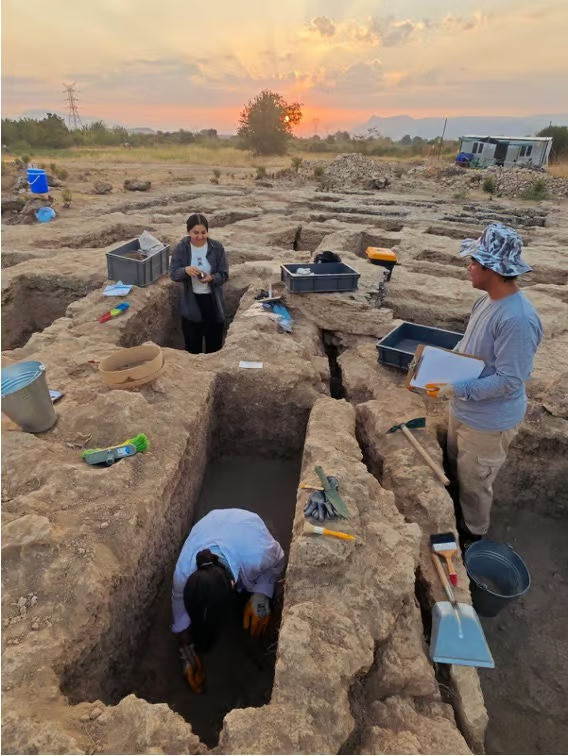
Excavation of Roman-period rock-cut tombs at Colossae. Photo courtesy Barış Yener.
What were some of the highlights of the first excavation season?
Yener: One of the most important achievements of our first excavation season was simply establishing a reliable archaeological framework for a site that had never been excavated before. We focused on the northern necropolis, and this work confirmed that the area contains an extensive Roman-period cemetery with multiple types of rock-cut tombs. Documenting these burial forms—some of which are quite unusual for the region—was a major highlight, as they offer valuable insights into local funerary practices and social structures.
Another significant result was the discovery of a surprisingly rich assemblage of small finds within the disturbed tombs, including amulets, inscribed stones, and objects associated with magical or protective traditions. These finds open new avenues for understanding beliefs, rituals, and social identities in the Roman community of Colossae.
How long do you plan to excavate the site? What are your hopes and plans for the site once the excavations conclude?
Yener: Excavations are, by their very nature, long-term undertakings. It is clear that no single scholar could hope to excavate the entirety of Colossae within a lifetime. Unless a completely new, revolutionary system of archaeological fieldwork is developed, the site will likely continue to be explored by archaeologists for centuries. Despite these challenges, we have taken the decisive step of initiating the project, and our plan is to conduct excavations for roughly six months each year—at least until I retire.
My broader hope is that, as the excavated areas expand, the site will gradually evolve into a meaningful and accessible archaeological park. I would like visitors to walk through the exposed remains, to sense the depth of the city’s past, and to form a genuine connection with the landscape and its history. This requires careful long-term planning, not only in terms of excavation strategy but also in conservation, interpretation, and visitor infrastructure.
Of course, all of this depends on sustaining the financial support necessary for such an ambitious project. If the excavation continues to receive the resources it needs, I believe Colossae has the potential to become both a major research center and a place where the public can engage deeply with the heritage of the Lycus Valley.
Editor’s Note: Bible History Daily appreciates the support of Dr. Mark Wilson of the Asia Minor Research Center for facilitating this interview with Professor Yener.
Education and Religion
History and Religion
Uncovering an important Biblical city
Previous Post
July 12, 2026
The Poetry reflected in Lombardo's Odyssey and Iliad
Next Post
July 14, 2026 The Content of the Odyssey and the Iliad
Browse Our Archives
Select a Category Uncategorized
Select a Month October 2026 September 2026 August 2026 July 2026 June 2026 May 2026 April 2026 March 2026 February 2026 January 2026 December 2025 November 2025 October 2025 September 2025 August 2025 July 2025 June 2025 May 2025 April 2025 March 2025 February 2025 January 2025 December 2024 November 2024 October 2024 September 2024 August 2024 July 2024 June 2024 May 2024 April 2024 March 2024 February 2024 January 2024 December 2023 November 2023 October 2023 September 2023 August 2023 July 2023 June 2023 May 2023 April 2023 March 2023 February 2023 January 2023 December 2022 November 2022 October 2022 September 2022 August 2022 July 2022 June 2022 May 2022 April 2022 March 2022 February 2022 January 2022 December 2021 November 2021 October 2021 September 2021 August 2021 July 2021 June 2021 May 2021 April 2021 March 2021 February 2021 January 2021 December 2020 November 2020 October 2020 September 2020 August 2020 July 2020 June 2020 May 2020 April 2020 March 2020 February 2020 January 2020 December 2019 November 2019 October 2019 September 2019 August 2019 July 2019 June 2019 May 2019 April 2019 March 2019 February 2019 January 2019 December 2018 November 2018 October 2018 September 2018 August 2018 July 2018 June 2018 May 2018 April 2018 March 2018 February 2018 January 2018 December 2017 November 2017 October 2017 September 2017 August 2017 July 2017 June 2017 May 2017 April 2017 March 2017 February 2017 January 2017 December 2016 November 2016 October 2016 September 2016 August 2016 July 2016 June 2016 May 2016 April 2016 March 2016 February 2016 January 2016 December 2015 November 2015 October 2015 September 2015 August 2015 July 2015 June 2015 May 2015 April 2015 March 2015 February 2015 January 2015 December 2014 November 2014 October 2014 September 2014 August 2014 July 2014 June 2014 May 2014 April 2014 March 2014 February 2014 January 2014 December 2013 November 2013 October 2013 September 2013 August 2013 July 2013 June 2013 May 2013 April 2013 March 2013 February 2013 January 2013 December 2012 November 2012 October 2012 September 2012 August 2012 July 2012 June 2012 May 2012 April 2012 March 2012 February 2012 January 2012 December 2011 November 2011 October 2011 September 2011 August 2011 July 2011 June 2011 May 2011 April 2011 March 2011 February 2011 January 2011
Follow Us!
TAKE THE
Religious Wisdom Quiz
What was a "phylactery," criticized by Jesus in Matthew 23?
Select your answer to see how you score.
A robe A lamp A fishing net A small box with Scripture
Books by This Author Books by Ben Witherington
Related posts from The Bible and Culture


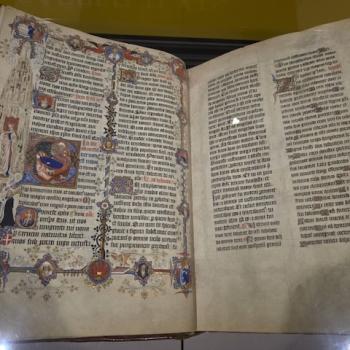
The British Library-- Part Two
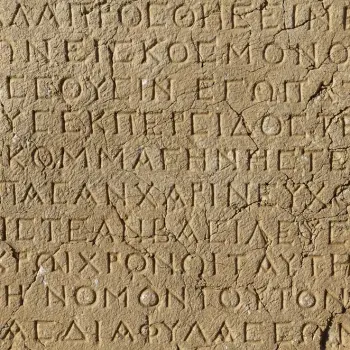
The British Library-- Part One
TRENDING AT PATHEOS Evangelical

The First Eucharistic Controversy: Christ’s Real Presence
For Catholics, the Eucharist is the source and summit of the Christian...

How to Make a Decision When You Can't...
Main point: It’s much more valuable to stay close to God so...

Archdiocese Hosts Military Marriage Retreat in Germany
RASTATT, Germany — The transient military lifestyle, with its frequent deployments and...

Nearly every morning, I make the drive to Detroit with my high-school-age...

The Real AI Story Is Adoption Without Trust
Artificial intelligence has crossed a political threshold. It is no longer a...

A new article, written by Jeff Lindsay and Gale L. Pooley,...
view all Evangelical blogs
Ad-Free & Subscriber Log-In Subscription Support
- About Us
- 2026 Calendar
- Videos
- Podcasts
- Library of World Religions
- Faith In Media Tracker
- Advertise With Us
- Write for Us
- Privacy Policy
- Terms of Service
- Do Not Sell My Data
- Contact Us
- Radiant Digital
- Manage Newsletter Subscriptions
- Unsubscribe From Notifications
- Sitemap
Copyright 2008-2026, Patheos. All rights reserved.
Subscription Support Ad-Free & Subscriber Log-In
Follow Patheos