
BuddhistCatholicContemplativeEvangelicalGeneral ChristianHinduJewishLatter-day SaintMuslimNew VisionsProgressive Christian
Beliefs
- Buddhist
- Catholic
- Contemplative
- Evangelical
- General Christian
- Hindu
- Jewish
- Latter-day Saint
- More Voices
- Muslim
- New Visions
- Pagan
- Progressive Christian
Topics
- Religion News
- Food and Religion
- Sports and Religion
- Religious Art
- Religious Music and Entertainment
- Religious Events
- History and Religion
- Style and Religion
- Politics and Religion
- Women in Religion
- Recreation Outdoors and Religion
- Business Finance and Religion
- Careers Workplace and Religion
- Education and Religion
- Family Parenting and Religion
- Health Fitness and Religion
- Home and Religion
- Relationships and Religion
- Technology and Religion
- Travel and Religion
Columnists
- Buddhist Columnists
- Business Finance and Religion Columnists
- Careers Workplace and Religion Columnists
- Catholic Columnists
- Contemplative Columnists
- Education and Religion Columnists
- Evangelists Columnists
- Family Parenting and Religion Columnists
- General Christian Columnists
- Health Fitness and Religion Columnists
- Hindu Columnists
- History and Religion Columnists
- Home and Religion Columnists
- Jewish Columnists
- More Voices Columnists
- Latter Day Columnists
- Muslim Columnists
- New Visions Columnists
- Nonreligious Columnists
- Pagan Columnists
- Politics and Religion Columnists
- Progressive Columnists
- Recreation Outdoors and Religion Columnists
- Relationships and Religion Columnists
- Religion News Columnists
- Religious Art Columnists
- Religious Events Columnists
- Religious Music and Entertainment Columnists
- Sports and Religion Columnists
- Style and Religion Columnists
- Technology and Religion Columnists
- Travel and Religion Columnists
- Women in Religion Columnists
Resource Library
- 2026 Calendar
- Library of World Religions
- The 100 Most Holy Places on Earth
- Patheos Answers
- Podcasts
- Videos
- Faith Leaders Database
- Anglican Episcopalian
- Bahai
- Baptist
- Buddhism
- Christianity
- Confucianism
- Eastern Orthodoxy
- Hinduism
- Holiness and Pentecostal
- ISKCON
- Islam
- Judaism
- Lutheran
- Methodist
- The Church of Jesus Christ of Latter-day Saints
- New Age
- Paganism
- Presbytarian and Reformed
- Protestantism
- Religion Behind the Scenes
- Roman Catholic
- Scientology
- Shia Islam
- Sikhism
- Sufism
- Sunni Islam
- Taoism
- Zen
- See all religions
Research Tools
 Ad-Free & Subscriber Log-In Subscription Support
Ad-Free & Subscriber Log-In Subscription Support
Follow Patheos 

- Trending:
- Forgiveness
- |
- Marriage
- |
- Consciousness
- |
- Death Penalty
- |
- Election
- |
- Halloween

- Home
- Evangelical
- Education and Religion
- Why Mark did not End at Mk. 16.8
Why Mark did not End at Mk. 16.8
Last updated on: May 12, 2025 at 12:06 am by Ben Witherington
Why Mark did not End at Mk. 16.8 2025-05-10T07:51:08-04:00 Ben Witherington
Patheos Explore the world's faith through different perspectives on religion and spirituality! Patheos has the views of the prevalent religions and spiritualities of the world.
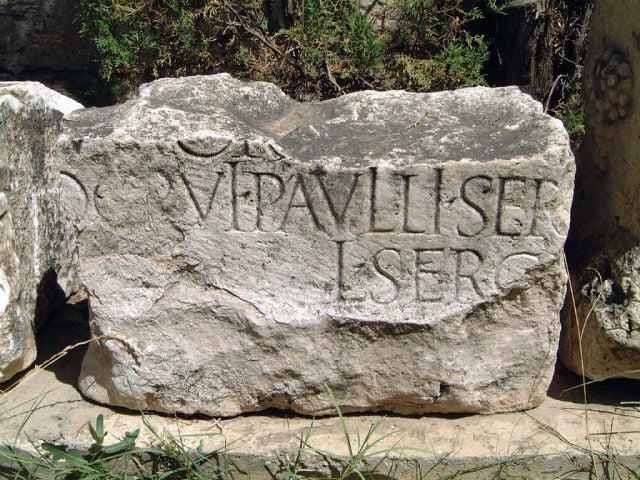
Here is a limestone inscription about the Sergius Paulus family, who were from Pisidian Antioch, the place Paul visited on his first missionary journey. Notice that at the end of the line the name Sergius is cut off in both the first and the second lines of inscription. If this can happen on a stone inscription, it was all the more likely to happen with fragile papyri. And here is where I mention that ancients were no better than moderns during the age of video tapes, where Blockbuster would have an inscription saying ‘please be kind and rewind’ but alas, the patrons often didn’t. This sadly was also true with ancient papyri. A person would scroll right through the manuscript, finish reading, and then no bother to rewind the scroll! This apparently happened a lot because we have discovered that the ‘syllabus’ from which we get the word syllabus, which in antiquity served as an identifying tag as to what was in the scroll was attached not to the beginning but rather to the end of the manuscript. The ancients didn’t have tape machines that with the push of a button would rewind the tape. Hence, the end of a manuscript was sometimes torn, sometimes mutilated by exposure to the elements and sometimes just crumbled if it was used a lot. You can readily see this if you study papyri of any sort from antiquity. No doubt it is one of the reasons Christians began to choose a different medium, namely parchment (scraped animal skin) something apparently first created in Pergamon for their sacred and important texts. Preservation was important before there began to be whole collections of manuscripts put together, sometimes sown together in codex form (first a collection Paul’s letters, then the four Gospels).
All of this is of relevance to the study of the ending of Mark, as Clayton Croy in his monograph about that ending has shown at length in his The Mutilation of Mark’s Gospel . The second and third century Christians were not moderns, and when they came across a copy of Mark’s Gospel which abruptly stopped at Mk. 16.8 with the phrase ‘ephoboubto gar……..’ (for they were afraid…..) They rightly concluded, that that could not be the original ending, hence the threefold attempt to add something that rounded the document out (see the discussion in the latest edition of Metzger’s Textual handbook, showing all the variants etc.). There was the so-called long ending of Mark which clearly seems to be a mash up of various sources and adds the bits about drinking poison and allowing one’s self to be bitten by snakes. The grammar, syntax and vocabulary are different from Mark’s Gospel, among other problems, but it does include an appearance of Jesus to some disciples. Then there was Codex Washingtonius, and then there was a third attempt at an ending of a single verse—
“But they reported briefly to Peter and those with him all that they had been told. And after this, Jesus himself sent out by means of them, from east to west, the sacred and imperishable proclamation of eternal salvation.”
Note that Codex Sinaiticus composed in 325 in its presentation of Mark 16, also does not end with 16.8, but rather has some form of the long ending, which later became the preferred text used by the King James translation team in the early 17th century.
While various scholars have pointed out that it was not grammatically impossible that ephobounto gar was the original ending, from the point of view of theology it makes no sense. Fright and flight were not the appropriate response to the announcement by the angels that Jesus was risen and that the women were commanded to go tell Peter and the other disciples that Jesus was going before them into Galilee and they would see him there. If Mk. 16.8 is the original ending they apparently disobeyed the angelic command.
But the other three Gospel were having none of this sort of all too modern rationalizing about a mysterious ending that comports with the so-called Messianic secret in Mark. Furthermore, Matthew’s Gospel takes over 95% of Mark, and while he records the shocked response the women, he goes on to relate Jesus’ appearance to them, and the sequel that leads to an appearance in Galilee. If one leaves out the uniquely Matthean report about the guards at the tomb and their reporting back (Mt. 28.11-15), one probably has the Markan ending that Matthew’s author knew with some Matthean editing.
Yet at some point after its use by the first Evangelist, a widely circulated copy of Mark, the earliest Gospel in all likelihood, abruptly came to a halt with ‘and they said nothing to anyone for they were afraid…’ It should also be noted that this negative portrayal of the women as non-witnesses to Easter not only does not comport with what Matthew, Luke, and John indicate, it also doesn’t comport with the internal evidence in Mark, where in the Passion narrative itself we hear that the story about the woman who anointed Jesus would spread far and wide to her credit (Mk 14), indeed according to Jesus himself this story becomes essential to the Good News retelling—“Truly I tell you, wherever the gospel is preached throughout the world, what she has done will also be told, in memory of her.” In short, the Mk. 16.8 text as an ending falls short of comporting even with the theological and ethical viewpoint of Mark.
Enough said.
Education and Religion
History and Religion
The long and short of Mark 16.8
Previous Post

May 11, 2025
Mother's Day
Next Post
May 14, 2025 New Documents Illustrating Early Christianity Vol. 11 A-B
Browse Our Archives
Select a Category Uncategorized
Select a Month October 2026 September 2026 August 2026 July 2026 June 2026 May 2026 April 2026 March 2026 February 2026 January 2026 December 2025 November 2025 October 2025 September 2025 August 2025 July 2025 June 2025 May 2025 April 2025 March 2025 February 2025 January 2025 December 2024 November 2024 October 2024 September 2024 August 2024 July 2024 June 2024 May 2024 April 2024 March 2024 February 2024 January 2024 December 2023 November 2023 October 2023 September 2023 August 2023 July 2023 June 2023 May 2023 April 2023 March 2023 February 2023 January 2023 December 2022 November 2022 October 2022 September 2022 August 2022 July 2022 June 2022 May 2022 April 2022 March 2022 February 2022 January 2022 December 2021 November 2021 October 2021 September 2021 August 2021 July 2021 June 2021 May 2021 April 2021 March 2021 February 2021 January 2021 December 2020 November 2020 October 2020 September 2020 August 2020 July 2020 June 2020 May 2020 April 2020 March 2020 February 2020 January 2020 December 2019 November 2019 October 2019 September 2019 August 2019 July 2019 June 2019 May 2019 April 2019 March 2019 February 2019 January 2019 December 2018 November 2018 October 2018 September 2018 August 2018 July 2018 June 2018 May 2018 April 2018 March 2018 February 2018 January 2018 December 2017 November 2017 October 2017 September 2017 August 2017 July 2017 June 2017 May 2017 April 2017 March 2017 February 2017 January 2017 December 2016 November 2016 October 2016 September 2016 August 2016 July 2016 June 2016 May 2016 April 2016 March 2016 February 2016 January 2016 December 2015 November 2015 October 2015 September 2015 August 2015 July 2015 June 2015 May 2015 April 2015 March 2015 February 2015 January 2015 December 2014 November 2014 October 2014 September 2014 August 2014 July 2014 June 2014 May 2014 April 2014 March 2014 February 2014 January 2014 December 2013 November 2013 October 2013 September 2013 August 2013 July 2013 June 2013 May 2013 April 2013 March 2013 February 2013 January 2013 December 2012 November 2012 October 2012 September 2012 August 2012 July 2012 June 2012 May 2012 April 2012 March 2012 February 2012 January 2012 December 2011 November 2011 October 2011 September 2011 August 2011 July 2011 June 2011 May 2011 April 2011 March 2011 February 2011 January 2011
Follow Us!
TAKE THE
Religious Wisdom Quiz
According to Jesus, "Blessed are those who hunger and thirst for." what?
Select your answer to see how you score.
Money Popularity Righteousness Power
Books by This Author Books by Ben Witherington
Related posts from The Bible and Culture


Methodist Central Hall and Westminster Abbey


TRENDING AT PATHEOS Evangelical

Jad Gillies on New Hillsong Worship Songs and...
For worship leader Jad Gillies, Hillsong Worship’s next chapter is not about...

Looking at the Largest Orthodox Cathedral on Earth
There is often a considerable amount of anger and, shall we...

The Problem with False Prophets
Miller’s Station UMC| 10/18/26| Anchor Verse: Jeremiah 23: 1, 9-23 I...

Emotion in Early Christianity by Andrew Crislip
Andrew Crislip’s Emotion in Early Christianity examines an often overlooked dimension of...

16 Spiritual Touchstones for a More Grounded Life
After decades of spiritual study, here are 16 principles I try...

Catholic Evangelization: Sharing Your Faith Every Day
Welcome back to the Graceful Awakening mini-series called, “From Faith to Mission.” ...
view all Evangelical blogs
Ad-Free & Subscriber Log-In Subscription Support
- About Us
- 2026 Calendar
- Videos
- Podcasts
- Library of World Religions
- Faith In Media Tracker
- Advertise With Us
- Write for Us
- Privacy Policy
- Terms of Service
- Do Not Sell My Data
- Contact Us
- Radiant Digital
- Manage Newsletter Subscriptions
- Unsubscribe From Notifications
- Sitemap
Copyright 2008-2026, Patheos. All rights reserved.
Subscription Support Ad-Free & Subscriber Log-In
Follow Patheos