
BuddhistCatholicContemplativeEvangelicalGeneral ChristianHinduJewishLatter-day SaintMuslimNew VisionsProgressive Christian
Beliefs
- Buddhist
- Catholic
- Contemplative
- Evangelical
- General Christian
- Hindu
- Jewish
- Latter-day Saint
- More Voices
- Muslim
- New Visions
- Pagan
- Progressive Christian
Topics
- Religion News
- Food and Religion
- Sports and Religion
- Religious Art
- Religious Music and Entertainment
- Religious Events
- History and Religion
- Style and Religion
- Politics and Religion
- Women in Religion
- Recreation Outdoors and Religion
- Business Finance and Religion
- Careers Workplace and Religion
- Education and Religion
- Family Parenting and Religion
- Health Fitness and Religion
- Home and Religion
- Relationships and Religion
- Technology and Religion
- Travel and Religion
Columnists
- Buddhist Columnists
- Business Finance and Religion Columnists
- Careers Workplace and Religion Columnists
- Catholic Columnists
- Contemplative Columnists
- Education and Religion Columnists
- Evangelists Columnists
- Family Parenting and Religion Columnists
- General Christian Columnists
- Health Fitness and Religion Columnists
- Hindu Columnists
- History and Religion Columnists
- Home and Religion Columnists
- Jewish Columnists
- More Voices Columnists
- Latter Day Columnists
- Muslim Columnists
- New Visions Columnists
- Nonreligious Columnists
- Pagan Columnists
- Politics and Religion Columnists
- Progressive Columnists
- Recreation Outdoors and Religion Columnists
- Relationships and Religion Columnists
- Religion News Columnists
- Religious Art Columnists
- Religious Events Columnists
- Religious Music and Entertainment Columnists
- Sports and Religion Columnists
- Style and Religion Columnists
- Technology and Religion Columnists
- Travel and Religion Columnists
- Women in Religion Columnists
Resource Library
- 2026 Calendar
- Library of World Religions
- The 100 Most Holy Places on Earth
- Patheos Answers
- Podcasts
- Videos
- Faith Leaders Database
- Anglican Episcopalian
- Bahai
- Baptist
- Buddhism
- Christianity
- Confucianism
- Eastern Orthodoxy
- Hinduism
- Holiness and Pentecostal
- ISKCON
- Islam
- Judaism
- Lutheran
- Methodist
- The Church of Jesus Christ of Latter-day Saints
- New Age
- Paganism
- Presbytarian and Reformed
- Protestantism
- Religion Behind the Scenes
- Roman Catholic
- Scientology
- Shia Islam
- Sikhism
- Sufism
- Sunni Islam
- Taoism
- Zen
- See all religions
Research Tools
 Ad-Free & Subscriber Log-In Subscription Support
Follow Patheos 

- Trending:
- Advent
- |
- Forgiveness
- |
- Thanksgiving
- |
- Election
- |
- Seasonal Holidays
- |
- Marriage

- Home
- Evangelical
- History and Religion
- Donne on Death
Donne on Death
Last updated on: December 31, 2022 at 1:09 am by Ben Witherington
Donne on Death 2022-09-11T06:17:28-04:00 Ben Witherington
Patheos Explore the world's faith through different perspectives on religion and spirituality! Patheos has the views of the prevalent religions and spiritualities of the world.
John Donne has always been my favorite metaphysical poet..
Full marks to the NY Times for publishing the following—
What John Donne Knew About Death Can Teach Us a Lot About Life
Sept. 10, 2022
Credit…Getty Images

By Katherine Rundell
Ms. Rundell is the author, most recently, of “Super-Infinite: The Transformations of John Donne,” from which this essay has been adapted.
The power of John Donne’s words nearly killed a man.
It was the spring of 1623, on the morning of Ascension Day, and Donne, long a struggling poet, had finally secured for himself celebrity, fortune and a captive audience. He had been appointed dean of St. Paul’s Cathedral two years before. He was 51, slim and amply bearded, and his preaching was famous across the whole of London. His congregation — merchants, aristocrats, actors in elaborate ruffs, the whole of the city’s elite — came to his sermons. Some carried paper and ink to write down his finest passages and take them home to relish and dissect them. Donne often wept in the pulpit, in joy and in sorrow, and his audience would weep with him.
That morning he was not preaching in his own church but 15 minutes’ easy walk across London at Lincoln’s Inn, in the center of town. Word went out: Wherever he was, people came flocking to hear him speak. But too many flocked, and as the crowd pushed closer to hear his words, some men were shoved to the ground, trampled and badly injured. A contemporary wrote in a letter, “Two or three were endangered, and taken up dead for the time.” There’s no record of Donne halting his sermon; so it’s not impossible that he kept going in his rich, authoritative voice as the bloodied men were carried off and out of sight.
A certain amount of ease around death would have been in character. John Donne was honest about death and its place in the task of living, just as he insisted on joy. Both his life and his work tell us the same thing: It is only by keeping death nearby that one can truly live.
Confronted with the thought of death, many of us perform the psychological equivalent of hiding in a box with our knees under our chin. But Donne saluted death; he wrote it poetry, he threw it parties. He had a memento mori that he left to a friend in his will, “the picture called The Skeleton which hangs in the hall.” For Donne, that we are born astride the grave was a truth to welcome.

Credit…Getty Images
Death — the looming fact of it, its finality and clarifying power — calls us to attention and wakes us up to life. Donne spoke it from the pulpit, in a passage from a sermon he gave in his late 40s:
Now was there ever any man seen to sleep in the cart, between Newgate and Tyburn? Between the prison, and the place of execution, does any man sleep? And we sleep all the way; from the womb to the grave we are never thoroughly awake.
Awake is his call. And Donne’s work laid out how: He insisted on the vivid, the alert, the original. His poetry is famously difficult, and the images can sometimes take all your sustained focus to untangle. That is deliberate. In repayment for your effort, you will look at the world with both more awe and more skepticism.
First, though, you must shake yourself out of cliché. In a time when other poets were still largely engaged in the “my lady is a perfect dove” game, he refused to play. Love was almost certainly not like a flower, nor a dove. Why would it be? But it might be like a pair of compasses. It may be like a flea. His women are never roses, birds or fawns, but they might be compared to a mythic sucking fish: They thrum with idiosyncratic life.
Bodies, doomed to decay, delighted him. He kicked aside the Petrarchan traditions of idealized, sanitized desire and joyfully brought the body to collide with the soul. His writing about sex is explicit, joyful and strange: a bodily salute to life:
License my roving hands, and let them go
Behind, before, above, between, below!
O my America! My new-found land!
My kingdom, safeliest when with one man manned!
He also loved the “trans-” prefix: It’s scattered everywhere across his writing — “transpose,” “translate,” “transport,” “transubstantiate.” In this Latin preposition — meaning “across, to the other side of, over, beyond” — he saw both the chaos and potential of us. We are, he believed, creatures born transformable.
And Donne reimagined and reinvented himself, over and over: He was a poet, lover, essayist, lawyer, pirate, recusant, preacher, satirist, politician, courtier, chaplain to the king, dean of the finest cathedral in London. He worked his way from failure and penury to recognition within his lifetime as one of the finest minds of his age.
He lived intensely, even for a time in which intensity seemed to be the hallmark. He sailed the high seas, rode through Europe, wore a hat large enough to sail a cat in. He was a man who often added the super- prefix to words that others would not think needed them: “super-infinite,” “super-miraculous,” “super-eternal,” “super-exaltation,” even “super-dying.”
If the human soul was visible, he believed, it would be larger than the world itself. “It is too little to call Man a little world; except God, man is a diminutive to nothing. Man consists of more pieces, more parts, than the world doth, nay, than the world is,” he wrote in “Devotions Upon Emergent Occasions.” Tap humans, he believed, and they’d ring with the sound of infinity.
But humans, he also knew, are unique in their capacity to ruin themselves and one another: “Nothing but man, of all envenomed things,/Doth work upon itself with inborn stings,” he wrote at age 37 in an elegy for a friend.
Donne was born into a Roman Catholic family in a time when the religion was illegal in England. One of his great-uncles was arrested in an anti-Catholic raid and executed; another was locked inside the Tower of London, where Donne visited him as a small boy, venturing fearfully in among the men sentenced to death. His younger brother, caught harboring a priest, was locked in a plague-ridden jail, where he died alone and in agony.
Donne married a young woman, Anne More, clandestinely and hurried by love, which derailed his early career and got him thrown in an ice-cold prison. Even after his release he and Anne were often poor and at the mercy of richer friends and relations. He knew what it was to be jealous and thwarted and bitter. He lost, over the course of his life, six children. And he lost Anne when she was just 33.
In his life, Donne walked so often in darkness that it became for him a daily commute. And as he grew older, he grew drier and harsher, but he always insisted determinedly on awe. Donne believed our minds could, with work, be forged into citadels against the world’s chaos: “be thine own palace, or the world’s thy jail,” he wrote in a verse letter to his friend Henry Wotton, when they were both still young men in their 20s.
We humans are both miracles and catastrophes. We must, he demanded, acknowledge both death and joy, horror and awe. It is an astonishment to be alive, and life calls on you to be astonished; but lifelong astonishment will take iron-willed discipline.
Wake, his writing tells us, over and over. Weep for this world and gasp for it. Wake, and pay attention to our mortality, to the precise ways in which beauty cuts through us. Pay attention to the softness of skin and the majesty of hands and feet. Attention — real, sustained, unflinching attention — is what this life, with its disasters and delights, demands of you.
And if a skeleton in the hall helps, well then: Bring on the skeletons.
By Katherine Rundell, fellow of All Souls College, Oxford
History and Religion
Education and Religion
Previous Post

December 30, 2022
71 and Still Having Fun
Next Post
January 1, 2023 Into Turkey-- Part Forty-Two
Browse Our Archives
Select a Category Uncategorized
Select a Month November 2026 October 2026 September 2026 August 2026 July 2026 June 2026 May 2026 April 2026 March 2026 February 2026 January 2026 December 2025 November 2025 October 2025 September 2025 August 2025 July 2025 June 2025 May 2025 April 2025 March 2025 February 2025 January 2025 December 2024 November 2024 October 2024 September 2024 August 2024 July 2024 June 2024 May 2024 April 2024 March 2024 February 2024 January 2024 December 2023 November 2023 October 2023 September 2023 August 2023 July 2023 June 2023 May 2023 April 2023 March 2023 February 2023 January 2023 December 2022 November 2022 October 2022 September 2022 August 2022 July 2022 June 2022 May 2022 April 2022 March 2022 February 2022 January 2022 December 2021 November 2021 October 2021 September 2021 August 2021 July 2021 June 2021 May 2021 April 2021 March 2021 February 2021 January 2021 December 2020 November 2020 October 2020 September 2020 August 2020 July 2020 June 2020 May 2020 April 2020 March 2020 February 2020 January 2020 December 2019 November 2019 October 2019 September 2019 August 2019 July 2019 June 2019 May 2019 April 2019 March 2019 February 2019 January 2019 December 2018 November 2018 October 2018 September 2018 August 2018 July 2018 June 2018 May 2018 April 2018 March 2018 February 2018 January 2018 December 2017 November 2017 October 2017 September 2017 August 2017 July 2017 June 2017 May 2017 April 2017 March 2017 February 2017 January 2017 December 2016 November 2016 October 2016 September 2016 August 2016 July 2016 June 2016 May 2016 April 2016 March 2016 February 2016 January 2016 December 2015 November 2015 October 2015 September 2015 August 2015 July 2015 June 2015 May 2015 April 2015 March 2015 February 2015 January 2015 December 2014 November 2014 October 2014 September 2014 August 2014 July 2014 June 2014 May 2014 April 2014 March 2014 February 2014 January 2014 December 2013 November 2013 October 2013 September 2013 August 2013 July 2013 June 2013 May 2013 April 2013 March 2013 February 2013 January 2013 December 2012 November 2012 October 2012 September 2012 August 2012 July 2012 June 2012 May 2012 April 2012 March 2012 February 2012 January 2012 December 2011 November 2011 October 2011 September 2011 August 2011 July 2011 June 2011 May 2011 April 2011 March 2011 February 2011 January 2011
Follow Us!
TAKE THE
Religious Wisdom Quiz
In the Parable of the Talents, what did the faithful servants receive?
Select your answer to see how you score.
Riches Nothing More responsibility Punishment
Books by This Author Books by Ben Witherington
Related posts from The Bible and Culture

Rock N' Roll-- Morphing into/for a New Generation...

Salisbury Cathedral (outside)-- Part Four

Salisbury Cathedral (the windows)-- Part Three
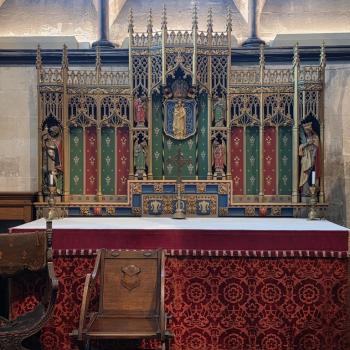
Salisbury Cathedral-- Part Two
TRENDING AT PATHEOS Evangelical

Here are two Thanksgiving columns that I originally wrote for the...

Book III, Chapter 3: Christ "Classic" (Matt. 9:9-34)
Book III, Chapter 3: Christ "Classic" (Matt. 9:9-34) In honor of tomorrow's...

Jesus explicitly mentions the book of Jonah twice, but he retells the...

Peggy Sue Got Married: Coppola’s Always Been Like...
I enjoyed Megalopolis (2024). It’s a mess, but I enjoyed it. The...

My dissertation The Place of Mysticism in the Late Middle Ages concerns...

God and the Contingency of This World
The great Catholic philosopher Aquinas and the great Lutheran philosopher Leibniz developed...
view all Evangelical blogs
Ad-Free & Subscriber Log-In Subscription Support
- About Us
- 2026 Calendar
- Videos
- Podcasts
- Library of World Religions
- Faith In Media Tracker
- Advertise With Us
- Write for Us
- Privacy Policy
- Terms of Service
- Do Not Sell My Data
- Contact Us
- Radiant Digital
- Manage Newsletter Subscriptions
- Unsubscribe From Notifications
- Sitemap
Copyright 2008-2026, Patheos, part of the Radiant Digital network of media brands. All rights reserved.
Subscription Support Ad-Free & Subscriber Log-In
Follow Patheos