
BuddhistCatholicContemplativeEvangelicalGeneral ChristianHinduJewishLatter-day SaintMuslimNew VisionsProgressive Christian
Beliefs
- Buddhist
- Catholic
- Contemplative
- Evangelical
- General Christian
- Hindu
- Jewish
- Latter-day Saint
- More Voices
- Muslim
- New Visions
- Pagan
- Progressive Christian
Topics
- Religion News
- Food and Religion
- Sports and Religion
- Religious Art
- Religious Music and Entertainment
- Religious Events
- History and Religion
- Style and Religion
- Politics and Religion
- Women in Religion
- Recreation Outdoors and Religion
- Business Finance and Religion
- Careers Workplace and Religion
- Education and Religion
- Family Parenting and Religion
- Health Fitness and Religion
- Home and Religion
- Relationships and Religion
- Technology and Religion
- Travel and Religion
Columnists
- Buddhist Columnists
- Business Finance and Religion Columnists
- Careers Workplace and Religion Columnists
- Catholic Columnists
- Contemplative Columnists
- Education and Religion Columnists
- Evangelists Columnists
- Family Parenting and Religion Columnists
- General Christian Columnists
- Health Fitness and Religion Columnists
- Hindu Columnists
- History and Religion Columnists
- Home and Religion Columnists
- Jewish Columnists
- More Voices Columnists
- Latter Day Columnists
- Muslim Columnists
- New Visions Columnists
- Nonreligious Columnists
- Pagan Columnists
- Politics and Religion Columnists
- Progressive Columnists
- Recreation Outdoors and Religion Columnists
- Relationships and Religion Columnists
- Religion News Columnists
- Religious Art Columnists
- Religious Events Columnists
- Religious Music and Entertainment Columnists
- Sports and Religion Columnists
- Style and Religion Columnists
- Technology and Religion Columnists
- Travel and Religion Columnists
- Women in Religion Columnists
Resource Library
- 2026 Calendar
- Library of World Religions
- The 100 Most Holy Places on Earth
- Patheos Answers
- Podcasts
- Videos
- Faith Leaders Database
- Anglican Episcopalian
- Bahai
- Baptist
- Buddhism
- Christianity
- Confucianism
- Eastern Orthodoxy
- Hinduism
- Holiness and Pentecostal
- ISKCON
- Islam
- Judaism
- Lutheran
- Methodist
- The Church of Jesus Christ of Latter-day Saints
- New Age
- Paganism
- Presbytarian and Reformed
- Protestantism
- Religion Behind the Scenes
- Roman Catholic
- Scientology
- Shia Islam
- Sikhism
- Sufism
- Sunni Islam
- Taoism
- Zen
- See all religions
Research Tools
 Ad-Free & Subscriber Log-In Subscription Support
Ad-Free & Subscriber Log-In Subscription Support
Follow Patheos 

- Trending:
- Forgiveness
- |
- Marriage
- |
- Consciousness
- |
- Death Penalty
- |
- Election
- |
- Halloween

- Home
- Evangelical
- Mary, Mary Au Contrary
Mary, Mary Au Contrary
Last updated on: August 27, 2022 at 1:14 am by Ben Witherington
Mary, Mary Au Contrary 2022-08-18T17:10:03-04:00 Ben Witherington
Patheos Explore the world's faith through different perspectives on religion and spirituality! Patheos has the views of the prevalent religions and spiritualities of the world.
RECENT QUERIES ABOUT THE MARYS
One of the real problems in early Christian history was the tendency to blend people with similar or the same names together, as if they were all the same person. We have this problem with assuming John Zebedee is the same person as John the elder who in turn is also the same person as John the seer who was in exile on Patmos. In fact, there were at least two if not three different persons involved, as Papias’s comments made clear who says he met John the elder, but not John the original apostle.
This same problem has arisen notoriously with Mary Magdalene, who was assumed to be the same person as the anonymous sinner woman mentioned in Luke 7, and sometimes also assumed to be the same person as the Mary of Mary and Martha fame mentioned in Luke 10 and John 11. A part of this tendency has recently been resurrected by the research of Elizabeth Schrader who has done her doctoral work at Duke University (and see also the recent JBL article by Joan Taylor and Elizabeth Schrader. “The Meaning of Magdalene. A Review of Literary Evidence”, SBL 140.4. The problem is, this study does not properly engage with the non-Christian early Jewish evidence, and the proper archaeological evidence at Migdal which has been and is being dug as we speak).
In this particular post I want to deal with certain assumptions that are undergirding some of this lets blend together the Marys speculation (and speculation it is). The first point has to do with textual criticism. There has in the guild been an increasing tendency to suggest that there is considerable ‘elasticity’ or flexibility, when it comes to the issue of textual variants. Now Schrader quite rightly admits that most textual variants are innocuous, of no real historical or theological import. But some are not. I underline the word some. This is true. It is also true that we have very few manuscripts that we can securely date to the 2nd century A.D.
Nevertheless, one of the tendencies that has surfaced in the wake of all the Nag Hammadi materials and the rise of interest in ‘Gnostic’ Gospel texts in recent decades is a serious failure to consider the source of the documents. The question that should be asked is do these documents come from proto-orthodox sources which are the mainstream of early Christianity, or do they come from heterodox sources like the numerous Gnostic texts. The failure to consider seriously the source of the material is a serious failure indeed, and it has led to all sorts of historical mistakes—for instance the assumption that Jesus was likely married to Mary Magdalene, or that Mary Magdalene was the beloved disciple (when John 11.3 is perfectly clear that it is Mary of Bethany’s brother, Lazarus who is the one called ‘the one whom Jesus loved’ and there are no textual variants for that verse that might lead us to think otherwise). I could say much more about synthetic tendencies and their problems, and problematic readings of textual variants without considering where they came from, but I need to move on to another problem.
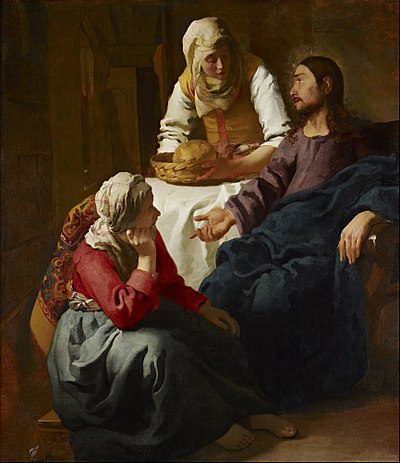
This particular problem has to do with the misreading of Luke 10, and the famous story of Jesus’ visit to Mary and Martha’s house. First of all, this story is in Luke’s famous journeying to Jerusalem chronicle that encompasses part of Luke 9 all the way to Luke 19. It is a repeated motif in this material that he is journeying up to Jerusalem, and various things are placed in those almost 10 chapters that are not in chronological order. In the case of Luke 10 itself, the theme of what it means to be a good disciple of Jesus, and also how to act as a loving neighbor are the most obvious themes. We are not told in Luke 10 where the village is that Jesus visited with Mary and Martha but we certainly cannot conclude it must be in Galilee because it is part of a literary creation and sequence of texts that is part of the journeying up to Jerusalem motif. Luke is more concerned with a theological ordering than a chronological ordering of materials in Luke 9-19. Secondly, the attempt to distinguish the Mary and Martha in Luke 10 from the Mary and Martha of John 11 simply falls flat, because in both cases the personal characterization of these two women is too similar in these two texts to ignore. Thirdly, it is simply not the case that because we are told in Luke 10 that the house in question is Martha’s house that this must mean its not Simon the Leper’s house or Lazarus’ house. This is an argument from silence, not an argument from substance. If Martha is in fact the homemaker for her siblings, say as the older sister, and if Simon the Leper has passed away, there is no reason why the home could not be said to be her home. The focus is after all on the relationship of Jesus with these two sisters, just as it is in John 11.
Then there are the assumptions about Mary Magdalene that surface in this kind of approach. She is now being called Mary the Tower, as if Magdalena were a personal attribute of Mary herself. I’m sorry, but this ignores altogether that the town Luke is referring to is a real Galilean town called Migdal, which does indeed mean tower. It’s the town, not the person that Luke is referring to. Here I would refer all the readers to Richard Bauckham’s very careful study of Migdal including names and nomenclatures in his work entitled Magdala of Galilee. A Jewish City of the Hellenistic and Roman Period and also his study entitled Gospel Women. The careful historical work that went into these two studies simply can’t be ignored or dismissed, and they lead to the conclusion that Mary from Migdal/Magdala not Mary the Tower is the correct reading of the data. She is a Galilean disciple, out of whom Jesus exorcised some demons, and her name always comes first in the list of female disciples from Galilee. This is surely NOT the same person as the Mary in Luke 10 or John 11.
I could say much more about all this (see my Women in the Ministry of Jesus), but this must suffice. Curiosity and historical conjecture are of course important parts of analyzing the incomplete data of the New Testament, especially because of all the aporia. One must keep an open mind about traditional assumptions. But at the end of the day, there are usually very good reasons to reject speculations that the vast majority of scholars have not and do not now entertain, for good reasons. The newest is not always the truest and the latest is not always the greatest when it comes to the analysis of the NT and its texts and textual variants.
One of the real problems in early Christian history was the tendency to blend people with similar or the same names together, as if they were all the same person. We have this problem with assuming John Zebedee is the same person as John the elder who in turn is also the same person as John the seer who was in exile on Patmos. In fact, there were at least two if not three different persons involved, as Papias’s comments made clear who says he met John the elder, but not John the original apostle.
This same problem has arisen notoriously with Mary Magdalene, who was assumed to be the same person as the anonymous sinner woman mentioned in Luke 7, and sometimes also assumed to be the same person as the Mary of Mary and Martha fame mentioned in Luke 10 and John 11. A part of this tendency has recently been resurrected by the research of Elizabeth Schrader who has done her doctoral work at Duke University (and see also the recent JBL article by Joan Taylor and Elizabeth Schrader. “The Meaning of Magdalene. A Review of Literary Evidence”, SBL 140.4. The problem is, this study does not properly engage with the non-Christian early Jewish evidence, and the proper archaeological evidence at Migdal which has been and is being dug as we speak).
In this particular post I want to deal with certain assumptions that are undergirding some of this speculation (and speculation it is). The first point has to do with textual criticism. There has in the guild been an increasing tendency to suggest that there is considerable ‘elasticity’ or flexibility, when it comes to the issue of textual variants. Now Schrader quite rightly admits that most textual variants are innocuous, of no real historical or theological import. But some are not. I underline the word some. This is true. It is also true that we have very few manuscripts that we can securely date to the 2nd century A.D. Nevertheless, one of the tendencies that has surfaced in the wake of all the Nag Hammadi materials and the rise of interest in ‘Gnostic’ texts in recent decades is a serious failure to consider the source of the documents. The question that should be asked do these documents come from proto-orthodox sources which are the mainstream of early Christianity, or do they come from heterodox sources like the numerous Gnostic texts. The failure to consider seriously the source of the material is a serious failure indeed, and it has led to all sorts of historical mistakes—for instance the assumption that Jesus was likely married to Mary Magdalene, or that Mary Magdalene was the beloved disciple (when John 11.3 is perfectly clear that it is Mary of Bethany’s brother, Lazarus who is the one called ‘the one whom Jesus loved’ (and there are no textual variants for that verse that might lead us to think otherwise). I could say much more about synthetic tendencies and their problems, and problematic readings of textual variants without considering where they came from, but I need to move on to another problem.
This particular problem has to do with the misreading of Luke 10, and the famous story of Jesus’ visit to Mary and Martha’s house. First of all, this story is in Luke’s famous journeying to Jerusalem chronicle that encompasses part of Luke 9 all the way to Luke 19. It is a repeated motif in this material, and various things are placed in those almost 10 chapters that are not in chronological order. In the case of Luke 10 itself, the theme of what it means to be a good disciple of Jesus, and also how to act as a loving neighbor are the most obvious themes. We are not told in Luke 10 where the village is that Jesus visited with Mary and Martha but we certainly cannot conclude it must be in Galilee because it is part of a literary creation and sequence of texts that is part of the journeying up to Jerusalem motif. Luke is more concerned with a theological ordering than a chronological ordering of materials in Luke 9-19. Secondly, the attempt to distinguish the Mary and Martha in Luke 10 from the Mary and Martha of John 11 simply falls flat, because in both cases the personal characterization of these two women is too similar in these two texts to ignore. Thirdly, it is simply not the case that because we are told in Luke 10 that the house in question is Martha’s house that this must mean its not Simon the Leper’s house or Lazarus’ house. This is an argument from silence, not an argument from substance. If Martha is in fact the homemaker for her siblings, say as the older sister, and if Simon the Leper has passed away, there is no reason why the home could not be said to be her home. The focus is after all on the relationship of Jesus with these two sisters, just as it is in John 11.
Then there are the assumptions about Mary Magdalene that surface in this kind of approach. She is now being called Mary the Tower, as if Magdalena were a personal attribute of Mary herself. I’m sorry, but this ignores altogether that the town Luke is referring to is a real Galilean town called Migdal, which does indeed mean tower. It’s the town, not the person that Luke is referring to. Here I would refer all the readers to Richard Bauckham’s very careful study of Migdal including names and nomenclatures in his work entitled Magdala of Galilee. A Jewish City of the Hellenistic and Roman Period and also his study entitled Gospel Women. The careful historical work that went into these two studies simply can’t be ignored or dismissed, and they lead to the conclusion that Mary from Migdal/Magdala not Mary the Tower is correct reading of the data. She is a Galilean disciple, out of whom Jesus exorcised some demons, and her name always comes first in the list of female disciples from Galilee. This is surely not the same person as the Mary in Luke 10 or John 11.
I could say much more about all this (see my Women in the Ministry of Jesus), but this must suffice. Curiosity and historical conjecture are of course important parts of analyzing the incomplete data of the New Testament, especially because of all the aporia. One must keep an open mind about traditional assumptions. But at the end of the day, there are usually very good reasons to reject speculations that the vast majority of scholars have not and do not now entertain, for good reasons. The newest is not always the truest and the latest is not always the greatest when it comes to the analysis of the NT and its texts and textual variants.
Previous Post

August 26, 2022
About the Beatles Beginning in the U.S.
Next Post
August 28, 2022 Pet Peeves--- Part One
Browse Our Archives
Select a Category Uncategorized
Select a Month October 2026 September 2026 August 2026 July 2026 June 2026 May 2026 April 2026 March 2026 February 2026 January 2026 December 2025 November 2025 October 2025 September 2025 August 2025 July 2025 June 2025 May 2025 April 2025 March 2025 February 2025 January 2025 December 2024 November 2024 October 2024 September 2024 August 2024 July 2024 June 2024 May 2024 April 2024 March 2024 February 2024 January 2024 December 2023 November 2023 October 2023 September 2023 August 2023 July 2023 June 2023 May 2023 April 2023 March 2023 February 2023 January 2023 December 2022 November 2022 October 2022 September 2022 August 2022 July 2022 June 2022 May 2022 April 2022 March 2022 February 2022 January 2022 December 2021 November 2021 October 2021 September 2021 August 2021 July 2021 June 2021 May 2021 April 2021 March 2021 February 2021 January 2021 December 2020 November 2020 October 2020 September 2020 August 2020 July 2020 June 2020 May 2020 April 2020 March 2020 February 2020 January 2020 December 2019 November 2019 October 2019 September 2019 August 2019 July 2019 June 2019 May 2019 April 2019 March 2019 February 2019 January 2019 December 2018 November 2018 October 2018 September 2018 August 2018 July 2018 June 2018 May 2018 April 2018 March 2018 February 2018 January 2018 December 2017 November 2017 October 2017 September 2017 August 2017 July 2017 June 2017 May 2017 April 2017 March 2017 February 2017 January 2017 December 2016 November 2016 October 2016 September 2016 August 2016 July 2016 June 2016 May 2016 April 2016 March 2016 February 2016 January 2016 December 2015 November 2015 October 2015 September 2015 August 2015 July 2015 June 2015 May 2015 April 2015 March 2015 February 2015 January 2015 December 2014 November 2014 October 2014 September 2014 August 2014 July 2014 June 2014 May 2014 April 2014 March 2014 February 2014 January 2014 December 2013 November 2013 October 2013 September 2013 August 2013 July 2013 June 2013 May 2013 April 2013 March 2013 February 2013 January 2013 December 2012 November 2012 October 2012 September 2012 August 2012 July 2012 June 2012 May 2012 April 2012 March 2012 February 2012 January 2012 December 2011 November 2011 October 2011 September 2011 August 2011 July 2011 June 2011 May 2011 April 2011 March 2011 February 2011 January 2011
Follow Us!
TAKE THE
Religious Wisdom Quiz
What Christian group is known for their "Circuit Riders" in history?
Select your answer to see how you score.
Baptists Methodists Anglicans Lutherans
Books by This Author Books by Ben Witherington
Related posts from The Bible and Culture


The British Library-- Part Two
The British Library-- Part One
TRENDING AT PATHEOS Evangelical

How to Make a Decision When You Can't...
Main point: It’s much more valuable to stay close to God so...

Archdiocese Hosts Military Marriage Retreat in Germany
RASTATT, Germany — The transient military lifestyle, with its frequent deployments and...

Nearly every morning, I make the drive to Detroit with my high-school-age...

The Real AI Story Is Adoption Without Trust
Artificial intelligence has crossed a political threshold. It is no longer a...

A new article, written by Jeff Lindsay and Gale L. Pooley,...

Swimfan: Forgotten Aughts Pleasures
This is a recovery effort. In 2002, My Big Fat Greek Wedding...
view all Evangelical blogs
Ad-Free & Subscriber Log-In Subscription Support
- About Us
- 2026 Calendar
- Videos
- Podcasts
- Library of World Religions
- Faith In Media Tracker
- Advertise With Us
- Write for Us
- Privacy Policy
- Terms of Service
- Do Not Sell My Data
- Contact Us
- Radiant Digital
- Manage Newsletter Subscriptions
- Unsubscribe From Notifications
- Sitemap
Copyright 2008-2026, Patheos. All rights reserved.
Subscription Support Ad-Free & Subscriber Log-In
Follow Patheos