
BuddhistCatholicContemplativeEvangelicalGeneral ChristianHinduJewishLatter-day SaintMuslimNew VisionsProgressive Christian
Beliefs
- Buddhist
- Catholic
- Contemplative
- Evangelical
- General Christian
- Hindu
- Jewish
- Latter-day Saint
- More Voices
- Muslim
- New Visions
- Pagan
- Progressive Christian
Topics
- Religion News
- Food and Religion
- Sports and Religion
- Religious Art
- Religious Music and Entertainment
- Religious Events
- History and Religion
- Style and Religion
- Politics and Religion
- Women in Religion
- Recreation Outdoors and Religion
- Business Finance and Religion
- Careers Workplace and Religion
- Education and Religion
- Family Parenting and Religion
- Health Fitness and Religion
- Home and Religion
- Relationships and Religion
- Technology and Religion
- Travel and Religion
Columnists
- Buddhist Columnists
- Business Finance and Religion Columnists
- Careers Workplace and Religion Columnists
- Catholic Columnists
- Contemplative Columnists
- Education and Religion Columnists
- Evangelists Columnists
- Family Parenting and Religion Columnists
- General Christian Columnists
- Health Fitness and Religion Columnists
- Hindu Columnists
- History and Religion Columnists
- Home and Religion Columnists
- Jewish Columnists
- More Voices Columnists
- Latter Day Columnists
- Muslim Columnists
- New Visions Columnists
- Nonreligious Columnists
- Pagan Columnists
- Politics and Religion Columnists
- Progressive Columnists
- Recreation Outdoors and Religion Columnists
- Relationships and Religion Columnists
- Religion News Columnists
- Religious Art Columnists
- Religious Events Columnists
- Religious Music and Entertainment Columnists
- Sports and Religion Columnists
- Style and Religion Columnists
- Technology and Religion Columnists
- Travel and Religion Columnists
- Women in Religion Columnists
Resource Library
- 2026 Calendar
- Library of World Religions
- The 100 Most Holy Places on Earth
- Patheos Answers
- Podcasts
- Videos
- Faith Leaders Database
- Anglican Episcopalian
- Bahai
- Baptist
- Buddhism
- Christianity
- Confucianism
- Eastern Orthodoxy
- Hinduism
- Holiness and Pentecostal
- ISKCON
- Islam
- Judaism
- Lutheran
- Methodist
- The Church of Jesus Christ of Latter-day Saints
- New Age
- Paganism
- Presbytarian and Reformed
- Protestantism
- Religion Behind the Scenes
- Roman Catholic
- Scientology
- Shia Islam
- Sikhism
- Sufism
- Sunni Islam
- Taoism
- Zen
- See all religions
Research Tools
 Ad-Free & Subscriber Log-In Subscription Support
Ad-Free & Subscriber Log-In Subscription Support
Follow Patheos 

- Trending:
- Forgiveness
- |
- Marriage
- |
- Consciousness
- |
- Death Penalty
- |
- Election
- |
- Halloween

- Home
- Evangelical
- Chris Tilling’s Paul’s Divine Christology
Chris Tilling’s Paul’s Divine Christology
Last updated on: September 22, 2020 at 1:05 am by Ben Witherington
Chris Tilling’s Paul’s Divine Christology 2020-08-25T10:09:05-04:00 Ben Witherington
Patheos Explore the world's faith through different perspectives on religion and spirituality! Patheos has the views of the prevalent religions and spiritualities of the world.
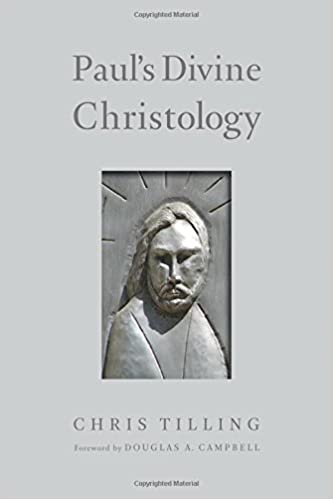
C. Tilling, Paul’s Divine Christology, (Eerdmans, 2015, 336 pages).
There are not many doctoral dissertations that move the needle dramatically in a new positive direction in the huge field of Pauline studies. But Chris Tilling’s Paul’s Divine Christology (which originally appeared in print in the WUNT series of J.C.B. Mohr in 2012) is the exception to all such evaluations of the work of budding NT scholars. While it is true that one of the main criteria for evaluating a doctoral thesis is ‘does it make a contribution to the discussion of X’, sometimes with the addition of the word ‘fresh’ before contribution, it is very hard to accomplish something like that in the well-trod roads of Pauline studies, where one is more apt to hear the Qoheleth dictum: ‘there is nothing new under the sun here’. But again, Tilling’s work does set the discussion of whether or not Paul had a ‘divine’ Christology on new footing.
This study accomplishes this impressive feat by: 1) placing the discussion on a broader footing, namely taking into account all the evidence from the capital Paulines about the Christ relationship of Paul and his converts, not just the evidence of cultic worship of Christ or the discussion of Christ’s pre-existence. The study involves detailed contextual exegesis, especially of 1 Cor. 8-10, not just cherry picking of titles or ideas; and 2) making clear that Paul talks about Christian relationship to Christ in the same way that Israel’s relationship to YHWH had always been envisioned and discussed, and 3) getting beyond the rehash of discussing the titles of Christ, once more with feeling.
The net effect of this is that yes indeed there can be found plentiful evidence of an early high Christology in the earliest documents in the NT, Paul’s letters, evidence, as R. Bauckham would put it, that Christ was viewed by Paul as part of the divine identity, and he did not see this as a violation of Jewish monotheism. Indeed, he could include Jesus as Lord within an expanded version of the Shema in 1 Cor. 8, without blinking or fearing huge pushback from fellow apostles such as Peter and others. This comports well with the fact that after Paul’s meetings with the pillar apostles in Jerusalem they had agreed on the essence of the Gospels for both Jews and Gentiles, while they may not have fully agreed about what that meant in regard to the ongoing relationship between Jewish Jesus followers and the keeping of the Mosaic covenant (see Gal. 1-2).
If that were not enough, Tilling takes ample time to show that the supposed early Jewish precedents for including lesser figures within the Godhead (angels, Adam, Enoch, etc.) on closer review really aren’t precedents. For example, it is the way the relationship with the Lord of the Spirits is discussed in the Enoch literature that is analogous to the way Paul talks about the Christ relationship, not the way the relationship of the Son of Man with God is discussed in that literature, and in any case it is not clear that the relevant Enoch literature was known by Paul, not least because the crucial parts of that literature may well post-date Paul’s letters.
Methodologically, there is more to be said because Tilling is rightly wary of the whole history of ideas approach to discussing Pauline Christology, especially when it is accompanied by upward evolutionary spiral thinking (low Christology must be early, high Christology developed later). As Doug Campbell points out in his Forward, this sort of abstracting of ideas from the complex ways Paul talks about the Christ relationship had by believers is the product of post-Enlightenment ways of approach the data, something Paul himself was ignorant and innocent of. In any case, as Martin Hengel showed long ago, and before him Lightfoot, if we are actually evaluating trends in early Christian thinking it would be more plausible to think of the high Christology being early and continuing on later, for instance in the Johannine literature.
Another important methodological point is Tilling’s resistance to the strict dictum that ontology is one thing and function is another. The person of Christ should not be abstracted from his work, for in the Christ relationship he was known through his transformative work not just on the cross, but through the personal transformation of the mind and life of believers through the Holy Spirit. ‘No one can authentically confess Jesus is Lord except by the Holy Spirit’ says Paul. One cannot eliminate the experiential side of things from the evaluation of whether or not Paul had a divine Christology. And besides, few scholars doubt that the Johannine Gospel reflects a divine Christology, and yet that Gospel also stresses the subordination of the Son to the Father, just as Paul does. The subordination discussion does not cancel out Paul’s divine Christology.
I take it for granted that Chris Tilling has demonstrated the essence of his thesis that in the capital Paulines Paul and his converts related to Christ in the same way Israel related to YHWH, and that the implicates of this are that Paul and various converts saw Christ as part of the divine identity, to use Bauckham’s language. Were Larry Hurtado, of blessed memory, still around, he would be sending Chris the coffee mug he sent me and various others as members of ‘the early high Christology club’. But Chris’s crucial insight does not fully take into account that in Paul’s letters Christ relates to God’s people in the same way the OT describes YHWH relating to Israel. To give but one example, in 1 Cor. 10, Paul makes the remarkable statement that when Israel was wandering in the wilderness their source of water turned out to be Christ (‘the rock was Christ’). A simply reading of the Pentateuch in its original language and context does not suggest such a surprising idea, rather it makes clear it was YHWH who provided sustenance and water for Israel. In short, we need the exploration of both sides of the relationship and the way Paul conceives them to support the case for Paul having a divine Christology. The actions of Christ, and the resulting Christ relationship on the part of believers provide a fuller proof that Paul indeed had a divine Christology.
Previous Post

September 21, 2020
Time for a Woman in the White House?
Next Post
September 23, 2020 Pandemics, Natural Disasters, and the Will of God
Browse Our Archives
Select a Category Uncategorized
Select a Month October 2026 September 2026 August 2026 July 2026 June 2026 May 2026 April 2026 March 2026 February 2026 January 2026 December 2025 November 2025 October 2025 September 2025 August 2025 July 2025 June 2025 May 2025 April 2025 March 2025 February 2025 January 2025 December 2024 November 2024 October 2024 September 2024 August 2024 July 2024 June 2024 May 2024 April 2024 March 2024 February 2024 January 2024 December 2023 November 2023 October 2023 September 2023 August 2023 July 2023 June 2023 May 2023 April 2023 March 2023 February 2023 January 2023 December 2022 November 2022 October 2022 September 2022 August 2022 July 2022 June 2022 May 2022 April 2022 March 2022 February 2022 January 2022 December 2021 November 2021 October 2021 September 2021 August 2021 July 2021 June 2021 May 2021 April 2021 March 2021 February 2021 January 2021 December 2020 November 2020 October 2020 September 2020 August 2020 July 2020 June 2020 May 2020 April 2020 March 2020 February 2020 January 2020 December 2019 November 2019 October 2019 September 2019 August 2019 July 2019 June 2019 May 2019 April 2019 March 2019 February 2019 January 2019 December 2018 November 2018 October 2018 September 2018 August 2018 July 2018 June 2018 May 2018 April 2018 March 2018 February 2018 January 2018 December 2017 November 2017 October 2017 September 2017 August 2017 July 2017 June 2017 May 2017 April 2017 March 2017 February 2017 January 2017 December 2016 November 2016 October 2016 September 2016 August 2016 July 2016 June 2016 May 2016 April 2016 March 2016 February 2016 January 2016 December 2015 November 2015 October 2015 September 2015 August 2015 July 2015 June 2015 May 2015 April 2015 March 2015 February 2015 January 2015 December 2014 November 2014 October 2014 September 2014 August 2014 July 2014 June 2014 May 2014 April 2014 March 2014 February 2014 January 2014 December 2013 November 2013 October 2013 September 2013 August 2013 July 2013 June 2013 May 2013 April 2013 March 2013 February 2013 January 2013 December 2012 November 2012 October 2012 September 2012 August 2012 July 2012 June 2012 May 2012 April 2012 March 2012 February 2012 January 2012 December 2011 November 2011 October 2011 September 2011 August 2011 July 2011 June 2011 May 2011 April 2011 March 2011 February 2011 January 2011
Follow Us!
TAKE THE
Religious Wisdom Quiz
Which language is the official language of the Roman Catholic Mass worldwide since Vatican II?
Select your answer to see how you score.
Local vernacular Latin Greek French
Books by This Author Books by Ben Witherington
Related posts from The Bible and Culture


Methodist Central Hall and Westminster Abbey


TRENDING AT PATHEOS Evangelical

The Problem with False Prophets
Miller’s Station UMC| 10/18/26| Anchor Verse: Jeremiah 23: 1, 9-23 I...

Emotion in Early Christianity by Andrew Crislip
Andrew Crislip’s Emotion in Early Christianity examines an often overlooked dimension of...

16 Spiritual Touchstones for a More Grounded Life
After decades of spiritual study, here are 16 principles I try...

Catholic Evangelization: Sharing Your Faith Every Day
Welcome back to the Graceful Awakening mini-series called, “From Faith to Mission.” ...

The Pillar of the Boatmen: the Ancient Monument...
The Pillar of the Boatmen is a Romano-Gaulish sculpture that dates from...

In one sense walking into Westminster Abbey is like walking down the...
view all Evangelical blogs
Ad-Free & Subscriber Log-In Subscription Support
- About Us
- 2026 Calendar
- Videos
- Podcasts
- Library of World Religions
- Faith In Media Tracker
- Advertise With Us
- Write for Us
- Privacy Policy
- Terms of Service
- Do Not Sell My Data
- Contact Us
- Radiant Digital
- Manage Newsletter Subscriptions
- Unsubscribe From Notifications
- Sitemap
Copyright 2008-2026, Patheos. All rights reserved.
Subscription Support Ad-Free & Subscriber Log-In
Follow Patheos