
BuddhistCatholicContemplativeEvangelicalGeneral ChristianHinduJewishLatter-day SaintMuslimNew VisionsProgressive Christian
Beliefs
- Buddhist
- Catholic
- Contemplative
- Evangelical
- General Christian
- Hindu
- Jewish
- Latter-day Saint
- More Voices
- Muslim
- New Visions
- Pagan
- Progressive Christian
Topics
- Religion News
- Food and Religion
- Sports and Religion
- Religious Art
- Religious Music and Entertainment
- Religious Events
- History and Religion
- Style and Religion
- Politics and Religion
- Women in Religion
- Recreation Outdoors and Religion
- Business Finance and Religion
- Careers Workplace and Religion
- Education and Religion
- Family Parenting and Religion
- Health Fitness and Religion
- Home and Religion
- Relationships and Religion
- Technology and Religion
- Travel and Religion
Columnists
- Buddhist Columnists
- Business Finance and Religion Columnists
- Careers Workplace and Religion Columnists
- Catholic Columnists
- Contemplative Columnists
- Education and Religion Columnists
- Evangelists Columnists
- Family Parenting and Religion Columnists
- General Christian Columnists
- Health Fitness and Religion Columnists
- Hindu Columnists
- History and Religion Columnists
- Home and Religion Columnists
- Jewish Columnists
- More Voices Columnists
- Latter Day Columnists
- Muslim Columnists
- New Visions Columnists
- Nonreligious Columnists
- Pagan Columnists
- Politics and Religion Columnists
- Progressive Columnists
- Recreation Outdoors and Religion Columnists
- Relationships and Religion Columnists
- Religion News Columnists
- Religious Art Columnists
- Religious Events Columnists
- Religious Music and Entertainment Columnists
- Sports and Religion Columnists
- Style and Religion Columnists
- Technology and Religion Columnists
- Travel and Religion Columnists
- Women in Religion Columnists
Resource Library
- 2026 Calendar
- Library of World Religions
- The 100 Most Holy Places on Earth
- Patheos Answers
- Podcasts
- Videos
- Faith Leaders Database
- Anglican Episcopalian
- Bahai
- Baptist
- Buddhism
- Christianity
- Confucianism
- Eastern Orthodoxy
- Hinduism
- Holiness and Pentecostal
- ISKCON
- Islam
- Judaism
- Lutheran
- Methodist
- The Church of Jesus Christ of Latter-day Saints
- New Age
- Paganism
- Presbytarian and Reformed
- Protestantism
- Religion Behind the Scenes
- Roman Catholic
- Scientology
- Shia Islam
- Sikhism
- Sufism
- Sunni Islam
- Taoism
- Zen
- See all religions
Research Tools
 Ad-Free & Subscriber Log-In Subscription Support
Ad-Free & Subscriber Log-In Subscription Support
Follow Patheos 

- Trending:
- Forgiveness
- |
- Marriage
- |
- Consciousness
- |
- Death Penalty
- |
- Election
- |
- Halloween

- Home
- Evangelical
- Scot McKnight’s Reading Romans Backwards— a Review
Scot McKnight’s Reading Romans Backwards— a Review
Last updated on: October 28, 2019 at 1:02 am by Ben Witherington
Scot McKnight’s Reading Romans Backwards— a Review 2019-10-07T13:05:36-04:00 Ben Witherington
Patheos Explore the world's faith through different perspectives on religion and spirituality! Patheos has the views of the prevalent religions and spiritualities of the world.
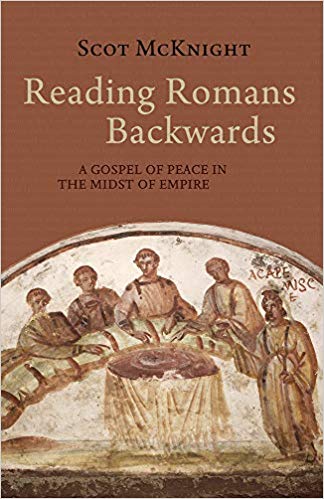
READING ROMANS BACKWARDS: A GOSPEL OF PEACE IN THE MIDST OF EMPIRE, Baylor U. Press, 2019.
Scot McKnight, 236 pages, $17.65 paperback.
It is the measure of a good book that it manages to stir up serious discussion and rethinking on a subject that is an already very heavily trod path by scholars. If the book can also manage to shoo away a few sacred cows which should have been put out to pasture long ago, so much the better (like the notion that obedience to God has little do with salvation since it is sole fidei, sola gratia). If the book can also do this in a perspicuous and svelte manner, this is a plus as well, since there are far too many obese books on Romans. Scot McKnight’s new book entitled Reading Romans Backwards, accomplishes all this and more.
On p. 142, Scot sums up what he sees as the logic of Romans: “Romans 12-16 is the context, 9-11 is the narrative approach to the problem of that context, and Romans 1-4 is Paul’s rebuttal of the Weak’s claim to priority, elective privilege, and approach to how to live as followers of Jesus in Rome. Their claim was that ‘if everyone would agree with us and follow the Torah, then we’d be one big happy family.’ Paul’s Abraham-rooted gospel of redemption in Christ by grace through faith is what creates the big happy family, not Torah observance. So Romans 5-8 maps Paul’s theory of the theological rationale for the lived theology of Romans 12-16. That is, Romans 5-8 is the solution to the problem of tension between the Weak and the Strong in the Roman house churches.”
Thus, the whole of Romans is read backwards as reflecting McKnight’s view of the Weak and Strong in Rome, mentioned in Rom. 14. He argues that only some of the Jewish Christians are being characterized as the Weak and some of the Gentile Christians are characterized as the Strong. But the whole argument, from Romans 1 on involves talking about either the weak ( e.g in Rom. 1-4) or strong (e.g Rom. 5-8) as Paul toggles back and forth between two parts of his audience. Of course, what this implies is that Paul knows a lot more about the social situation on the ground in Rome than one might have expected for a man who had never yet visited Rome and did not found the congregations there.
And this assumption is a weakness of this book, for even a close look at the list of names in Rom. 16 does not provide us with a list of a bunch of Pauline Jewish converts who could have been called ‘the weak’ in Rome. Rather there are some of his co-workers, like Priscilla and Aquila and Andronicus and Junia, and other Jews that he knows who are now in Rome. Epenetus is mentioned as the first convert in Asia, but nothing in Rom. 16 suggests he is characterizing any of these Jews listed as ‘the weak’. One suspects Paul is talking in more general terms in Rom. 14, than he does in 1 Cor. 8-10 where he knows exactly what is going on there. Nor is there anything in Romans to suggest that some of the Jewish Christians in Rome were acting like the Judaizers in Galatia, and trying to get the ‘strong’ Gentiles to keep kosher etc. But it is with this strong assumption about two specific groups within the Roman house churches who cannot be equated with all Jews or all Gentiles in those churches that McKnight wishes to re-read Romans (in the light of Rom. 14) from start to finish.
So for example, when McKnight gets to Rom. 1-2, because he sees this as a part of the critique of the weak (found in all Rom. 1-4), he tries to argue that Rom. 1.18-32 is the polemic of the ‘weak’ against pagan idolatry and immorality, which Paul then turns around and criticizes on the grounds that the interlocutor in Rom. 2.1-16 is a judgmental Jewish Christian. To the contrary, Rom. 2.1-16 is about a judgmental Gentile Christian, which as Paul points out, was formerly like those he is critiquing in 1.18-32, whereas Rom. 2.17ff. is indeed about a judgmental Jewish commentator. Yes, there is a toggling back and forth at times between critique of Gentiles and critique of Jews in Romans, but not in the way McKnight sees the matter, and not just of the limited group of weak and strong judgmental persons. Paul is an equal opportunity critiquer of all Jewish and Gentile Christians, in Rome and elsewhere. As Paul will say in Rom. 3— ‘all have sinned and fallen short’, and so yes, all come under God’s judgment on sin. There’s no room for self-congratulatory boasting or preening by anyone.
Scot rightly recognized Paul is doing speech in character in Rom. 7.7-13, but wrongly identifies the speaker as a generic judgmental person, presumably a Jew, when speech in character requires the speaker to be a known historical figure, and Paul has just referenced such a person in Rom. 5.12-21—namely Adam, who best fits the descriptions in Rom. 7.7-13 as a person who had only one commandment from God and who existed before there was any law at all.
Or take another example, from the discussion of Rom. 13— here Paul is seen as exhorting specifically the Jewish Christians to respect the authorities and pay their taxes. But surely Paul is telling all the Christians in Rome to be good citizens and do this. Gentiles in Rome were famous for belly-aching about the Emperor’s taxes.
What surfaces in the extended discussion of Rom. 9-11 is McKnight thinks this discussion is needed by the weak Jews with too many scruples in Rome who want the Gentile converts to keep Torah. Those chapters are better taken as a lesson for Gentile converts with anti-Semitic tendencies who thought God had replaced his first chosen people with another one—Gentiles and perhaps especially Roman Gentiles, now riding high on the wave of Empire which was swamping the whole Mediterranean crescent. Paul is answering the question—Has God abandoned his first chosen people with an emphatic NO! and the audience that needed to hear that was surely the Gentiles in Rome, not the Jewish Christians who would agree with much of what Paul says in Rom. 9-11.
One of the great virtues of this book throughout is Scot’s insistence that Paul is doing lived theology, not abstract theology, and that what we call the theology and ethics of Romans is intricately intertwined. Just so. One could have wished for more discussion on this topic throughout the book, even if it meant less reading of the whole of Romans in light of Rom. 14.
And in the end, even the house churches in Rome would not have read Romans backwards, they would have listened to it forwards, and as such, they could not have guessed from Rom. 1-13 that the real target audience for Paul’s exhortations was a subset of the whole Christian community in Rome, namely was the weak Jewish Christians who wanted everyone to be Torah true, and the strong, higher status Gentile Christians mentioned in Rom. 14-15 that looked down on the newly returned from exile Jewish Christians.
This book is to be highly commended for taking the road less traveled in understanding Romans, and some fine and fresh insights into the most famous Pauline letter come to light, even if at the end of the day it does not provide the best explanation for the whole of Paul’s rhetoric and reason for writing this famous document.
Previous Post

October 26, 2019
Scot McKnight's Reading Romans Backwards-- The Dialogue Part Thirteen
Next Post
October 28, 2019 Scot McKnight's Reading Romans Backwards--- Part Fourteen
Browse Our Archives
Select a Category Uncategorized
Select a Month October 2026 September 2026 August 2026 July 2026 June 2026 May 2026 April 2026 March 2026 February 2026 January 2026 December 2025 November 2025 October 2025 September 2025 August 2025 July 2025 June 2025 May 2025 April 2025 March 2025 February 2025 January 2025 December 2024 November 2024 October 2024 September 2024 August 2024 July 2024 June 2024 May 2024 April 2024 March 2024 February 2024 January 2024 December 2023 November 2023 October 2023 September 2023 August 2023 July 2023 June 2023 May 2023 April 2023 March 2023 February 2023 January 2023 December 2022 November 2022 October 2022 September 2022 August 2022 July 2022 June 2022 May 2022 April 2022 March 2022 February 2022 January 2022 December 2021 November 2021 October 2021 September 2021 August 2021 July 2021 June 2021 May 2021 April 2021 March 2021 February 2021 January 2021 December 2020 November 2020 October 2020 September 2020 August 2020 July 2020 June 2020 May 2020 April 2020 March 2020 February 2020 January 2020 December 2019 November 2019 October 2019 September 2019 August 2019 July 2019 June 2019 May 2019 April 2019 March 2019 February 2019 January 2019 December 2018 November 2018 October 2018 September 2018 August 2018 July 2018 June 2018 May 2018 April 2018 March 2018 February 2018 January 2018 December 2017 November 2017 October 2017 September 2017 August 2017 July 2017 June 2017 May 2017 April 2017 March 2017 February 2017 January 2017 December 2016 November 2016 October 2016 September 2016 August 2016 July 2016 June 2016 May 2016 April 2016 March 2016 February 2016 January 2016 December 2015 November 2015 October 2015 September 2015 August 2015 July 2015 June 2015 May 2015 April 2015 March 2015 February 2015 January 2015 December 2014 November 2014 October 2014 September 2014 August 2014 July 2014 June 2014 May 2014 April 2014 March 2014 February 2014 January 2014 December 2013 November 2013 October 2013 September 2013 August 2013 July 2013 June 2013 May 2013 April 2013 March 2013 February 2013 January 2013 December 2012 November 2012 October 2012 September 2012 August 2012 July 2012 June 2012 May 2012 April 2012 March 2012 February 2012 January 2012 December 2011 November 2011 October 2011 September 2011 August 2011 July 2011 June 2011 May 2011 April 2011 March 2011 February 2011 January 2011
Follow Us!
TAKE THE
Religious Wisdom Quiz
What does "Gethsemane" mean?
Select your answer to see how you score.
Garden Spring Olive tree Oil press
Books by This Author Books by Ben Witherington
Related posts from The Bible and Culture


Methodist Central Hall and Westminster Abbey


TRENDING AT PATHEOS Evangelical

The Problem with False Prophets
Miller’s Station UMC| 10/18/26| Anchor Verse: Jeremiah 23: 1, 9-23 I...

Emotion in Early Christianity by Andrew Crislip
Andrew Crislip’s Emotion in Early Christianity examines an often overlooked dimension of...

16 Spiritual Touchstones for a More Grounded Life
After decades of spiritual study, here are 16 principles I try...

Catholic Evangelization: Sharing Your Faith Every Day
Welcome back to the Graceful Awakening mini-series called, “From Faith to Mission.” ...

The Pillar of the Boatmen: the Ancient Monument...
The Pillar of the Boatmen is a Romano-Gaulish sculpture that dates from...

In one sense walking into Westminster Abbey is like walking down the...
view all Evangelical blogs
Ad-Free & Subscriber Log-In Subscription Support
- About Us
- 2026 Calendar
- Videos
- Podcasts
- Library of World Religions
- Faith In Media Tracker
- Advertise With Us
- Write for Us
- Privacy Policy
- Terms of Service
- Do Not Sell My Data
- Contact Us
- Radiant Digital
- Manage Newsletter Subscriptions
- Unsubscribe From Notifications
- Sitemap
Copyright 2008-2026, Patheos. All rights reserved.
Subscription Support Ad-Free & Subscriber Log-In
Follow Patheos