
BuddhistCatholicContemplativeEvangelicalGeneral ChristianHinduJewishLatter-day SaintMuslimNew VisionsProgressive Christian
Beliefs
- Buddhist
- Catholic
- Contemplative
- Evangelical
- General Christian
- Hindu
- Jewish
- Latter-day Saint
- More Voices
- Muslim
- New Visions
- Pagan
- Progressive Christian
Topics
- Religion News
- Food and Religion
- Sports and Religion
- Religious Art
- Religious Music and Entertainment
- Religious Events
- History and Religion
- Style and Religion
- Politics and Religion
- Women in Religion
- Recreation Outdoors and Religion
- Business Finance and Religion
- Careers Workplace and Religion
- Education and Religion
- Family Parenting and Religion
- Health Fitness and Religion
- Home and Religion
- Relationships and Religion
- Technology and Religion
- Travel and Religion
Columnists
- Buddhist Columnists
- Business Finance and Religion Columnists
- Careers Workplace and Religion Columnists
- Catholic Columnists
- Contemplative Columnists
- Education and Religion Columnists
- Evangelists Columnists
- Family Parenting and Religion Columnists
- General Christian Columnists
- Health Fitness and Religion Columnists
- Hindu Columnists
- History and Religion Columnists
- Home and Religion Columnists
- Jewish Columnists
- More Voices Columnists
- Latter Day Columnists
- Muslim Columnists
- New Visions Columnists
- Nonreligious Columnists
- Pagan Columnists
- Politics and Religion Columnists
- Progressive Columnists
- Recreation Outdoors and Religion Columnists
- Relationships and Religion Columnists
- Religion News Columnists
- Religious Art Columnists
- Religious Events Columnists
- Religious Music and Entertainment Columnists
- Sports and Religion Columnists
- Style and Religion Columnists
- Technology and Religion Columnists
- Travel and Religion Columnists
- Women in Religion Columnists
Resource Library
- 2026 Calendar
- Library of World Religions
- The 100 Most Holy Places on Earth
- Patheos Answers
- Podcasts
- Videos
- Faith Leaders Database
- Anglican Episcopalian
- Bahai
- Baptist
- Buddhism
- Christianity
- Confucianism
- Eastern Orthodoxy
- Hinduism
- Holiness and Pentecostal
- ISKCON
- Islam
- Judaism
- Lutheran
- Methodist
- The Church of Jesus Christ of Latter-day Saints
- New Age
- Paganism
- Presbytarian and Reformed
- Protestantism
- Religion Behind the Scenes
- Roman Catholic
- Scientology
- Shia Islam
- Sikhism
- Sufism
- Sunni Islam
- Taoism
- Zen
- See all religions
Research Tools
 Ad-Free & Subscriber Log-In Subscription Support
Ad-Free & Subscriber Log-In Subscription Support
Follow Patheos 

- Trending:
- Forgiveness
- |
- Marriage
- |
- Consciousness
- |
- Death Penalty
- |
- Election
- |
- Halloween

- Home
- Evangelical
- Bruce Longenecker’s The Crosses of Pompeii– Part Six
Bruce Longenecker’s The Crosses of Pompeii– Part Six
Last updated on: July 3, 2016 at 1:38 am by Ben Witherington
Bruce Longenecker’s The Crosses of Pompeii– Part Six 2016-06-08T15:51:44-04:00 Ben Witherington
Patheos Explore the world's faith through different perspectives on religion and spirituality! Patheos has the views of the prevalent religions and spiritualities of the world.
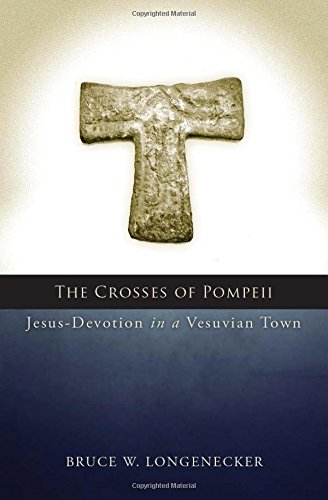
BEN: As it turns out, talking about waste is not a waste of time when discussing the crosses in the streets of Pompeii. I take your point about human latrines and private toilets and the baths etc. But as you say carts pulled by animals were allowed in the streets of Pompeii, and it is unconvincing to suggest there wouldn’t be animal dung in the streets when farmers brought their produce to market in town. Yes, there may have been civic slaves with pooper scoopers of some sort, but the notion that the streets could be considered a good locale for a sacred symbolic having apotropaic function seems a stretch knowing what we know about life in an ancient city. The streets frankly were not kept pristinely clean so far as we know. Furthermore, the ancients would have had to be looking for those tiny crosses. It would not take any effort to see public shrines at intersections, but these crosses are a different story.
BRUCE:
I agree with your points about waste in the streets, having made all of them myself in the book, as you note. (Of course, the streets were not channels of oozing waste-sludge either, as popular imagination seems to have them.) But the fact that the streets were not pristinely clean is another good reason why the street crosses cannot have been directional markers to the residences of Pompeii Christians (they often wouldn’t have been visible). Moreover, it is precisely why those street crosses must have had an apotropaic quality.
The street crosses would have been utterly useless as directional markers. Once all the other options are ruled out, the only option left is that these street crosses were apotropaic devises. This was precisely the nature of many apotropaic devises – no one imagined that they needed to be seen by humans to be effective in warding off evil spirits. The ancients believed that things happened in the spiritual realms that the human eye was not privy to. Pompeian Christians would have known that the street crosses were there, and they would have derived psychological benefit from that fact, since an apotropaic device is effective even when it is not visible to the human eye.
For instance, if someone’s winter cloak inadvertently covered her apotropaic bracelet, this did not leave her vulnerable to spiritual invasion; it was not the case that she was exposed until the cloak was adjusted or removed and the apotropaion was once again visible to the suprahuman eye. If a woman wore an apotropaic bracelet, she was thought to be protected, whether or not her cloak happened to cover the apotropaic bracelet.
Similarly, to the ancient mind, suprahuman spirits feasted on sacrificial food that was left for them, even though the human eye could not perceive it; so too, suprahuman spirits could perceive the presence of apotropaic devices even when those devices were not visible to the human eye.
Precisely because the streets were not pristinely clear, the only interpretation of them that does justice to every aspect of their character is the interpretation that sees them as power symbols that align with the petition of the Lord’s Prayer, “Deliver us from evil.”
This might be what Stephen Westerholm was getting at when he wrote the following (as cited in chapter 1 of The Crosses of Pompeii): “Jews and non-Jews alike had always been concerned to keep on good terms with the supernatural powers that influenced, or even controlled, their destinies. With such concerns, [the Christian] message found a natural resonance.”
BEN: I think your study has established, beyond reasonable doubt, that there were some Christians in Pompeii prior to the eruption in A.D. 79. I think you also have established that the cross was one of their important symbols, and probably one of the reasons why is apotropaic reasons. But I do doubt that ‘shelter from the storm’ was a main reason people converted to Christianity. After all, many Greco-Roman deities were claimed to offer protection from the evil eye, or evil spirits. This would not be a distinctive feature of Christianity. No, what Christianity offered was real change in a person’s life, the sort of change that the mystery religions may have offered but could not deliver.
The famous Roman satire about The Gourdification of (the Divine) Claudius is telling precisely because it ridicules an essential notion Christians held dearly – real change in human nature by divine work. It also ridicules the imperial cult notion that a human could become a God, but the issue is fundamental change in a human life. I think much depends on how much influence from Judaism guided the thoughts of the early Christians about things like the evil eye, evil spirits, etc. I can understand a Gentile Christian, say who ran the bakery in Pompeii leaving up the ‘hex signs’ of previous renters (after all it was not his place), and adding a cross to the mix, not because he saw it as a more effective warder off of evil, but because he believed Jesus had changed his life for the better, through Jesus’ death and resurrection, and given him the gift of everlasting life. It must be of some importance that Paul doesn’t really discuss demons per se in the undisputed Paulines, except in 1 Corinthians. I don’t think even his Gentile converts were all that worried about evil spirits infiltrating their homes, to judge from the numerous subjects he covers in his letters. How do you respond?
BRUCE:
Well, of course, don’t forget Galatians 3:1, where Paul taps into fear of suprahuman powers when he says, “Oh foolish Galatians, who has bewitched you with the evil eye” – with the evil eye being such a fearful thing for reasons we have already made clear. Paul subtly links abandonment of the message of the cross with the influence of fearful powers. And it is in the same letter that he mentions “sorcery” as one of the “works of the flesh” – a list he deemed relevant to the Galatian situation, and a list of activities and attitudes that the Spirit of God opposes (5:20).
And of course Paul ends the first half of his letter to Roman Jesus-followers speaking of all the things that will not be able to separate them from the love of God in Christ Jesus, including suprahuman entities (8:38-39).
And beyond Paul’s letters, we need to account for the Synoptic Gospels as well. If they have some claim to having been written “for all Christians” in the Greco-Roman world, it is also significant that Jesus’s control of the demonic spirits is not suppressed within the recounting of those narratives. Arguably the evangelists of those Gospels expected that aspect of their narratives to resonate with the worldview of their urban audiences.
But that isn’t to take away from your point that for Paul and other early Christians, the message of the cross stood at the forefront in that process of opposing evil within transformational communities. (This, to repeat the point, is part of the force of Mark’s Gospel in relation to “the second church” of the late first century.) The good news should not be “emptied of its power,” as Paul says in 1 Corinthians 1:18 when attacking the factionalism of the Corinthian community who were beginning to look like a dysfunctional association of the Greco-Roman world. Clearly, as I have argued in Remember the Poor and elsewhere, Paul imagined the “power” of the good news to be played out in transformational lifestyles within the body of Christ. That transformation of lifestyle is what Paul called upon to serve as his own “letter of recommendation” (2 Corinthians 3) – his calling card, in a sense.
So couldn’t much the same transformational life have been on display within Jesus-groups in Pompeii? Of course it could have. Maybe Paul’s younger associate Jesus-groups in Pompeii? Of course it could have. Maybe Paul’s younger associate John Mark would have loved what he found if he ever ventured into a Pompeian Christian community in the 70s. The problem is that, while Pompeii gives us indicators of Jesus-devotion within its walls, it tells us very little about the character of that devotion in the corporate life of Jesus-devotees.
I think we can surmise three things about them, but each point also leaves us without complete clarity. First, I think some of Pompeian Jesus-devotees saw the cross as a means of protection against malignant forces in a spiritual battle. Were they syncretistic or exclusive in their devotion to Jesus? It’s very hard to say one way or the other.
Second, we can surmise that some Jesus-followers met in a bakery where pagan symbols resided on the walls. Do those symbols indicate a continued allegiance to standard forms of pagan devotion, or are they simply incidental? It is very hard to say one way or another.
Third, we can see from one or two of the artifacts that some saw their Jesus-devotion in relation to Isis-devotion. It is significant in this regard that devotion to the Egyptian deity Isis was catching on like wildfire in Pompeii. Similarities between the benefits offered by Isis and by Jesus Christ are really quite significant. Devotees to Isis expected to receive from her an enhanced life in the present and an animated form of life beyond death. Much the same, phenomenologically speaking, was on offer in the Christian gospel. So when two Christian crosses from Pompeii closely replicate the Ankh of Isis (except without the famous handle of the Ankh, which differentiates the cross and the Ankh), we can see that Jesus-devotees were comparing Jesus Christ to Isis. Did they think that Jesus Christ had usurped Isis and delegitimized her, or did they imagine the two deities in more of a syncretistic or symbiotic fashion? It could have gone either way.
Beyond those three things, we have no evidence about what might have transpired within the corporate life of Pompeii’s Jesus-followers. But since Christian communities were not always very good at living up to the apostolic ideal, perhaps we should not expect too much in this regard from Jesus-devotees in Pompeii, who probably never had an “apostolic visitation,” and who might only have heard “apostolic things” through the grapevine. Paul found the Corinthians filtering the “power” of the cross into typical patterns of Greco-Roman life. If that was the case for the Corinthians (with whom Paul had lived for eighteen months and upon whom he needed to lavish so much discursive attention), how much more might the same have been the case for fledgling communities of Jesus-devotion that did not enjoy the same apostolic encounters and influences?
BEN: In some ways I wish you had discussed earlier in the book, what you lay out at its conclusion, namely the precariousness felt by residents of Pompeii after the earthquake and before the eruption. That in turn, would have helped make your case for the emphasis on the apotropaic function of crosses in a perilous situation. I wondered as well if you might have considered that some Christians fleeing Rome in 49 due to the edict, may have gotten no further than Pompeii. I think you are right that Christians met in homes, and even some slaves will have come to meetings outside where they lived. The situation was more fluid than sometimes imagined. But what I also think is that the evidence from Paul suggests (with folk like Erastus and Phoebe, and fellow guild members like Priscilla and Aquila) that Paul’s strategy at least involved converting some more socially elite persons who could actually host such meetings easily enough in their homes. I’m not convinced by the notion that Christians were overwhelmingly women, slaves, minors, and the poor. I suspect there was a great cross-section of society in early Christianity, and house churches were generally led by the more socially advantaged members of the group, who for one thing could read, were literate. I agree with you that Pompeii should now be seen as a good workshop for us to rethink the social make-up of earliest Christianity. What the evidence suggests is that it was diverse, ethnically, genderwise, socio-economically, educationally, and in terms of tasks that Christians performed as well. Final thoughts about the relationship of trade guilds, say the association of bakers, and early Christian groups?
BRUCE:
The structure of an argument is always a give-and-take situation, with advantages and disadvantages to every possibility. If I had placed the section on Pompeian life between earthquake and eruption earlier in the book, some would have said, “Bad structure; make your main point first, then look to the broader issues and implications.” And that was my take on the matter too.
(By the way, I further explore the precariousness of life in Pompeii between earthquake and eruption in an article, “The Empress, The Goddess, and the Earthquake: Atmospheric Conditions Permitting Public Displays of Jesus-Devotion in Pompeii.” This will be appearing in November 2016 in a book of essays entitled Early Christianity in Pompeian Light, with contributors including Lyn Osiek, Peter Oakes, David Balch, and others.)
I entertained various scenarios regarding the arrival of Jesus-devotion in Pompeii in chapter 15 of The Crosses of Pompeii (and I entertain another one in the “Atmospheric Conditions” article). How Jesus-devotion arrived in Pompeii is an intriguing question, with some fascinating possibilities. We’ll never be able to know the answer to that conundrum with any degree of certainty, obviously, but the more possibilities we consider, the better we’ll be able to rank them in terms of their likelihood.
I hope your readers don’t get the idea from your comments that I think Jesus-devotees were all among the poor. My book Remember the Poor shows how Jesus-devotion fell along a greater socio-economic spectrum than that, and the data collected in The Crosses of Pompeii gives us insight into that spectrum in a specific location. The baker in Pompeii was not among the destitute, for instance. In my mind, I place him at ES5 on my “economy scale,” although I didn’t do that in the book itself. (ES5 is the descriptor for those slightly below the middling groups, but above those at basic subsistence level, ES6, and certainly above those in desperate poverty, ES7.)
Interestingly, a cross that I found very late in the research may have been oriented in relation to yet another bakery in Pompeii; I haven’t been able to study that scenario in any depth, since I discovered that cross only in my final minutes of my last visit to Pompeii (adding only a few sentences about that street cross to The Crosses of Pompeii, which was already with the publisher when the discovery was made). But if that cross operated in relation to yet another bakery, it might well be significant that we have two Pompeian bakers adopting Jesus-devotion. Might an association of Pompeii bakers have been one way in which Jesus-devotion spread within Pompeii?
Along similar lines, I demonstrated how a personal ring worn by a man named Meges included two symbols pertaining to Jesus-devotion. Meges was probably a slave, and his ring would have been used to authorize business transactions on behalf of his master. This would make Meges some kind of manager for his master’s household. People of Meges’s socio-economic profile frequently had certain social freedoms and economic reserves of their own (as I demonstrate in chapter 15). So here we have a slave who had adopted Jesus-devotion, but he was a certain social freedoms and economic reserves of their own (as I demonstrate in chapter 15). So here we have a slave who had adopted Jesus-devotion, but he was a managerial slave rather than a menial slave.
On the other hand, we might have evidence of some Jesus-followers who lived in a rather precarious economic situation. I’m thinking here of the residents of a very small workshop (at location 6.17.22 in Pompeii) who, in all likelihood, were freedpersons. Judging from their tiny workshop and residence, they were most likely simply getting by, with few economic reserves, being economically vulnerable to the slightest downturn in their overall circumstances (i.e., ES6).
Anyway, this is just to say that the artifacts of Jesus-devotion in Pompeii go beyond simply being the only material evidence of “the first urban Christians” (to use Wayne Meeks’s phrase); they also allow us to glimpse the diversity of those who chose to adopt devotion to Jesus Christ in a predominately pro-Roman urban center of the first century.
Previous Post

July 2, 2016
Bruce Longenecker's The Crosses of Pompeii-- Part Five
Next Post
July 4, 2016 Aaron Copland's A Lincoln Portrait -- LA Philharmonic
Browse Our Archives
Select a Category Uncategorized
Select a Month October 2026 September 2026 August 2026 July 2026 June 2026 May 2026 April 2026 March 2026 February 2026 January 2026 December 2025 November 2025 October 2025 September 2025 August 2025 July 2025 June 2025 May 2025 April 2025 March 2025 February 2025 January 2025 December 2024 November 2024 October 2024 September 2024 August 2024 July 2024 June 2024 May 2024 April 2024 March 2024 February 2024 January 2024 December 2023 November 2023 October 2023 September 2023 August 2023 July 2023 June 2023 May 2023 April 2023 March 2023 February 2023 January 2023 December 2022 November 2022 October 2022 September 2022 August 2022 July 2022 June 2022 May 2022 April 2022 March 2022 February 2022 January 2022 December 2021 November 2021 October 2021 September 2021 August 2021 July 2021 June 2021 May 2021 April 2021 March 2021 February 2021 January 2021 December 2020 November 2020 October 2020 September 2020 August 2020 July 2020 June 2020 May 2020 April 2020 March 2020 February 2020 January 2020 December 2019 November 2019 October 2019 September 2019 August 2019 July 2019 June 2019 May 2019 April 2019 March 2019 February 2019 January 2019 December 2018 November 2018 October 2018 September 2018 August 2018 July 2018 June 2018 May 2018 April 2018 March 2018 February 2018 January 2018 December 2017 November 2017 October 2017 September 2017 August 2017 July 2017 June 2017 May 2017 April 2017 March 2017 February 2017 January 2017 December 2016 November 2016 October 2016 September 2016 August 2016 July 2016 June 2016 May 2016 April 2016 March 2016 February 2016 January 2016 December 2015 November 2015 October 2015 September 2015 August 2015 July 2015 June 2015 May 2015 April 2015 March 2015 February 2015 January 2015 December 2014 November 2014 October 2014 September 2014 August 2014 July 2014 June 2014 May 2014 April 2014 March 2014 February 2014 January 2014 December 2013 November 2013 October 2013 September 2013 August 2013 July 2013 June 2013 May 2013 April 2013 March 2013 February 2013 January 2013 December 2012 November 2012 October 2012 September 2012 August 2012 July 2012 June 2012 May 2012 April 2012 March 2012 February 2012 January 2012 December 2011 November 2011 October 2011 September 2011 August 2011 July 2011 June 2011 May 2011 April 2011 March 2011 February 2011 January 2011
Follow Us!
TAKE THE
Religious Wisdom Quiz
What is the Christian view about material possessions?
Select your answer to see how you score.
They are temporary Riches guarantee happiness They are the most important thing Seek them after righteousness
Books by This Author Books by Ben Witherington
Related posts from The Bible and Culture


The British Library-- Part Two
The British Library-- Part One
TRENDING AT PATHEOS Evangelical

Pope Leo Celebrates Mass for Nurses & Docs...
I don't have any idea how he did it, but Pope Leo...

The Sermon on the Mount, Part I: Matthew...
The Sermon on the Mount, Part I (Matthew 4:12-5:12) St. Matthew moves...

What's up from Crossway: Reviewing some of their latest A few weeks...

Janie Learns the Way of the Cross: A...
Teaching children about Jesus' Passion can be challenging. Many parents and educators...

Looking For Good Catholic Writing - October 2026
He alone extends the heavens, and he walks upon the waves of...

In "Irreplaceable," our book on vocation and technology, Trevor Sutton and I...
view all Evangelical blogs
Ad-Free & Subscriber Log-In Subscription Support
- About Us
- 2026 Calendar
- Videos
- Podcasts
- Library of World Religions
- Faith In Media Tracker
- Advertise With Us
- Write for Us
- Privacy Policy
- Terms of Service
- Do Not Sell My Data
- Contact Us
- Radiant Digital
- Manage Newsletter Subscriptions
- Unsubscribe From Notifications
- Sitemap
Copyright 2008-2026, Patheos. All rights reserved.
Subscription Support Ad-Free & Subscriber Log-In
Follow Patheos