
BuddhistCatholicContemplativeEvangelicalGeneral ChristianHinduJewishLatter-day SaintMuslimNew VisionsProgressive Christian
Beliefs
- Buddhist
- Catholic
- Contemplative
- Evangelical
- General Christian
- Hindu
- Jewish
- Latter-day Saint
- More Voices
- Muslim
- New Visions
- Pagan
- Progressive Christian
Topics
- Religion News
- Food and Religion
- Sports and Religion
- Religious Art
- Religious Music and Entertainment
- Religious Events
- History and Religion
- Style and Religion
- Politics and Religion
- Women in Religion
- Recreation Outdoors and Religion
- Business Finance and Religion
- Careers Workplace and Religion
- Education and Religion
- Family Parenting and Religion
- Health Fitness and Religion
- Home and Religion
- Relationships and Religion
- Technology and Religion
- Travel and Religion
Columnists
- Buddhist Columnists
- Business Finance and Religion Columnists
- Careers Workplace and Religion Columnists
- Catholic Columnists
- Contemplative Columnists
- Education and Religion Columnists
- Evangelists Columnists
- Family Parenting and Religion Columnists
- General Christian Columnists
- Health Fitness and Religion Columnists
- Hindu Columnists
- History and Religion Columnists
- Home and Religion Columnists
- Jewish Columnists
- More Voices Columnists
- Latter Day Columnists
- Muslim Columnists
- New Visions Columnists
- Nonreligious Columnists
- Pagan Columnists
- Politics and Religion Columnists
- Progressive Columnists
- Recreation Outdoors and Religion Columnists
- Relationships and Religion Columnists
- Religion News Columnists
- Religious Art Columnists
- Religious Events Columnists
- Religious Music and Entertainment Columnists
- Sports and Religion Columnists
- Style and Religion Columnists
- Technology and Religion Columnists
- Travel and Religion Columnists
- Women in Religion Columnists
Resource Library
- 2026 Calendar
- Library of World Religions
- The 100 Most Holy Places on Earth
- Patheos Answers
- Podcasts
- Videos
- Faith Leaders Database
- Anglican Episcopalian
- Bahai
- Baptist
- Buddhism
- Christianity
- Confucianism
- Eastern Orthodoxy
- Hinduism
- Holiness and Pentecostal
- ISKCON
- Islam
- Judaism
- Lutheran
- Methodist
- The Church of Jesus Christ of Latter-day Saints
- New Age
- Paganism
- Presbytarian and Reformed
- Protestantism
- Religion Behind the Scenes
- Roman Catholic
- Scientology
- Shia Islam
- Sikhism
- Sufism
- Sunni Islam
- Taoism
- Zen
- See all religions
Research Tools
 Ad-Free & Subscriber Log-In Subscription Support
Ad-Free & Subscriber Log-In Subscription Support
Follow Patheos 

- Trending:
- Forgiveness
- |
- Marriage
- |
- Consciousness
- |
- Death Penalty
- |
- Election
- |
- Halloween

- Home
- Evangelical
- Bruce Longenecker’s The Crosses of Pompeii– Part Five
Bruce Longenecker’s The Crosses of Pompeii– Part Five
Last updated on: July 2, 2016 at 1:30 am by Ben Witherington
Bruce Longenecker’s The Crosses of Pompeii– Part Five 2016-06-08T15:37:35-04:00 Ben Witherington
Patheos Explore the world's faith through different perspectives on religion and spirituality! Patheos has the views of the prevalent religions and spiritualities of the world.
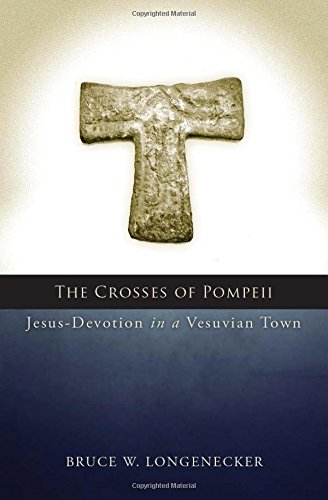
BEN: In the streets of Ephesos, there are also things carved in the street paving stones that people walked on. Famously, there is one which seems to give directions to a brothel in town from the southern agora and port. This evidence might support the notion that things carved in paving stones were meant to be directional in character. I wonder if you have explored other ancient cities like Ephesos for such crosses? Or know of evidence of such from some other person’s scholarly work?
BRUCE:
There is also a bas-relief phallic symbol in the main east-west street of Pompeii that points in the direction of a brothel, about three minutes away from the symbol. It is possible that that symbol served as a marketing device with directional force. That’s disputed, of course, since it isn’t clear that it would have been very effective in that role. But even if it did serve that role, that’s a bit different from much smaller and relatively insignificant crosses being incised into paving stones.
Anyway, I haven’t explored other ancient sites…yet. I’m very interested in Ephesus, however. In that ancient city, there are several examples of “the ichthus wheel,” in which the Greek word ichthus (seemingly representing the slogan “Jesus Christ, Son of God, Savior”) was etched into a few street stones, a wheel that simultaneously replicates the shape of the cross. It might be hard to date those data securely, but however they are to be dated, I’d be surprised if those incisions in the ancient streets of Ephesus served a directional purpose.
BEN: I find your theory that the cross marks in the road having some sort of apotropaic function interesting, even fascinating at points, but not wholly convincing. For one thing, shrines at crossroads were thought to be places where certain positive spirits dwelt and protected the residences. That is, the shrines did not have a merely symbolic function for devotional purposes, they were spots where the genii or good daemons would be, protecting those around. But on your theory if I understand you, the crosses are not places where Jesus shows up to do spiritual warfare, you just have a talisman symbol to ward off the evil spirits — right? The second problem I have with your theory is that the ancients did not envision spirits or genii as confined to the same laws of gravity and physics as human bodies are — i.e. they could go through walls, and certainly did not have to walk down streets to get somewhere. Besides these two factors, it would be rather pointless to set up your cross ‘security system’ in one direction or two directions, but leave wide open access through other streets or passageways. I find it much more likely that the crosses are indeed directional markers to, for instance, the bakery where Christians meet. One of the things clearest to me from spending a good deal of time in port cities like Corinth and Ephesus, is that there were lots of transient Christians looking for fellow Christians and where they met, and at least at Izmir at the agora we seem clearly to have some directional Christian symbols to help point Christians to their fellows. We also have the directional graffiti in the paving stones at Ephesus. I don’t accept an explanation that simply says ‘people coming to a significant sized town would have no difficulty finding fellow Cretans or etc. Why not? There were not, so far as we know Chinatowns or ethnic ghettos in ancient Greco-Roman cities. How would you respond to this?
BRUCE:
Wow, there’s a lot to unpack there. Okay, first, when you say, “on your theory if I understand you, the crosses are not places where Jesus shows up to do spiritual warfare, you just have a talisman symbol to ward off the evil spirits,” I don’t think a distinction of that kind is helpful. The warding off of evil spirits (in this case, through the power of a deity who himself was resurrected from the grip of evil’s power) is precisely the spiritual warfare that concerned most people in the Greco-Roman world.
And when you say that “the ancients did not envision spirits or genii as confined to the same laws of gravity and physics as human bodies are – i.e. they could go through walls” – all that might be true, but that didn’t stop the ancients from placing protective devises precisely at entryways into their houses. As I point out in the book, anthropologists have long recognized this feature of ancient architecture – the entryways have to be guarded from evil entering through them. That’s why so many shrines appear at entryways into houses – to ensure that suprahuman forces favorable to the household are on sentry duty to protect those inside.
There were other ways of drawing protective power to the entryway of premises. We even know of a Jewish inscription at the entryway of a Pompeii house that served this purpose, complete with a five-pointed star. Evidently some Jews protected their households at the entryway, just as their pagan contemporaries did; they just used different apotropaic devices.
This form of protection at entryways is on display over and over again in Pompeii, and tourists can see them displayed there even today. The most famous examples of this are the mosaics of dogs and other potentially fearsome animals (a wild boar, a wounded bear) in the entryway of Pompeian houses. These were not pictures of beloved animals; these mosaics were thought to tap into the power of the animal spirit as a form of fierce protection against any (human or suprahuman) who might seek to disadvantage the household. This was a common phenomenon in the ancient world.
In Ostia, for instance, a floor mosaic of a phallus greets the person who enters a particular house. This was a way of tapping into what Pliny the Elder called “the divine protection of Fascinus” – by which he meant, the suprahuman power of the phallus that served as the “guardian” against evil spirits (Natural History 28.7.39).
The Pompeii bakery in which one of the Christian crosses was found enjoyed precisely this form of protection directly above its oven – a phallic symbol. Depictions of snakes could do the same, since the beneficial spirit of the snake protected the household. The same bakery that displayed a Christian cross at its entryway also had a snake portrait at the same entryway, and a portrait of the snake next to the oven and near the phallic symbol.
And the same bakery stood the center of a system of crosses etched into the paving stones of a particular neighborhood in Pompeii. The problem with seeing the paving stones as a first-century GPS system (leading recently-arrived Christians to the households of other Christians) is that the data can’t fit the theory, for at least two reasons.
First, in order for these paving-stone crosses to have served directional purposes, we would have to imagine that Christians from beyond Pompeii knew of the symbolic value of the cross as a mark of Christian identity. Now while I’m the first to say that the cross was a Christian symbol long before Constantine (see The Cross before Constantine), I cannot establish that it was a symbol in every sector of Christian community, especially at this very early date. It is quite possible that Pompeian Jesus-devotion was indigenously distinct in this understanding of the symbolic function of the cross. Even if we assume that Christians in Pompeii hoped that visiting Christians would seek them out by finding symbolic crosses in key places, the small crosses in the street stones wouldn’t be necessary at all. The bakery around which the crosses converge displayed a cross openly on its wall. As soon as he opened his shop for business, passers-by could easily have seen the cross symbol there. There was no need for small directional signals in the streets.
Second, there is an inscription from Pompeii that refers to Christians, so they were known by their neighbors. It wouldn’t have been hard for Christians to arrive in Pompeii and ask a fish seller in the Forum if he or she knew where Christians resided or met. “Sure, in the bakery just northeast of the Forum Baths. You can’t miss them. They’re the ones with the funny symbol attached to the wall.” Once that contact was made, other contacts would follow from there.
Together with this, it needs to be noted that the idea that Christians wouldn’t have stuck their neck out to have conversations of this kind (which is not something you’ve postulated, Ben, but is in the air of these kind of conversations) comes from an undifferentiated understanding of the pre-Constantinian world. The assumption behind this notion is that every Christian was always fearful for his or her life, so that directional signals would have been needed to avoid asking for directions to residences of Christians, who wouldn’t have wanted their own neighbors to know of their religious commitment. But the material and literary evidence is pretty clear that such a situation did not pertain to every situation throughout the pre-Constantinian world. In fact, as literary sources tell us, the late 60s and 70s was a time of considerable sympathy for Christians, in the aftermath of Nero’s persecution of them from 64-68 or so. The last decade of Pompeii’s life overlaps precisely with the time when a general tolerance of Christians was in the air – a precursor to the time of Constantine in the fourth century.
So anyway, all this is to say that there’s no need to imagine that these paving-stone crosses were directional markers. They served another function altogether.
Previous Post

July 1, 2016
Bruce Longenecker's The Crosses of Pompeii-- Part Four
Next Post
July 3, 2016 Bruce Longenecker's The Crosses of Pompeii-- Part Six
Browse Our Archives
Select a Category Uncategorized
Select a Month October 2026 September 2026 August 2026 July 2026 June 2026 May 2026 April 2026 March 2026 February 2026 January 2026 December 2025 November 2025 October 2025 September 2025 August 2025 July 2025 June 2025 May 2025 April 2025 March 2025 February 2025 January 2025 December 2024 November 2024 October 2024 September 2024 August 2024 July 2024 June 2024 May 2024 April 2024 March 2024 February 2024 January 2024 December 2023 November 2023 October 2023 September 2023 August 2023 July 2023 June 2023 May 2023 April 2023 March 2023 February 2023 January 2023 December 2022 November 2022 October 2022 September 2022 August 2022 July 2022 June 2022 May 2022 April 2022 March 2022 February 2022 January 2022 December 2021 November 2021 October 2021 September 2021 August 2021 July 2021 June 2021 May 2021 April 2021 March 2021 February 2021 January 2021 December 2020 November 2020 October 2020 September 2020 August 2020 July 2020 June 2020 May 2020 April 2020 March 2020 February 2020 January 2020 December 2019 November 2019 October 2019 September 2019 August 2019 July 2019 June 2019 May 2019 April 2019 March 2019 February 2019 January 2019 December 2018 November 2018 October 2018 September 2018 August 2018 July 2018 June 2018 May 2018 April 2018 March 2018 February 2018 January 2018 December 2017 November 2017 October 2017 September 2017 August 2017 July 2017 June 2017 May 2017 April 2017 March 2017 February 2017 January 2017 December 2016 November 2016 October 2016 September 2016 August 2016 July 2016 June 2016 May 2016 April 2016 March 2016 February 2016 January 2016 December 2015 November 2015 October 2015 September 2015 August 2015 July 2015 June 2015 May 2015 April 2015 March 2015 February 2015 January 2015 December 2014 November 2014 October 2014 September 2014 August 2014 July 2014 June 2014 May 2014 April 2014 March 2014 February 2014 January 2014 December 2013 November 2013 October 2013 September 2013 August 2013 July 2013 June 2013 May 2013 April 2013 March 2013 February 2013 January 2013 December 2012 November 2012 October 2012 September 2012 August 2012 July 2012 June 2012 May 2012 April 2012 March 2012 February 2012 January 2012 December 2011 November 2011 October 2011 September 2011 August 2011 July 2011 June 2011 May 2011 April 2011 March 2011 February 2011 January 2011
Follow Us!
TAKE THE
Religious Wisdom Quiz
What was the sign of the new covenant given in Ezekiel's vision?
Select your answer to see how you score.
Gold in the Temple Rebuilt walls A new heart and new spirit Fiery chariots
Books by This Author Books by Ben Witherington
Related posts from The Bible and Culture


The British Library-- Part Two
The British Library-- Part One
TRENDING AT PATHEOS Evangelical

Nearly every morning, I make the drive to Detroit with my high-school-age...

The Real AI Story Is Adoption Without Trust
Artificial intelligence has crossed a political threshold. It is no longer a...

A new article, written by Jeff Lindsay and Gale L. Pooley,...

Swimfan: Forgotten Aughts Pleasures
This is a recovery effort. In 2002, My Big Fat Greek Wedding...

Top Three Anti-Catholic Lies About Catholicism
This is my initial transcript for the video, "THE 3 WORST...

Pope Leo Celebrates Mass for Nurses & Docs...
I don't have any idea how he did it, but Pope Leo...
view all Evangelical blogs
Ad-Free & Subscriber Log-In Subscription Support
- About Us
- 2026 Calendar
- Videos
- Podcasts
- Library of World Religions
- Faith In Media Tracker
- Advertise With Us
- Write for Us
- Privacy Policy
- Terms of Service
- Do Not Sell My Data
- Contact Us
- Radiant Digital
- Manage Newsletter Subscriptions
- Unsubscribe From Notifications
- Sitemap
Copyright 2008-2026, Patheos. All rights reserved.
Subscription Support Ad-Free & Subscriber Log-In
Follow Patheos