
BuddhistCatholicContemplativeEvangelicalGeneral ChristianHinduJewishLatter-day SaintMuslimNew VisionsProgressive Christian
Beliefs
- Buddhist
- Catholic
- Contemplative
- Evangelical
- General Christian
- Hindu
- Jewish
- Latter-day Saint
- More Voices
- Muslim
- New Visions
- Pagan
- Progressive Christian
Topics
- Religion News
- Food and Religion
- Sports and Religion
- Religious Art
- Religious Music and Entertainment
- Religious Events
- History and Religion
- Style and Religion
- Politics and Religion
- Women in Religion
- Recreation Outdoors and Religion
- Business Finance and Religion
- Careers Workplace and Religion
- Education and Religion
- Family Parenting and Religion
- Health Fitness and Religion
- Home and Religion
- Relationships and Religion
- Technology and Religion
- Travel and Religion
Columnists
- Buddhist Columnists
- Business Finance and Religion Columnists
- Careers Workplace and Religion Columnists
- Catholic Columnists
- Contemplative Columnists
- Education and Religion Columnists
- Evangelists Columnists
- Family Parenting and Religion Columnists
- General Christian Columnists
- Health Fitness and Religion Columnists
- Hindu Columnists
- History and Religion Columnists
- Home and Religion Columnists
- Jewish Columnists
- More Voices Columnists
- Latter Day Columnists
- Muslim Columnists
- New Visions Columnists
- Nonreligious Columnists
- Pagan Columnists
- Politics and Religion Columnists
- Progressive Columnists
- Recreation Outdoors and Religion Columnists
- Relationships and Religion Columnists
- Religion News Columnists
- Religious Art Columnists
- Religious Events Columnists
- Religious Music and Entertainment Columnists
- Sports and Religion Columnists
- Style and Religion Columnists
- Technology and Religion Columnists
- Travel and Religion Columnists
- Women in Religion Columnists
Resource Library
- 2026 Calendar
- Library of World Religions
- The 100 Most Holy Places on Earth
- Patheos Answers
- Podcasts
- Videos
- Faith Leaders Database
- Anglican Episcopalian
- Bahai
- Baptist
- Buddhism
- Christianity
- Confucianism
- Eastern Orthodoxy
- Hinduism
- Holiness and Pentecostal
- ISKCON
- Islam
- Judaism
- Lutheran
- Methodist
- The Church of Jesus Christ of Latter-day Saints
- New Age
- Paganism
- Presbytarian and Reformed
- Protestantism
- Religion Behind the Scenes
- Roman Catholic
- Scientology
- Shia Islam
- Sikhism
- Sufism
- Sunni Islam
- Taoism
- Zen
- See all religions
Research Tools
 Ad-Free & Subscriber Log-In Subscription Support
Ad-Free & Subscriber Log-In Subscription Support
Follow Patheos 

- Trending:
- Forgiveness
- |
- Marriage
- |
- Consciousness
- |
- Death Penalty
- |
- Election
- |
- Halloween

- Home
- Evangelical
- Jesus is Lord, Caesar is Not: Part Five
Jesus is Lord, Caesar is Not: Part Five
Last updated on: March 13, 2015 at 10:51 pm by Ben Witherington
Jesus is Lord, Caesar is Not: Part Five 2015-03-13T22:51:13-04:00 Ben Witherington
Patheos Explore the world's faith through different perspectives on religion and spirituality! Patheos has the views of the prevalent religions and spiritualities of the world.
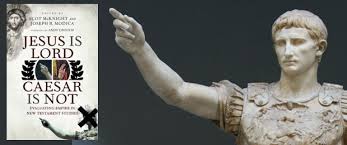
AN INTERVIEW WITH SCOT MCKNIGHT
Ben: It appears that the purpose of this book was to offer a certain tempering of the recent rhetoric about the anti-imperial rhetoric found in the NT? Yes?
Yes, in part, but only because both Joe and I thought the entire issue was getting out of hand. We didn’t, however, actually know all that much about what the individual authors in the volume thought about all the issues. We wanted an even-handed analysis of the evidence being used for anti-imperial rhetoric found in the NT. When a study like Walsh-Keesmaat can get the kind of naïve acceptance we saw among some we thought there was a reason to give the whole theme a new look. Joe and I each, independently, had already observed that this theme was too often concerned with Bush, and we have seen a noticeable absence of the theme in the Obama years. Ironically, Brian Walsh at the IBR meeting asked a public question: “Have you learned nothing from Bush?” It was to me an obvious slip of admitting the Bush years shaped what they were seeing in Colossians.
B: Perhaps you and I are just getting old, but on the surface of things it appears you deliberately chose mostly young scholars, one even not finished with dissertation, to write this volume. Why that decision, and what benefits do you think it brought to the table?
Joe had asked a few; I asked a few; Joel Willitts as a colleague and friend suggested a few names to me of folks who had touched on such themes in various authors of the New Testament. I don’t recall having a conversation to ask younger scholars, but I am committed (as you can see in the Story of God Bible Commentary) to enlist the younger scholars when we can. I am grateful that a few publishers stuck their neck out for me when I was young and so I’ve had a bent toward gathering the next generation’s scholars into projects when possible.
Plus, is there any doubt what some of us older rank professors would think about such topics?
B: One of the things that did surprise me about the book is that the sovereignty of God hardly came up. By this I mean, that traditionally Jews who often suffered from the empires of the ANE would respond to such not with anti-imperial rhetoric, but rather by assuring the faithful that despite appearances to the contrary, God was still in charge of the world, and after all empires rise and fall, and God’s reign would endure and out last them. In other words, I don’t see much discussion about how the Kingdom of God language in the NT should have relativized or minimized even the felt need for sharp Empire criticism on the part of the NT authors. Did this surprise you when you read and edited these essays?
Ben, this is a good point. As I think through the essays the categories were established by what the empire critics were using to prove their points, and I don’t recall that being much of a topic among the empire critics. In fact, their leanings are toward activism if not rebellion. So, instead of offering a positive counter-proposal, which would surely include God’s sovereignty over history (as we see so forcefully in Tom Wright’s Paul books as he has updated his own empire criticism, which I see as an improvement of his older version), our authors addressed the critics and how they were framing the topics. The same applies to kingdom of God – had the topic been what the NT actually says when it comes to the nations and empires, that would have come up (I would hope).
B: From time to time in these essays the issue of hidden scripts, or coded language comes up, with the verdict being sort of yes and no when one applies that idea to the NT. Yes, in the case of an apocalyptic book like Revelation, but no in general, not least because the NT documents were not public documents, not broadsheets nailed to a post in the agora, they were insider literature, with little need or motive for insider language. After you read these essays, did your views on this issue change, or remain the same, and in either case—- Why?
Hidden scripts… that was one theme I would like to have seen more theoretical attention to. There is a new research (by Christoph Heilig) addressing the methodological issue of discovering hidden scripts that will take this entire issue to a new level – using some sophisticated mathematics! This is probably the most irritating feature of the empire critics, and the argument often goes like this: “If you knew Roman or Greek sources, as I know and can’t detail here extensively, you’d know this language in [insert NT author] is profoundly anti-empire and subversive.” Well, the odd thing for me is that every time Paul actually mentions Rome he’s positive, and I don’t think Paul was a cowering, fearful speaker. He’d have thumped Caesar in the nose had he wanted to. The hidden subversions of Romans 13 have never convinced me.
B: One of the more constant themes in these essays is that monotheists of course could not abide any kind of idolatry, which of course included the emperor cult, but that it does not seem that many or most of the NT documents single out the new cult on the block, the Emperor cult, for special criticism. Would you agree?
Yes, I agree with this. The impression I get from our essayists is that the authors of the NT were not as concerned with Rome’s power and Rome’s religion near as much as some think. What we do see is the Roman power ideology under withering critique in the Pauline ethical stances, not least being the cross and denying one’s status. Joe Hellerman’s two books on this theme are outstanding displays of Paul cutting into Roman power ideologies, but I see very little direct address to the issues of imperial worship. It is in Acts, clearly, and Kavin Rowe has helped us all here, but as an overall immediate implication of kingdom or Lord, I’m not so sure.
Scot: Ben, a question back to you: I grew up in this field reading JB Lightfoot, BF Wescott, and FF Bruce, and while they were brilliantly aware of the Roman ideologies and Caesar’s reach, I don’t recall their making much of Paul or John or Peter, or Jesus, having an agenda against the Roman imperial worship and ideology. I did grow up knowing that calling Jesus “Lord” had some potency in that world, but I don’t recall their making a big deal of this. If I’m right in this description, then those who were most familiar with this literature – far more than most empire critics today – did not see all that is being seen today.
B: I completely agree, and these new volumes on Lightfoot I’m publishing just further that point. There is nothing said about it at all, even when we get to John 1 and the calling of Jesus God, Lord, and Savior. Nothing.
B: Finally, for a somewhat more probing question, the presentation of government and a Christian’s relationship to government in the NT is varied. When the pagan government becomes idolatrous or abusive or engages in over-reach, then there is criticism, even sharp criticism that governments and rulers can become the tools of the demonic, agents of evil. This we see rather clearly in Revelation. But when that government is not behaving in this manner, we tend to hear things like ‘obey the governing officials’ and ‘all governing officials (even Nero apparently in Romans) have authority and power which devolves from God’ or ‘pay your taxes’. What do you make of this variety of responses to government in the NT? It seems that the specifics of the social situation determines what is said about the matter.
I totally agree. The earliest Christians were so miniscule they simply did not have designs on the empire. They knew the overwhelming power of the Roman empire and Caesar and his various representatives; they knew the way to get along was to be good (1 Peter). When Rome demanded too much, they went with God. Otherwise, they saw Rome as the pagan empire and someday coming down under the good hand of God’s judgment, but in the meantime they were to be good people and be gospelers. Their politics was the church. So the positives are probably as much pragmatics as they were theory.
Previous Post

October 13, 2014
The Bible and Science--- Some Reflections
Next Post
October 14, 2014 Reading and Understanding the Bible-- A Guide for the Perplexed
Browse Our Archives
Select a Category Uncategorized
Select a Month October 2026 September 2026 August 2026 July 2026 June 2026 May 2026 April 2026 March 2026 February 2026 January 2026 December 2025 November 2025 October 2025 September 2025 August 2025 July 2025 June 2025 May 2025 April 2025 March 2025 February 2025 January 2025 December 2024 November 2024 October 2024 September 2024 August 2024 July 2024 June 2024 May 2024 April 2024 March 2024 February 2024 January 2024 December 2023 November 2023 October 2023 September 2023 August 2023 July 2023 June 2023 May 2023 April 2023 March 2023 February 2023 January 2023 December 2022 November 2022 October 2022 September 2022 August 2022 July 2022 June 2022 May 2022 April 2022 March 2022 February 2022 January 2022 December 2021 November 2021 October 2021 September 2021 August 2021 July 2021 June 2021 May 2021 April 2021 March 2021 February 2021 January 2021 December 2020 November 2020 October 2020 September 2020 August 2020 July 2020 June 2020 May 2020 April 2020 March 2020 February 2020 January 2020 December 2019 November 2019 October 2019 September 2019 August 2019 July 2019 June 2019 May 2019 April 2019 March 2019 February 2019 January 2019 December 2018 November 2018 October 2018 September 2018 August 2018 July 2018 June 2018 May 2018 April 2018 March 2018 February 2018 January 2018 December 2017 November 2017 October 2017 September 2017 August 2017 July 2017 June 2017 May 2017 April 2017 March 2017 February 2017 January 2017 December 2016 November 2016 October 2016 September 2016 August 2016 July 2016 June 2016 May 2016 April 2016 March 2016 February 2016 January 2016 December 2015 November 2015 October 2015 September 2015 August 2015 July 2015 June 2015 May 2015 April 2015 March 2015 February 2015 January 2015 December 2014 November 2014 October 2014 September 2014 August 2014 July 2014 June 2014 May 2014 April 2014 March 2014 February 2014 January 2014 December 2013 November 2013 October 2013 September 2013 August 2013 July 2013 June 2013 May 2013 April 2013 March 2013 February 2013 January 2013 December 2012 November 2012 October 2012 September 2012 August 2012 July 2012 June 2012 May 2012 April 2012 March 2012 February 2012 January 2012 December 2011 November 2011 October 2011 September 2011 August 2011 July 2011 June 2011 May 2011 April 2011 March 2011 February 2011 January 2011
Follow Us!
TAKE THE
Religious Wisdom Quiz
Who was the ruler of Egypt during Joseph's time?
Select your answer to see how you score.
Cyrus Nebuchadnezzar Pharaoh Caesar
Books by This Author Books by Ben Witherington
Related posts from The Bible and Culture


Methodist Central Hall and Westminster Abbey


TRENDING AT PATHEOS Evangelical

The Problem with False Prophets
Miller’s Station UMC| 10/18/26| Anchor Verse: Jeremiah 23: 1, 9-23 I...

Emotion in Early Christianity by Andrew Crislip
Andrew Crislip’s Emotion in Early Christianity examines an often overlooked dimension of...

16 Spiritual Touchstones for a More Grounded Life
After decades of spiritual study, here are 16 principles I try...

Catholic Evangelization: Sharing Your Faith Every Day
Welcome back to the Graceful Awakening mini-series called, “From Faith to Mission.” ...

The Pillar of the Boatmen: the Ancient Monument...
The Pillar of the Boatmen is a Romano-Gaulish sculpture that dates from...

In one sense walking into Westminster Abbey is like walking down the...
view all Evangelical blogs
Ad-Free & Subscriber Log-In Subscription Support
- About Us
- 2026 Calendar
- Videos
- Podcasts
- Library of World Religions
- Faith In Media Tracker
- Advertise With Us
- Write for Us
- Privacy Policy
- Terms of Service
- Do Not Sell My Data
- Contact Us
- Radiant Digital
- Manage Newsletter Subscriptions
- Unsubscribe From Notifications
- Sitemap
Copyright 2008-2026, Patheos. All rights reserved.
Subscription Support Ad-Free & Subscriber Log-In
Follow Patheos