
BuddhistCatholicContemplativeEvangelicalGeneral ChristianHinduJewishLatter-day SaintMuslimNew VisionsProgressive Christian
Beliefs
- Buddhist
- Catholic
- Contemplative
- Evangelical
- General Christian
- Hindu
- Jewish
- Latter-day Saint
- More Voices
- Muslim
- New Visions
- Pagan
- Progressive Christian
Topics
- Religion News
- Food and Religion
- Sports and Religion
- Religious Art
- Religious Music and Entertainment
- Religious Events
- History and Religion
- Style and Religion
- Politics and Religion
- Women in Religion
- Recreation Outdoors and Religion
- Business Finance and Religion
- Careers Workplace and Religion
- Education and Religion
- Family Parenting and Religion
- Health Fitness and Religion
- Home and Religion
- Relationships and Religion
- Technology and Religion
- Travel and Religion
Columnists
- Buddhist Columnists
- Business Finance and Religion Columnists
- Careers Workplace and Religion Columnists
- Catholic Columnists
- Contemplative Columnists
- Education and Religion Columnists
- Evangelists Columnists
- Family Parenting and Religion Columnists
- General Christian Columnists
- Health Fitness and Religion Columnists
- Hindu Columnists
- History and Religion Columnists
- Home and Religion Columnists
- Jewish Columnists
- More Voices Columnists
- Latter Day Columnists
- Muslim Columnists
- New Visions Columnists
- Nonreligious Columnists
- Pagan Columnists
- Politics and Religion Columnists
- Progressive Columnists
- Recreation Outdoors and Religion Columnists
- Relationships and Religion Columnists
- Religion News Columnists
- Religious Art Columnists
- Religious Events Columnists
- Religious Music and Entertainment Columnists
- Sports and Religion Columnists
- Style and Religion Columnists
- Technology and Religion Columnists
- Travel and Religion Columnists
- Women in Religion Columnists
Resource Library
- 2026 Calendar
- Library of World Religions
- The 100 Most Holy Places on Earth
- Patheos Answers
- Podcasts
- Videos
- Faith Leaders Database
- Anglican Episcopalian
- Bahai
- Baptist
- Buddhism
- Christianity
- Confucianism
- Eastern Orthodoxy
- Hinduism
- Holiness and Pentecostal
- ISKCON
- Islam
- Judaism
- Lutheran
- Methodist
- The Church of Jesus Christ of Latter-day Saints
- New Age
- Paganism
- Presbytarian and Reformed
- Protestantism
- Religion Behind the Scenes
- Roman Catholic
- Scientology
- Shia Islam
- Sikhism
- Sufism
- Sunni Islam
- Taoism
- Zen
- See all religions
Research Tools
 Ad-Free & Subscriber Log-In Subscription Support
Follow Patheos 

- Trending:
- Advent
- |
- Forgiveness
- |
- Thanksgiving
- |
- Election
- |
- Seasonal Holidays
- |
- Marriage

- Home
- Evangelical
- Self-Designations and Group Identity– Part Seven
Self-Designations and Group Identity– Part Seven
Last updated on: March 13, 2015 at 11:05 pm by Ben Witherington
Self-Designations and Group Identity– Part Seven 2015-03-13T23:05:20-04:00 Ben Witherington
Patheos Explore the world's faith through different perspectives on religion and spirituality! Patheos has the views of the prevalent religions and spiritualities of the world.
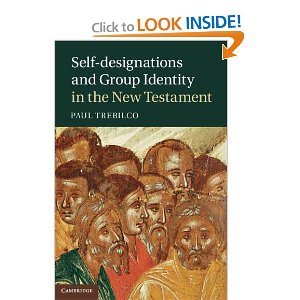
It will come as some surprise to many that the term ‘Christian’ or in this case ‘christianos’ in the Greek, is found exactly three times in the NT, no more, and no less. Paul does not use the term at all, he rather speaks of those who are ‘in Christ’, which has a different sense than ‘christianos’. The former tells you where they are, the latter tells you who they are the adherents of. The three NT occurrences are two in Acts (11.25-26; 26.28), and one in 1 Peter 4.16. That’s all folks. It also occurs in the Apostolic Fathers– five times in Ignatius, once in the Didache (12.4), four times in the martyrdom of Polycarp (in chapters 3,10,12) and 14 times in the apologetical document the Epistle to Diognetus.
One of the clues that Trebilco rightly highlights to understanding this term and its provenance is that ‘christianos’ is a Latinism– the use of a Latin term in this case christianus which is turned into a Greek term by changing the ending so it suits a Greek language context. In this case it is like the term Herodianos– the partisans or adherents of Herod. Here finally we have a term that is regularly used by outsiders of Christians and we find it in Josephus, Tacitus, Pliny, Suetonius and Trajan. This comports with the suggestion that like the label ‘Methodist’ it was originally an outsider term used to identify a particular group, in this case a religious group, and used to distinguish them from ordinary Jews. Also like the term Methodist, it is used by Tacitus and others in a pejorative way. Luke however turns this around and uses it in a positive way, since it squarely labels who these believers are the followers of, adherents to, and believers in— Christ.
Acts 11.25-26 suggests Luke is citing an historical source and giving a report— in Antioch is where they were first called Christians… and the question must be— by whom?? Not,to judge from Paul’s letters, by Christians themselves (see pp. 276-77). I agree with Trebilco that the designation was likely coined by Gentiles not Jews, as Jews who were not Christians would not call Jesus ‘the Christ’ whereas Gentiles would simply take the term Christos to mean the anointed or daubed one— not a very special term (christos as an adjective in any case is found on ancient perfume bottles meaning for external application only– i.e. for anointing not dipping bread in). It is even possible that the term was first coined by Roman administrators like Felix, though in this case in Antioch (so presumably by an official from the Syrian province). If it is true that Agrippa II and Felix used the term it was used at least as early as the late 50s A.D.
In 1 Peter however, the term is used by a Christian as a term of honor. If in fact it was first used in Antioch in the late 30s early 40s as Acts 11 may suggest, then Peter could have heard it there (see Galatians 2) and adapted it for his own purposes later, writing from Rome. David Horrell is cited approvingly by Trebilco when he stresses that creative reinterpretation of a derogatory phrase is a classic practice of a new religious or political group (p. 284). Peter in 1 Peter seems to assume his audience all over eastern and northern Turkey already knows the meaning of this term. It is important to remember that all the NT documents are written to Christians, and so are insider facing documents. Any use of the term christianos in such documents is for Christian’s benefit, and assumes their understanding of the term. But clearly the term continued to be used by outsiders of Christians as the evidence from Tacitus and Pliny etc. shows, as does the evidence in Ignatius as well who takes the term to be such a badge of honor that one can only really live into it if one is martyred like Christ. Not accidentally both Polycarp and the author of the letter to Diognetus are writing to outsiders and use the term frequently. It had become a label known both inside and outside the church. So important does the label become, that by the time of Pliny in Bithynia in the early second century confessing or denying one is a christianos can be the ultimate litmus test and a matter of life and death (see Pliny’s Epistle 10.96-97). It proved to be a label that stuck and was embraced by Christians then, and continually sense.
As Trebilco’s fine book shows, the earliest Christians were creative and had a variety of ways of talking about themselves, even embracing some outsider labels and using them positively. They truly saw themselves as the true people of God, ardently believing in and following Christ, regularly assembling together, being pilgrims on the way, disciples of a master who was more than a teacher, and more than that they saw themselves as family, a new eschatological family of faith which is the terminology they seem to have used most frequently with each other– brothers and sisters in Christ. The use of the seven terms we have been examining helped boundary definition for Christians, and helped them understand who and whose they were.
The real implications of the study become clear in the Conclusions (see especially p. 306) where it becomes clear that the terminology is exclusive in various ways– if we are the believers, others are not. If we are the saints, others are not. If we are the followers of the right way, others are not. The very terminology reflects, and helps pave the parting of the ways with Judaism. Jewish self-definition is very different from what is meant by these terms, especially as they point to belief in and emulation of Christ. Christians do not call themselves ever in this literature the baptised ones. Contrast this with ‘the circumcision’ terminology for Jews. Once a significant number of pure pagans became Christ followers without ever being God-fearers, or the like, and are accepted simply on the basis of their faith in Christ and following him, we are already de facto talking about a non-ethnically based religion which while it has Jews roots, sees itself as the natural and true development of God’s people— Jew and Gentile united in Christ. The language which Jewish Christians saw as fulfillment or completionism language, is the same language non-Christian Jews saw as not merely sectarian but as supercessionism— and rightly so. When Paul in 2 Cor. 3 or the author of Hebrews in various places indicates that the Mosaic covenant was pro tempore, and now obsolete in light of the new covenant and in light of Christ, clearly the discussion has simply accepted the parting of the ways and moved on. It appears to me that this was already happening in the 40s and during Paul’s ministry. As Trebilco points out, Christians could no longer call Jews ‘hagioi’ because what they now meant by the term was set apart by and for Christ, or in the case of the use of believer terminology it meant something specific, belief in Christ, something that could not be said of non-Christian Jews (see p. 309). On p. 310 Trebilco makes a misstep when suggesting that what Paul is saying is that Gentiles are being grafted into non-Christian Israel. This is not correct. In regard to Jews who reject Jesus, Paul says they are branches broken off from the olive tree, albeit temporarily so Gentiles could be grafted in. For Paul the line of continuity goes from OT saints to Jewish Christians to Gentile Christians. Gentile Christians are grafted into the inheritance of Abraham through being united with Jewish Christians… the ‘true Jews’ in Paul’s view. True enough, God has a plan by which all Israel will be saved (see Rom. 11.25-26) but the plan is for them to be grafted back in by grace through faith in Jesus when he returns to turn away the impiety of Jacob at the second coming. In other words, there will not be any people of God who doesn’t confess Jesus is Lord in the end. Paul does not believe in the notion that there has ever been two peoples of God co-existing at the same time.
I cannot recommend this book highly enough, because it is truly thorough in what it sets out to do, even if one could have wished for less old style word studies and more new fangled social identity theory analysis. Even so, it is one of the best books written on the NT is a good while.
Previous Post

November 24, 2012
The Life of Pi---- Gets a 3.14 rating
Next Post
November 26, 2012 Adrian Warnock on What is a Christian?
Browse Our Archives
Select a Category Uncategorized
Select a Month November 2026 October 2026 September 2026 August 2026 July 2026 June 2026 May 2026 April 2026 March 2026 February 2026 January 2026 December 2025 November 2025 October 2025 September 2025 August 2025 July 2025 June 2025 May 2025 April 2025 March 2025 February 2025 January 2025 December 2024 November 2024 October 2024 September 2024 August 2024 July 2024 June 2024 May 2024 April 2024 March 2024 February 2024 January 2024 December 2023 November 2023 October 2023 September 2023 August 2023 July 2023 June 2023 May 2023 April 2023 March 2023 February 2023 January 2023 December 2022 November 2022 October 2022 September 2022 August 2022 July 2022 June 2022 May 2022 April 2022 March 2022 February 2022 January 2022 December 2021 November 2021 October 2021 September 2021 August 2021 July 2021 June 2021 May 2021 April 2021 March 2021 February 2021 January 2021 December 2020 November 2020 October 2020 September 2020 August 2020 July 2020 June 2020 May 2020 April 2020 March 2020 February 2020 January 2020 December 2019 November 2019 October 2019 September 2019 August 2019 July 2019 June 2019 May 2019 April 2019 March 2019 February 2019 January 2019 December 2018 November 2018 October 2018 September 2018 August 2018 July 2018 June 2018 May 2018 April 2018 March 2018 February 2018 January 2018 December 2017 November 2017 October 2017 September 2017 August 2017 July 2017 June 2017 May 2017 April 2017 March 2017 February 2017 January 2017 December 2016 November 2016 October 2016 September 2016 August 2016 July 2016 June 2016 May 2016 April 2016 March 2016 February 2016 January 2016 December 2015 November 2015 October 2015 September 2015 August 2015 July 2015 June 2015 May 2015 April 2015 March 2015 February 2015 January 2015 December 2014 November 2014 October 2014 September 2014 August 2014 July 2014 June 2014 May 2014 April 2014 March 2014 February 2014 January 2014 December 2013 November 2013 October 2013 September 2013 August 2013 July 2013 June 2013 May 2013 April 2013 March 2013 February 2013 January 2013 December 2012 November 2012 October 2012 September 2012 August 2012 July 2012 June 2012 May 2012 April 2012 March 2012 February 2012 January 2012 December 2011 November 2011 October 2011 September 2011 August 2011 July 2011 June 2011 May 2011 April 2011 March 2011 February 2011 January 2011
Follow Us!
TAKE THE
Religious Wisdom Quiz
Which prophet was told to eat a scroll in a vision?
Select your answer to see how you score.
Ezekiel Joel Daniel Obadiah
Books by This Author Books by Ben Witherington
Related posts from The Bible and Culture

Rock N' Roll-- Morphing into/for a New Generation...

Salisbury Cathedral (outside)-- Part Four
Salisbury Cathedral (the windows)-- Part Three
Salisbury Cathedral-- Part Two
TRENDING AT PATHEOS Evangelical

Thomas Paine, the Smiths, the apostles in England,...
I'm pleased to announce that the Becoming Brigham Black Friday Sale,...

CatholicTV Series: Six Black Catholics on Path to...
WATERTOWN, Mass., November 9, 2026 – In recognition of Black Catholic History...

New Advent Journal Invites Catholics to Be Pilgrims
Florissant, MO, November 16, 2026— What if Advent were more than a...

INNER CIRCLE: John's Quantum Gospel
INTRODUCTION In this next Inner Circle series, which I anticipate will...
"Three B's" of My Apologetics Ministry (+ VIDEO)
In early December 2026 (less than a week from the time...

James Ishmael Ford's books on Zen
James Ishmael Ford's Official Website provides the most complete annotated list of...
view all Evangelical blogs
Ad-Free & Subscriber Log-In Subscription Support
- About Us
- 2026 Calendar
- Videos
- Podcasts
- Library of World Religions
- Faith In Media Tracker
- Advertise With Us
- Write for Us
- Privacy Policy
- Terms of Service
- Do Not Sell My Data
- Contact Us
- Radiant Digital
- Manage Newsletter Subscriptions
- Unsubscribe From Notifications
- Sitemap
Copyright 2008-2026, Patheos, part of the Radiant Digital network of media brands. All rights reserved.
Subscription Support Ad-Free & Subscriber Log-In
Follow Patheos