
BuddhistCatholicContemplativeEvangelicalGeneral ChristianHinduJewishLatter-day SaintMuslimNew VisionsProgressive Christian
Beliefs
- Buddhist
- Catholic
- Contemplative
- Evangelical
- General Christian
- Hindu
- Jewish
- Latter-day Saint
- More Voices
- Muslim
- New Visions
- Pagan
- Progressive Christian
Topics
- Religion News
- Food and Religion
- Sports and Religion
- Religious Art
- Religious Music and Entertainment
- Religious Events
- History and Religion
- Style and Religion
- Politics and Religion
- Women in Religion
- Recreation Outdoors and Religion
- Business Finance and Religion
- Careers Workplace and Religion
- Education and Religion
- Family Parenting and Religion
- Health Fitness and Religion
- Home and Religion
- Relationships and Religion
- Technology and Religion
- Travel and Religion
Columnists
- Buddhist Columnists
- Business Finance and Religion Columnists
- Careers Workplace and Religion Columnists
- Catholic Columnists
- Contemplative Columnists
- Education and Religion Columnists
- Evangelists Columnists
- Family Parenting and Religion Columnists
- General Christian Columnists
- Health Fitness and Religion Columnists
- Hindu Columnists
- History and Religion Columnists
- Home and Religion Columnists
- Jewish Columnists
- More Voices Columnists
- Latter Day Columnists
- Muslim Columnists
- New Visions Columnists
- Nonreligious Columnists
- Pagan Columnists
- Politics and Religion Columnists
- Progressive Columnists
- Recreation Outdoors and Religion Columnists
- Relationships and Religion Columnists
- Religion News Columnists
- Religious Art Columnists
- Religious Events Columnists
- Religious Music and Entertainment Columnists
- Sports and Religion Columnists
- Style and Religion Columnists
- Technology and Religion Columnists
- Travel and Religion Columnists
- Women in Religion Columnists
Resource Library
- 2026 Calendar
- Library of World Religions
- The 100 Most Holy Places on Earth
- Patheos Answers
- Podcasts
- Videos
- Faith Leaders Database
- Anglican Episcopalian
- Bahai
- Baptist
- Buddhism
- Christianity
- Confucianism
- Eastern Orthodoxy
- Hinduism
- Holiness and Pentecostal
- ISKCON
- Islam
- Judaism
- Lutheran
- Methodist
- The Church of Jesus Christ of Latter-day Saints
- New Age
- Paganism
- Presbytarian and Reformed
- Protestantism
- Religion Behind the Scenes
- Roman Catholic
- Scientology
- Shia Islam
- Sikhism
- Sufism
- Sunni Islam
- Taoism
- Zen
- See all religions
Research Tools
 Ad-Free & Subscriber Log-In Subscription Support
Ad-Free & Subscriber Log-In Subscription Support
Follow Patheos 

- Trending:
- Forgiveness
- |
- Marriage
- |
- Consciousness
- |
- Death Penalty
- |
- Election
- |
- Halloween

- Home
- Evangelical
- Margaret Mitchell’s Paul, The Corinthians, and the Birth of Hermeneutics Part Three
Margaret Mitchell’s Paul, The Corinthians, and the Birth of Hermeneutics Part Three
Last updated on: March 13, 2015 at 11:06 pm by Ben Witherington
Margaret Mitchell’s Paul, The Corinthians, and the Birth of Hermeneutics Part Three 2015-03-13T23:06:48-04:00 Ben Witherington
Patheos Explore the world's faith through different perspectives on religion and spirituality! Patheos has the views of the prevalent religions and spiritualities of the world.
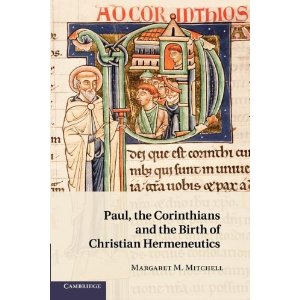
Towards the end of Margaret Mitchells book (at the beginning of what was her final lecture), Margaret cites a person who has been her regular dialogue partner in this book— Gregory of Nyssa. Here is what he says (cited on page 95):
“One could collect from the rest of the prophetic corpus countless examples in addition to these of the necessity of the ‘theoria'[i.e. contemplative]-reading that accords with the sense of the words. If the ‘theoria’ is rejected however, as pleases some people, the result is what seems to me to be the same as if someone might lay out unworked grain on a table for human beings to eat… without peeling back the stalk, without separating the kernel from the husks by winnowing, without threshing the grain into flour, without preparing bread in a way suitable for the baking arts. Consequently, just as unworked produce is food for beasts and not for humans, thus one could say that the divinely inspired words of scripture not only of the Old Testament, but also many words of the gospel teaching–if they have not been worked over by the refinement of ‘theoria’, are food for irrational rather than rational beings. These gospel words include the winnowing wand that clears the threshing floor, the chaff is blown away, the grain that remains at the feet of the winnower, the unquenchable fire, the good storehouse (Matt. 3.12) the tree that produces evil fruits, the threat of the axe that frighteningly shows its sharp blade to the tree (Matt. 3.10) the stones that take place of human nature (Matt. 3.9) (from his Song of Songs Commentary Prologue).
The point of this little parable is that texts do not easily release their treasures. They must be worked over by intelligent readers who are ready for serious labor, who anticipate the feast that is to come, according to Mitchell (p. 96).
The art of interpreting complex texts, never mind figurative texts like parables is neither easy nor is the skill to do it easily acquired. And yet still, as Mitchell says, Paul with no little irony can say to his rather error=prone readers in 2 Cor. 1.13– ‘we do not write to you anything but what you read and understand.’ Clearly, this sentence must be ironic in character, for if the Corinthians had truly understood 1 Corinthians, Paul would not have needed to write the discourse in which we find this very sentence. If there is one thing I have learned in the last 30 years it is this— if you are unable to read the rhetorical signals of a text like this (i.e. in this case when it is ironic, and when it is deadly serious) you are bound to misinterpret it in a whole new fashion.
There thus arises two problems, one of which has to do with the text, and one of which has to do with its readers. That Paul’s letters were heavy weather is evident not only from 2 Pet. 3 where we hear ‘there are some things in Paul’s letters difficult to understand which the ignorant and unstable twist to their own destruction’ but also from so careful a reader as John Donne who says ‘wheresoever I open Paul’s letters I hear thunder, a thunder which rolls throughout all the earth’.
In short, the meaning the Pauline text is not always self-evident, requires a careful reading and indeed a careful contextual study that is rhetorically adept, and even if with such a reading the text becomes clear, there is the further problem that the reader may be ‘cloudy’ or as the author of 2 Pet. 3 puts it either ignorant or unstable or both, and prone to twist the text in their own preferred directions.
The analogy of Gregory of course suggests that the hermeneut or preacher or teacher has a lot of work to do with the text before it becomes not merely palatable but nourishing to a given audience. This is in part because the text is complex, or because the text is figural or because the genre of the text requires prior understanding (e.g. parables, or the coded language of apocalyptic prophecy).
And then of course there is the problem that a literal reading of a figural or fictional or poetic text is a violation of the way the author intended the text to be read or heard in the first place. Sometimes the speaker expects the audience to attend to the surface meaning of what he says, sometimes the speaker intends for the audience to read his intent more than the mere words on his lips, sometimes the speaker conveys a meaning through tone of voice that would belie the surface meaning if read off cold— for example when Paul says to the Corinthians “I resolved to know nothing among you but Christ and him crucified” and then of course he went on to ‘know’ many other things among them as well, and to discourse on many other things in 1 Corinthians as well.
Paul’s letters are full of such things— consider for example ‘For even if I made you sorry with my letter, I do not regret it, (though I did regret it, for I see that I grieved you with that letter, though only briefly). Now I rejoice, not because of you were grieved, but because your grief led to repentance, for you felt a godly grief, so that you were not harmed in any way by us.” So now we learn there are: 1) several kinds of grief, and 2) Paul only intended the good kind, and 3) he was glad that the good kind happened that led to repentance and renewal of relationship though he says initially he didn’t want to cause them any grief.
The point Mitchell makes is not so much that Paul is slippery, as that what he says is part of an ongoing conversation which cannot really be frozen in time, and has to be interpreted in light of what he said both before and after he said this, has to be interpreted in light of whether it’s tongue in cheek or merely cheeky, has to be interpreted according to the sort of rhetoric and genre it is, and so on.
What all the above suggests is that not merely Mitchell, but Gregory was right in saying that Christians need a guide to the perplexing nature of some of this scriptural material. Having a good translation and a decent mind and the Holy Spirit is apparently not enough in many cases to lead to full understanding of the Scriptures.
Of course, this flies in the face of the fundamentalist assumptions that: 1) those resources are perfectly adequate for interpreting the Bible because, 2) the text is perfectly clear if we just sincerely apply ourselves to the text calling on the Spirit to guide us, and 3) if we are alert, and spiritually attuned then the text itself couldn’t possibly be all that complex, or require detailed study, say in the original languages and contexts in which it was given.
Of course not. That’s too much like hard work. That sort of study often means being dependent on other people, trustworthy guides from the past to help one understand the Bible. It requires study in concert with the rest of the body of Christ over many generations. And that’s a violation of my personal autonomy and my belief that me and Jesus and the Spirit and the Word are all I need to ‘rightly divide the word of truth’.
The truth is, over 2,000 years of water has gone under the bridge, and we all need all the help we can get, mundane and supernatural, to understand these Biblical texts, and not muck up their interpretation. God has given us not merely a Book, he has given us a body of Christ to help us understand the Book, he has given us not merely a mind for what matters, he has given us challenging texts to stretch that mind so that we actually learn new things, actually change our views and sedentary ways, actually grow in Christ.
Certainly, I agree that ancient texts have meaning which has to be figured out in light of their original contexts. The texts still have those same meanings, though their significances and applications change with each situation and generation. Margaret Mitchell calls us to a rebirth of humility when it comes to interpreting Paul and thinking we have full grasped the measure of the man and his writings. She reminds us— we have not. It is much like the famous aphorism of John Donne which he told on himself—
‘when you think you have donne, you have not done, because there is more’.
The question Mitchell’s book raises up for teachers and preachers is— are you serving up bread, or merely uncooked kernels of grain, hard to chew or swallow? If the Word is indeed like a seed sown in a field (see Mark 4), then these sorts of questions are perfectly appropriate.
Previous Post

September 23, 2012
Francis Watson--- 'The Jesus Wife Papyrus is a Rerun'
Next Post
September 25, 2012 Here we Go Again--- Karen King Unveils 'Jesus' Wife'
Browse Our Archives
Select a Category Uncategorized
Select a Month October 2026 September 2026 August 2026 July 2026 June 2026 May 2026 April 2026 March 2026 February 2026 January 2026 December 2025 November 2025 October 2025 September 2025 August 2025 July 2025 June 2025 May 2025 April 2025 March 2025 February 2025 January 2025 December 2024 November 2024 October 2024 September 2024 August 2024 July 2024 June 2024 May 2024 April 2024 March 2024 February 2024 January 2024 December 2023 November 2023 October 2023 September 2023 August 2023 July 2023 June 2023 May 2023 April 2023 March 2023 February 2023 January 2023 December 2022 November 2022 October 2022 September 2022 August 2022 July 2022 June 2022 May 2022 April 2022 March 2022 February 2022 January 2022 December 2021 November 2021 October 2021 September 2021 August 2021 July 2021 June 2021 May 2021 April 2021 March 2021 February 2021 January 2021 December 2020 November 2020 October 2020 September 2020 August 2020 July 2020 June 2020 May 2020 April 2020 March 2020 February 2020 January 2020 December 2019 November 2019 October 2019 September 2019 August 2019 July 2019 June 2019 May 2019 April 2019 March 2019 February 2019 January 2019 December 2018 November 2018 October 2018 September 2018 August 2018 July 2018 June 2018 May 2018 April 2018 March 2018 February 2018 January 2018 December 2017 November 2017 October 2017 September 2017 August 2017 July 2017 June 2017 May 2017 April 2017 March 2017 February 2017 January 2017 December 2016 November 2016 October 2016 September 2016 August 2016 July 2016 June 2016 May 2016 April 2016 March 2016 February 2016 January 2016 December 2015 November 2015 October 2015 September 2015 August 2015 July 2015 June 2015 May 2015 April 2015 March 2015 February 2015 January 2015 December 2014 November 2014 October 2014 September 2014 August 2014 July 2014 June 2014 May 2014 April 2014 March 2014 February 2014 January 2014 December 2013 November 2013 October 2013 September 2013 August 2013 July 2013 June 2013 May 2013 April 2013 March 2013 February 2013 January 2013 December 2012 November 2012 October 2012 September 2012 August 2012 July 2012 June 2012 May 2012 April 2012 March 2012 February 2012 January 2012 December 2011 November 2011 October 2011 September 2011 August 2011 July 2011 June 2011 May 2011 April 2011 March 2011 February 2011 January 2011
Follow Us!
TAKE THE
Religious Wisdom Quiz
I am a small member of the body, yet I boast great things. I am a fire, a world of iniquity. What am I?
Select your answer to see how you score.
The eye The heart The tongue The hand
Books by This Author Books by Ben Witherington
Related posts from The Bible and Culture


Methodist Central Hall and Westminster Abbey


TRENDING AT PATHEOS Evangelical

Jad Gillies on New Hillsong Worship Songs and...
For worship leader Jad Gillies, Hillsong Worship’s next chapter is not about...

Looking at the Largest Orthodox Cathedral on Earth
There is often a considerable amount of anger and, shall we...

The Problem with False Prophets
Miller’s Station UMC| 10/18/26| Anchor Verse: Jeremiah 23: 1, 9-23 I...

Emotion in Early Christianity by Andrew Crislip
Andrew Crislip’s Emotion in Early Christianity examines an often overlooked dimension of...

16 Spiritual Touchstones for a More Grounded Life
After decades of spiritual study, here are 16 principles I try...

Catholic Evangelization: Sharing Your Faith Every Day
Welcome back to the Graceful Awakening mini-series called, “From Faith to Mission.” ...
view all Evangelical blogs
Ad-Free & Subscriber Log-In Subscription Support
- About Us
- 2026 Calendar
- Videos
- Podcasts
- Library of World Religions
- Faith In Media Tracker
- Advertise With Us
- Write for Us
- Privacy Policy
- Terms of Service
- Do Not Sell My Data
- Contact Us
- Radiant Digital
- Manage Newsletter Subscriptions
- Unsubscribe From Notifications
- Sitemap
Copyright 2008-2026, Patheos. All rights reserved.
Subscription Support Ad-Free & Subscriber Log-In
Follow Patheos