
BuddhistCatholicContemplativeEvangelicalGeneral ChristianHinduJewishLatter-day SaintMuslimNew VisionsProgressive Christian
Beliefs
- Buddhist
- Catholic
- Contemplative
- Evangelical
- General Christian
- Hindu
- Jewish
- Latter-day Saint
- More Voices
- Muslim
- New Visions
- Pagan
- Progressive Christian
Topics
- Religion News
- Food and Religion
- Sports and Religion
- Religious Art
- Religious Music and Entertainment
- Religious Events
- History and Religion
- Style and Religion
- Politics and Religion
- Women in Religion
- Recreation Outdoors and Religion
- Business Finance and Religion
- Careers Workplace and Religion
- Education and Religion
- Family Parenting and Religion
- Health Fitness and Religion
- Home and Religion
- Relationships and Religion
- Technology and Religion
- Travel and Religion
Columnists
- Buddhist Columnists
- Business Finance and Religion Columnists
- Careers Workplace and Religion Columnists
- Catholic Columnists
- Contemplative Columnists
- Education and Religion Columnists
- Evangelists Columnists
- Family Parenting and Religion Columnists
- General Christian Columnists
- Health Fitness and Religion Columnists
- Hindu Columnists
- History and Religion Columnists
- Home and Religion Columnists
- Jewish Columnists
- More Voices Columnists
- Latter Day Columnists
- Muslim Columnists
- New Visions Columnists
- Nonreligious Columnists
- Pagan Columnists
- Politics and Religion Columnists
- Progressive Columnists
- Recreation Outdoors and Religion Columnists
- Relationships and Religion Columnists
- Religion News Columnists
- Religious Art Columnists
- Religious Events Columnists
- Religious Music and Entertainment Columnists
- Sports and Religion Columnists
- Style and Religion Columnists
- Technology and Religion Columnists
- Travel and Religion Columnists
- Women in Religion Columnists
Resource Library
- 2026 Calendar
- Library of World Religions
- The 100 Most Holy Places on Earth
- Patheos Answers
- Podcasts
- Videos
- Faith Leaders Database
- Anglican Episcopalian
- Bahai
- Baptist
- Buddhism
- Christianity
- Confucianism
- Eastern Orthodoxy
- Hinduism
- Holiness and Pentecostal
- ISKCON
- Islam
- Judaism
- Lutheran
- Methodist
- The Church of Jesus Christ of Latter-day Saints
- New Age
- Paganism
- Presbytarian and Reformed
- Protestantism
- Religion Behind the Scenes
- Roman Catholic
- Scientology
- Shia Islam
- Sikhism
- Sufism
- Sunni Islam
- Taoism
- Zen
- See all religions
Research Tools
 Ad-Free & Subscriber Log-In Subscription Support
Ad-Free & Subscriber Log-In Subscription Support
Follow Patheos 

- Trending:
- Forgiveness
- |
- Marriage
- |
- Consciousness
- |
- Death Penalty
- |
- Election
- |
- Halloween

- Home
- Evangelical
- The Patio Tomb of Joseph? Part Four
The Patio Tomb of Joseph? Part Four
Last updated on: March 13, 2015 at 11:10 pm by Ben Witherington
The Patio Tomb of Joseph? Part Four 2015-03-13T23:10:05-04:00 Ben Witherington
Patheos Explore the world's faith through different perspectives on religion and spirituality! Patheos has the views of the prevalent religions and spiritualities of the world.
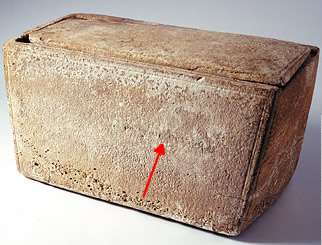
Having had time now to digest James Tabor’s latest discoveries there are a variety of things that need to be said about them. Let’s deal with a few facts first. I am going to assume that at the least you have scanned the report in Part Three of this series. If not, go back and look over the 46 pages closely. Here are some of the things that strike me about it. (To the right see the James ossuary with its inscription, which has no known connections with the Talpiot tomb and was found in Silwan, not Talpiot, despite the suggests of Tabor and Jacobovici).
First of all, neither James Tabor nor Rami Arav, nor any other member of this particular archaeological team have ever been in the so-called Patio tomb. They made an agreement with orthodox Jews only to take pictures by a remarkable robotic technology (which in some ways is the most interesting part of the report) and they agreed not even to move the ossuaries around so they could take better pictures. The results are still quite interesting, but let’s be clear. This team has no way of knowing all that is on, or of dating these ossuaries. Not all Jewish ossuaries are from the first century A.D.
The suggestion that they are first century ossuaries is unlikely for several good reasons: 1) firstly we see a picture of a cross in one of these loculi. If it is actually a Christian cross, so far as we know this was not a Christian symbol in the first century A.D.; 2) the comparable images of the whale (and perhaps Jonah) in the catacombs in Rome are from the 3rd and 4th centuries, not from the first century. It is not even clear that the image is that of a fish. See the discussion below by Eric Meyers about the ‘nephesh’ and floral tomb decorations. My friend Richard Bauckham in a forthcoming article will deal with the inscription at some length. His conclusions are that this inscription has nothing to do with early Christianity and that it means ‘Belonging to Zeus IOAI.
I, Hagab, exalt (him/you). He points out that it is incorrect to say that Jews would not write the divine name. It’s just that they avoided pronouncing or mis-pronouncing it. ; 3) the use of Greek and Hebrew letters for God’s name on an ossuary or in a tomb appears unprecedented for first century Jewish ossuaries, though I suppose it is possible. More likely, it suggests later and more specifically Christian practice; 4) the name Joseph of Aramathea nowhere appears in or in connection with this tomb. That is simply a conjecture based on no evidence.
Indeed, it is a conjecture that goes quite against the actual Biblical evidence which suggests Joseph’s tomb was within easy walking distance of Golgotha (remember they were carrying a corpse), and could be gotten to before sundown on Friday April 7th A.D. 30. The theory of Tabor that the body was temporarily placed in a tomb near Golgotha and then moved to Talpiot some miles away is again an argument without any historical or archaeological evidence to support it. 5) since the team was unable to go in the tomb, no patina tests on the inscriptions could be done, so we have no scientific basis at all to date these things. Indeed, since the inscriptions in question are not formally rendered but are like the toe tag inscriptions scrawled by the buriers of other ossuaries, epigraphical studies hardly help. 6) the name ‘Mara’ if it is even a name and not a title (remembering that Mar anatha– means our Lord come, so presumably Mara would mean ‘Lady’ as a title) is not the same as the form of the name for Mary, Martha, or Mary Magadalene in the NT, whether we find this name form in the Talpiot tomb or the Patio tomb. On this whole matter see Bauckham’s original article “The Names on the Ossuaries” in Charles L. Quarles (ed.), Buried Hope or Risen Savior? (Nashville: B & H, 2008), 69-112.
7) once more with feeling the names in the so called Jesus (Talpiot) tomb do not match up with the names in Jesus’ family, and in any case 8) why in the world would a family that has origins in Bethlehem and roots in Nazareth be buried in Talpiot, which is neither!! 9) one would do better to explore the traditions about the burial of Jesus’ mother in Ephesus than piling these conjectures, one on top of another on top of another; 10) by their own admission the Patio tomb is a good 50 yards away from the so-called Jesus tomb. The chances this is all one big tomb are slim and none. Indeed, the authors can provide no evidence at all for connecting these two tombs. Their proximity tells us nothing, any more than the proximity of various diverse tombs on the Mt. of Olives or in the Kidron valley, many of which are much closer together than 45 meters! 11) In the this is no way to run a railroad category, you don’t do a press conference and a TV show before you run the results of your research by your peers and see how they respond. Peer reviewed scholarship takes time, which of course is why Simcha no doubt did not want to wait for the poll results, as he would have been ‘scooped’ by then. The major results of this study would also have been widely criticized and rejected by then as well by major scholars. Simcha doubtless wanted to get in, in time for the Easter market to make some hay while the sun shines….. and so did the publishers of the book on ‘the Jesus Discovery’. If you want to see how sane scholars respond to such hype……
We now have Eric Meyers weighing in on this supposed revolutionary discovery with the following— “We know these authors from the James Ossuary controversy of some years back, when they identified a tomb as the James Ossuary Tomb or East Talpiot A. Now called the new “Garden Tomb,” it is less than 200 feet from Talpiot B, or what they call the “Patio Tomb,” and which they explored with a robotic camera just two years ago. The major discovery in the new tomb is an inscription and image on an ossuary. They describe the image and depiction of Jonah being spit out of the mouth of a big fish, which they take to be proof of the family of Jesus’ belief in his resurrection. The only image of the ossuary drawing published. The book is truly much ado about nothing and is a sensationalist presentation of data that are familiar to anyone with knowledge of first-century Jerusalem. Nothing in the book “revolutionizes our understanding of Jesus or early Christianity” as the authors and publisher claim, and we may regard this book as yet another in a long list of presentations that misuse not only the Bible but also archaeology. in the book (on page 91, fig.30) is very washed out, and any fish imagery is hardly identifiable let alone that of a fish spewing out a human. In fact, the image in the book is so poorly reproduced in my copy that one suspects it has been intentionally altered so that no one could see what the the image really is. Indeed, the image actually seems to resemble a nephesh, or tomb monument, like those found in many places in Jerusalem in the first century CE and depicted on ossuaries of this very period (so for example in fig. 13 or 30 of Rahmani’s A Catalogue of Jewish Ossuaries, 1994). A nephesh is the above-ground monument of a tomb that marks the tomb below and the one(s) buried there. Also it would not be surprising that a Jewish burial of the first century CE, even in an ossuary that was a secondary burial, might be related to a belief in resurrection. This belief was central to Judaism at the time according to first-century literary sources, and it was equally held by early Christians. But a belief in resurrection is not so much the question here as is the issue of the names on the ossuaries in the two-named tombs, which the authors identify with the family of Jesus. Remarkably they claim that the names included the child and spouse of Jesus, a claim that can hardly be supported by the material data from the tombs. Much of their argument involves defending the assumption of the placement of the James ossuary in the adjacent tomb, the so-called “Garden Tomb,” and defending their readings of the inscriptions in that tomb even those readings have been rejected by the overwhelming majority of the scholarly community.” (This is from http://asorblog.org/?p=1612).
Even more devastating is the critique by Chris Rollston which is found here— http://asorblog.org/?p=1642. He is completely convinced there is no fish at all in the new findings and he concludes….
“(1) The technology that was used to explore this tomb is stunning and auspicious. Certainly the applications for it will be both broad and deep. Tabor and Jacobovici are to be congratulated for leading in the development and employment of these robotic and photographic technologies, and it is hoped that these technologies can be refined even more during the coming months and years.
(2) The epigraphic finds from these tombs are important, but they are not earth shattering nor do they provide dramatic, new evidence for understanding Jesus or Christianity. They were likely made public during Lent to take advantage of the public’s interest in Jesus around the Easter season, but the finds do not us with anything new.
(3) There is no necessary connection between these two tombs and there is no convincing evidence that some famous figure of history (not Jesus of Nazareth, not Joseph of Arimathea, not Mary Magdalene, etc.) was buried in these tombs.
(4) I doubt that the inscription in Talpiyot Tomb B refers to a resurrection, but in any case, many Jews during the Second Temple Period believed in the resurrection, long before the rise of Christianity.
(5) I am certain that the tetragrammaton (i.e., “Yahweh”) is not present in the four-line inscription from Talpiyot Tomb B.
(6) The ornamentation on the ossuary in Talpiyot Tomb B which Tabor and Jacobovici wish to consider Jonah and the Whale is actually simply a nephesh tower or tomb façade, just as Eric Meyers has argued.
(7) It is not prudent to assume that the word ‘Mara’ is definitely feminine. It could just as readily be masculine (and, in this time period, it could be used as a way of referring to the husband, or patriarch of the family).
Ultimately, therefore, I would suggest that this is a fairly standard, mundane Jerusalem tomb of the Late Second Temple period. Its contents are important and interesting, but there is nothing that is particularly sensational or unique. I wish that it were different. After all, it would be quite fascinating to find a tomb that could be said to be “Christian” and to hail from the very century that Christianity arose. Moreover, it would be particularly interesting to find a tomb that could be associated with Jesus of Nazareth and his family. But, alas, the evidence does not suggest this.
“A basic methodological stricture is this: dramatic claims require dramatic and decisive evidence. Stringing together a series of “maybe this” or “perhaps this” or “could it be” will sell books, but it will not convince careful historians nor will it change the facts. Careful historians and students want evidence and reasonable conclusions. Tabor and Jacobovici (much as I like these two people on a personal level) simply do not provide the goods. They have stretched the evidence far beyond the breaking point in their attempt to make sensational claims.”
I agree with those last two sentences. What is entirely lacking however is good critical judgment being applied to the data, which is always necessary if you are going to make large claims about large first century figures.
Let’s finish this discussion by saying: 1) it is always good to have more evidence of the practice of osslegium (on which see Shanks and Witherington The Brother of Jesus. The discussion there is still relevant on this issue) and more evidence of inscriptions of ossuaries whether Jewish or Christian or Jewish Christian. 2) probably the best reading of the crucial inscription involves an invocation written by a loved one on his departed family member’s ossuary meaning ‘God raise him/ her up.’ This is in fact deemed the most likely rendering of the Greek and Hebrew by Tabor himself, and I think he is right.
But what this means is that the writer of the inscription does not associate resurrection with ascension of the soul into heaven. To the contrary, the writer is praying that God will raise up and put flesh on the bones interred within. That’s the main reason for keeping the bones in one place in an ossuary of course. In other words, Tabor’s attempt to redefine resurrection in some purely spiritual way that doesn’t involve a physical body is…. as we would say in North Carolina ‘a dog that won’t hunt’, a thesis that is not supported by any early Christian Biblical evidence, nor by the evidence from the ossuaries of the period.
Previous Post

March 9, 2012
The Patio Tomb of Joseph? Part Three
Next Post
March 11, 2012 Christy's Fund
Browse Our Archives
Select a Category Uncategorized
Select a Month October 2026 September 2026 August 2026 July 2026 June 2026 May 2026 April 2026 March 2026 February 2026 January 2026 December 2025 November 2025 October 2025 September 2025 August 2025 July 2025 June 2025 May 2025 April 2025 March 2025 February 2025 January 2025 December 2024 November 2024 October 2024 September 2024 August 2024 July 2024 June 2024 May 2024 April 2024 March 2024 February 2024 January 2024 December 2023 November 2023 October 2023 September 2023 August 2023 July 2023 June 2023 May 2023 April 2023 March 2023 February 2023 January 2023 December 2022 November 2022 October 2022 September 2022 August 2022 July 2022 June 2022 May 2022 April 2022 March 2022 February 2022 January 2022 December 2021 November 2021 October 2021 September 2021 August 2021 July 2021 June 2021 May 2021 April 2021 March 2021 February 2021 January 2021 December 2020 November 2020 October 2020 September 2020 August 2020 July 2020 June 2020 May 2020 April 2020 March 2020 February 2020 January 2020 December 2019 November 2019 October 2019 September 2019 August 2019 July 2019 June 2019 May 2019 April 2019 March 2019 February 2019 January 2019 December 2018 November 2018 October 2018 September 2018 August 2018 July 2018 June 2018 May 2018 April 2018 March 2018 February 2018 January 2018 December 2017 November 2017 October 2017 September 2017 August 2017 July 2017 June 2017 May 2017 April 2017 March 2017 February 2017 January 2017 December 2016 November 2016 October 2016 September 2016 August 2016 July 2016 June 2016 May 2016 April 2016 March 2016 February 2016 January 2016 December 2015 November 2015 October 2015 September 2015 August 2015 July 2015 June 2015 May 2015 April 2015 March 2015 February 2015 January 2015 December 2014 November 2014 October 2014 September 2014 August 2014 July 2014 June 2014 May 2014 April 2014 March 2014 February 2014 January 2014 December 2013 November 2013 October 2013 September 2013 August 2013 July 2013 June 2013 May 2013 April 2013 March 2013 February 2013 January 2013 December 2012 November 2012 October 2012 September 2012 August 2012 July 2012 June 2012 May 2012 April 2012 March 2012 February 2012 January 2012 December 2011 November 2011 October 2011 September 2011 August 2011 July 2011 June 2011 May 2011 April 2011 March 2011 February 2011 January 2011
Follow Us!
TAKE THE
Religious Wisdom Quiz
What guards the Garden of Eden?
Select your answer to see how you score.
Lions Serpents Cherubim Eagles
Books by This Author Books by Ben Witherington
Related posts from The Bible and Culture


The British Library-- Part Two
The British Library-- Part One
TRENDING AT PATHEOS Evangelical

The Real AI Story Is Adoption Without Trust
Artificial intelligence has crossed a political threshold. It is no longer a...

A new article, written by Jeff Lindsay and Gale L. Pooley,...

Swimfan: Forgotten Aughts Pleasures
This is a recovery effort. In 2002, My Big Fat Greek Wedding...

Top Three Anti-Catholic Lies About Catholicism
This is my initial transcript for the video, "THE 3 WORST...

Pope Leo Celebrates Mass for Nurses & Docs...
I don't have any idea how he did it, but Pope Leo...

The Sermon on the Mount, Part I: Matthew...
The Sermon on the Mount, Part I (Matthew 4:12-5:12) St. Matthew moves...
view all Evangelical blogs
Ad-Free & Subscriber Log-In Subscription Support
- About Us
- 2026 Calendar
- Videos
- Podcasts
- Library of World Religions
- Faith In Media Tracker
- Advertise With Us
- Write for Us
- Privacy Policy
- Terms of Service
- Do Not Sell My Data
- Contact Us
- Radiant Digital
- Manage Newsletter Subscriptions
- Unsubscribe From Notifications
- Sitemap
Copyright 2008-2026, Patheos. All rights reserved.
Subscription Support Ad-Free & Subscriber Log-In
Follow Patheos