
BuddhistCatholicContemplativeEvangelicalGeneral ChristianHinduJewishLatter-day SaintMuslimNew VisionsProgressive Christian
Beliefs
- Buddhist
- Catholic
- Contemplative
- Evangelical
- General Christian
- Hindu
- Jewish
- Latter-day Saint
- More Voices
- Muslim
- New Visions
- Pagan
- Progressive Christian
Topics
- Religion News
- Food and Religion
- Sports and Religion
- Religious Art
- Religious Music and Entertainment
- Religious Events
- History and Religion
- Style and Religion
- Politics and Religion
- Women in Religion
- Recreation Outdoors and Religion
- Business Finance and Religion
- Careers Workplace and Religion
- Education and Religion
- Family Parenting and Religion
- Health Fitness and Religion
- Home and Religion
- Relationships and Religion
- Technology and Religion
- Travel and Religion
Columnists
- Buddhist Columnists
- Business Finance and Religion Columnists
- Careers Workplace and Religion Columnists
- Catholic Columnists
- Contemplative Columnists
- Education and Religion Columnists
- Evangelists Columnists
- Family Parenting and Religion Columnists
- General Christian Columnists
- Health Fitness and Religion Columnists
- Hindu Columnists
- History and Religion Columnists
- Home and Religion Columnists
- Jewish Columnists
- More Voices Columnists
- Latter Day Columnists
- Muslim Columnists
- New Visions Columnists
- Nonreligious Columnists
- Pagan Columnists
- Politics and Religion Columnists
- Progressive Columnists
- Recreation Outdoors and Religion Columnists
- Relationships and Religion Columnists
- Religion News Columnists
- Religious Art Columnists
- Religious Events Columnists
- Religious Music and Entertainment Columnists
- Sports and Religion Columnists
- Style and Religion Columnists
- Technology and Religion Columnists
- Travel and Religion Columnists
- Women in Religion Columnists
Resource Library
- 2026 Calendar
- Library of World Religions
- The 100 Most Holy Places on Earth
- Patheos Answers
- Podcasts
- Videos
- Faith Leaders Database
- Anglican Episcopalian
- Bahai
- Baptist
- Buddhism
- Christianity
- Confucianism
- Eastern Orthodoxy
- Hinduism
- Holiness and Pentecostal
- ISKCON
- Islam
- Judaism
- Lutheran
- Methodist
- The Church of Jesus Christ of Latter-day Saints
- New Age
- Paganism
- Presbytarian and Reformed
- Protestantism
- Religion Behind the Scenes
- Roman Catholic
- Scientology
- Shia Islam
- Sikhism
- Sufism
- Sunni Islam
- Taoism
- Zen
- See all religions
Research Tools
 Ad-Free & Subscriber Log-In Subscription Support
Follow Patheos 

- Trending:
- Advent
- |
- Forgiveness
- |
- Thanksgiving
- |
- Election
- |
- Seasonal Holidays
- |
- Marriage

- Home
- Evangelical
- The Advent of Advent
The Advent of Advent
Last updated on: March 13, 2015 at 11:11 pm by Ben Witherington
The Advent of Advent 2015-03-13T23:11:22-04:00 Ben Witherington
Patheos Explore the world's faith through different perspectives on religion and spirituality! Patheos has the views of the prevalent religions and spiritualities of the world.
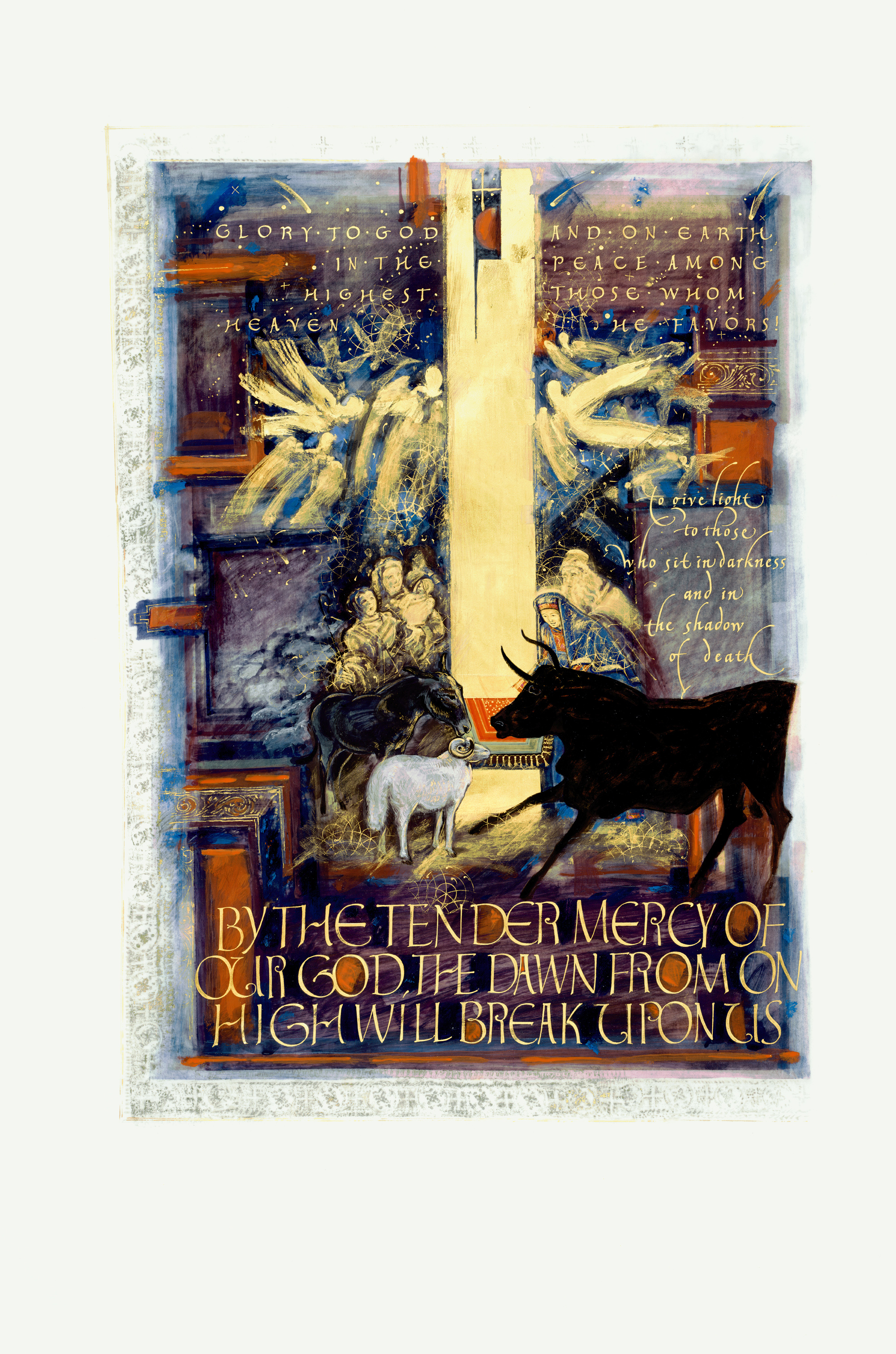
(This nice picture from St. John’s Bible used by permission)
(Here is a nice summary about Advent from Wiki– accessed Nov. 15 2011)
Advent (from the Latin word adventus meaning “coming”) is a season observed in many Western Christian churches, a time of expectant waiting and preparation for the celebration of the Nativity of Jesus at Christmas. It is the beginning of the Western liturgical year and commences on Advent Sunday, called Levavi. The Eastern churches’ equivalent of Advent is called the Nativity Fast, but it differs both in length and observances and does not begin the church year, which starts instead on September 1.[1]
The progression of the season may be marked with an Advent calendar, a practice introduced by German Lutherans. At least in the Roman Catholic, Anglican, Lutheran and Methodist calendars, Advent starts on the fourth Sunday before December 25, the Sunday from November 27 to December 3 inclusive.
Latin adventus is the translation of the Greek word parousia, commonly used in reference to the Second Coming of Christ. For Christians, the season of Advent serves as a reminder both of the original waiting that was done by the Hebrews for the birth of their Messiah as well as the waiting of Christians for Christ’s return.
he theme of readings and teachings during Advent is often to prepare for the Second Coming while commemorating the First Coming of Christ at Christmas. With the view of directing the thoughts of Christians to the first coming of Jesus Christ as savior and to his second coming as judge, special readings are prescribed for each of the four Sundays in Advent.
The usual liturgical colour in Western Christianity for Advent is purple or blue.[2] The purple colour is often used for hangings around the church, on the vestments of the clergy, and often also the tabernacle. On the 3rd Sunday of Advent, Gaudete Sunday, rose may be used instead, referencing the rose used on Laetare Sunday, the 4th Sunday of Lent. In some Christian denominations, blue, a colour representing hopefulness, is an alternative liturgical colour for Advent, a custom traced to the usage of the Church of Sweden (Lutheran) and the medieval Sarum Rite in England. In addition, the colour blue is also used in the Mozarabic Rite (Catholic and Anglican), which dates to the eighth century.[2] This colour is often referred to as “Sarum blue”. The Lutheran Book of Worship lists blue as the preferred colour for Advent while the Methodist Book of Worship identifies purple or blue as being appropriate for Advent.[2] There has been an increasing trend to supplant purple with blue during Advent as it is an hopeful season of preparation that anticipates both Bethlehem and the consummation of history in the second coming of Jesus Christ.[2][3] Proponents of this new liturgical trend argue that purple is traditionally associated with solemnity and somberness, which is fitting to the repentant character of Lent.[2] During the Nativity Fast, red is used among the denominations of Eastern Christianity, although gold is an alternative colour.[4]
In Advent, the Advent Prose, an antiphonal plainsong, may be sung. The “Late Advent Weekdays”, December 17–24, mark the singing of the Great Advent ‘O antiphons’. These are the antiphons for the Magnificat at Vespers, or Evening Prayer (in the Roman Catholic and Lutheran churches) and Evensong in Anglican churches each day and mark the forthcoming birth of the Messiah. They form the basis for each verse of the popular Advent hymn, “O come, O come, Emmanuel”.
A child lighting candles on an Advent wreath in Serbia.
From the 4th century the season was kept as a period of fasting as strict as that of Lent (commencing in some localities on 11 November; this being the feast day of St. Martin of Tours, the fast became known as “St. Martin’s Lent”, “St. Martin’s Fast” or the “forty days of St. Martin”). The feast day was in many countries a time of frolic and heavy eating, since the 40-day fast began the next day. In the Anglican and Lutheran churches this fasting rule was later relaxed, with the Roman Catholic Church doing likewise later, but still keeping Advent as a season of penitence. In addition to fasting, dancing and similar festivities were forbidden in these traditions. The third Sunday in Advent was a Rose Sunday, when the color of the vestments was changed and a relaxation of the fast was permitted. The Eastern Orthodox and Oriental Orthodox churches still hold the tradition of fasting for 40 days before the Nativity Feast.
In many countries Advent was long marked by diverse popular observances, some of which still survive. In England, especially in the northern counties, there was a custom (now extinct) for poor women to carry around the “Advent images”, two dolls dressed to represent Jesus and the Blessed Virgin Mary. A halfpenny coin was expected from every one to whom these were exhibited and bad luck was thought to menace the household not visited by the doll-bearers before Christmas Eve at the latest.[5]
In Normandy, farmers employed children under twelve to run through the fields and orchards armed with torches, setting fire to bundles of straw, and thus it is believed driving out such vermin as are likely to damage the crops.[6] In Italy, among other Advent celebrations, is the entry into Rome in the last days of Advent of the Calabrian pifferari, or bagpipe players, who play before the shrines of Mary, the mother of Jesus, the Italian tradition being that the shepherds played these pipes when they came to the manger at Bethlehem to pay homage to the infant Jesus.[7]
In recent times the commonest observance of Advent outside church circles has been the keeping of an advent calendar or advent candle, with one door being opened in the calendar, or one section of the candle being burned, on each day in December leading up to Christmas Eve.
[edit] End of the liturgical year
Censing during solemn Advent vespers
In Anglican churches the Sunday before Advent is sometimes nicknamed Stir-up Sunday after the opening lines of the Book of Common Prayer collect for that day. In the Roman Catholic Church since 1969, and in most Anglican churches since at least 2000, the final Sunday of the liturgical year before Advent has been celebrated as the Feast of Christ the King. This feast is now also widely observed in many Protestant churches, sometimes as the Reign of Christ. In consequence, the collect for the first Sunday of Advent in the Episcopal Church USA is no longer “stir up”. Since the 1979 revision of the Book of Common Prayer that collect is read on the third Sunday of the season.
Previous Post

November 30, 2011
Grisham Tries the Rope a Dope Strategy---'The Litigators'
Next Post
December 2, 2011 Bible Trivia about the KJV and Shakespeare
Browse Our Archives
Select a Category Uncategorized
Select a Month November 2026 October 2026 September 2026 August 2026 July 2026 June 2026 May 2026 April 2026 March 2026 February 2026 January 2026 December 2025 November 2025 October 2025 September 2025 August 2025 July 2025 June 2025 May 2025 April 2025 March 2025 February 2025 January 2025 December 2024 November 2024 October 2024 September 2024 August 2024 July 2024 June 2024 May 2024 April 2024 March 2024 February 2024 January 2024 December 2023 November 2023 October 2023 September 2023 August 2023 July 2023 June 2023 May 2023 April 2023 March 2023 February 2023 January 2023 December 2022 November 2022 October 2022 September 2022 August 2022 July 2022 June 2022 May 2022 April 2022 March 2022 February 2022 January 2022 December 2021 November 2021 October 2021 September 2021 August 2021 July 2021 June 2021 May 2021 April 2021 March 2021 February 2021 January 2021 December 2020 November 2020 October 2020 September 2020 August 2020 July 2020 June 2020 May 2020 April 2020 March 2020 February 2020 January 2020 December 2019 November 2019 October 2019 September 2019 August 2019 July 2019 June 2019 May 2019 April 2019 March 2019 February 2019 January 2019 December 2018 November 2018 October 2018 September 2018 August 2018 July 2018 June 2018 May 2018 April 2018 March 2018 February 2018 January 2018 December 2017 November 2017 October 2017 September 2017 August 2017 July 2017 June 2017 May 2017 April 2017 March 2017 February 2017 January 2017 December 2016 November 2016 October 2016 September 2016 August 2016 July 2016 June 2016 May 2016 April 2016 March 2016 February 2016 January 2016 December 2015 November 2015 October 2015 September 2015 August 2015 July 2015 June 2015 May 2015 April 2015 March 2015 February 2015 January 2015 December 2014 November 2014 October 2014 September 2014 August 2014 July 2014 June 2014 May 2014 April 2014 March 2014 February 2014 January 2014 December 2013 November 2013 October 2013 September 2013 August 2013 July 2013 June 2013 May 2013 April 2013 March 2013 February 2013 January 2013 December 2012 November 2012 October 2012 September 2012 August 2012 July 2012 June 2012 May 2012 April 2012 March 2012 February 2012 January 2012 December 2011 November 2011 October 2011 September 2011 August 2011 July 2011 June 2011 May 2011 April 2011 March 2011 February 2011 January 2011
Follow Us!
TAKE THE
Religious Wisdom Quiz
Which high priest led in the reading and explaining of the Law to the people?
Select your answer to see how you score.
Zerubbabel Nehemiah Eliashib Ezra
Books by This Author Books by Ben Witherington
Related posts from The Bible and Culture

Salisbury Cathedral (outside)-- Part Four

Salisbury Cathedral (the windows)-- Part Three
Salisbury Cathedral-- Part Two
Salisbury: Magna Carta and Magna Steeple---Part One
TRENDING AT PATHEOS Evangelical

Adventurous Lectionary -1st. Sunday of Advent - November...
The Adventurous Lectionary - The First Sunday of Advent – November 29,...

Will Islam become the world's biggest religion by 2035? Congo will replace...

Best Books of 2026 on American Christianity
The resilience of the Christian faith in the english speaking world of...

An Advent Calendar, and a Tree full of...
I've spent the weekend deeply invested in internet drama about a $150...

How to Have Financial Transparency in Marriage
Despite the fact that financial issues and money problems are the number...
The Healing Power of Forgiveness in Marriage
Learning how to give and accept apologies are essential ingredients of a...
view all Evangelical blogs
Ad-Free & Subscriber Log-In Subscription Support
- About Us
- 2026 Calendar
- Videos
- Podcasts
- Library of World Religions
- Faith In Media Tracker
- Advertise With Us
- Write for Us
- Privacy Policy
- Terms of Service
- Do Not Sell My Data
- Contact Us
- Radiant Digital
- Manage Newsletter Subscriptions
- Unsubscribe From Notifications
- Sitemap
Copyright 2008-2026, Patheos. All rights reserved.
Subscription Support Ad-Free & Subscriber Log-In
Follow Patheos