
BuddhistCatholicContemplativeEvangelicalGeneral ChristianHinduJewishLatter-day SaintMuslimNew VisionsProgressive Christian
Beliefs
- Buddhist
- Catholic
- Contemplative
- Evangelical
- General Christian
- Hindu
- Jewish
- Latter-day Saint
- More Voices
- Muslim
- New Visions
- Pagan
- Progressive Christian
Topics
- Religion News
- Food and Religion
- Sports and Religion
- Religious Art
- Religious Music and Entertainment
- Religious Events
- History and Religion
- Style and Religion
- Politics and Religion
- Women in Religion
- Recreation Outdoors and Religion
- Business Finance and Religion
- Careers Workplace and Religion
- Education and Religion
- Family Parenting and Religion
- Health Fitness and Religion
- Home and Religion
- Relationships and Religion
- Technology and Religion
- Travel and Religion
Columnists
- Buddhist Columnists
- Business Finance and Religion Columnists
- Careers Workplace and Religion Columnists
- Catholic Columnists
- Contemplative Columnists
- Education and Religion Columnists
- Evangelists Columnists
- Family Parenting and Religion Columnists
- General Christian Columnists
- Health Fitness and Religion Columnists
- Hindu Columnists
- History and Religion Columnists
- Home and Religion Columnists
- Jewish Columnists
- More Voices Columnists
- Latter Day Columnists
- Muslim Columnists
- New Visions Columnists
- Nonreligious Columnists
- Pagan Columnists
- Politics and Religion Columnists
- Progressive Columnists
- Recreation Outdoors and Religion Columnists
- Relationships and Religion Columnists
- Religion News Columnists
- Religious Art Columnists
- Religious Events Columnists
- Religious Music and Entertainment Columnists
- Sports and Religion Columnists
- Style and Religion Columnists
- Technology and Religion Columnists
- Travel and Religion Columnists
- Women in Religion Columnists
Resource Library
- 2026 Calendar
- Library of World Religions
- The 100 Most Holy Places on Earth
- Patheos Answers
- Podcasts
- Videos
- Faith Leaders Database
- Anglican Episcopalian
- Bahai
- Baptist
- Buddhism
- Christianity
- Confucianism
- Eastern Orthodoxy
- Hinduism
- Holiness and Pentecostal
- ISKCON
- Islam
- Judaism
- Lutheran
- Methodist
- The Church of Jesus Christ of Latter-day Saints
- New Age
- Paganism
- Presbytarian and Reformed
- Protestantism
- Religion Behind the Scenes
- Roman Catholic
- Scientology
- Shia Islam
- Sikhism
- Sufism
- Sunni Islam
- Taoism
- Zen
- See all religions
Research Tools
 Ad-Free & Subscriber Log-In Subscription Support
Follow Patheos 

- Trending:
- Advent
- |
- Forgiveness
- |
- Thanksgiving
- |
- Election
- |
- Seasonal Holidays
- |
- Marriage

- Home
- Evangelical
- John Chrysostom on Hermeneutics
John Chrysostom on Hermeneutics
Last updated on: March 13, 2015 at 11:14 pm by Guest Contributor
John Chrysostom on Hermeneutics 2015-03-13T23:14:50-04:00 Guest Contributor
Patheos Explore the world's faith through different perspectives on religion and spirituality! Patheos has the views of the prevalent religions and spiritualities of the world.
The Relationship of the OT to the NT according to John Chrysostom

(This is a post from 2007 back by popular demand).
Reflecting on texts like Hebrews 10.1 “the Law is only a shadow of the good things that are coming– not the image/portrait (eikon)/ realities themselves” John Chrysostom (which means golden mouth), the greatest preacher and teacher of the Greek-speaking Fathers who commented on the NT in detail (mainly in Antioch and Constantinople–349-407 A.D.) has some interesting reflections on the relationship of the OT and the NT. Bear in mind that Chrysostom, like all these church fathers was very orthodox in his theology and had an extremely high view of the inspiration, authority and truthfulness of the Scriptures. Here is what he said in one of his homilies:
“”What then is the shadow (skia) what then is the truth (aletheia)? …You have often seen an Emperor’s portrait which is prepared on a dark background, then the artist by drawing white lines all around it, makes an emperor, an imperial throne, and horses standing nearby, and body guards, and bound prisoners of war lying down. Now when you see these things merely sketched out you neither know everything nor are you totally ignorant of everything, but you know that a man and a horse are drawn there, though they are indistinct. But you don’t accurately [or fully] know what sort of emperor or what sort of prisoner it is until the truth of the colors comes and makes the face distinct and clear. For just as you don’t ask everything of that image/portrait before the truth of the colors, but if you receive some indistinct knowledge of what is there, you consider the sketch to be sufficiently ready , in just that same way consider with me the Old and New Testaments , and don’t demand from me the whole fullness of the truth in the [OT] type…For as in the painting, until someone draws in colors it is a shadowy sketch.” (Hom. om 1 Cor. 10.1ff).
Chrysostom is putting his finger on some important Christian guidelines for properly reading the OT, namely that it must be seen in the light of its sequel, but it must not be confused with that sequel. The OT is not the NT in advance and the conditions, terms of discussion, theological rubrics and ethical categories are all preparatory, sketchy so to speak, not final, full, or completely revealing. The ‘shadows’ or ‘sketches’ are true as far as they go, but they must not be confused with the full bodied portraits of Christ, the Christian life, the nature of reality, the ultimate and full character of what God demands of those saved by grace and so on.
Now this whole way of reading the OT involves a consciousness of historical development, and also of progressive revelation. There is a before and after to God’s revelation of the divine purpose and will, and one gets the clearest picture of what God is like, what God intends, what God demands in Christ and in the eschatological revelation that comes to Christians after Pentecost. This in turn led to the reading of the OT in terms of typology– types and ante-types, and again we can see this played out in both Paul in texts like 1 Cor. 10, and in Hebrews. In fact the NT writers believed that what was happening to Israel at least in part happened as an object lesson for later generations, particularly the eschatological people of God to heed and shun.
This way of thinking assumes that God’s character is the same at all times (sorry ‘openness theologians’) and so it is not a surprise that things that God has done in the past, and the way he has dealt with his wayward people then foreshadows what is yet to come. In a sense then, Chrysostom is urging Christian readers of the OT to remember that what we find there is a preliminary sketch which begins to give one the idea of proper theology and ethics, proper ways that humans can relate to God and the like, but not the final definitive revelation of what that ought to look like. He also affirms that the new covenant is not simply the old covenant renewed. It involves new promises, new stipulations, new expectations. This is in part because it is believed that more has been given by way of grace to the followers of Christ than was given to God’s OT people. ‘To whom more is given, more is required’.
Then too, this whole way of reading the canon, is narratological. You don’t have the climax to the story prematurely. The hero does not show up prematurely in the OT, but only when the ‘fullness of time’ has come (see Gal. 4). As C.S. Lewis once aptly put it ‘when the author of the play steps out on the stage, the play is over” (or nearly so).
Now what is so interesting about this whole hermeneutical approach is that it believes that one must do justice to the history if one is to do theology and ethics right. Christianity was a religion grounded and founded in history, and so theology proper was a reflection on God’s mighty acts in history which had a before and after to them. It was not an abstract science or philosophy where one took ideas and simply linked them together without them arising out of historical events and their substance. In the end, Chrysostom’s hermeneutic mirrors that of Paul and the author of Hebrews. It would be my view that we should go and do likewise.
Let me stress in closing, that Chrysostom would have been horrified if someone had said to him– ‘well then you are saying that some of the things in the OT are not true’. His response was clear– ‘No, I am saying that we only have the outline, the preliminary sketch of truth in the OT, and we cannot tell what it fully or properly means to so or ought to look like without the fuller definitive filling in of the substances or colors in the NT.’ Chrysostom was clear enough that just because something is preliminary and not definitive, this does not mean it is untrue. It does mean it is incomplete. A timely truth, is no less true than a timeless or more complete one, but if must be evaluated for what it intends to tell us, not what we would like it to tell us. The OT must not be read as if it already was the NT, and all the same things applied, but it must certainly be read as the pre-quel to the sequel if you are to fully understand the sequel at all correctly. Reading the Bible processively and progressively as historical development from front to back, and then also from back to front provides the sort of balance necessary for proper interpretation. All of it is needed and valuable if we are to ‘get the picture’ God has been painting for us for so long.
Think on these things.
Previous Post

April 27, 2011
On Forbearance, Tolerance, and Concord---the Constantinian Model
Next Post
April 29, 2011 Closure
Browse Our Archives
Select a Category Uncategorized
Select a Month November 2026 October 2026 September 2026 August 2026 July 2026 June 2026 May 2026 April 2026 March 2026 February 2026 January 2026 December 2025 November 2025 October 2025 September 2025 August 2025 July 2025 June 2025 May 2025 April 2025 March 2025 February 2025 January 2025 December 2024 November 2024 October 2024 September 2024 August 2024 July 2024 June 2024 May 2024 April 2024 March 2024 February 2024 January 2024 December 2023 November 2023 October 2023 September 2023 August 2023 July 2023 June 2023 May 2023 April 2023 March 2023 February 2023 January 2023 December 2022 November 2022 October 2022 September 2022 August 2022 July 2022 June 2022 May 2022 April 2022 March 2022 February 2022 January 2022 December 2021 November 2021 October 2021 September 2021 August 2021 July 2021 June 2021 May 2021 April 2021 March 2021 February 2021 January 2021 December 2020 November 2020 October 2020 September 2020 August 2020 July 2020 June 2020 May 2020 April 2020 March 2020 February 2020 January 2020 December 2019 November 2019 October 2019 September 2019 August 2019 July 2019 June 2019 May 2019 April 2019 March 2019 February 2019 January 2019 December 2018 November 2018 October 2018 September 2018 August 2018 July 2018 June 2018 May 2018 April 2018 March 2018 February 2018 January 2018 December 2017 November 2017 October 2017 September 2017 August 2017 July 2017 June 2017 May 2017 April 2017 March 2017 February 2017 January 2017 December 2016 November 2016 October 2016 September 2016 August 2016 July 2016 June 2016 May 2016 April 2016 March 2016 February 2016 January 2016 December 2015 November 2015 October 2015 September 2015 August 2015 July 2015 June 2015 May 2015 April 2015 March 2015 February 2015 January 2015 December 2014 November 2014 October 2014 September 2014 August 2014 July 2014 June 2014 May 2014 April 2014 March 2014 February 2014 January 2014 December 2013 November 2013 October 2013 September 2013 August 2013 July 2013 June 2013 May 2013 April 2013 March 2013 February 2013 January 2013 December 2012 November 2012 October 2012 September 2012 August 2012 July 2012 June 2012 May 2012 April 2012 March 2012 February 2012 January 2012 December 2011 November 2011 October 2011 September 2011 August 2011 July 2011 June 2011 May 2011 April 2011 March 2011 February 2011 January 2011
Follow Us!
TAKE THE
Religious Wisdom Quiz
Who said: "I am the Alpha and the Omega, who is, and who was, and who is to come, the Almighty"?
Select your answer to see how you score.
John Jesus God (the Lord God) An angel
Books by This Author Books by Ben Witherington
Related posts from The Bible and Culture

Salisbury Cathedral (outside)-- Part Four

Salisbury Cathedral (the windows)-- Part Three
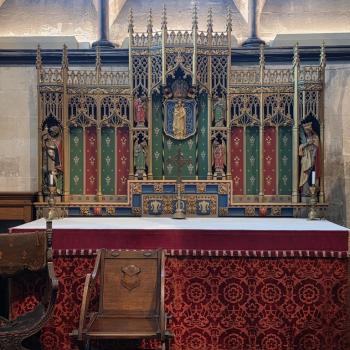
Salisbury Cathedral-- Part Two

Salisbury: Magna Carta and Magna Steeple---Part One
TRENDING AT PATHEOS Evangelical

An Advent Calendar, and a Tree full of...
I've spent the weekend deeply invested in internet drama about a $150...

How to Have Financial Transparency in Marriage
Despite the fact that financial issues and money problems are the number...
The Healing Power of Forgiveness in Marriage
Learning how to give and accept apologies are essential ingredients of a...

The West's Christian Moral Inheritance: A Legacy Denied
Whether we like it or not, our environment matters, shaping us both...

How Does Tôḏâ Connect Florida & Thanksgiving?
The big news this weekend has been about the continued flooding on...

Were Early Christians Drinking Psychedelic Wine?
The Secret Sacrament the Church Took Away The early Christian church was...
view all Evangelical blogs
Ad-Free & Subscriber Log-In Subscription Support
- About Us
- 2026 Calendar
- Videos
- Podcasts
- Library of World Religions
- Faith In Media Tracker
- Advertise With Us
- Write for Us
- Privacy Policy
- Terms of Service
- Do Not Sell My Data
- Contact Us
- Radiant Digital
- Manage Newsletter Subscriptions
- Unsubscribe From Notifications
- Sitemap
Copyright 2008-2026, Patheos. All rights reserved.
Subscription Support Ad-Free & Subscriber Log-In
Follow Patheos