
BuddhistCatholicContemplativeEvangelicalGeneral ChristianHinduJewishLatter-day SaintMuslimNew VisionsProgressive Christian
Beliefs
- Buddhist
- Catholic
- Contemplative
- Evangelical
- General Christian
- Hindu
- Jewish
- Latter-day Saint
- More Voices
- Muslim
- New Visions
- Pagan
- Progressive Christian
Topics
- Religion News
- Food and Religion
- Sports and Religion
- Religious Art
- Religious Music and Entertainment
- Religious Events
- History and Religion
- Style and Religion
- Politics and Religion
- Women in Religion
- Recreation Outdoors and Religion
- Business Finance and Religion
- Careers Workplace and Religion
- Education and Religion
- Family Parenting and Religion
- Health Fitness and Religion
- Home and Religion
- Relationships and Religion
- Technology and Religion
- Travel and Religion
Columnists
- Buddhist Columnists
- Business Finance and Religion Columnists
- Careers Workplace and Religion Columnists
- Catholic Columnists
- Contemplative Columnists
- Education and Religion Columnists
- Evangelists Columnists
- Family Parenting and Religion Columnists
- General Christian Columnists
- Health Fitness and Religion Columnists
- Hindu Columnists
- History and Religion Columnists
- Home and Religion Columnists
- Jewish Columnists
- More Voices Columnists
- Latter Day Columnists
- Muslim Columnists
- New Visions Columnists
- Nonreligious Columnists
- Pagan Columnists
- Politics and Religion Columnists
- Progressive Columnists
- Recreation Outdoors and Religion Columnists
- Relationships and Religion Columnists
- Religion News Columnists
- Religious Art Columnists
- Religious Events Columnists
- Religious Music and Entertainment Columnists
- Sports and Religion Columnists
- Style and Religion Columnists
- Technology and Religion Columnists
- Travel and Religion Columnists
- Women in Religion Columnists
Resource Library
- 2026 Calendar
- Library of World Religions
- The 100 Most Holy Places on Earth
- Patheos Answers
- Podcasts
- Videos
- Faith Leaders Database
- Anglican Episcopalian
- Bahai
- Baptist
- Buddhism
- Christianity
- Confucianism
- Eastern Orthodoxy
- Hinduism
- Holiness and Pentecostal
- ISKCON
- Islam
- Judaism
- Lutheran
- Methodist
- The Church of Jesus Christ of Latter-day Saints
- New Age
- Paganism
- Presbytarian and Reformed
- Protestantism
- Religion Behind the Scenes
- Roman Catholic
- Scientology
- Shia Islam
- Sikhism
- Sufism
- Sunni Islam
- Taoism
- Zen
- See all religions
Research Tools
 Ad-Free & Subscriber Log-In Subscription Support
Ad-Free & Subscriber Log-In Subscription Support
Follow Patheos 

- Trending:
- Forgiveness
- |
- Marriage
- |
- Consciousness
- |
- Death Penalty
- |
- Election
- |
- Halloween
 Between Two Kingdoms
- Home
- Evangelical
- Religious Music & Entertainment
- A Typology of Conservative Protestants in an Anxious Age
A Typology of Conservative Protestants in an Anxious Age
Last updated on: November 29, 2022 at 2:42 pm by John Ehrett
A Typology of Conservative Protestants in an Anxious Age 2022-11-29T14:42:11-05:00 John Ehrett
Patheos Explore the world's faith through different perspectives on religion and spirituality! Patheos has the views of the prevalent religions and spiritualities of the world.
In the last couple of weeks, there’s been a lot of intense discussion surrounding Stephen Wolfe’s new book The Case for Christian Nationalism. (I have a much longer review of that volume forthcoming.) Most of the recent drama surrounds Wolfe’s longtime podcast collaborator Thomas Achord, who was recently discovered to have been tweeting out antisemitic and white nationalist statements under a pseudonym. In the minds of many of Wolfe’s critics, Achord’s apparent embrace of “kinism”—a philosophy of racial separatism justified on supposedly biblical grounds—casts a pall over Wolfe’s intellectual project as a whole, which generally emphasizes distinction and particularity over universalism.
What makes this case interesting is that Achord’s record wasn’t uncovered by left-wing journalists, but by Anglican theologian Alastair Roberts and Orthodox journalist Rod Dreher—nobody’s idea of political liberals. Nevertheless, defenders of Wolfe and Achord have raised questions about Roberts’s and Dreher’s motivations, and framed the whole thing as just a power struggle between competing conservative factions.
I don’t think that’s quite right. However, it does seem like the Achord affair has disclosed a number of major intellectual fissures within a bloc that critics like to call “the Religious Right” or “white evangelicals,” as if this group were a single monolithic thing. It strikes me that it may be worth trying to identify these cleavages a little bit more clearly, in the vein of Shikha Dalmia’s recent “Typology of the New Right,” which is pitched at a slightly higher-order level of the population. (Also influential here is Kevin DeYoung’s similar article from 2021—though he appears to think more in terms of a spectrum than the “quadrants” approach I discuss below.)
(N.B. None of the group descriptors I use is intended to be pejorative, and I’ve tried to be pretty careful with the wording. I would hope that those who fall into each of the categories below would claim the labels with a wry smile.)
Without further ado, here are the quadrants—with an explanation to follow:
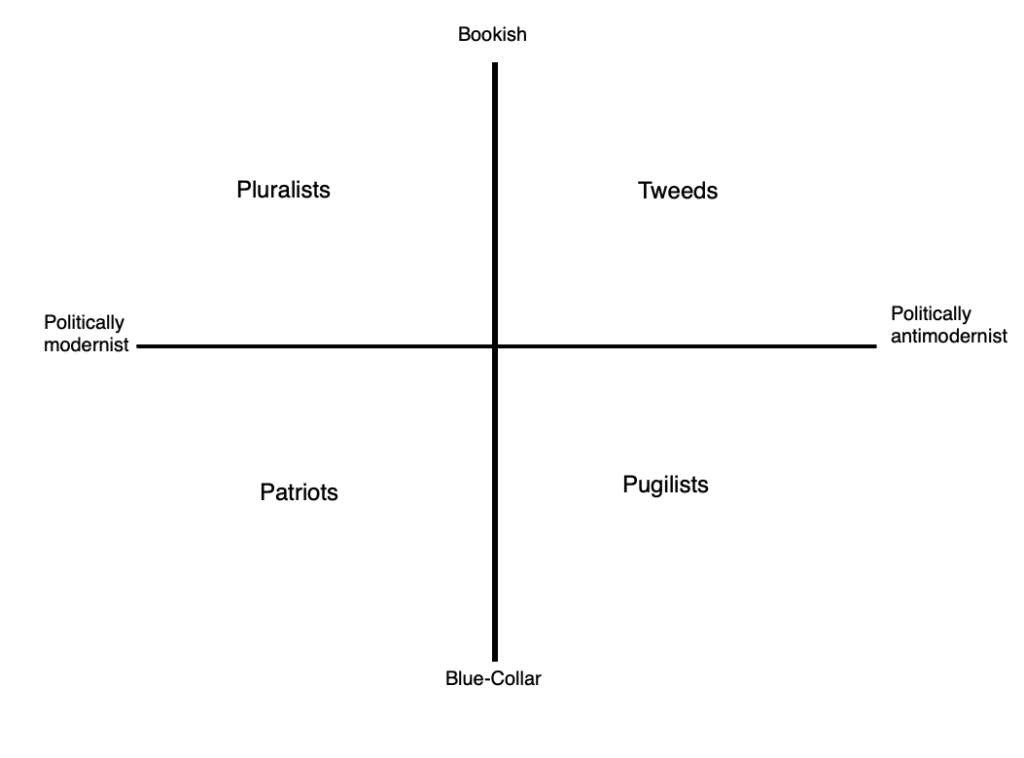
- Neo-Anabaptist pluralists
Christians in this intellectual camp tend to be fairly skeptical of culture warring, especially when undertaken by political conservatives. Instead, they favor cultivating what (in their minds) is a more authentic faith defined by its resilience and compassion under conditions of cultural hostility and persecution. The ur-text for this group would probably be theologian Russell Moore’s positive treatment of the collapse of “Bible Belt” cultural Christianity. And to be clear, “Neo-Anabaptist” describes a general approach rather than a denominational label: I would put David French into this category also, even though he’s a Presbyterian.
This faction plays an outsize role in the complex of institutions usually labeled by its critics as “Big Eva”—especially Christianity Today magazine. While members of this group tend to be drawn from the same socioeconomic pool as the Tweeds, the Pluralists are far more uncomfortable with the idea of political power being used—even abstractly—to enforce religiously grounded principles. (Recent debates over the value of “winsomeness” can be interpreted as exercises in line-drawing between the Pluralists and the Tweeds.)
- Evangelical patriots
This group of Protestants strongly supports the symbols of American nationhood, identifies explicitly with the Republican Party, and in many ways echoes the religious conservatism of the George W. Bush years. A tendency toward a dispensational-premillennialist eschatology leads to apocalypticism, as well as to a strong sense of the reality of spiritual warfare. This group is probably more willing than the others to form big-tent coalitions in pursuit of a common end, and likely won’t police theological distinctions as aggressively as the Tweeds or the Pugilists. You also won’t catch them criticizing “democracy” or waxing nostalgic about monarchy, as the Tweeds might.
For a lot of mainstream journalists, this is the group that comes to mind when they think “evangelicals,” and so this group attracts a disproportionate level of press coverage. This is also the contingent of Protestants associated with ideas like the “Seven Mountain Mandate”—which I’ve never really heard of, probably because I’m not part of this sub-faction.
Many Southern megachurches would probably fall into this category. That said, this is the group I probably know the least about.
- Tweedy liturgical types
This group is composed of Protestants who are theologically conservative, but whose political conservatism is probably heterodox at some level (e.g., they may support robust state welfare systems, unions, and other traditionally left-wing causes). The Davenant Institute and its affiliated writers are good exemplars of this approach.
Members tend to share a strong interest in ressourcement, particularly of the Protestant scholastic tradition, and tend to be fairly circumspect about their engagement with partisan political projects. The membership of this group, like that of the Pluralists, is disproportionately white-collar, and tends to be highly educated. Nobody would likely accuse them of being political agitators—a reason they may be criticized by Patriots and Pugilists alike. Their actual political views, though, tend to upend the standard assumptions of “liberalism” as such.
- Paleo-trad pugilists
This group, exemplified by the complex of institutions built and led by Douglas Wilson and the Christian Reformed Evangelical Church (CREC), is composed of intellectual descendants of the Southern Agrarian writers and the American paleoconservative tradition.
Members of this group tend to be postmillennialist, and have a strong interest in institution building. They tend to be strongly skeptical of centralized political authority (a trait they share with the Patriots, but decidedly not the Tweeds), favor localism, and generally practice what they preach. They also tend to be much blunter about doctrinal disagreement than Pluralists or Tweeds, and are comfortable with blue-collar work. Due to this different pattern of social engagement, members of the secular political faction that Matthew Walther has labeled “barstool conservatives” would probably feel at home among the Pugilists.
* * *
While all four of these groups would likely profess the Reformation solas and identify with the creedal Christian tradition, they have pretty significant disagreements with one another:
- From the perspective of the Pluralists: the Patriots tend to idolize the nation, the Tweeds are betraying the sacrificial witness of the early church, and the Pugilists aren’t taking the gentleness of Christ seriously.
- From the perspective of the Patriots: the Pluralists are liberal wolves in sheep’s clothing, the Tweeds don’t “know what time it is” politically, and the Pugilists are a little bit too disreputable. (That being said, Patriots and Pugilists tend to get along more often than not.)
- From the perspective of the Tweeds: the Pluralists have betrayed their own developed tradition, the Patriots tend to let partisan politics drive their theology rather than the opposite, and the Pugilists have let ethnocentrism override the universality of Christianity.
- From the perspective of the Pugilists: the Pluralists are cultural compromisers, the Patriots place the national partisan horse-race over the hard work of local institution-building, and the Tweeds are nerds who will be steamrolled by a hostile culture.
These are, of course, loose categories, and there’s plenty of line-blurring between them. But a lot of the arguments that have raged between different conservative Protestant factions over the last few years make more sense when viewed through this grid.
In light of this general scheme, Wolfe’s new book on Christian nationalism is a particularly fascinating case because it cuts across factions. The book is likely to be perceived by the mainstream press as a Patriot work, and given its heavy reliance on scholastic argumentation and sourcing, it’s possible to read The Case for Christian Nationalism as a Tweed work. However, the book’s aggressively worded epilogue, its localist orientation, and its heavy promotion by Canon Press all suggest that it is a Pugilist text.
I don’t expect that these tensions will be resolved anytime soon. Identifying them, though, should be the first step.
Previous Post

October 5, 2022
The “Common Good” Doesn’t Have to Suck
Next Post

December 1, 2022 The Best Books I Read This Year (2022 Edition)
Browse Our Archives
Select a Category Culture Ecclesiology Education Imagination Movies Political Theory Scripture Uncategorized Worship
Select a Month December 2022 November 2022 October 2022 September 2022 August 2022 June 2022 May 2022 April 2022 March 2022 February 2022 January 2022 December 2021 November 2021 October 2021 September 2021 August 2021 July 2021 June 2021 May 2021 April 2021 March 2021 February 2021 January 2021 December 2020 November 2020 October 2020 September 2020 August 2020 July 2020 June 2020 May 2020 April 2020 March 2020 February 2020 January 2020 December 2019 November 2019 October 2019 September 2019 August 2019 June 2019 April 2019 January 2019 December 2018 October 2018 September 2018 August 2018 July 2018 June 2018 May 2018
TAKE THE
Religious Wisdom Quiz
True or False: Naaman was healed of leprosy by washing seven times in the Jordan River.
Select your answer to see how you score.
FALSE TRUE
Related posts from Between Two Kingdoms

The Best Books I Read This Year (2022...

The MFA Novel and the Mystery Box

Tim Keller and the Two Senses of “Winsome”
Is There a Rising “Neo-Fundamentalism”?
TRENDING AT PATHEOS Evangelical

The REST of Your Life: A Creative Wrestles...
This week I had a conversation with a good friend from church....

How the author of the world's best hymn...
I've been working with John Newton for a while now. This makes...

Long before this Lectio Divina, Psalm 130 - the song - started...

What About the Trees? Another Living Parable
After I finished writing the last article about falling leaves as a...

Why Classical Education Is a Conversation, Not a...
Come and Read: Joy in Classical Education When I was a little...

Cornell University has received a great deal of negative publicity and intense...
view all Evangelical blogs
Ad-Free & Subscriber Log-In Subscription Support
- About Us
- 2026 Calendar
- Videos
- Podcasts
- Library of World Religions
- Faith In Media Tracker
- Advertise With Us
- Write for Us
- Privacy Policy
- Terms of Service
- Do Not Sell My Data
- Contact Us
- Radiant Digital
- Manage Newsletter Subscriptions
- Unsubscribe From Notifications
- Sitemap
Copyright 2008-2026, Patheos. All rights reserved.
Subscription Support Ad-Free & Subscriber Log-In
Follow Patheos