
BuddhistCatholicContemplativeEvangelicalGeneral ChristianHinduJewishLatter-day SaintMuslimNew VisionsProgressive Christian
Beliefs
- Buddhist
- Catholic
- Contemplative
- Evangelical
- General Christian
- Hindu
- Jewish
- Latter-day Saint
- More Voices
- Muslim
- New Visions
- Pagan
- Progressive Christian
Topics
- Religion News
- Food and Religion
- Sports and Religion
- Religious Art
- Religious Music and Entertainment
- Religious Events
- History and Religion
- Style and Religion
- Politics and Religion
- Women in Religion
- Recreation Outdoors and Religion
- Business Finance and Religion
- Careers Workplace and Religion
- Education and Religion
- Family Parenting and Religion
- Health Fitness and Religion
- Home and Religion
- Relationships and Religion
- Technology and Religion
- Travel and Religion
Columnists
- Buddhist Columnists
- Business Finance and Religion Columnists
- Careers Workplace and Religion Columnists
- Catholic Columnists
- Contemplative Columnists
- Education and Religion Columnists
- Evangelists Columnists
- Family Parenting and Religion Columnists
- General Christian Columnists
- Health Fitness and Religion Columnists
- Hindu Columnists
- History and Religion Columnists
- Home and Religion Columnists
- Jewish Columnists
- More Voices Columnists
- Latter Day Columnists
- Muslim Columnists
- New Visions Columnists
- Nonreligious Columnists
- Pagan Columnists
- Politics and Religion Columnists
- Progressive Columnists
- Recreation Outdoors and Religion Columnists
- Relationships and Religion Columnists
- Religion News Columnists
- Religious Art Columnists
- Religious Events Columnists
- Religious Music and Entertainment Columnists
- Sports and Religion Columnists
- Style and Religion Columnists
- Technology and Religion Columnists
- Travel and Religion Columnists
- Women in Religion Columnists
Resource Library
- 2026 Calendar
- Library of World Religions
- The 100 Most Holy Places on Earth
- Patheos Answers
- Podcasts
- Videos
- Faith Leaders Database
- Anglican Episcopalian
- Bahai
- Baptist
- Buddhism
- Christianity
- Confucianism
- Eastern Orthodoxy
- Hinduism
- Holiness and Pentecostal
- ISKCON
- Islam
- Judaism
- Lutheran
- Methodist
- The Church of Jesus Christ of Latter-day Saints
- New Age
- Paganism
- Presbytarian and Reformed
- Protestantism
- Religion Behind the Scenes
- Roman Catholic
- Scientology
- Shia Islam
- Sikhism
- Sufism
- Sunni Islam
- Taoism
- Zen
- See all religions
Research Tools
 Ad-Free & Subscriber Log-In Subscription Support
Ad-Free & Subscriber Log-In Subscription Support
Follow Patheos 

- Trending:
- Forgiveness
- |
- Marriage
- |
- Consciousness
- |
- Death Penalty
- |
- Election
- |
- Halloween
 Between Two Kingdoms
- Home
- Evangelical
- Religious Music & Entertainment
- Does “Kenogaia” Have a Happy Ending?
Does “Kenogaia” Have a Happy Ending?
Last updated on: February 14, 2022 at 1:40 pm by John Ehrett
Does “Kenogaia” Have a Happy Ending? 2022-02-14T13:40:09-05:00 John Ehrett
Patheos Explore the world's faith through different perspectives on religion and spirituality! Patheos has the views of the prevalent religions and spiritualities of the world.
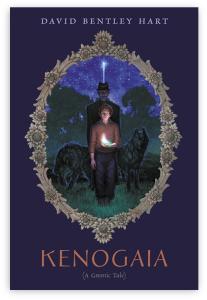 Eastern Orthodox scholar David Bentley Hart is undoubtedly best known for his comprehensively metaphysical theology and his distinctive writing style. But I don’t expect that his recent novel Kenogaia—arriving as it does from a niche publisher, without an expensive promotional campaign—will get a lot of mainstream attention. And that’s a great shame, because it’s one of Hart’s finest works (not to mention a cracking good fantasy novel).
On its face, Kenogaia begins like almost any other YA-influenced dystopian novel. Young Michael Ambrosius, forced to live under the authoritarian regime that has kidnapped his father, witnesses the mysterious woodlands appearance of an otherworldly boy named “Oriens.” But it quickly becomes clear that Hart has the power to dramatically elevate the genre within which he’s working: once the story really kicks into gear, readers get a level of worldbuilding that puts Brandon Sanderson to shame.
Specifically, the world-picture that animates Kenogaia is what Oswald Spengler would describe as a “cavern”: a thoroughly Ptolemaic universe taking the form of concentric cosmic spheres, with stars charting fixed courses over the heads of all those dwelling within the “innermost” sphere. But what, if anything, lies outsidethe cavern, altogether beyond all the interlocking spheres of creation? That is the question of transcendence and divine light, and it is the question that drives Kenogaia.
Under threat from werewolves, shadow demons, and sorcerers, Michael and Oriens— together with their friend Laura—must undertake a dangerous journey to the capital city. There they hope to free Oriens’s sister, whose dream-energy ostensibly powers the entire structure of the cosmic spheres and keeps their inhabitants from reaching their true home beyond the stars. But the rulers of the spheres, of course, have no interest in letting this happen.
Structurally speaking, Kenogaia’s story of captivity, forgetfulness, and return to the divine draws inspiration from the Gnostic Hymn of the Pearl, an extract from the Acts of Thomas. (And indeed, Kenogaia is subtitled “A Gnostic Tale.”) And here, some clarification is likely in order.
Today, the adjective “Gnostic” is often used as a pejorative, referring to a very specific impulse: the desire to fly away from the bondage of the phenomenal world toward an otherworldly heaven. But as Hart would wish us to note, similar themes are echoed in canonical Christian texts. As Romans 8:21–22 tells us, “the whole creation groaneth and travaileth in pain together until now” and human souls long to “be delivered from the bondage of corruption into the glorious liberty of the children of God.” (KJV) Hart would likely go further than I would in characterizing the created order as principally a site of bondage, rather than as something good and yet fundamentally damaged, but the overarching point stands: what is usually called “Gnosticism” today posed such a challenge to the early Church because in many ways it shared a common conceptual vocabulary. In light of this, Kenogaia’s labeling as “A Gnostic Tale” shouldn’t be an unqualified red flag: the vision it portrays is not so much anti-Christian as pre-Christian, incomplete in the sense that a mythology can be theologically incomplete and yet still point toward a fuller truth.
Indeed, it’s this sense of incompleteness that makes Kenogaia so haunting, and its ending so elegiac. Oriens’s cosmic father and mother, a dyad of King and Queen, dwell in an inaccessible mountain palace, unavailable even to those souls emancipated from the clockwork spheres. Seemingly foreclosed forever, on this cosmology, is any prospect of knowing God “face to face.” (1 Cor. 13:12) For on a traditional Gnostic metaphysics, the highest principle can never come in contact with creation—and it took the Nicene Christian breakthrough to finally resolve this impasse. As it stands, though, a shadow of tragedy looms over Kenogaia, lending the work an unearthly beauty all its own.
In the end, I suppose that if I had to draw an analogy, I’d probably describe this novel as something like “Chronicles of Narnia meets A Series of Unfortunate Events, with a dash of BioShock.” I can’t recommend it highly enough, and I can’t wait to read it aloud to my son once he’s old enough to understand it. Books that fire the imagination like this one are in short supply.
Previous Post

February 3, 2022
After “Faithful Presence”
Next Post

February 25, 2022 “Pan’s Labyrinth” and the Logic of Sacrifice
Browse Our Archives
Select a Category Culture Ecclesiology Education Imagination Movies Political Theory Scripture Uncategorized Worship
Select a Month December 2022 November 2022 October 2022 September 2022 August 2022 June 2022 May 2022 April 2022 March 2022 February 2022 January 2022 December 2021 November 2021 October 2021 September 2021 August 2021 July 2021 June 2021 May 2021 April 2021 March 2021 February 2021 January 2021 December 2020 November 2020 October 2020 September 2020 August 2020 July 2020 June 2020 May 2020 April 2020 March 2020 February 2020 January 2020 December 2019 November 2019 October 2019 September 2019 August 2019 June 2019 April 2019 January 2019 December 2018 October 2018 September 2018 August 2018 July 2018 June 2018 May 2018
TAKE THE
Religious Wisdom Quiz
Which Psalm contains "The Lord is my shepherd; I shall not want"?
Select your answer to see how you score.
Psalm 119 Psalm 23 Psalm 1 Psalm 51
Related posts from Between Two Kingdoms

Ad Astra Per Fidem: A Review of Christiana...

Enchantments and Disenchantment

The Best Books I Read This Year (2022...
TRENDING AT PATHEOS Evangelical

The REST of Your Life: A Creative Wrestles...
This week I had a conversation with a good friend from church....

How the author of the world's best hymn...
I've been working with John Newton for a while now. This makes...

Long before this Lectio Divina, Psalm 130 - the song - started...

What About the Trees? Another Living Parable
After I finished writing the last article about falling leaves as a...

Why Classical Education Is a Conversation, Not a...
Come and Read: Joy in Classical Education When I was a little...

Cornell University has received a great deal of negative publicity and intense...
view all Evangelical blogs
Ad-Free & Subscriber Log-In Subscription Support
- About Us
- 2026 Calendar
- Videos
- Podcasts
- Library of World Religions
- Faith In Media Tracker
- Advertise With Us
- Write for Us
- Privacy Policy
- Terms of Service
- Do Not Sell My Data
- Contact Us
- Radiant Digital
- Manage Newsletter Subscriptions
- Unsubscribe From Notifications
- Sitemap
Copyright 2008-2026, Patheos. All rights reserved.
Subscription Support Ad-Free & Subscriber Log-In
Follow Patheos