
BuddhistCatholicContemplativeEvangelicalGeneral ChristianHinduJewishLatter-day SaintMuslimNew VisionsProgressive Christian
Beliefs
- Buddhist
- Catholic
- Contemplative
- Evangelical
- General Christian
- Hindu
- Jewish
- Latter-day Saint
- More Voices
- Muslim
- New Visions
- Pagan
- Progressive Christian
Topics
- Religion News
- Food and Religion
- Sports and Religion
- Religious Art
- Religious Music and Entertainment
- Religious Events
- History and Religion
- Style and Religion
- Politics and Religion
- Women in Religion
- Recreation Outdoors and Religion
- Business Finance and Religion
- Careers Workplace and Religion
- Education and Religion
- Family Parenting and Religion
- Health Fitness and Religion
- Home and Religion
- Relationships and Religion
- Technology and Religion
- Travel and Religion
Columnists
- Buddhist Columnists
- Business Finance and Religion Columnists
- Careers Workplace and Religion Columnists
- Catholic Columnists
- Contemplative Columnists
- Education and Religion Columnists
- Evangelists Columnists
- Family Parenting and Religion Columnists
- General Christian Columnists
- Health Fitness and Religion Columnists
- Hindu Columnists
- History and Religion Columnists
- Home and Religion Columnists
- Jewish Columnists
- More Voices Columnists
- Latter Day Columnists
- Muslim Columnists
- New Visions Columnists
- Nonreligious Columnists
- Pagan Columnists
- Politics and Religion Columnists
- Progressive Columnists
- Recreation Outdoors and Religion Columnists
- Relationships and Religion Columnists
- Religion News Columnists
- Religious Art Columnists
- Religious Events Columnists
- Religious Music and Entertainment Columnists
- Sports and Religion Columnists
- Style and Religion Columnists
- Technology and Religion Columnists
- Travel and Religion Columnists
- Women in Religion Columnists
Resource Library
- 2026 Calendar
- Library of World Religions
- The 100 Most Holy Places on Earth
- Patheos Answers
- Podcasts
- Videos
- Faith Leaders Database
- Anglican Episcopalian
- Bahai
- Baptist
- Buddhism
- Christianity
- Confucianism
- Eastern Orthodoxy
- Hinduism
- Holiness and Pentecostal
- ISKCON
- Islam
- Judaism
- Lutheran
- Methodist
- The Church of Jesus Christ of Latter-day Saints
- New Age
- Paganism
- Presbytarian and Reformed
- Protestantism
- Religion Behind the Scenes
- Roman Catholic
- Scientology
- Shia Islam
- Sikhism
- Sufism
- Sunni Islam
- Taoism
- Zen
- See all religions
Research Tools
 Ad-Free & Subscriber Log-In Subscription Support
Ad-Free & Subscriber Log-In Subscription Support
Follow Patheos 

- Trending:
- Forgiveness
- |
- Marriage
- |
- Consciousness
- |
- Death Penalty
- |
- Election
- |
- Halloween
 Between Two Kingdoms
- Home
- Evangelical
- Religious Music & Entertainment
- Bishop Spong’s Radical Gambit
Bishop Spong’s Radical Gambit
Last updated on: September 24, 2021 at 10:12 am by John Ehrett
Bishop Spong’s Radical Gambit 2021-09-24T10:12:04-05:00 John Ehrett
Patheos Explore the world's faith through different perspectives on religion and spirituality! Patheos has the views of the prevalent religions and spiritualities of the world.
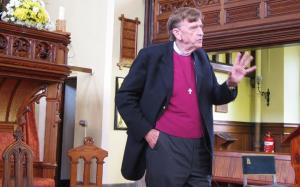
Image credit: Religion News Service/David Gibson
This month marked the passing of Episcopal theologian John Shelby Spong, the longtime Bishop of Newark. Despite my strong theological disagreements with him, I’ve always found Spong an interesting figure: Spong displayed none of the vacillation and ambiguity characteristic of those “deconstructing” their faith today. Instead, like a fever dream of J. Gresham Machen, he was quite confident in his radical proposals for internal reform—regularly prophesying that without dramatic doctrinal change, Christianity would disappear in the modern world.
Out of bemusement more than anything else, I recently took a detour through Spong’s bestselling polemic Why Christianity Must Change or Die: A Bishop Speaks to Believers in Exile. It is not a text that has aged particularly well.
Following existentialist theologian Paul Tillich, Spong is comfortable with a confession of God as the Ground of Being—but as for anything beyond that, a top-to-bottom transvaluation of traditional Christian symbols is required. (Having read a fair amount of Tillich myself, I am not at all confident that he would approve of the uses to which Spong puts his theology, but that’s neither here nor there.) Any idea of “original sin” must be expunged from the baptismal rite, to be replaced with a celebration of the faith commitment of the community to a reality transcending itself. The metaphysics of the Eucharist must yield to an account of Communion as an acknowledgment of individuals’ innate spiritual hunger. The proclamation of the Gospel must be reconceived as a call to human beings to discover their God-nature within, and to relate to Jesus as an exemplar of such God-nature. And so on and on his arguments ran.
Now, there are a lot of conceptual problems here for the dissecting. Most obviously, it’s simply false that the doctors of Christian tradition were, to a one, philosophical rubes incapable of thinking beyond an absolutist literalism. Spong spends page after page denouncing the reduction of God to an anthropomorphic “being among beings” (and displays in the process an annoying and anachronistic propensity to label this anthropomorphism “classical theism”), but none of his claims here would be at all unfamiliar to Augustine, Gregory of Nyssa, Thomas Aquinas, Martin Luther, John Calvin, or almost any other real theological luminary. Strictly speaking, Tillich’s metaphysics of God weren’t all that controversial; more questionable was his “method of correlation” that endeavored to map Christian doctrines onto the lingua franca of modernity.
And indeed, a similar move constitutes the fascinating paradox at the heart of Spong’s project: who would have guessed that a book ostensibly written to make the Christian faith intelligible to a “postmodern world” would rely so profoundly on the hoary old modernist categories that “postmodernism” called into question?
According to Spong, the “objective” data provided by science and modern ethics must set the standard against which any future Christian faith should be measured. Never mind that these disciplines, as scholars like John Milbank have repeatedly demonstrated in painstaking detail, are freighted with metaphysical assumptions of their own; for Spong, modern minds have simply moved beyond the “three-tiered universe” and “human exceptionalism” of the Bible, and so everything must yield to the relentless march of the zeitgeist. Crucially, for Spong theological language is either literal or metaphorical (in the most fairy-tale sense imaginable).
But, just as before, this simply isn’t how the grammar of Christian theology has typically worked. Ancient theological language—like “being of one substance with the Father” or “neither confounding the persons nor dividing their substance*”*—represents centuries of effort to capture the deepest metaphysical realities within the finite categories of human speech. And if millennia of theological reflection on such propositions is any indication, they are certainly not altogether meaningless. Hence Thomas Aquinas’s famous doctrine of analogical language: the limitations of human language do not render theological claims essentially untrue, but rather open-ended.
There’s a connection between the idea of analogy and something like George Lindbeck’s theory of Christian doctrine as essentially “regulative,” as constituting the structure within which Christian theology happens. That view certainly does not exclude the fact that doctrines plainly entail truth-claims of their own, but conceiving of doctrine as also a boundary-setting mechanism helps explain how theological development can and has occurred within a framework called “orthodoxy.” In the simplest possible terms, when you abandon the language of Christian theology, you abandon anything that could be recognizably identified as Christian theology; the meaning of theological language may be (and is) contested and debated within the “Christian” fold, but apart from it, there’s nothing authentically “Christian” left to work with.
And this is the cul-de-sac into which Spong’s project inevitably leads: a reduction of organized faith to “existential experience” that must always remain beholden to other disciplines for the content of its ethics and the contours of its metaphysics. Neglected altogether is the possibility that theological categories themselves can meaningfully shape how we interpret the data of our life experiences. For example, if I take pleasure in the misfortune of someone I dislike, is this reaction first and foremost a “sin” (the traditional theological answer), or is it merely a “natural emotional response” (a common modern response)? Note that even my framing in this hypothetical isn’t purely neutral: I use the word “pleasure” here because it’s a recognizable term, but in generations past the proper term would’ve been “passion”—which carries with it the connotations of an undesirable, morally base reaction.
So, what’s the answer? Is such an impulse a sin or a benign human response? Should we consider it “pleasure” or “passion”? That question can never be answered by the empirical sciences, because at heart it’s a value judgment necessarily grounded in a particular comprehensive world-picture. And for his part, Spong makes little attempt to ground the plausibility of his own world-picture in anything beyond his subjective sense of “how people these days think.”
In any event, Spong’s life’s work—devising a reinterpretation of Christianity that would survive the buffeting of contemporary culture—cannot be judged successful even by his own lights. Those denominations that have, more or less, taken Spong’s advice have watched their membership numbers decline at a far steeper rate than others. That outcome should be entirely unsurprising, because at bottom Spong’s proposed path is not an appealing one. Human beings need myth and symbol, to be sure, but they also need the traditions within which those symbols make sense. Anything else simply saws off the branch upon which a mature faith must rest.
Previous Post

September 9, 2021
The “Matrix” Sequels Are Better Than You Remember
Next Post

September 27, 2021 The Three Little Pigs and the Last Judgment
Browse Our Archives
Select a Category Culture Ecclesiology Education Imagination Movies Political Theory Scripture Uncategorized Worship
Select a Month December 2022 November 2022 October 2022 September 2022 August 2022 June 2022 May 2022 April 2022 March 2022 February 2022 January 2022 December 2021 November 2021 October 2021 September 2021 August 2021 July 2021 June 2021 May 2021 April 2021 March 2021 February 2021 January 2021 December 2020 November 2020 October 2020 September 2020 August 2020 July 2020 June 2020 May 2020 April 2020 March 2020 February 2020 January 2020 December 2019 November 2019 October 2019 September 2019 August 2019 June 2019 April 2019 January 2019 December 2018 October 2018 September 2018 August 2018 July 2018 June 2018 May 2018
TAKE THE
Religious Wisdom Quiz
I danced before the ark with all my might, wearing only a linen ephod. Who am I?
Select your answer to see how you score.
Solomon Jonathan Saul David
Related posts from Between Two Kingdoms

The Three Little Pigs and the Last Judgment

Typological Biblical Interpretation Needs Athens, Not Just Jerusalem

The Wrongheaded Smear Campaign Against Southern Baptist Theological...

Against the “Hermeneutic of Harm”
TRENDING AT PATHEOS Evangelical

The REST of Your Life: A Creative Wrestles...
This week I had a conversation with a good friend from church....

How the author of the world's best hymn...
I've been working with John Newton for a while now. This makes...

Long before this Lectio Divina, Psalm 130 - the song - started...

What About the Trees? Another Living Parable
After I finished writing the last article about falling leaves as a...

Why Classical Education Is a Conversation, Not a...
Come and Read: Joy in Classical Education When I was a little...

Cornell University has received a great deal of negative publicity and intense...
view all Evangelical blogs
Ad-Free & Subscriber Log-In Subscription Support
- About Us
- 2026 Calendar
- Videos
- Podcasts
- Library of World Religions
- Faith In Media Tracker
- Advertise With Us
- Write for Us
- Privacy Policy
- Terms of Service
- Do Not Sell My Data
- Contact Us
- Radiant Digital
- Manage Newsletter Subscriptions
- Unsubscribe From Notifications
- Sitemap
Copyright 2008-2026, Patheos. All rights reserved.
Subscription Support Ad-Free & Subscriber Log-In
Follow Patheos