
BuddhistCatholicContemplativeEvangelicalGeneral ChristianHinduJewishLatter-day SaintMuslimNew VisionsProgressive Christian
Beliefs
- Buddhist
- Catholic
- Contemplative
- Evangelical
- General Christian
- Hindu
- Jewish
- Latter-day Saint
- More Voices
- Muslim
- New Visions
- Pagan
- Progressive Christian
Topics
- Religion News
- Food and Religion
- Sports and Religion
- Religious Art
- Religious Music and Entertainment
- Religious Events
- History and Religion
- Style and Religion
- Politics and Religion
- Women in Religion
- Recreation Outdoors and Religion
- Business Finance and Religion
- Careers Workplace and Religion
- Education and Religion
- Family Parenting and Religion
- Health Fitness and Religion
- Home and Religion
- Relationships and Religion
- Technology and Religion
- Travel and Religion
Columnists
- Buddhist Columnists
- Business Finance and Religion Columnists
- Careers Workplace and Religion Columnists
- Catholic Columnists
- Contemplative Columnists
- Education and Religion Columnists
- Evangelists Columnists
- Family Parenting and Religion Columnists
- General Christian Columnists
- Health Fitness and Religion Columnists
- Hindu Columnists
- History and Religion Columnists
- Home and Religion Columnists
- Jewish Columnists
- More Voices Columnists
- Latter Day Columnists
- Muslim Columnists
- New Visions Columnists
- Nonreligious Columnists
- Pagan Columnists
- Politics and Religion Columnists
- Progressive Columnists
- Recreation Outdoors and Religion Columnists
- Relationships and Religion Columnists
- Religion News Columnists
- Religious Art Columnists
- Religious Events Columnists
- Religious Music and Entertainment Columnists
- Sports and Religion Columnists
- Style and Religion Columnists
- Technology and Religion Columnists
- Travel and Religion Columnists
- Women in Religion Columnists
Resource Library
- 2026 Calendar
- Library of World Religions
- The 100 Most Holy Places on Earth
- Patheos Answers
- Podcasts
- Videos
- Faith Leaders Database
- Anglican Episcopalian
- Bahai
- Baptist
- Buddhism
- Christianity
- Confucianism
- Eastern Orthodoxy
- Hinduism
- Holiness and Pentecostal
- ISKCON
- Islam
- Judaism
- Lutheran
- Methodist
- The Church of Jesus Christ of Latter-day Saints
- New Age
- Paganism
- Presbytarian and Reformed
- Protestantism
- Religion Behind the Scenes
- Roman Catholic
- Scientology
- Shia Islam
- Sikhism
- Sufism
- Sunni Islam
- Taoism
- Zen
- See all religions
Research Tools
 Ad-Free & Subscriber Log-In Subscription Support
Follow Patheos 

- Trending:
- Advent
- |
- Forgiveness
- |
- Thanksgiving
- |
- Election
- |
- Seasonal Holidays
- |
- Marriage
 Between Two Kingdoms
- Home
- Evangelical
- Religious Music & Entertainment
- “The Decadent Society” Misses the Mark
“The Decadent Society” Misses the Mark
Last updated on: March 8, 2020 at 12:23 pm by John Ehrett
“The Decadent Society” Misses the Mark 2020-03-08T12:23:54-05:00 John Ehrett
Patheos Explore the world's faith through different perspectives on religion and spirituality! Patheos has the views of the prevalent religions and spiritualities of the world.
 It is a truth universally acknowledged (or, well, it should be) that Ross Douthat is far-and-away the best columnist at the New York Times. When I click through to a Douthat column, I already know that I’m going to read something quite different from the center-left party line that dominates most of the paper. (A few years ago I wrote here about one of his more astute cultural observations.)
Alas, the same cannot be said of his books. From Bad Religion and To Change the Church to the latest—The Decadent Society—Douthat’s books tend to lean heavily on description without evaluation, offering well-written diagnoses of a current cultural moment but steadfastly refusing to make predictions, outline theories, or advance provocative theses. And the new book is no different. The Decadent Society reads like a column stretched beyond its natural bounds, teasing provocative questions but declining to really address them.
Douthat’s central argument is intriguing, if not exactly stirring: contra those who see a new civil war or cultural collapse on the horizon, it’s quite likely that the Western neoliberal order will keep limping along for the foreseeable future. This is because, Douthat argues, the West has moved into a decadent phase of existence. Drawing on the work of Jacques Barzun, Douthat defines “decadence” as “economic stagnation, institutional decay, and cultural and intellectual exhaustion at a high level of material prosperity and technological development.”
Like all good conservative accounts of cultural decline, Douthat links the “decadent turn” to a distinct historical moment. For Douthat, the last great human achievement was the Apollo 11 moon landing in 1969, and almost everything since then has exemplified decadence and stagnation rather than real forward progress.
From there, Douthat proceeds to an extended discussion of issues that will be familiar to those who’ve read other books in the tragedy-of-modernity genre. We read about a hedonistic elite flush with economic gains, widespread technological surveillance, the collapse of mainline Protestantism and European secularization, the opioid crisis and “deaths of despair,” the ubiquity of hardcore pornography, the challenges of immigration and assimilation, and so on. All of this will be quite familiar to most of Douthat’s target audience.
And then the book just—stops. There’s an interesting stretch of the book outlining possible alternative paths leading away from decadence, but Douthat is largely reluctant to state which paths he finds either historically plausible or normatively desirable. (Unfortunately, there’s nothing here that would scandalize the average Ivy League humanities professor. I would’ve loved to read Douthat’s outline of what a post-decadent Christian polity might look like.)
That abrupt ending would perhaps not be such a stark disappointment if The Decadent Society set out a stronger argument, but sadly the book does not. The linchpin of Douthat’s case—that the space race represented the last great movement of a flourishing society— is interesting, but seriously underdeveloped. It’s not at all obvious that everything since then has been a simple manifestation of decadence, and possible counterexamples are legion. (Economic triumph over the USSR in the 1980s? The digital revolution of the 1990s and 2000s? The resurgence of populism in 2016 and beyond?) As a result, much of the book feels like it’s retrofitting evidence to Douthat’s thesis rather than vice versa.
On this front, perhaps the book’s oddest argument is its claim that the Internet didn’t substantially alter the course of American decadence and quiescence. To even a casual observer, it seems obvious that—for better or worse—the internet has become a proxy battlefield, with conflicts that regularly spill over into the “meatspace” of physical reality. And the rage, anger, and balkanization of that battlefield has grown worse in recent years.
Douthat clearly understands this—an extended section of The Decadent Society is devoted to the phenomenon of social media mobs driving their targets to ruin—but nonetheless treats online politicking as primarily theatrical, a way of shielding oneself from real risk. This doesn’t hold up to scrutiny. For those on the receiving end of mob justice, it’s immaterial whether extremists are gathering on the streets or on Reddit: the net result—the destruction of one’s livelihood—is the same. If you’re rendered unhireable because your employer is barraged with messages from outraged Twitter denizens, your life has been materially disrupted just as much as if your employer was picketed and threatened by goons in the street. The stakes of online life have only grown higher with time. (Curiously, Douthat cites media critic James Poulos on the nexus between capitalism and surveillance culture, but somehow neglects much of Poulos’s insightful work on the transformative effects of digital culture.)
Elsewhere, Douthat argues that Hollywood’s current sequel/reboot/remake feedback loop reflects a creative failure that’s lasted since the 1970s. But—and here I speak as someone who’s had a bit of professional exposure to movie-industry realities—the issue isn’t exactly creative exhaustion, but the skyrocketing costs of “tentpole” blockbusters and the resulting need to produce films that are comprehensible across very different cultures. It turns out that explosions and robots are the lingua franca of the modern age (who knew?), so that’s why all the big money flows to sci-fi blockbusters. For those willing to look, there’s plenty of cinematic creativity on offer—HBO’s The Young Pope, Netflix’s Orange Is the New Black, Amazon’s The Boys, and so on, to say nothing of foreign films like Parasite and The Farewell that are more accessible than ever before. The rise of streaming media might’ve led to an explosion of mediocre entertainment, but it’s also caused some real breakthroughs.
I could go on with a point-by-point breakdown, but it’d be futile because I think Douthat himself hints at the book he really wanted to write. At the very end of the book, Douthat leaves readers with a startling observation: “I suspect that a truly globalized civilization cannot help tending toward decadence so long as it remains earthbound, so long as there is no hope of finding actual new worlds to leap toward, conquer, or explore.” The implication here is that some form of physical exploration—concerns over colonialism notwithstanding—is a necessary condition for the flourishing of a human society. That is a striking, compelling, and original argument that would’ve made for a fantastic book (and it could go in some very interesting directions—deep-sea exploration, anyone?).
Note that this argument is only incidentally related to the various cultural pathologies Douthat describes. Viewed from this angle, the internet (and almost everything else Douthat chronicles) isn’t so much an expression of decadence so much as it is a distraction from full engagement with the mystery and wonder of reality. In turning inward—in focusing on entertainment, drugs, pleasure, and identity—America has lost its focus on the majesty of the cosmos and the possibility of true transcendence.
That’s the argument that The Decadent Society needed to make, and I think it’s a pretty good one. It’s a shame that’s not the book that hit the shelves.
Previous Post

March 4, 2020
Originalism Without a Constitution?
Next Post

March 10, 2020 What Does Healthy Campus Debate Look Like?
Browse Our Archives
Select a Category Culture Ecclesiology Education Imagination Movies Political Theory Scripture Uncategorized Worship
Select a Month December 2022 November 2022 October 2022 September 2022 August 2022 June 2022 May 2022 April 2022 March 2022 February 2022 January 2022 December 2021 November 2021 October 2021 September 2021 August 2021 July 2021 June 2021 May 2021 April 2021 March 2021 February 2021 January 2021 December 2020 November 2020 October 2020 September 2020 August 2020 July 2020 June 2020 May 2020 April 2020 March 2020 February 2020 January 2020 December 2019 November 2019 October 2019 September 2019 August 2019 June 2019 April 2019 January 2019 December 2018 October 2018 September 2018 August 2018 July 2018 June 2018 May 2018
TAKE THE
Religious Wisdom Quiz
Who said, "What must I do to be saved?"
Select your answer to see how you score.
The Philippian jailer Nicodemus Zacchaeus Peter
Related posts from Between Two Kingdoms

The Best Books I Read This Year (2022...
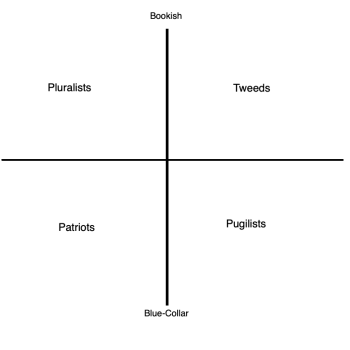
A Typology of Conservative Protestants in an Anxious...

The MFA Novel and the Mystery Box

Tim Keller and the Two Senses of “Winsome”
TRENDING AT PATHEOS Evangelical

When you hear the word riches, what comes to mind? For most...

Don’t Miss the Parents: A Creative Christmas Meditation
As we enter the Advent Season, I see many people trying to...

Making Stones Into Bread: Choosing the “Right” Work
I was on my online arts ministry Zoom meeting with the International...

Ukraine’s exhausted Christians face fifth winter of war
By Julian Lukins The full-scale war in Ukraine is taking “a serious...

Russell Brand's Conviction is not anti-Christian Persecution
How do we shed the reputation that the Church is OK with...

Have you ever caught yourself saying, “I’ll do it tomorrow,” or “Now...
view all Evangelical blogs
Ad-Free & Subscriber Log-In Subscription Support
- About Us
- 2026 Calendar
- Videos
- Podcasts
- Library of World Religions
- Faith In Media Tracker
- Advertise With Us
- Write for Us
- Privacy Policy
- Terms of Service
- Do Not Sell My Data
- Contact Us
- Radiant Digital
- Manage Newsletter Subscriptions
- Unsubscribe From Notifications
- Sitemap
Copyright 2008-2026, Patheos, part of the Radiant Digital network of media brands. All rights reserved.
Subscription Support Ad-Free & Subscriber Log-In
Follow Patheos