
BuddhistCatholicContemplativeEvangelicalGeneral ChristianHinduJewishLatter-day SaintMuslimNew VisionsProgressive Christian
Beliefs
- Buddhist
- Catholic
- Contemplative
- Evangelical
- General Christian
- Hindu
- Jewish
- Latter-day Saint
- More Voices
- Muslim
- New Visions
- Pagan
- Progressive Christian
Topics
- Religion News
- Food and Religion
- Sports and Religion
- Religious Art
- Religious Music and Entertainment
- Religious Events
- History and Religion
- Style and Religion
- Politics and Religion
- Women in Religion
- Recreation Outdoors and Religion
- Business Finance and Religion
- Careers Workplace and Religion
- Education and Religion
- Family Parenting and Religion
- Health Fitness and Religion
- Home and Religion
- Relationships and Religion
- Technology and Religion
- Travel and Religion
Columnists
- Buddhist Columnists
- Business Finance and Religion Columnists
- Careers Workplace and Religion Columnists
- Catholic Columnists
- Contemplative Columnists
- Education and Religion Columnists
- Evangelists Columnists
- Family Parenting and Religion Columnists
- General Christian Columnists
- Health Fitness and Religion Columnists
- Hindu Columnists
- History and Religion Columnists
- Home and Religion Columnists
- Jewish Columnists
- More Voices Columnists
- Latter Day Columnists
- Muslim Columnists
- New Visions Columnists
- Nonreligious Columnists
- Pagan Columnists
- Politics and Religion Columnists
- Progressive Columnists
- Recreation Outdoors and Religion Columnists
- Relationships and Religion Columnists
- Religion News Columnists
- Religious Art Columnists
- Religious Events Columnists
- Religious Music and Entertainment Columnists
- Sports and Religion Columnists
- Style and Religion Columnists
- Technology and Religion Columnists
- Travel and Religion Columnists
- Women in Religion Columnists
Resource Library
- 2026 Calendar
- Library of World Religions
- The 100 Most Holy Places on Earth
- Patheos Answers
- Podcasts
- Videos
- Faith Leaders Database
- Anglican Episcopalian
- Bahai
- Baptist
- Buddhism
- Christianity
- Confucianism
- Eastern Orthodoxy
- Hinduism
- Holiness and Pentecostal
- ISKCON
- Islam
- Judaism
- Lutheran
- Methodist
- The Church of Jesus Christ of Latter-day Saints
- New Age
- Paganism
- Presbytarian and Reformed
- Protestantism
- Religion Behind the Scenes
- Roman Catholic
- Scientology
- Shia Islam
- Sikhism
- Sufism
- Sunni Islam
- Taoism
- Zen
- See all religions
Research Tools
 Ad-Free & Subscriber Log-In Subscription Support
Ad-Free & Subscriber Log-In Subscription Support
Follow Patheos 

- Trending:
- Forgiveness
- |
- Marriage
- |
- Consciousness
- |
- Death Penalty
- |
- Election
- |
- Halloween
 Between the Shadows
- Home
- Pagan
- Seekers and Guides: A Coven Leader’s Primer
Seekers and Guides: A Coven Leader’s Primer
Last updated on: May 12, 2015 at 8:00 am by Sable Aradia
Seekers and Guides: A Coven Leader’s Primer 2015-05-11T23:13:39-08:00 Sable Aradia
Patheos Explore the world's faith through different perspectives on religion and spirituality! Patheos has the views of the prevalent religions and spiritualities of the world.
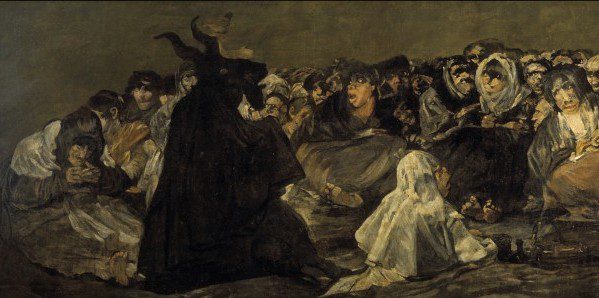
Francisco dem Goya y Lucientes – Witches’ Sabbath (The Great He-Goat) 1798. Source: Wikimedia Commons.
I’m really struggling to meet a deadline this week, so I hope you’ll forgive me if I re-run an old article from my Agora days. I was inspired by some things going on around me in my community at the moment, and also by the latest article on Oathbound.
I started a new teaching coven a few days ago. I wasn’t going to for quite some time. Coven leadership is a lot of work, and it’s an incredible emotional and temporal investment. But the Lady sent a bunch of eager new people my way, and I realized that Diana was reminding me of the calling I agreed to undertake. As I settle into working with this new group, I find myself going over the basics of establishing a new coven, and thought I would share with you the things I wish someone had told me when I started out.
Establish a Safe Space
Magickal work requires you to face your subconscious personal issues. It is said that the gates above the doors of Eleusis read, “Know Thyself.” In many ways, it becomes a bit like a support group. It is important to establish that kind of safe environment so that your students can be comfortable with doing this necessary Work. First, make sure that everyone understands that anything said in coven is confidential. Second, once the group has established itself (within the first two or three meetings) don’t allow new coveners without very careful scrutiny and the mutual agreement of the rest of the coven. Third, when disputes inevitably arise between covenmates, encourage them to work it out much as siblings do, with you serving in a role of mediator/facilitator if necessary.
Outline Expectations
They say that “assuming” makes an “ass” out of “u” and “me.” I have learned that it is very important to delineate your expectations when the group is established, otherwise feelings will get hurt and someone (likely you) will feel as though you are being taken advantage of. I have a very firm policy: I will not bear any of the financial burdens of running a coven (such as cakes, ale, candles, incense, handouts, gas and travel) because my time and my instruction are already a significant contribution. But I don’t charge fees, either; I just expect people to do, and pay, their share. I have had students promise to pay my gas to drive for 2 hours and then not do it, demand rides from me to the meeting site, or expect me to give them an entire book’s worth of paper handouts for free. I also refuse to be the one who always has to arrive early to set up the altar and leave an hour later because I was left to clean up. It is not inappropriate to expect a certain level of adult responsibility from your students, and I believe it’s actually good for their training because it teaches them about the Wiccan Rede.
Group Structure
It’s important to be clear about the structure of your group. Do you make most decisions by consensus (in which case, your role is that of facilitator) or is your tradition hierarchical (in which case, your role is leader and organizer?) There are merits and flaws to both approaches. If members have grievances, how do they resolve them? How intimate is your group? Are you just a teaching circle (read: classroom,) or are you a group of friends, or do you embrace the deep emotional connections that often come with searching your subconscious and dealing with the issues found there? If your students object to your work as Guide, do they have the right to take over somehow or do they need to go and start their own group; and is there an established process for this? What are the expectations of each of the degrees of study, if your tradition acknowledges degrees? Whose job is it to host, whose is it to phone everyone, and whose is it to set up the altar?
Be Aware of Group Dynamics
A coven is a small, very intimate group. In many ways, it is like a family. Human nature often leads us to play out the dynamics of our family of origin in such small groups. This is going to create all kinds of interpersonal concerns. Your coveners will project elements of their families and histories upon you and their covenmates. I would like to say that it doesn’t always happen, but in my experience I would be lying. Understanding the circumstances your coveners come from might give you some clues as to how that might manifest when it does, and help you overcome the issues that are created, especially when they reach the equivalent of Second Degree.
Sometimes, however, differences are irreconcilable. There should be a process for expelling troublesome members. It should always be the last resort, but there are certain problem personalities and situations that are always bad news and will destroy your coven. Amber K’s book Coven Craft offers a breakdown of some of them.
Theology and Practice
A coven requires a consistent theology and practice in its workings to be magickally effective. This helps the coveners attune to the coven egregor and the symbolism being used. I find it’s good to be specific. I tell my students, “This is not the only way to do Wicca, and all ways are valid; but this is the way that we are doing Wicca in this group. You are welcome to do whatever you want in your private practice, however.” And then I stick to it. Sometimes “because I said so,” really is a legitimate response.
When to Let Go
Eventually, all things come to an end. Your students will (at least if you’re doing your job) outgrow your teachings. Like being a parent, sometimes the hardest thing in the world to do is to release the apron strings. There are things you can do to ease the process. One is to encourage your more advanced students to aid with the teaching of newer students. Another is to allow them to lead ritual once in a while. A third is to insist upon participation (such as calling the quarters.)
Sometimes, students will decide to move on of their own accord. That’s their choice. Be satisfied that you have contributed to their magickal development and let it be.
And sometimes, a group just dissolves. My last coven ended when the majority of the students reached their second degree and decided to found their own coven. Ebb and flow applies to groups too.
You can get all the latest updates at the Between the Shadows Facebook page. Or you can read Between the Shadows directly on the Patheos Pagan site.
Previous Post

May 9, 2015
Fire Transforms Us
Next Post
May 20, 2015 Seekers and Guides: The Three Degrees of Wicca
Browse Our Archives
Select a Category A Quest for Canada Between the Shadows Books Columns Current Events Dance & Sacred Movement Feminism From the Shadows Gender How To Access Services Humour Intent Interviews Intoxicants Magick My Books Opinion Pagan community Pagan music Politics Praxis Quantum Woo Reviews Rituals Sabbats Sacred Universe Seekers and Guides Sexuality Sit for a Spell Stories the Craft The Great Rite the Scourge The Witch's Eight Paths of Power Theology Traditions Trance Video Wicca Witchcraft Witchcraft & Voodoo Witchcraft & Voodoo Writing
Select a Month October 2019 July 2019 June 2019 May 2019 March 2019 February 2019 January 2019 December 2018 October 2018 September 2018 August 2018 July 2018 June 2018 May 2018 April 2018 March 2018 February 2018 December 2017 November 2017 October 2017 September 2017 August 2017 July 2017 June 2017 May 2017 April 2017 March 2017 February 2017 January 2017 December 2016 November 2016 October 2016 September 2016 August 2016 July 2016 June 2016 May 2016 April 2016 March 2016 February 2016 January 2016 December 2015 November 2015 October 2015 September 2015 August 2015 July 2015 June 2015 May 2015 April 2015 March 2015 February 2015 January 2015 December 2014 November 2014 October 2014 September 2014
Follow Us!
TAKE THE
Religious Wisdom Quiz
What did Esther risk by approaching the king without being summoned?
Select your answer to see how you score.
Her fortune Her reputation Her citizenship Her life
Related posts from Between the Shadows


Pagan Book Review: Circe by Madeline Miller

Pagan Book Review: The Chains that Bind by...
Witchcraft & Voodoo: Ritual Tools (Video Premiere)
TRENDING AT PATHEOS Pagan

I was recently chatting with someone on Instagram. She asked me what...

While there are many people who share their results, the end of...

On July 23, I saw Christopher Nolan's The Odyssey which is Homer’s...

As I write this two big events have just finished up. One...

Restoring the Watershed of Divine Love
Perhaps cooperation is not something we manufacture through legislation, ideology, or moral...

Many UUs don’t pray because of bad experiences in a previous religion,...
view all Pagan blogs
Ad-Free & Subscriber Log-In Subscription Support
- About Us
- 2026 Calendar
- Videos
- Podcasts
- Library of World Religions
- Faith In Media Tracker
- Advertise With Us
- Write for Us
- Privacy Policy
- Terms of Service
- Do Not Sell My Data
- Contact Us
- Radiant Digital
- Manage Newsletter Subscriptions
- Unsubscribe From Notifications
- Sitemap
Copyright 2008-2026, Patheos. All rights reserved.
Subscription Support Ad-Free & Subscriber Log-In
Follow Patheos