
BuddhistCatholicContemplativeEvangelicalGeneral ChristianHinduJewishLatter-day SaintMuslimNew VisionsProgressive Christian
Beliefs
- Buddhist
- Catholic
- Contemplative
- Evangelical
- General Christian
- Hindu
- Jewish
- Latter-day Saint
- More Voices
- Muslim
- New Visions
- Pagan
- Progressive Christian
Topics
- Religion News
- Food and Religion
- Sports and Religion
- Religious Art
- Religious Music and Entertainment
- Religious Events
- History and Religion
- Style and Religion
- Politics and Religion
- Women in Religion
- Recreation Outdoors and Religion
- Business Finance and Religion
- Careers Workplace and Religion
- Education and Religion
- Family Parenting and Religion
- Health Fitness and Religion
- Home and Religion
- Relationships and Religion
- Technology and Religion
- Travel and Religion
Columnists
- Buddhist Columnists
- Business Finance and Religion Columnists
- Careers Workplace and Religion Columnists
- Catholic Columnists
- Contemplative Columnists
- Education and Religion Columnists
- Evangelists Columnists
- Family Parenting and Religion Columnists
- General Christian Columnists
- Health Fitness and Religion Columnists
- Hindu Columnists
- History and Religion Columnists
- Home and Religion Columnists
- Jewish Columnists
- More Voices Columnists
- Latter Day Columnists
- Muslim Columnists
- New Visions Columnists
- Nonreligious Columnists
- Pagan Columnists
- Politics and Religion Columnists
- Progressive Columnists
- Recreation Outdoors and Religion Columnists
- Relationships and Religion Columnists
- Religion News Columnists
- Religious Art Columnists
- Religious Events Columnists
- Religious Music and Entertainment Columnists
- Sports and Religion Columnists
- Style and Religion Columnists
- Technology and Religion Columnists
- Travel and Religion Columnists
- Women in Religion Columnists
Resource Library
- 2026 Calendar
- Library of World Religions
- The 100 Most Holy Places on Earth
- Patheos Answers
- Podcasts
- Videos
- Faith Leaders Database
- Anglican Episcopalian
- Bahai
- Baptist
- Buddhism
- Christianity
- Confucianism
- Eastern Orthodoxy
- Hinduism
- Holiness and Pentecostal
- ISKCON
- Islam
- Judaism
- Lutheran
- Methodist
- The Church of Jesus Christ of Latter-day Saints
- New Age
- Paganism
- Presbytarian and Reformed
- Protestantism
- Religion Behind the Scenes
- Roman Catholic
- Scientology
- Shia Islam
- Sikhism
- Sufism
- Sunni Islam
- Taoism
- Zen
- See all religions
Research Tools
 Ad-Free & Subscriber Log-In Subscription Support
Ad-Free & Subscriber Log-In Subscription Support
Follow Patheos 

- Trending:
- Forgiveness
- |
- Marriage
- |
- Consciousness
- |
- Death Penalty
- |
- Election
- |
- Halloween
 Between the Shadows
- Home
- Pagan
- Seekers and Guides: Maypole Magic
Seekers and Guides: Maypole Magic
Last updated on: April 27, 2015 at 10:06 am by Sable Aradia
Seekers and Guides: Maypole Magic 2015-04-27T10:06:23-08:00 Sable Aradia
Patheos Explore the world's faith through different perspectives on religion and spirituality! Patheos has the views of the prevalent religions and spiritualities of the world.
The most iconic symbol we associate with May Day is the maypole. I think it’s mostly because it’s a lot of fun to dance the maypole dance, but it’s bright, and cheerful, and contains an incredible depth of symbolism.
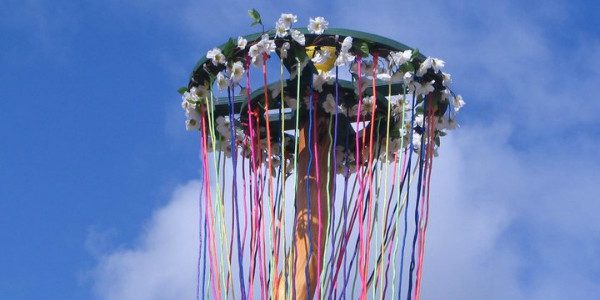
Maypole Crown. Beltaine Faire 2011, Edmonton, AB. Photo by Sable Aradia. Copyright (c) 2014. All rights reserved.
One could interpret it as a fertility symbol (a pole sticking into a hole, wrapped in white and red ribbons – you figure it out). One could interpret it as a Year-Wheel. One could see it as a World Tree or a model of the Universe (especially potent when rainbow ribbons are used.)
One of the most directly-successful spells I ever did involved a maypole. You can invest a magical intent into your maypole dance, even if you’re dancing with others who do not share your magical goal. Some ideas:
-
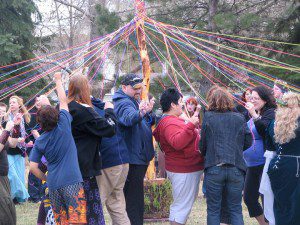
Maypole, Beltaine Faire 2011, Edmonton, AB. Photo by Sable Aradia. Copyright (c) 2011. All rights reserved.
A protection charm, especially when travelling – keeps you rooted in the earth and represents being centered
-
A spell to assure completion of a major project
-
When danced by a couple, especially when among other couples, a charm to maintain love
-
A charm to help bind a coven or community together – can be especially effective at the inauguration of a coven or group, or to bring disparate groups of people together
-
A fertility charm (this was very successful for me) – best followed by some babymaking sex!
-
A spell to bring growth and fertility to a piece of land – really effective when done in a garden
-
A spell to “get some” – concentrate on attracting sexy people who find you sexy!
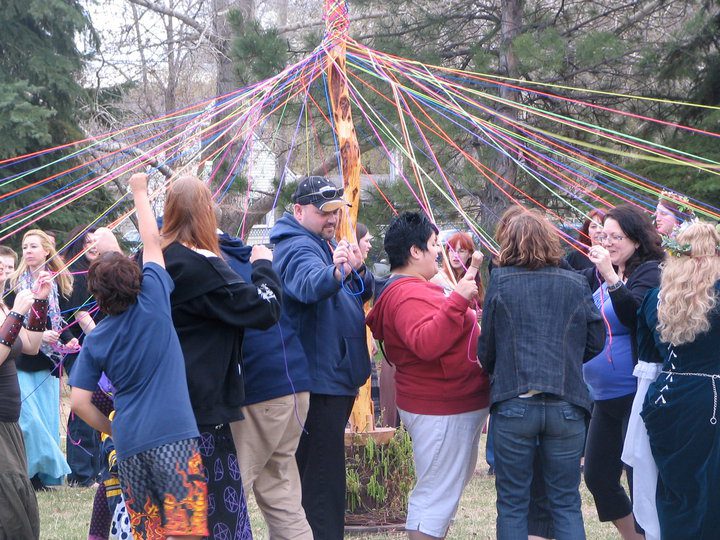
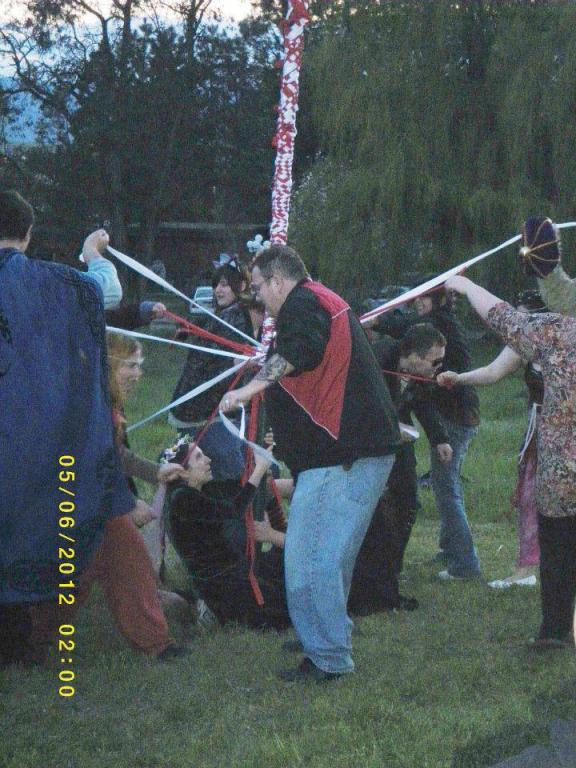
Beltane 2012 in Vernon, BC. Photo by Anari Houston, copyright (c) 2012. Used by permission.
How to Dance a Maypole[1]
You will need a maypole, which is a pole with streamers or ribbons all around the top. Sometimes a ring is fastened to it (coat hangers twisted into position to form a ring and a “cap” for the pole work nicely, especially if you cut a slot in the pole’s head) and sometimes the streamers are attached right to the top of the pole. You can cap it with flowers (tradition uses hawthorn or seasonal fruit blossoms). I advise you not to use crepe paper party streamers because they dissolve completely when wet and they don’t have good tensile strength to begin with. The ribbons are traditionally red (for the fertile menstrual blood of the Goddess) and white (for the God’s fertile seed) or multicolored.
You need to have as many streamers as there are people, and there needs to be an even number of them. I find it is better to err on the side of caution rather than have a whole bunch of unused streamers, which means not everyone might be able to participate. The maypole dance is physically demanding, so your less mobile folk may prefer to chant or drum anyway. I can tell you as a healthy asthmatic I find it challenging!
At one annual Beltane celebration I attend, the women dig the hole in the earth to hold the pole while the men chop it down and put it in. Both groups help to cap it with the ring of ribbons before it is propped up. The symbolism here should be fairly obvious!
Traditionally, everyone forms a circle, alternating men and women, though this convention will depend on your group. It is a fertility dance, so if you have a mixed gendered group, this can enhance the experience. Men and women face each other in pairs, with the women facing widdershins (direction of the moon) and men facing deosil (direction of the sun). I imagine in the southern hemisphere this would be reversed. If you aren’t alternating men and women, you still need two groups going in opposite directions.
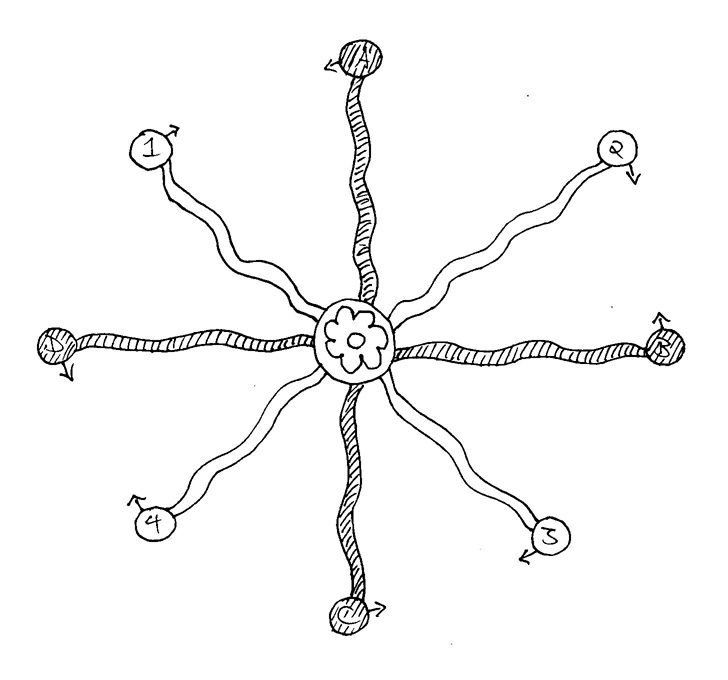
Maypole 1 by Sable Aradia. Copyright (c) 2014. All rights reserved.
Women hold the red streamers; men hold the white ones (or just pass them out in order, if your streamers are multicolored.)
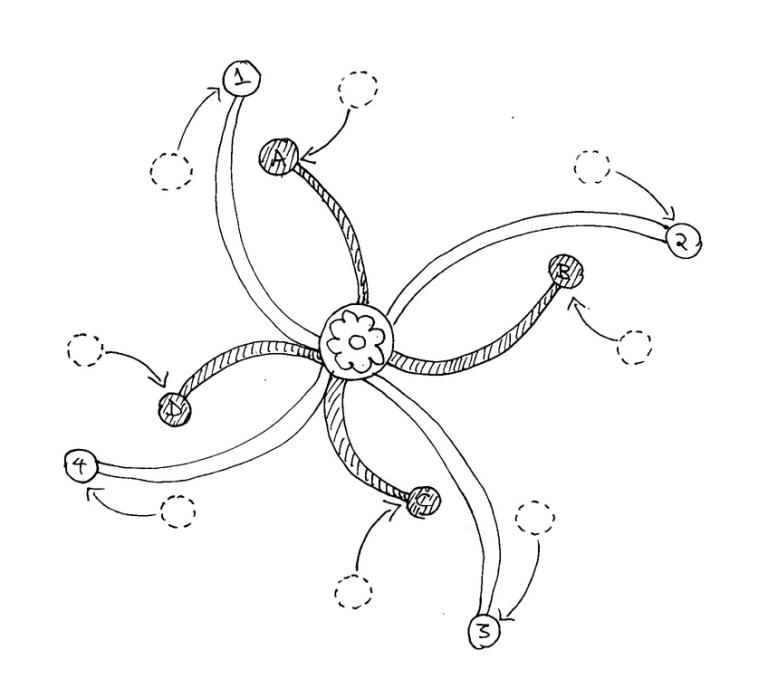
Maypole 2 by Sable Aradia. Copyright (c) 2014. All rights reserved.
Pulling the ribbons fairly taut, the dance begins with one group moving to the outside and the other moving to the inside as they pass each other. Women, again, move widdershins and men move deosil. It is easiest to have the widdershins group start to the inside and the deosil group start to the outside.
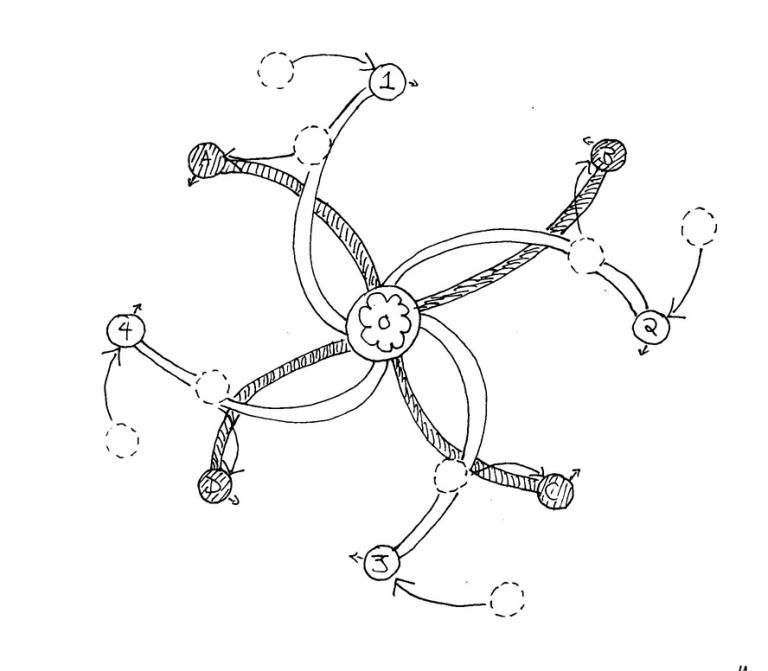
Maypole 3 by Sable Aradia. Copyright (c) 2014. All rights reserved.
Almost right away, you will be face-to-face with a new partner. Now move past that person to the opposite side of the one you started with (so if you passed the first person to the outside, now pass to the inside).
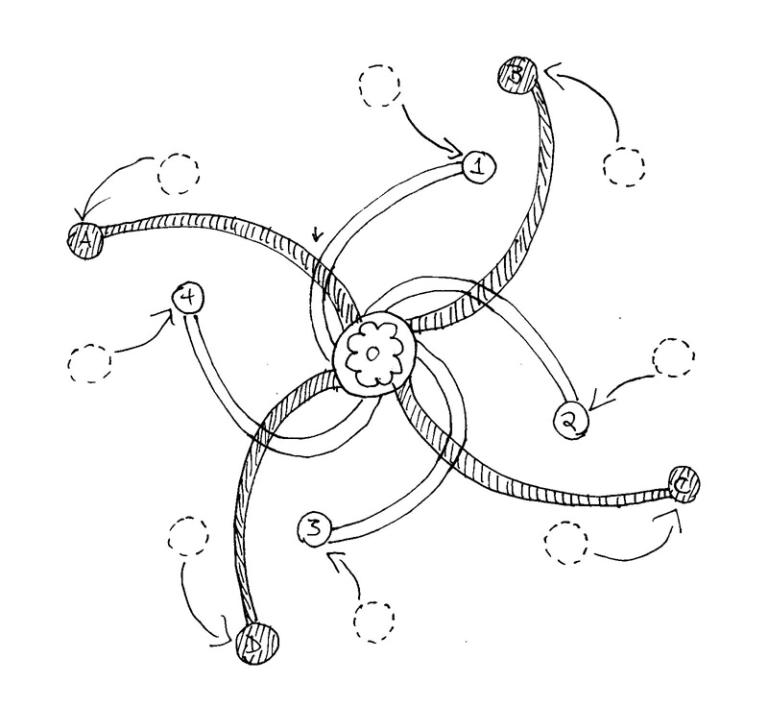
Maypole 4 by Sable Aradia. Copyright (c) 2014. All rights reserved.
When you reach the next person, pass to the other side again (so in our example, you would now be passing to the outside).
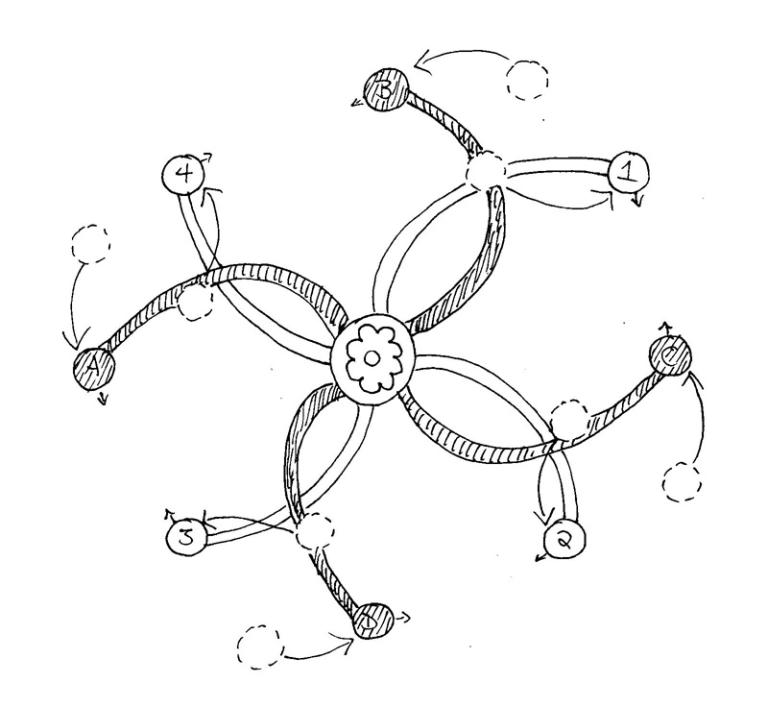
Maypole 5 by Sable Aradia. Copyright (c) 2014. All rights reserved.
Repeat the steps of this dance, alternating inside and outside. Try to remember which way you are supposed to move next—it is easy to get mixed up! You might end up hopelessly laughing and completely lost. It’s okay to replace people as they get tired if it goes on long enough, but just remember to keep alternating men and women if you started that way!
As the dance progresses, you will be weaving a pattern with the ribbons on the pole. If everyone remembers where they are, this will be quite beautiful. You will also find yourselves moving faster and faster as the ribbons shorten.
Eventually the streamers will be too short to be useful. At that point, start tying them off with other ribbons to hold them in place. People will begin to bow out of the dance as they run out of ribbon. When the last of the ribbons are tied off, the dance is done!
[1] Aradia, Lady Sable. The Witch’s Eight Paths of Power: A Complete Course in Magick and Witchcraft, p. 166-169. Red Wheel/Weiser, LLC, Sept. 2014.
Want to get all the latest updates first? Like the Between the Shadows Facebook page! And don’t forget to check out the Patheos Pagan channel for some great articles.
The Witch's Eight Paths of Power
The Witch's Eight Paths of Power

Next Post

April 30, 2015 Why Pagan Books Cost So Much (Part 2 of 2)
Browse Our Archives
Select a Category A Quest for Canada Between the Shadows Books Columns Current Events Dance & Sacred Movement Feminism From the Shadows Gender How To Access Services Humour Intent Interviews Intoxicants Magick My Books Opinion Pagan community Pagan music Politics Praxis Quantum Woo Reviews Rituals Sabbats Sacred Universe Seekers and Guides Sexuality Sit for a Spell Stories the Craft The Great Rite the Scourge The Witch's Eight Paths of Power Theology Traditions Trance Video Wicca Witchcraft Witchcraft & Voodoo Witchcraft & Voodoo Writing
Select a Month October 2019 July 2019 June 2019 May 2019 March 2019 February 2019 January 2019 December 2018 October 2018 September 2018 August 2018 July 2018 June 2018 May 2018 April 2018 March 2018 February 2018 December 2017 November 2017 October 2017 September 2017 August 2017 July 2017 June 2017 May 2017 April 2017 March 2017 February 2017 January 2017 December 2016 November 2016 October 2016 September 2016 August 2016 July 2016 June 2016 May 2016 April 2016 March 2016 February 2016 January 2016 December 2015 November 2015 October 2015 September 2015 August 2015 July 2015 June 2015 May 2015 April 2015 March 2015 February 2015 January 2015 December 2014 November 2014 October 2014 September 2014
Follow Us!
TAKE THE
Religious Wisdom Quiz
What does "Jehovah Rapha" mean?
Select your answer to see how you score.
The Lord Provides The Lord is Holy The Lord Heals The Lord Saves
Related posts from Between the Shadows


Pagan Book Review: Circe by Madeline Miller
Pagan Book Review: The Chains that Bind by...
Witchcraft & Voodoo: Ritual Tools (Video Premiere)
TRENDING AT PATHEOS Pagan

I was recently chatting with someone on Instagram. She asked me what...

While there are many people who share their results, the end of...

On July 23, I saw Christopher Nolan's The Odyssey which is Homer’s...

As I write this two big events have just finished up. One...

Restoring the Watershed of Divine Love
Perhaps cooperation is not something we manufacture through legislation, ideology, or moral...

Many UUs don’t pray because of bad experiences in a previous religion,...
view all Pagan blogs
Ad-Free & Subscriber Log-In Subscription Support
- About Us
- 2026 Calendar
- Videos
- Podcasts
- Library of World Religions
- Faith In Media Tracker
- Advertise With Us
- Write for Us
- Privacy Policy
- Terms of Service
- Do Not Sell My Data
- Contact Us
- Radiant Digital
- Manage Newsletter Subscriptions
- Unsubscribe From Notifications
- Sitemap
Copyright 2008-2026, Patheos. All rights reserved.
Subscription Support Ad-Free & Subscriber Log-In
Follow Patheos