
BuddhistCatholicContemplativeEvangelicalGeneral ChristianHinduJewishLatter-day SaintMuslimNew VisionsProgressive Christian
Beliefs
- Buddhist
- Catholic
- Contemplative
- Evangelical
- General Christian
- Hindu
- Jewish
- Latter-day Saint
- More Voices
- Muslim
- New Visions
- Pagan
- Progressive Christian
Topics
- Religion News
- Food and Religion
- Sports and Religion
- Religious Art
- Religious Music and Entertainment
- Religious Events
- History and Religion
- Style and Religion
- Politics and Religion
- Women in Religion
- Recreation Outdoors and Religion
- Business Finance and Religion
- Careers Workplace and Religion
- Education and Religion
- Family Parenting and Religion
- Health Fitness and Religion
- Home and Religion
- Relationships and Religion
- Technology and Religion
- Travel and Religion
Columnists
- Buddhist Columnists
- Business Finance and Religion Columnists
- Careers Workplace and Religion Columnists
- Catholic Columnists
- Contemplative Columnists
- Education and Religion Columnists
- Evangelists Columnists
- Family Parenting and Religion Columnists
- General Christian Columnists
- Health Fitness and Religion Columnists
- Hindu Columnists
- History and Religion Columnists
- Home and Religion Columnists
- Jewish Columnists
- More Voices Columnists
- Latter Day Columnists
- Muslim Columnists
- New Visions Columnists
- Nonreligious Columnists
- Pagan Columnists
- Politics and Religion Columnists
- Progressive Columnists
- Recreation Outdoors and Religion Columnists
- Relationships and Religion Columnists
- Religion News Columnists
- Religious Art Columnists
- Religious Events Columnists
- Religious Music and Entertainment Columnists
- Sports and Religion Columnists
- Style and Religion Columnists
- Technology and Religion Columnists
- Travel and Religion Columnists
- Women in Religion Columnists
Resource Library
- 2026 Calendar
- Library of World Religions
- The 100 Most Holy Places on Earth
- Patheos Answers
- Podcasts
- Videos
- Faith Leaders Database
- Anglican Episcopalian
- Bahai
- Baptist
- Buddhism
- Christianity
- Confucianism
- Eastern Orthodoxy
- Hinduism
- Holiness and Pentecostal
- ISKCON
- Islam
- Judaism
- Lutheran
- Methodist
- The Church of Jesus Christ of Latter-day Saints
- New Age
- Paganism
- Presbytarian and Reformed
- Protestantism
- Religion Behind the Scenes
- Roman Catholic
- Scientology
- Shia Islam
- Sikhism
- Sufism
- Sunni Islam
- Taoism
- Zen
- See all religions
Research Tools
 Ad-Free & Subscriber Log-In Subscription Support
Ad-Free & Subscriber Log-In Subscription Support
Follow Patheos 

- Trending:
- Forgiveness
- |
- Marriage
- |
- Consciousness
- |
- Death Penalty
- |
- Election
- |
- Halloween
 Between the Shadows
- Home
- Pagan
- Quantum Woo: The Uncertainty Principle
Quantum Woo: The Uncertainty Principle
Last updated on: December 15, 2014 at 9:00 am by Sable Aradia
Quantum Woo: The Uncertainty Principle 2014-12-15T08:02:50-08:00 Sable Aradia
Patheos Explore the world's faith through different perspectives on religion and spirituality! Patheos has the views of the prevalent religions and spiritualities of the world.
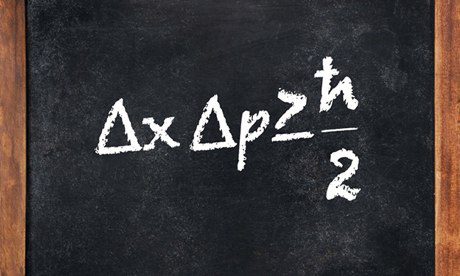
The Uncertainty Equation
At the quantum level, nature is more numinous than we realize in the material reality we experience. There is a fundamental limit to what we can know about the behaviour of quantum particles and, therefore, the smallest scales of matter and energy. It seems that the mere act of interacting with matter this small changes the way it behaves and it is impossible to observe the environment without affecting it. Measuring quantum particle waves requires that you measure both the position of a given particle and its momentum. But as Weiner Heisenberg put it:
The more precisely the position is determined, the less precisely the momentum is known in this instant, and vice versa.
–Heisenberg, uncertainty paper, 1927
This variable property of quantum particles is known as the Uncertainty Principle.
An early incarnation of the uncertainty principle appeared in Heisenberg’s 1927 paper from when he was working at Niels Bohr’s institute in Copenhagen, titled “On the Perceptual Content of Quantum Theoretical Kinematics and Mechanics”. The more familiar form of the equation came a few years later.
Among many counter-intuitive ideas, quantum theory proposed that energy was not continuous but instead came in packets (quanta) and that light could be described as both a wave and a stream of these quanta. In fleshing out this radical worldview, Heisenberg discovered a problem in the way that the basic physical properties of a particle in a quantum system could be measured.
From The Guardian:
The uncertainty principle says that we cannot measure the position (x) and the momentum (p) of a particle with absolute precision. The more accurately we know one of these values, the less accurately we know the other. Multiplying together the errors in the measurements of these values (the errors are represented by the triangle symbol in front of each property, the Greek letter “delta”) has to give a number greater than or equal to half of a constant called “h-bar”. This is equal to Planck’s constant (usually written as h) divided by 2π. Planck’s constant is an important number in quantum theory, a way to measure the granularity of the world at its smallest scales and it has the value 6.626 x 10⁻³⁴ joule seconds.
Here’s a handful of great videos to explain all of this. The first one explains the structure of an atom, which is a necessary primer for the second, which explains particle-wave duality (which we discussed in the last Quantum Woo column), and then the third introduces the Uncertainty Principle:
The Structure of Atoms
Wave Function and Wave-Particle Duality
The Uncertainty Principle
A website called “How Stuff Works” I was looking at explained it in very simplistic terms:
Imagine that you’re blind and over time you’ve developed a technique for determining how far away an object is by throwing a medicine ball at it. If you throw your medicine ball at a nearby stool, the ball will return quickly, and you’ll know that it’s close. If you throw the ball at something across the street from you, it’ll take longer to return, and you’ll know that the object is far away.
The problem is that when you throw a ball — especially a heavy one like a medicine ball — at something like a stool, the ball will knock the stool across the room and may even have enough momentum to bounce back. You can say where the stool was, but not where it is now. What’s more, you could calculate the velocity of the stool after you hit it with the ball, but you have no idea what its velocity was before you hit it.
This is the problem revealed by Heisenberg’s Uncertainty Principle. To know the velocity of a quark we must measure it, and to measure it, we are forced to affect it. The same goes for observing an object’s position. Uncertainty about an object’s position and velocity makes it difficult for a physicist to determine much about the object.

Image courtesy of Shutterstock
But it’s even more interesting that that. If you watch the second video in the series I’ve linked, you will see that the particle that we’re trying to determine the location of, actually winks in and out of existence, can appear out of nothing, can exist simultaneously in different spaces at once, and can disappear in one space and reappear in another without existing at any time in the spaces between. Our only saving grace in throwing that medicine ball (which are the light particles we are using to observe the experiment) is that these elusive “virtual particles” can only exist within certain permitted orbits in an atom (and therefore not others), and it is these permitted spaces, and the number of electrons within them, that ultimately determine what makes one element of the periodic table different from another.
Okay, those who don’t believe in magick can leave now because I’m going to explain how I think this has a bearing in metaphysics, and so I’m sure I’ll just bore you. *wink*
Let’s consider the mind-boggling notion that particles wink in and out of existence! I find this very exciting. First of all, it tells us that matter is not as firmly determined as we originally thought. Sometimes it exists; sometimes it doesn’t. We can’t perceive this because it’s all happening on such a microscopic level, and at such a rapid rate, that in terms of interacting with the physical universe that it might as well not be going on at all. But where do the particles go when they’re not here? If energy can be neither created nor destroyed, where is it in the meantime? There are numerous ideas about this and we’ll be exploring some of them in later articles in this series. Some of them will sound really familiar to mystics and magicians, but they were conceived of by physicists.
 Also, did anyone else catch that subatomic particles can actually teleport and co-locate? Of course there are limits to this: namely the “allowable orbits” of Bohr’s atomic model. So what seems like supernatural forces actual obey a set of laws and rules; though we obviously don’t quite understand them yet. But that’s the nature of magick and most perceived “supernatural” forces, isn’t it?
Now of course this proves nothing. The truth is that these “quanta” might not actually exist at all. They could merely be mathematical concepts created in order to interact with the environment in a way that makes sense to the creators of the idea, rather than an accurate description of the nature of how reality at the quantum level works. But this, of course, is exactly what magick is about; using a paradigm of symbology that probably isn’t actually the way things work, as a metaphor to enable us to interact with reality in productive ways. It works for physicists; why not us too?
Previous Post

December 12, 2014
Trained to Hate, Trained to Kill #Ferguson #Highway of Tears
Next Post

December 18, 2014 The Longest Night
Browse Our Archives
Select a Category A Quest for Canada Between the Shadows Books Columns Current Events Dance & Sacred Movement Feminism From the Shadows Gender How To Access Services Humour Intent Interviews Intoxicants Magick My Books Opinion Pagan community Pagan music Politics Praxis Quantum Woo Reviews Rituals Sabbats Sacred Universe Seekers and Guides Sexuality Sit for a Spell Stories the Craft The Great Rite the Scourge The Witch's Eight Paths of Power Theology Traditions Trance Video Wicca Witchcraft Witchcraft & Voodoo Witchcraft & Voodoo Writing
Select a Month October 2019 July 2019 June 2019 May 2019 March 2019 February 2019 January 2019 December 2018 October 2018 September 2018 August 2018 July 2018 June 2018 May 2018 April 2018 March 2018 February 2018 December 2017 November 2017 October 2017 September 2017 August 2017 July 2017 June 2017 May 2017 April 2017 March 2017 February 2017 January 2017 December 2016 November 2016 October 2016 September 2016 August 2016 July 2016 June 2016 May 2016 April 2016 March 2016 February 2016 January 2016 December 2015 November 2015 October 2015 September 2015 August 2015 July 2015 June 2015 May 2015 April 2015 March 2015 February 2015 January 2015 December 2014 November 2014 October 2014 September 2014
Follow Us!
TAKE THE
Religious Wisdom Quiz
Which king of Babylon saw the handwriting on the wall?
Select your answer to see how you score.
Belshazzar Darius Cyrus Nebuchadnezzar
Related posts from Between the Shadows


Pagan Book Review: Circe by Madeline Miller

Pagan Book Review: The Chains that Bind by...

Witchcraft & Voodoo: Ritual Tools (Video Premiere)
TRENDING AT PATHEOS Pagan

I was recently chatting with someone on Instagram. She asked me what...

While there are many people who share their results, the end of...

On July 23, I saw Christopher Nolan's The Odyssey which is Homer’s...

As I write this two big events have just finished up. One...

Restoring the Watershed of Divine Love
Perhaps cooperation is not something we manufacture through legislation, ideology, or moral...

Many UUs don’t pray because of bad experiences in a previous religion,...
view all Pagan blogs
Ad-Free & Subscriber Log-In Subscription Support
- About Us
- 2026 Calendar
- Videos
- Podcasts
- Library of World Religions
- Faith In Media Tracker
- Advertise With Us
- Write for Us
- Privacy Policy
- Terms of Service
- Do Not Sell My Data
- Contact Us
- Radiant Digital
- Manage Newsletter Subscriptions
- Unsubscribe From Notifications
- Sitemap
Copyright 2008-2026, Patheos. All rights reserved.
Subscription Support Ad-Free & Subscriber Log-In
Follow Patheos