
BuddhistCatholicContemplativeEvangelicalGeneral ChristianHinduJewishLatter-day SaintMuslimNew VisionsProgressive Christian
Beliefs
- Buddhist
- Catholic
- Contemplative
- Evangelical
- General Christian
- Hindu
- Jewish
- Latter-day Saint
- More Voices
- Muslim
- New Visions
- Pagan
- Progressive Christian
Topics
- Religion News
- Food and Religion
- Sports and Religion
- Religious Art
- Religious Music and Entertainment
- Religious Events
- History and Religion
- Style and Religion
- Politics and Religion
- Women in Religion
- Recreation Outdoors and Religion
- Business Finance and Religion
- Careers Workplace and Religion
- Education and Religion
- Family Parenting and Religion
- Health Fitness and Religion
- Home and Religion
- Relationships and Religion
- Technology and Religion
- Travel and Religion
Columnists
- Buddhist Columnists
- Business Finance and Religion Columnists
- Careers Workplace and Religion Columnists
- Catholic Columnists
- Contemplative Columnists
- Education and Religion Columnists
- Evangelists Columnists
- Family Parenting and Religion Columnists
- General Christian Columnists
- Health Fitness and Religion Columnists
- Hindu Columnists
- History and Religion Columnists
- Home and Religion Columnists
- Jewish Columnists
- More Voices Columnists
- Latter Day Columnists
- Muslim Columnists
- New Visions Columnists
- Nonreligious Columnists
- Pagan Columnists
- Politics and Religion Columnists
- Progressive Columnists
- Recreation Outdoors and Religion Columnists
- Relationships and Religion Columnists
- Religion News Columnists
- Religious Art Columnists
- Religious Events Columnists
- Religious Music and Entertainment Columnists
- Sports and Religion Columnists
- Style and Religion Columnists
- Technology and Religion Columnists
- Travel and Religion Columnists
- Women in Religion Columnists
Resource Library
- 2026 Calendar
- Library of World Religions
- The 100 Most Holy Places on Earth
- Patheos Answers
- Podcasts
- Videos
- Faith Leaders Database
- Anglican Episcopalian
- Bahai
- Baptist
- Buddhism
- Christianity
- Confucianism
- Eastern Orthodoxy
- Hinduism
- Holiness and Pentecostal
- ISKCON
- Islam
- Judaism
- Lutheran
- Methodist
- The Church of Jesus Christ of Latter-day Saints
- New Age
- Paganism
- Presbytarian and Reformed
- Protestantism
- Religion Behind the Scenes
- Roman Catholic
- Scientology
- Shia Islam
- Sikhism
- Sufism
- Sunni Islam
- Taoism
- Zen
- See all religions
Research Tools
 Ad-Free & Subscriber Log-In Subscription Support
Follow Patheos 

- Trending:
- Advent
- |
- Forgiveness
- |
- Thanksgiving
- |
- Election
- |
- Seasonal Holidays
- |
- Marriage
 Benjamin the Scribe
- Home
- Latter-day Saint
- Ten Intro Books For Getting a Handle on the Early Chapters of Genesis
Ten Intro Books For Getting a Handle on the Early Chapters of Genesis
Last updated on: March 9, 2018 at 1:18 pm by Ben Spackman
Ten Intro Books For Getting a Handle on the Early Chapters of Genesis 2018-03-09T13:18:25-05:00 Ben Spackman
Patheos Explore the world's faith through different perspectives on religion and spirituality! Patheos has the views of the prevalent religions and spiritualities of the world.
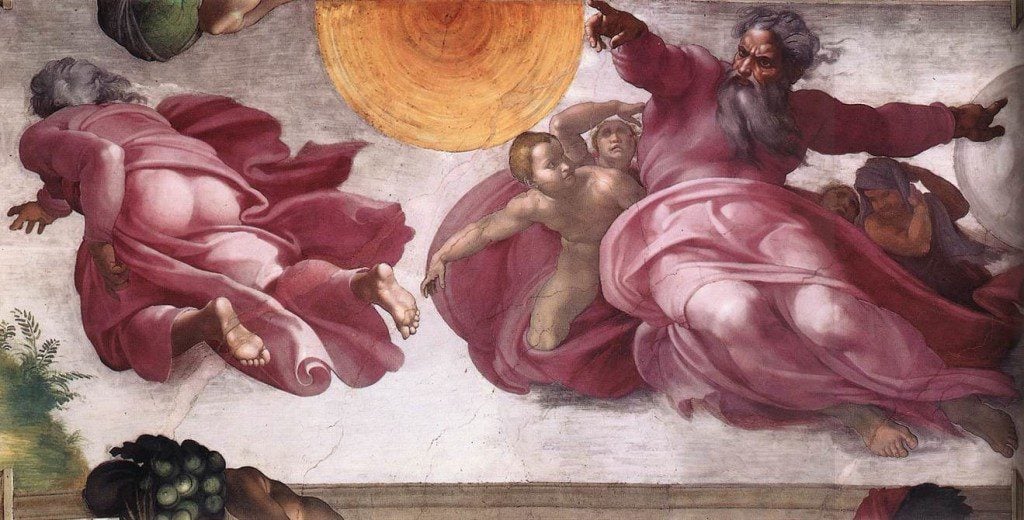
Creation of the Sun, Sistine Chapel
A friend recently asked for a list of books to read as an intro to the issues in Genesis 1-3 as well as the Moses and Abraham parallels. I focused on the former, because there’s not a whole lot dealing with the latter. I have a few chapters on it in my book, so I could write a separate post, if desired. When I taught my Institute class on Genesis a few years ago, I wrote a summary of each week. I treat Moses and Abraham briefly, here.
The books below are generally introductary volumes from different angles. If you read all of these, you’ll have a fairly good understanding of what Genesis 1-3 say, where they came from, how they have been interpreted in the past, and the major issues involved- evolution, age of the earth, “historical Adam,” etc.)
- My first suggestion is, always always begin with a good translation and some basic minimal commentary to get situated and familiar with the text. For that, I’d recommend The Jewish Study Bible with the entire Old Testament annoted and essayed, or if you want something a little narrower, Robert Alter’s The Five Books of Moses: A Translation with Commentary. Alter is primarily a literature scholar, but also Hebrew Bible; his notes are heavily informed by sensitivities to Hebrew and literary aspects of the text. For more background, see my Religious Educator article “Why Bible Translations Differ: A Guide for the Perplexed.” The latter half has suggestions about Bibles, commentaries, and how to use them profitably.
These other books are not in any particular order, but address different aspects of understanding the early chapters of Genesis within the Bible as a whole.
-
Either Scripture and Cosmology: Reading the Bible Between the Ancient World and Modern Science or The Biblical Cosmos: A Pilgrim’s Guide to the Weird and Wonderful World of the Bible.
-
Israelites conceived of the cosmos very differently than we do today; not as globes rotating around the sun, but as a flat earth with a solid dome above, and waters above and below that. I’ve only read excerpts of these, but as far as I can tell, each is written by someone who takes the Bible quite seriously and also has formal academic training. Anyone who insists that a “literal” reading of Genesis matches a scientific description of the modern cosmos, then, is imposing on and twisting the text, as well as making assumptions about its purpose. So-called “creation texts” in the ancient Near East are often about something other than creation, counter-intuititive though it may seem.Here’s a video showing Israelite cosmology (but none of the ancient Near Eastern parallels)
-
-
Barlow, Mormons and the Bible Updated ed, (Oxford Press, 2013).
- Based on his Harvard dissertation, Barlow demonstrates that LDS interpretation of the Bible at the highest levels has run the gamut from woodenly literal to extremely non-literal. It shows there has not been historical agreement on how to read the Bible, even among Apostles. That said, I’m not aware of any public statements from General Authorities current or past who show a real awareness of the contextual issues with e.g. dating Genesis 1 or strong similarities with Akkadian myths such as Enuma Elish (for Genesis 1) or Atrahasis/Gilgamesh (Genesis 6-9.)
-
Either Charles, Reading Genesis 1-2: An Evangelical Conversation or Halton, Genesis: History, Fiction, or Neither? Three Views
- Both of these have the same quasi-debate format. Multiple authors each present their own view, followed by short rebuttals by the other authors. The former has eight participants who are given more pages. (IIRC, Walton, Longman, Collins, and Averbeck all have some good things to say.) The latter volume is newer and has only three authors, including Kenton Sparks, who really nails it for me. Hoffmeier is particularly problematic, as reviewed by Peter Enns.
-
Barton/Wilkinson, Reading Genesis After Darwin (Oxford Press, 2009).
- A collection of 13 essays on a variety of issues relating to interpretation of Genesis 1-3, history of evolution, science, scripture, genre, what difference Darwin made to our understanding of Genesis (very little, actually), etc.
-
Peter Enns, both Inspiration and Incarnation:Evangelicals and the Problem of the Old Testament and The Evolution of Adam: What the Bible Does and Doesn’t Say About Human Origins.
- The former deals with three common assumptions about the Old Testament made by Evangelicals (and Mormons too!) While not focused entirely on Genesis 1-3, the assumptions Enns discusses relate directly to how we understand those chapters. (I reviewed it for The Interpreter.) In the latter book, he deals with Genesis 1-3, particularly the Eden story, and “the historical Adam question.”
-
Walton, both The Lost World of Genesis One: Ancient Cosmology and the Origins Debate and The Lost World of Adam and Eve: Genesis 2-3 and the Human Origins Debate.
- Now, I like Walton, I’ve read a lot of him, I recommend him, and just as I do with all of these books, I sometimes disagree (which is why I’m writing my own). The Genesis 2-3 volume is on my shelf, but I haven’t read it yet. My Dad liked it though. These are clear and easy to read. I reviewed Genesis One, with its temple-centric interpretation of creation for The Interpreter. Genesis 2-3 includes a section written by New Testament scholar N.T. Wright, a plus.
-
Jon Levenson, Creation and the Persistence of Evil: The Jewish Drama of Divine Omnipotence
- Levenson, a Jewish scholar at Harvard, takes a different approach. He looks at different creation accounts in the Bible for what they tell us about the world and the nature of good, evil, and God. A fantastic book, but I recommend some of these others first if you’re not used to quasi-scholarly discourse or haven’t read anything about Genesis 1 before.
-
Mark Smith, The Priestly Vision of Genesis 1 (Fortress Press, 2009)
- Smith is a brilliant and charismatic Catholic scholar at NYU. This volume is longer, more densely academic than the others, and excellent. As you might guess from the title, Smith focuses on the nature of Genesis 1 as written by Israelite priests in Babylon. A whole chapter is devoted, for example, to the question of “What is myth, and does Genesis 1 qualify?”
-
Most of these scholars accept some form of the idea that Genesis 1 and Genesis 2-3 were originally separate creation stories, with different focuses, and not entirely consistent with each other. The classical version of this is known under various terms, like Documentary Hypothesis or Source Theory. While not the most up-to-date, Friedman’s Who Wrote the Bible is the most accessible account of this idea, which goes back 1000 years to observations of inconsistancies in the Biblical text made by Jewish and Christian believers. Source criticism is one way to account for these inconsistancies.
Lastly, I’d check out Biologos, particularly those posts by Walton, Enns, Hyers, Wright, Sparks, and Giberson.
See also my older somewhat overlapping list of books on creation here.
As always, you can help me pay my tuition here, or you can support my work through making your regular Amazon purchases through this Amazon link. You can also get updates by email whenever a post goes up (subscription box on the right). If you friend me on Facebook, please drop me a note telling me you’re a reader. I tend not to accept friend requests from people I’m not acquainted with.
Previous Post

March 12, 2016
BoM Gospel Doctrine Lesson 10: 2Ne 26-30
Next Post
March 19, 2016 BoM Gospel Doctrine Lesson 11: 2Ne 31-33
Browse Our Archives
Select a Category ancient languages Announcements Book of Mormon books D&C evolution Genesis Gospel Doctrine Gospel Doctrine Resources history LDS Church History New Testament Old Testament prophets science and religion scripture study Seminary teaching temple Uncategorized
Select a Month August 2019 July 2019 June 2019 March 2019 January 2019 December 2018 November 2018 October 2018 September 2018 August 2018 July 2018 June 2018 May 2018 April 2018 March 2018 February 2018 January 2018 December 2017 November 2017 October 2017 September 2017 August 2017 July 2017 June 2017 May 2017 April 2017 March 2017 February 2017 January 2017 December 2016 November 2016 October 2016 September 2016 August 2016 July 2016 June 2016 May 2016 April 2016 March 2016 February 2016 January 2016 December 2015 November 2015 October 2015 September 2015 August 2015 July 2015 June 2015 May 2015 April 2015 March 2015 February 2015 January 2015 November 2014 October 2014 July 2014 June 2014 May 2014 April 2014 March 2014 February 2014 January 2014 January 2010 December 2009
Follow Us!
TAKE THE
Religious Wisdom Quiz
What did Jesus teach about judging others?
Select your answer to see how you score.
Ignore everyone Judge quickly Do not judge lest you be judged Use harsh words
Related posts from Benjamin the Scribe

Theological Twinkies and our Spiritual Diet

Covenant and law, grace, works, and faith.

A Sacrament Meeting Sermon on Forgiveness
New Testament Gospel Doctrine Resources (Post 2): The...
TRENDING AT PATHEOS Latter-day Saint

Did Prayer Cure His Cancer? Or Was It...
At 4 AM one morning, Joshua W. Brown’s wife awoke to a...

8 Ways a Near-Death Experience Rewires the Soul
Does Consciousness Survive Physical Death? After 50 Years of Research, Dr. Raymond...

Holy Longing: What Our Restlessness Is Telling Us
“One can find so many pains when the rain is falling.” -John...

What this is NOT about. This blog is definitely not about...

Who said the Israelites were God’s chosen? That’s right, they did. Who...

The Spirit World Is the Real World: God...
A Monk’s Wisdom on Body and Spirit I sit with Brother Martin...
view all Latter-day Saint blogs
Ad-Free & Subscriber Log-In Subscription Support
- About Us
- 2026 Calendar
- Videos
- Podcasts
- Library of World Religions
- Faith In Media Tracker
- Advertise With Us
- Write for Us
- Privacy Policy
- Terms of Service
- Do Not Sell My Data
- Contact Us
- Radiant Digital
- Manage Newsletter Subscriptions
- Unsubscribe From Notifications
- Sitemap
Copyright 2008-2026, Patheos, part of the Radiant Digital network of media brands. All rights reserved.
Subscription Support Ad-Free & Subscriber Log-In
Follow Patheos