
BuddhistCatholicContemplativeEvangelicalGeneral ChristianHinduJewishLatter-day SaintMuslimNew VisionsProgressive Christian
Beliefs
- Buddhist
- Catholic
- Contemplative
- Evangelical
- General Christian
- Hindu
- Jewish
- Latter-day Saint
- More Voices
- Muslim
- New Visions
- Pagan
- Progressive Christian
Topics
- Religion News
- Food and Religion
- Sports and Religion
- Religious Art
- Religious Music and Entertainment
- Religious Events
- History and Religion
- Style and Religion
- Politics and Religion
- Women in Religion
- Recreation Outdoors and Religion
- Business Finance and Religion
- Careers Workplace and Religion
- Education and Religion
- Family Parenting and Religion
- Health Fitness and Religion
- Home and Religion
- Relationships and Religion
- Technology and Religion
- Travel and Religion
Columnists
- Buddhist Columnists
- Business Finance and Religion Columnists
- Careers Workplace and Religion Columnists
- Catholic Columnists
- Contemplative Columnists
- Education and Religion Columnists
- Evangelists Columnists
- Family Parenting and Religion Columnists
- General Christian Columnists
- Health Fitness and Religion Columnists
- Hindu Columnists
- History and Religion Columnists
- Home and Religion Columnists
- Jewish Columnists
- More Voices Columnists
- Latter Day Columnists
- Muslim Columnists
- New Visions Columnists
- Nonreligious Columnists
- Pagan Columnists
- Politics and Religion Columnists
- Progressive Columnists
- Recreation Outdoors and Religion Columnists
- Relationships and Religion Columnists
- Religion News Columnists
- Religious Art Columnists
- Religious Events Columnists
- Religious Music and Entertainment Columnists
- Sports and Religion Columnists
- Style and Religion Columnists
- Technology and Religion Columnists
- Travel and Religion Columnists
- Women in Religion Columnists
Resource Library
- 2026 Calendar
- Library of World Religions
- The 100 Most Holy Places on Earth
- Patheos Answers
- Podcasts
- Videos
- Faith Leaders Database
- Anglican Episcopalian
- Bahai
- Baptist
- Buddhism
- Christianity
- Confucianism
- Eastern Orthodoxy
- Hinduism
- Holiness and Pentecostal
- ISKCON
- Islam
- Judaism
- Lutheran
- Methodist
- The Church of Jesus Christ of Latter-day Saints
- New Age
- Paganism
- Presbytarian and Reformed
- Protestantism
- Religion Behind the Scenes
- Roman Catholic
- Scientology
- Shia Islam
- Sikhism
- Sufism
- Sunni Islam
- Taoism
- Zen
- See all religions
Research Tools
 Ad-Free & Subscriber Log-In Subscription Support
Ad-Free & Subscriber Log-In Subscription Support
Follow Patheos 

- Trending:
- Forgiveness
- |
- Marriage
- |
- Consciousness
- |
- Death Penalty
- |
- Election
- |
- Halloween
 Benjamin the Scribe
- Home
- Latter-day Saint
- New Testament Gospel Doctrine Lesson 21: Matthew 24 + JST Matthew 24
New Testament Gospel Doctrine Lesson 21: Matthew 24 + JST Matthew 24
Last updated on: June 29, 2015 at 8:04 am by Ben Spackman
New Testament Gospel Doctrine Lesson 21: Matthew 24 + JST Matthew 24 2015-06-29T08:04:27-05:00 Ben Spackman
Patheos Explore the world's faith through different perspectives on religion and spirituality! Patheos has the views of the prevalent religions and spiritualities of the world.
Today covers only one chapter, an interesting one. Known sometimes as the Olivet Discourse (because it’s given on the Mount of Olives) or the Little Apocalypse (because Gr. apokalypsis is the word for “revelation.” The Book of Revelation would be the “big” revelation/apocalypse, and Matthew 24-25 is the little one.) Several things are of interest.
First, prompted by several (different?) questions, Jesus speaks of the future, both of earthly and heavenly things.
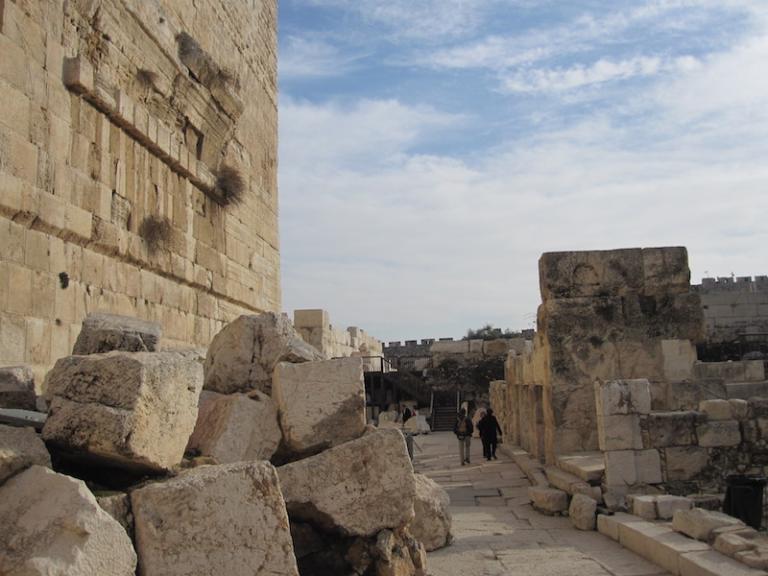
not one stone will be left here upon another; all will be thrown down…
Notably, the Jerusalem temple with its massive 100+ ton stones will be destroyed, and Jesus will return triumphantly, heralding the establishment of a new earth. The difficulty for modern readers is the connection between these.
v.29 “immediately following” the destruction of the temple and such, “the sun will grow dark, the moon will stop shining, the stars will fall from the sky, and the powers in heaven will be shaken. Then the sign of the Son of Man will appear in the sky, all the tribes of the Land will mourn, and they will see the Son of Man coming on the clouds of heaven with tremendous power and glory.”- (Mat 24:29-30 Complete Jewish Bible)
It’s clear to us in retrospect that Jesus’ triumphant return and the transformation of the earth did not occur shortly after the destruction of the temple. It’s also quite clear that the New Testament portrays Jesus, the Apostles, and Paul as expecting all these things to happen quite soon, within their day. There are several ways of understanding that. Jesus spoke, often, with human knowledge. Specifically on this question, he admitted not knowing the exact day and hour.
“But about that day and hour no one knows, neither the angels of heaven, nor the Son, but only the Father. (Mat 24:36 NRSV. The KJV reads differently, lacking “the son,” based on inferior manuscripts.)
Though divine, Jesus was limited in some ways by his mortality, and this appears to have been one of them. He thought like a Second Temple Israelite, sharing with many of his Jewish compatriots an “apocalyptic worldview,” which focused on The End, among other things. I don’t have a ton of time to get into that, so see this article on Apocalyticism from Eerdman’s Dictionary of Early Judaism, this one more specifically about Jesus from the Dictionary of Jesus and the Gospels, 2nd Ed. So while admitting a lack of knowledge, (assuming the New Testament is reliable here, see below), Jesus appears to have thought an end was soon. That may make some uncomfortable, especially when we are accustomed to thinking that Jesus’ perfection meant he always did everything right the first time, knew everything, would have been the best basketball player in the world who never missed a shot, etc. (I have heard the latter, and other similar examples.) I don’t think that’s the right way to think of Jesus. He was certainly divine in a way we are not, but human just as we are “yet without sin” (Heb. 4:15)
Perhaps this is part of what the author of Hebrews had in mind when he said that Christ was “made like his brothers in every way” (Heb. 2:17). Jesus was a first-century Jew. The languages of the time (Hebrew, Greek, Aramaic) were his languages. Their customs were his customs. He fit, he belonged, he was one of them.- Peter Enns, Inspiration and Incarnation
What about “translated correctly”? It’s very difficult to attribute this to scribal errors or later false tradition, because why would a later Christian scribe have Jesus speak something that could remotely be made to look like a false prophecy? Scribal tendencies ran the other direction. Notably, it is exactly the fact that things did not happen just as Matthew 24 portrays that bolsters the historicity of this prophecy, because it’s NOT the kind of thing anyone would make up.
Second, Joseph Smith was sensitive to this. The JST largely deals with the apparent confusion of divine timing by reworking the whole chapter, both by changing words as other JST but also by rearranging verses. WVS (a BYU professor) has a parallel text here. Watch the JST verse numbers carefully in his comparison, as they’ve been rearranged to match up to the Matthew text. See also “Joseph Smith- Matthew” in the Encyclopedia of Mormonism.
Third, how should we understand the questions of the disciples? As restatements of the same question, or as different questions?
¶ And Jesus went out, and departed from the temple: and his disciples came to him for to shew him the buildings of the temple. And Jesus said unto them, See ye not all these things? verily I say unto you, There shall not be left here one stone upon another, that shall not be thrown down. And as he sat upon the mount of Olives, the disciples came unto him privately, saying, Tell us,
when shall these things be? and
what shall be the sign of thy coming,
and of the end of the world?
I’ll address the third question. If you pick up most modern translations (including the very conservative revision to the KJV called the New KJV), you’ll find that the last line reads “the end of the age” not “the end of the world.” Growing up in the 80s as a bookish kid, I can’t hear “the end of the world” without thinking of all-out nuclear war, mushroom clouds, radiation poisoning, and so on. But nothing remotely like that is in view. Greek aiwn (EYE-own) doesn’t refer to creation or the planet, but an indefinitely long period of time, a time period, an age. It corresponds very nicely to Hebrew ‘olam. Jews then and now say ha’olam ha’ba “the coming age” to refer to the coming golden age, post-messiah, when all things will be set right. It is the end of the fallen degenerate age or aiwn that Jesus’ disciples are asking about. Notably, Paul implies that the “god of this world/age/aiwn” is Satan. (See my little essay here.)
The JST may well pick up on this in some ways, since it paraphrases “the end of the world” as “the destruction of the wicked” in v. 4.
what is the sign of thy coming, and of the end of the world, or the destruction of the wicked, which is the end of the world?
As for the other questions, the JST addresses them separately.
Tidbits-
- “Abomination of desolation”- This phrase, taken from Daniel (as are several other themes of Matt 24), refers to desecrating the temple, as had been done by Antiochus Epiphanies before the New Testament period. The Markan parallel to this Matthew 24 phrase reads clearer. “But when you see the desolating sacrilege set up where it ought not to be (let the reader understand), then those in Judea must flee to the mountains” Mark 13:14. The Romans, like Antiochus, were likely to insist upon altars and sacrifices to their political leaders and other deities, setting them up where they ought not to be, thus defiling the Jewish temple.
- Christians apparently read Matthew 24 and took it to heart. When the Romans came to destroy the temple between 66 and 70 AD, they fled to Pella, saving their lives. See this article in the Ensign, supplemented by this article on “Pella, Flight to” in the Dictionary of Later New Testament and its Developments
Next Post

June 13, 2015 New Testament Gospel Doctrine Lesson 22: Matthew 25
Browse Our Archives
Select a Category ancient languages Announcements Book of Mormon books D&C evolution Genesis Gospel Doctrine Gospel Doctrine Resources history LDS Church History New Testament Old Testament prophets science and religion scripture study Seminary teaching temple Uncategorized
Select a Month August 2019 July 2019 June 2019 March 2019 January 2019 December 2018 November 2018 October 2018 September 2018 August 2018 July 2018 June 2018 May 2018 April 2018 March 2018 February 2018 January 2018 December 2017 November 2017 October 2017 September 2017 August 2017 July 2017 June 2017 May 2017 April 2017 March 2017 February 2017 January 2017 December 2016 November 2016 October 2016 September 2016 August 2016 July 2016 June 2016 May 2016 April 2016 March 2016 February 2016 January 2016 December 2015 November 2015 October 2015 September 2015 August 2015 July 2015 June 2015 May 2015 April 2015 March 2015 February 2015 January 2015 November 2014 October 2014 July 2014 June 2014 May 2014 April 2014 March 2014 February 2014 January 2014 January 2010 December 2009
Follow Us!
TAKE THE
Religious Wisdom Quiz
We celebrate a feast with feasting and joy, remembering deliverance from destruction in Persia. What feast are we?
Select your answer to see how you score.
Passover Pentecost Hanukkah Purim
Related posts from Benjamin the Scribe

Theological Twinkies and our Spiritual Diet

Covenant and law, grace, works, and faith.


TRENDING AT PATHEOS Latter-day Saint

Did Prayer Cure His Cancer? Or Was It...
At 4 AM one morning, Joshua W. Brown’s wife awoke to a...

8 Ways a Near-Death Experience Rewires the Soul
Does Consciousness Survive Physical Death? After 50 Years of Research, Dr. Raymond...

Holy Longing: What Our Restlessness Is Telling Us
“One can find so many pains when the rain is falling.” -John...

What this is NOT about. This blog is definitely not about...

Who said the Israelites were God’s chosen? That’s right, they did. Who...

The Spirit World Is the Real World: God...
A Monk’s Wisdom on Body and Spirit I sit with Brother Martin...
view all Latter-day Saint blogs
Ad-Free & Subscriber Log-In Subscription Support
- About Us
- 2026 Calendar
- Videos
- Podcasts
- Library of World Religions
- Faith In Media Tracker
- Advertise With Us
- Write for Us
- Privacy Policy
- Terms of Service
- Do Not Sell My Data
- Contact Us
- Radiant Digital
- Manage Newsletter Subscriptions
- Unsubscribe From Notifications
- Sitemap
Copyright 2008-2026, Patheos. All rights reserved.
Subscription Support Ad-Free & Subscriber Log-In
Follow Patheos