
BuddhistCatholicContemplativeEvangelicalGeneral ChristianHinduJewishLatter-day SaintMuslimNew VisionsProgressive Christian
Beliefs
- Buddhist
- Catholic
- Contemplative
- Evangelical
- General Christian
- Hindu
- Jewish
- Latter-day Saint
- More Voices
- Muslim
- New Visions
- Pagan
- Progressive Christian
Topics
- Religion News
- Food and Religion
- Sports and Religion
- Religious Art
- Religious Music and Entertainment
- Religious Events
- History and Religion
- Style and Religion
- Politics and Religion
- Women in Religion
- Recreation Outdoors and Religion
- Business Finance and Religion
- Careers Workplace and Religion
- Education and Religion
- Family Parenting and Religion
- Health Fitness and Religion
- Home and Religion
- Relationships and Religion
- Technology and Religion
- Travel and Religion
Columnists
- Buddhist Columnists
- Business Finance and Religion Columnists
- Careers Workplace and Religion Columnists
- Catholic Columnists
- Contemplative Columnists
- Education and Religion Columnists
- Evangelists Columnists
- Family Parenting and Religion Columnists
- General Christian Columnists
- Health Fitness and Religion Columnists
- Hindu Columnists
- History and Religion Columnists
- Home and Religion Columnists
- Jewish Columnists
- More Voices Columnists
- Latter Day Columnists
- Muslim Columnists
- New Visions Columnists
- Nonreligious Columnists
- Pagan Columnists
- Politics and Religion Columnists
- Progressive Columnists
- Recreation Outdoors and Religion Columnists
- Relationships and Religion Columnists
- Religion News Columnists
- Religious Art Columnists
- Religious Events Columnists
- Religious Music and Entertainment Columnists
- Sports and Religion Columnists
- Style and Religion Columnists
- Technology and Religion Columnists
- Travel and Religion Columnists
- Women in Religion Columnists
Resource Library
- 2026 Calendar
- Library of World Religions
- The 100 Most Holy Places on Earth
- Patheos Answers
- Podcasts
- Videos
- Faith Leaders Database
- Anglican Episcopalian
- Bahai
- Baptist
- Buddhism
- Christianity
- Confucianism
- Eastern Orthodoxy
- Hinduism
- Holiness and Pentecostal
- ISKCON
- Islam
- Judaism
- Lutheran
- Methodist
- The Church of Jesus Christ of Latter-day Saints
- New Age
- Paganism
- Presbytarian and Reformed
- Protestantism
- Religion Behind the Scenes
- Roman Catholic
- Scientology
- Shia Islam
- Sikhism
- Sufism
- Sunni Islam
- Taoism
- Zen
- See all religions
Research Tools
 Ad-Free & Subscriber Log-In Subscription Support
Ad-Free & Subscriber Log-In Subscription Support
Follow Patheos 

- Trending:
- Forgiveness
- |
- Marriage
- |
- Consciousness
- |
- Death Penalty
- |
- Election
- |
- Halloween

- Home
- Catholic
- Relationships and Religion
- 7 Ways That God Loves Even the Bad People
7 Ways That God Loves Even the Bad People
Last updated on: October 15, 2025 at 8:37 am by Jocelyn Soriano
7 Ways That God Loves Even the Bad People 2025-09-11T12:02:10+08:00 Jocelyn Soriano
Patheos Explore the world's faith through different perspectives on religion and spirituality! Patheos has the views of the prevalent religions and spiritualities of the world.

Image from Canva Pro
Have you ever wondered if God loves even the bad people? How can God love those who are in darkness? How can He love those who hurt others?
It seems to be a natural human response to be repulsed by evil. We may fail to live up to our own standards of goodness, and we may sometimes be confused about what is evil or not, but if we consider something as bad, we naturally find it repugnant.
Perhaps this is the reason why we find it so hard to love our enemies. Intellectually, we can easily say that we hate the sin and we love the sinner, but how does that reflect in our words and deeds?
It’s so easy to fall into the trap of self-righteousness, having this air of holiness while having an attitude that reveals our true inner state.
In the face of good people, we are also kind and gentle. We are respectful with our words, we give our very best and we do what we can to serve them.
In the face of bad people, however, we can easily lose our temper. We start saying bad words, and we sometimes get to the point of wishing for their unhappiness and misery. After all, that’s what they deserve, doesn’t it?
On the contrary, Jesus told us to love even our enemies:
“But rather, love your enemies and do good to them, and lend expecting nothing back; then your reward will be great and you will be children of the Most High, for he himself is kind to the ungrateful and the wicked. Be merciful, just as [also] your Father is merciful.” – Luke 6:35-36 NABRE
And just in case we want to know exactly how we can love our enemies, the Bible couldn’t have been more detailed:
“But to you who hear I say, love your enemies, do good to those who hate you, bless those who curse you, pray for those who mistreat you. To the person who strikes you on one cheek, offer the other one as well, and from the person who takes your cloak, do not withhold even your tunic. Give to everyone who asks of you, and from the one who takes what is yours do not demand it back. Do to others as you would have them do to you.” – Luke 6:27-31 NABRE
Now, if God would command us to go this far, should we think that He wouldn’t do so much more than what we could for those who are bad?
God is love. That is His nature. He can’t stop being good or loving just because we are bad.
Let us try to ponder upon this truth by thinking about the many ways God can still love even those we deem as the “bad people”:
1. God’s gift of life
If God were that vengeful, He would have eradicated everyone who committed evil deeds long ago. The murderers, the thieves, the adulterers, the liars, and all of those who offended Him.
God, however, continues to give us the gift of life. He sustains even those who mock Him and those who don’t even believe that He exists.
2. Time for repentance
God does not cut us off as soon as we fall into sin. He gives us time to realize our faults and to repent. He gives us enough time to know Him and to accept His love.
3. Provision of daily needs
Jesus Himself said that God makes the sun shine on both the good and the bad. He also blessed both with rain.
God, through nature, provides us with the air we breathe and the water that we drink. He causes the plants to produce their fruits so that we may eat of them.
That’s how love shows His kindness even to sinners.
4. The capacity for happiness
God does not withhold, even from bad people, their capacity to derive happiness from objects of beauty and delight. He still allows them to appreciate the pleasure of hearing good music, of laughing at good jokes, of being pleased at beautiful sceneries and of the satisfaction derived from their hobbies and jobs.
5. The gift of a conscience
Even after committing an evil deed, God does not immediately take away one’s conscience. He leaves us a compass so that we may continue to have guidance about what is right or wrong. If we listen to our conscience, it can keep us from falling into deeper evil and sin.
6. The love of other people
Evil people are not isolated by God in such a way that they are barred from being loved by others. On the contrary, other people are free to love them and make them feel loved.
7. The gift of salvation
Jesus Christ died for everyone at a time when we were all in sin and darkness. Even today, He continues to offer us His salvation, a gift that He paid for with His passion and death on the cross.
Loving Sinners Out of His Goodness
God does not choose whom to love. He is Love Himself. His love overflows from His entire being and He continues to reach out to everyone so that all may come to repentance and salvation.
If you think that you are living in sin, do not think that God has given up on you. He loves you! And He is waiting for you to be found.
God’s goodness abounds in your life. He makes the sun shine each day for you and allows you to experience happiness and delight.
May you find the grace to turn to Him, the only One who can give you true peace and everlasting joy!
“So he got up and went back to his father. While he was still a long way off, his father caught sight of him, and was filled with compassion. He ran to his son, embraced him and kissed him. His son said to him, ‘Father, I have sinned against heaven and against you; I no longer deserve to be called your son.’ But his father ordered his servants, ‘Quickly bring the finest robe and put it on him; put a ring on his finger and sandals on his feet. Take the fattened calf and slaughter it. Then let us celebrate with a feast, because this son of mine was dead, and has come to life again; he was lost, and has been found.’” – Luke 15:20-24 NABRE
Jocelyn Soriano is the author of Mend My Broken Heart, Defending My Catholic Faith and 366 Days of Compassion. She also writes about faith and writing at Single Catholic Writer.
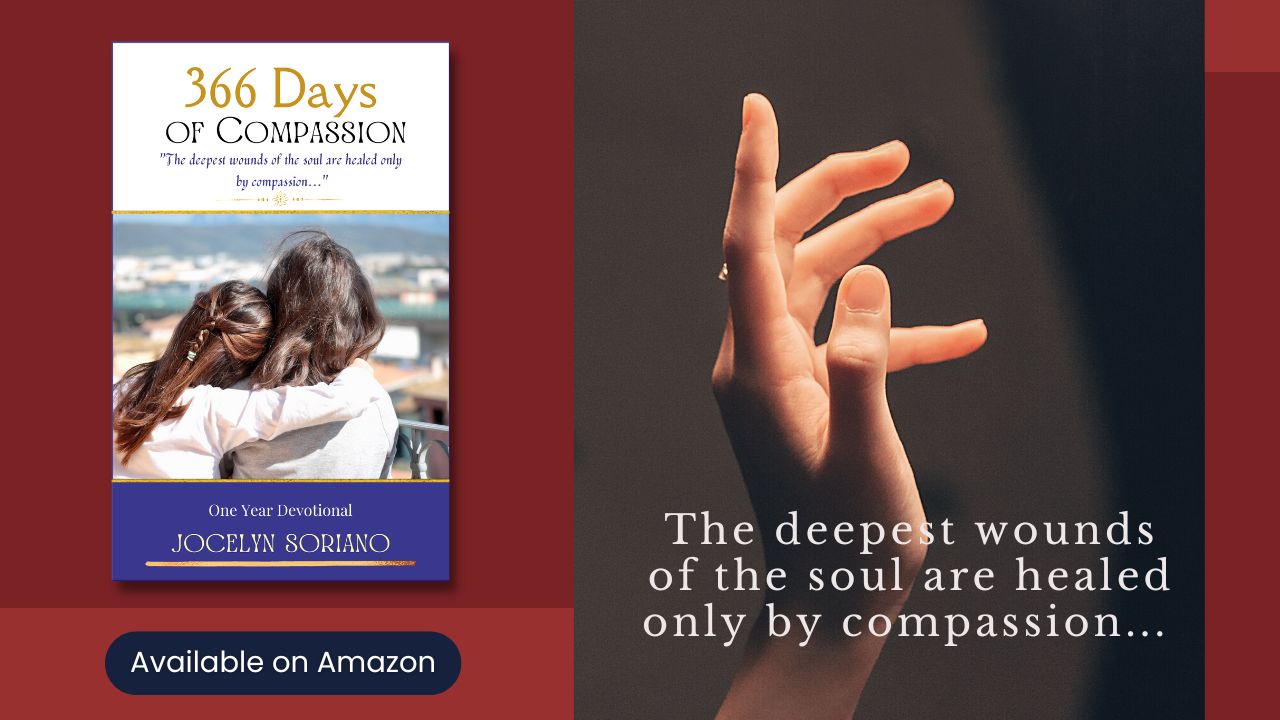
See Jocelyn’s books from other digital stores.
You may also want to read “6 Unforgettable Quotes on Mercy by Pope Francis.”
General Christian

About Jocelyn Soriano
Jocelyn Soriano is an author, poet, and book reviewer. She is an introvert who enjoys a cup of coffee and listening to the cello ****** while working.
She wrote the books To Love an Invisible God, Defending My Catholic Faith and Mend My Broken Heart. She also wrote books on poetry including Poems of Love and Letting Go and Of Waves and Butterflies: Poems on Grief. She has published more than 15 books and developed her own Android applications including God’s Promises and Catholic Answers and Apologetics.
She writes about relationships and common questions about God and the Catholic faith at Single Catholic Writer. She is currently single and happy and she would like everyone to know how happy we can be by drawing close to the love of God!
You can read more about the author here.
Previous Post

October 8, 2025
Are Digital Devices Corrupting Children’s Hearts?
Next Post

October 22, 2025 7 Ways We Excuse Ourselves From Sin
Browse Our Archives
Select a Category Christmas Church Issue Divine Mercy End Times Grief Healing Heaven Joy Miracles Movie Review Movies New Age Prayer Questions to God Relationships Single Life Spiritual Growth Technology Virgin Mary Wealth Management
Select a Month October 2026 September 2026 August 2026 July 2026 June 2026 May 2026 April 2026 March 2026 February 2026 January 2026 December 2025 November 2025 October 2025 September 2025 August 2025 July 2025 June 2025 May 2025 April 2025 March 2025 February 2025 January 2025 December 2024 November 2024 October 2024 September 2024 August 2024 July 2024 June 2024 May 2024 April 2024 March 2024 February 2024 January 2024 December 2023 November 2023 October 2023 September 2023 August 2023 July 2023 June 2023 May 2023 April 2023 March 2023 February 2023 January 2023
Follow Us!
TAKE THE
Religious Wisdom Quiz
What was the primary form of transportation in Biblical times?
Select your answer to see how you score.
Camel Donkey Horse Chariot
Books by This Author Books by Beloved
Related posts from Beloved

6 Ways To Prevent Resentment From Breaking Our...

Is Forgiveness Unfair? Why Gratitude May Be the...
Why Did Jesus Call the Canaanite Woman a...

Why the Quantity of Our Prayers Matters
TRENDING AT PATHEOS Catholic

The Problem with False Prophets
Miller’s Station UMC| 10/18/26| Anchor Verse: Jeremiah 23: 1, 9-23 I...

Emotion in Early Christianity by Andrew Crislip
Andrew Crislip’s Emotion in Early Christianity examines an often overlooked dimension of...

16 Spiritual Touchstones for a More Grounded Life
After decades of spiritual study, here are 16 principles I try...

Catholic Evangelization: Sharing Your Faith Every Day
Welcome back to the Graceful Awakening mini-series called, “From Faith to Mission.” ...

The Pillar of the Boatmen: the Ancient Monument...
The Pillar of the Boatmen is a Romano-Gaulish sculpture that dates from...

In one sense walking into Westminster Abbey is like walking down the...
view all Catholic blogs
Ad-Free & Subscriber Log-In Subscription Support
- About Us
- 2026 Calendar
- Videos
- Podcasts
- Library of World Religions
- Faith In Media Tracker
- Advertise With Us
- Write for Us
- Privacy Policy
- Terms of Service
- Do Not Sell My Data
- Contact Us
- Radiant Digital
- Manage Newsletter Subscriptions
- Unsubscribe From Notifications
- Sitemap
Copyright 2008-2026, Patheos. All rights reserved.
Subscription Support Ad-Free & Subscriber Log-In
Follow Patheos