
BuddhistCatholicContemplativeEvangelicalGeneral ChristianHinduJewishLatter-day SaintMuslimNew VisionsProgressive Christian
Beliefs
- Buddhist
- Catholic
- Contemplative
- Evangelical
- General Christian
- Hindu
- Jewish
- Latter-day Saint
- More Voices
- Muslim
- New Visions
- Pagan
- Progressive Christian
Topics
- Religion News
- Food and Religion
- Sports and Religion
- Religious Art
- Religious Music and Entertainment
- Religious Events
- History and Religion
- Style and Religion
- Politics and Religion
- Women in Religion
- Recreation Outdoors and Religion
- Business Finance and Religion
- Careers Workplace and Religion
- Education and Religion
- Family Parenting and Religion
- Health Fitness and Religion
- Home and Religion
- Relationships and Religion
- Technology and Religion
- Travel and Religion
Columnists
- Buddhist Columnists
- Business Finance and Religion Columnists
- Careers Workplace and Religion Columnists
- Catholic Columnists
- Contemplative Columnists
- Education and Religion Columnists
- Evangelists Columnists
- Family Parenting and Religion Columnists
- General Christian Columnists
- Health Fitness and Religion Columnists
- Hindu Columnists
- History and Religion Columnists
- Home and Religion Columnists
- Jewish Columnists
- More Voices Columnists
- Latter Day Columnists
- Muslim Columnists
- New Visions Columnists
- Nonreligious Columnists
- Pagan Columnists
- Politics and Religion Columnists
- Progressive Columnists
- Recreation Outdoors and Religion Columnists
- Relationships and Religion Columnists
- Religion News Columnists
- Religious Art Columnists
- Religious Events Columnists
- Religious Music and Entertainment Columnists
- Sports and Religion Columnists
- Style and Religion Columnists
- Technology and Religion Columnists
- Travel and Religion Columnists
- Women in Religion Columnists
Resource Library
- 2026 Calendar
- Library of World Religions
- The 100 Most Holy Places on Earth
- Patheos Answers
- Podcasts
- Videos
- Faith Leaders Database
- Anglican Episcopalian
- Bahai
- Baptist
- Buddhism
- Christianity
- Confucianism
- Eastern Orthodoxy
- Hinduism
- Holiness and Pentecostal
- ISKCON
- Islam
- Judaism
- Lutheran
- Methodist
- The Church of Jesus Christ of Latter-day Saints
- New Age
- Paganism
- Presbytarian and Reformed
- Protestantism
- Religion Behind the Scenes
- Roman Catholic
- Scientology
- Shia Islam
- Sikhism
- Sufism
- Sunni Islam
- Taoism
- Zen
- See all religions
Research Tools
 Ad-Free & Subscriber Log-In Subscription Support
Ad-Free & Subscriber Log-In Subscription Support
Follow Patheos 

- Trending:
- Forgiveness
- |
- Marriage
- |
- Consciousness
- |
- Death Penalty
- |
- Election
- |
- Halloween
 Barefoot and Pregnant
- Home
- Catholic
- Hindrance vs. Hope – Why Baptize if the Parents Are In Sin?
Hindrance vs. Hope – Why Baptize if the Parents Are In Sin?
Last updated on: December 30, 2014 at 10:18 am by Calah Alexander
Hindrance vs. Hope – Why Baptize if the Parents Are In Sin? 2014-12-30T10:18:36-05:00 Calah Alexander
Patheos Explore the world's faith through different perspectives on religion and spirituality! Patheos has the views of the prevalent religions and spiritualities of the world.
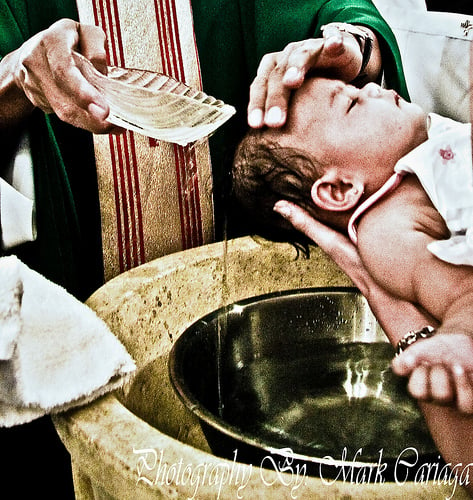
The Patheos Catholic Channel is hosting a Symposium on the Family in light of the upcoming Extraordinary Synod on the Family in October and the recent release of the working document for the Synod.
In January, Pope Francis set people’s heads exploding when he baptized the baby of a couple who were married civilly, but not sacramentally.
Seven years ago, the parish where I was undergoing the Rite of Christian Initiation set my own head exploding by refusing to baptize the baby of a couple who were married civilly, but not (yet) sacramentally — our daughter Sienna.
At the time, I tried desperately to make allowances for the Church I was leaping into. It was a leap of faith in a real sense, since so many times I found myself having to leap, without looking or understanding, right at the barbed fences the faithful kept putting up to keep me out. I didn’t want to believe ill of them. Truly, I don’t believe anything was ever done from malicious motivations. Well-meaning friends went to great lengths to explain how the sacrament of baptism could not be valid unless the parents were in a state of grace, how one or both parents living in mortal sin would render the baptism invalid, and how it was illicit to baptize a baby if one of the parents were not Catholic. After all, they explained, the priest must be confident that the child would be raised in the fullness of the Catholic faith, and although I was planning on converting, I wasn’t yet a Catholic. I could change my mind, and then where would that leave Sienna? But I was heartsick at the knowledge that because we were sinners, the Church wouldn’t grant our daughter mercy.
Our priest didn’t say too much about it. He just went to the bishop, got permission to baptize her himself at a different parish, got permission from the parish priest, and baptized her in a beautiful private ceremony.
I cried at her baptism, which shocked me. Not a few sparkling tears rolling down my beaming face — this was an ugly cry, all snot and tears and that kind of sobbing that feels like it will tear you apart. I kept having to wipe the tears off Sienna’s face and gown, and my father-in-law said afterward that she was baptized twice, once by the water, and once by my tears.
I cried because my family was there and I was hurting them. I was leaving the religion I was raised in, leaving them, in a way, for a new family. The pain was written all over their faces.
I cried because everything had to be done this way for us, privately, separate from the others, the good parents, the ones who hadn’t made a mess of their family before it even began. I was afraid that we wouldn’t be able to pull it together, to do it right, and that this tiny baby would suffer for it.
I cried because I felt the weight of Fr. Maguire’s words, the questions he asked, the responses we gave, and they felt like a promise, like a vow. I was so afraid that I would fail to keep that vow, and that my failure would leave Sienna adrift. I cried because my baby smelled like chrism and holiness, and I loved her so much that it hurt, and I knew that I would let her down, as I already had.
I cried, finally, because I wasn’t alone. I had my husband on one side, his brother next to him, and my best friend on the other. I had Fr. Maguire leading us through the words, three voices joining mine, and we had the whole invisible Chuch besides, the communion of the saints, the angels, Our Lady, Christ, and God Himself to walk with us, give us strength, and catch Sienna every time we stumbled and fell.
It was my first experience of a sacrament, my first experience of the visceral and sometimes awful way grace comes to us through them. Her baptism was my first fumbling step along a path of sanctification. In many ways, it was a fork in my life. Until then, I was allowing myself to be drawn along by vague notions and circumstance, but once my child was Catholic, I was all in. I’d never leave the Church, because I’d never leave her. In promising to do my best to get her soul to God, I swore an allegiance to the Church that I will not break. There was no certainty that I would raise my child Catholic before Sienna was baptized, but I’m certain that I would not have converted if her baptism was utterly refused.
In researching this post, I confess that I was shocked and somewhat appalled to find that, in fact, the Church does not require that parents be free from mortal sin, sacramentally married, or even Catholic. The Catechism says only that “for the grace of Baptism to unfold, the parents’ help is important (CCC 1255).”
It also says this:
Born with a fallen human nature and tainted by original sin, children also have need of the new birth in Baptism to be freed from the power of darkness and brought into the realm of the freedom of the children of God, to which all men are called.The sheer gratuitousness of the grace of salvation is particularly manifest in infant Baptism. The Church and the parents would deny a child the priceless grace of becoming a child of God were they not to confer Baptism shortly after birth.
Christian parents will recognize that this practice also accords with their role as nurturers of the life that God has entrusted to them.
and this
The Lord himself affirms that Baptism is necessary for salvation. He also commands his disciples to proclaim the Gospel to all nations and to baptize them. Baptism is necessary for salvation for those to whom the Gospel has been proclaimed and who have had the possibility of asking for this sacrament. The Church does not know of any means other than Baptism that assures entry into eternal beatitude; this is why she takes care not to neglect the mission she has received from the Lord to see that all who can be baptized are “reborn of water and the Spirit.” God has bound salvation to the sacrament of Baptism, but he himself is not bound by his sacraments.
(CCC 1257, bold emphasis mine)
In fact, the only mention of parental requirements is in the Code of Canon Law.
The parents or at least one of them or the person who legitimately takes their place must consent.
There must be a founded hope that the infant will be brought up in the Catholic religion; if such hope is altogether lacking, the baptism is to be delayed according to the prescripts of particular law after the parents have been advised about the reason.
An infant of Catholic parents or even of non-Catholic parents is baptized licitly in danger of death even against the will of the parents.
(CIC, c.868, §1)
What is always referenced is the “founded hope that the infant will be brought up in the Catholic religion” part…although I’ve almost always heard it changed to “reasonable expectation.” That is not the same thing, and is usually given as the reason why a baptism shouldn’t take place; for example, there is “no hope” if the child’s parents aren’t practicing Catholics, if they’re not Catholic at all, if they’re not sacramentally married, if they’re unmarried, if they’re gay, or if they’re not even in a relationship. But that seems backward to me. Those are all reasons why there is neither a guarantee, nor a “reasonable expectation”, that the child will be raised in the Catholic religion. Indeed, presenting a child for baptism while being human is not a guarantee that the child will be brought up Catholic, and casts doubt over the “reasonable expectation” of the same.
Hope can be found in the mere act of presenting the child for baptism in the first place. What person would do such a thing if they did not have some tie, be it cultural, familial, emotional, or spiritual, to the Catholic faith? Who knows what grace might work in that parent through the sacrament of baptism, to bring them more fully into the faith? Who knows what conduit of grace the child him or herself might be, having been freed from original sin and the power of darkness? Who knows anything, really, about the path that any parents might or might not travel? All we can do is hope.
Then there’s the question of avoiding scandal, of safeguarding the souls of the faithful. Particularly in the times in which we live, this question is difficult but vital. The faithful are assailed on all sides, both without the Church and within it. There is no common truth, no common good, no common anything, anymore, to which the world generally holds. Our grasp on faith is therefore more tenuous, like holding onto a lifeline in a tempest. That’s why discretion is paramount. Although it hurt all those years ago, our priest baptizing our daughter privately was the right thing to do. Our parish refusing to baptize her at all was the wrong thing to do.
Because here’s the real issue: baptism isn’t about the parents. And while I understand the necessity of discretion to avoid scandal, it’s not about anyone else, either. It’s about the eternal salvation of a human child. The Catechism is absolutely vehement that “Baptism is necessary for salvation for those to whom the Gospel has been proclaimed and who have had the possibility of asking for this sacrament”. If we really believed that, we’d be petitioning bishops, archbishops, and the Pope himself to allow the baptism of infants to proceed unhindered. If we really believed that, we’d be knocking down our priest’s door in the middle of the night if someone told us they couldn’t find anyone who would baptize their baby. This is the eternal soul of a child created by God Himself, and His Son specifically commanded baptism. He also explicitly told us not to hinder the little children from coming to Him. What is baptism if not the child’s first encounter with Christ? Who are we, any of us, to stand in the way of that?
What grace may work thought the sacrament of baptism is, like all sacraments, a mystery to us. Even sinners who wear their sin like a badge of honor are still coming to the Church and asking for something that only Christ’s Church can give. In baptizing a child of sinners, we ought not fear that we are opening the floodgates of moral relativism or normalizing the celebration of hedonism. We need only be assured that we are doing what God, and the parents of the child, have asked — giving the child mercy, grace, hope, and a way to Christ.
photo credit: Mark Cariaga via photopin cc
Previous Post

July 1, 2014
Where There is a Flame
Next Post
July 3, 2014 I Believe -- Help Me Obey
Browse Our Archives
Select a Category Uncategorized
Select a Month September 2016 August 2016 July 2016 June 2016 April 2016 March 2016 January 2016 December 2015 November 2015 October 2015 September 2015 August 2015 July 2015 June 2015 May 2015 April 2015 March 2015 February 2015 January 2015 December 2014 November 2014 October 2014 September 2014 August 2014 July 2014 June 2014 May 2014 April 2014 March 2014 February 2014 January 2014 December 2013 November 2013 October 2013 September 2013 August 2013 July 2013 June 2013 May 2013 April 2013 March 2013 February 2013 January 2013 December 2012 November 2012 October 2012 September 2012 August 2012 July 2012 June 2012 May 2012 April 2012 March 2012 February 2012 January 2012 December 2011 November 2011 October 2011 September 2011 August 2011 July 2011 June 2011 May 2011 April 2011 March 2011 February 2011 January 2011 December 2010 November 2010 October 2010 September 2010 August 2010 July 2010
Follow Us!
TAKE THE
Religious Wisdom Quiz
Though the fig tree does not bud and there are no grapes on the vines, yet I will rejoice in the Lord. What will God make my feet like?
Select your answer to see how you score.
Lions' paws A gazelle's legs Eagles' wings The feet of a deer
Related posts from Barefoot and Pregnant


#Synod14 -- See How They Hate Each Other!
Suffer the Sinners: On Gradualism

TRENDING AT PATHEOS Catholic

Rejecting Doom: Christian Hope And Human Action
Christianity is a religion of hope. We are to have hope and...

It’s What Comes From Within Which Matters
One of the most difficult things for us to understand is why...

Why I Choose the Eucharist Over the Sermon
Choose the Eucharist, Not the Sermon What are we supposed to get...

5 Design Elements Found in Spiritually Rooted Homes
Putting Spirituality Into Home Decor Our homes are more than our living...

Credo: A Story of God Told with the...
About 10 years ago, I began to imagine a personal "Credo" that...

The Anatomy of Divine Revelation in Catholic Thought
The claim that God has made Himself known to human beings is...
view all Catholic blogs
Ad-Free & Subscriber Log-In Subscription Support
- About Us
- 2026 Calendar
- Videos
- Podcasts
- Library of World Religions
- Faith In Media Tracker
- Advertise With Us
- Write for Us
- Privacy Policy
- Terms of Service
- Do Not Sell My Data
- Contact Us
- Radiant Digital
- Manage Newsletter Subscriptions
- Unsubscribe From Notifications
- Sitemap
Copyright 2008-2026, Patheos. All rights reserved.
Subscription Support Ad-Free & Subscriber Log-In
Follow Patheos