
BuddhistCatholicContemplativeEvangelicalGeneral ChristianHinduJewishLatter-day SaintMuslimNew VisionsProgressive Christian
Beliefs
- Buddhist
- Catholic
- Contemplative
- Evangelical
- General Christian
- Hindu
- Jewish
- Latter-day Saint
- More Voices
- Muslim
- New Visions
- Pagan
- Progressive Christian
Topics
- Religion News
- Food and Religion
- Sports and Religion
- Religious Art
- Religious Music and Entertainment
- Religious Events
- History and Religion
- Style and Religion
- Politics and Religion
- Women in Religion
- Recreation Outdoors and Religion
- Business Finance and Religion
- Careers Workplace and Religion
- Education and Religion
- Family Parenting and Religion
- Health Fitness and Religion
- Home and Religion
- Relationships and Religion
- Technology and Religion
- Travel and Religion
Columnists
- Buddhist Columnists
- Business Finance and Religion Columnists
- Careers Workplace and Religion Columnists
- Catholic Columnists
- Contemplative Columnists
- Education and Religion Columnists
- Evangelists Columnists
- Family Parenting and Religion Columnists
- General Christian Columnists
- Health Fitness and Religion Columnists
- Hindu Columnists
- History and Religion Columnists
- Home and Religion Columnists
- Jewish Columnists
- More Voices Columnists
- Latter Day Columnists
- Muslim Columnists
- New Visions Columnists
- Nonreligious Columnists
- Pagan Columnists
- Politics and Religion Columnists
- Progressive Columnists
- Recreation Outdoors and Religion Columnists
- Relationships and Religion Columnists
- Religion News Columnists
- Religious Art Columnists
- Religious Events Columnists
- Religious Music and Entertainment Columnists
- Sports and Religion Columnists
- Style and Religion Columnists
- Technology and Religion Columnists
- Travel and Religion Columnists
- Women in Religion Columnists
Resource Library
- 2026 Calendar
- Library of World Religions
- The 100 Most Holy Places on Earth
- Patheos Answers
- Podcasts
- Videos
- Faith Leaders Database
- Anglican Episcopalian
- Bahai
- Baptist
- Buddhism
- Christianity
- Confucianism
- Eastern Orthodoxy
- Hinduism
- Holiness and Pentecostal
- ISKCON
- Islam
- Judaism
- Lutheran
- Methodist
- The Church of Jesus Christ of Latter-day Saints
- New Age
- Paganism
- Presbytarian and Reformed
- Protestantism
- Religion Behind the Scenes
- Roman Catholic
- Scientology
- Shia Islam
- Sikhism
- Sufism
- Sunni Islam
- Taoism
- Zen
- See all religions
Research Tools
 Ad-Free & Subscriber Log-In Subscription Support
Ad-Free & Subscriber Log-In Subscription Support
Follow Patheos 

- Trending:
- Forgiveness
- |
- Marriage
- |
- Consciousness
- |
- Death Penalty
- |
- Election
- |
- Halloween
 Barefoot and Pregnant
- Home
- Catholic
- Live Unbruised, and Love
Live Unbruised, and Love
Last updated on: March 9, 2017 at 5:05 pm by Calah Alexander
Live Unbruised, and Love 2017-03-09T17:05:26-05:00 Calah Alexander
Patheos Explore the world's faith through different perspectives on religion and spirituality! Patheos has the views of the prevalent religions and spiritualities of the world.
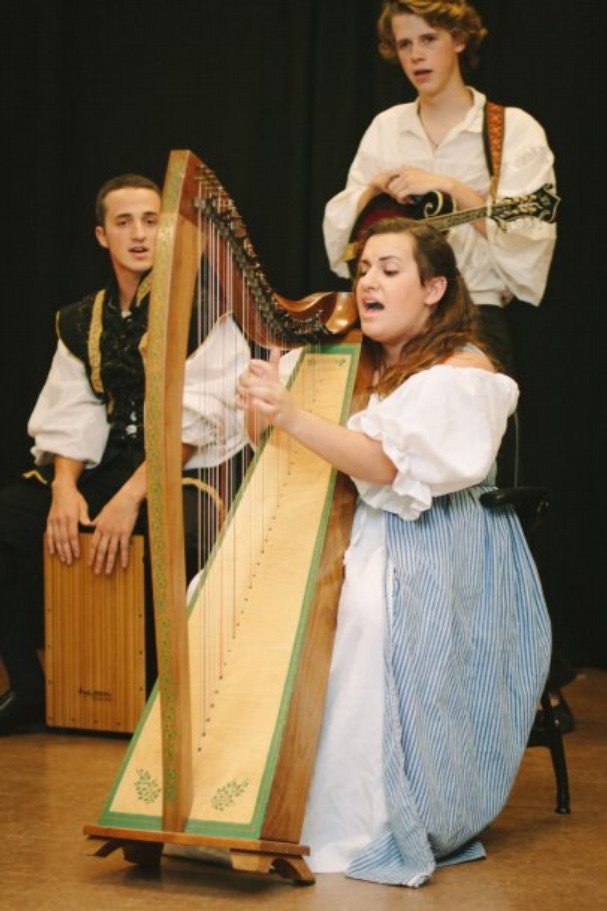
These instruments are not props. These kids play instruments I’ve never even seen before. And their singing voices could break your heart. I’m pretty sure Leonato’s “Hey Nonny Nonny” broke mine.
This is part II of my review of Ave Maria’s Shakespeare in Performance’s Much Ado About Nothing. You can read the first part here.
When I wrote my first review of Ave’s Much Ado About Nothing, I focused mainly on Don Pedro and Claudio. I was upset by them, but to tell you the truth, there was another character that upset me so much more that my ire at Don Pedro and Claudio paled in comparison.
My most brilliant and wonderful friar cracked the play open a wee bit for me so that I was able to understand my anger at those two as actually being kind of the point. But there really wasn’t any way I was able spin my frustration with the other character. It almost ruined the play for me, actually. I didn’t even leave the play saying, “Man, that was great!” or even “that was pretty good.” I left saying, “why the hell was there a real-life cartoon villain in place of Don John?”
Truly, I cannot accurately convey in words the remarkable ability of this actor to become a cartoon character. I felt like I was watching Who Framed Roger Rabbit?, the Elizabethan version. It was so terribly painful at first that I desperately hoped it was a combination of nerves and Red Bull, and the actor would settle down and be normal after a bit. But he didn’t. Every scene with Don John in it was like watching a train wreck. I frantically wanted it to not be happening, especially right in front of me, but there was nothing I could do to stop it, and I could not look away.
I’ve seen Much Ado a few times, but the version I’m most familiar with is Kenneth Branagh’s, in spite of my aversion to Kenneth Branagh and my absolute hatred for the way he plays Benedick. I love all the other characters, though, particularly Keanu as Don John. In all the other versions of Much Ado I’ve seen, Don John is played similarly to Keanu’s. Tortured, brooding, damaged, seething, and maybe slightly constipated. The Don John of my acquaintance isn’t in pain; he is pain. His existence is like a supernova of hatred and despair, sucking in everyone around him. He’s dreadful, and the shaming scene has always seemed to me his crowning glory, the moment when he turned love itself into hatred, rage, and despair, playing the rest of the characters like puppets on a string.
The problem with this Don John, though, was that I couldn’t take him seriously. He wasn’t a tortured mastermind of villiany; he was just sort of ridiculously determined to be absolutely other. Not laughing when they laughed, not bowing to their conventions, seeking pain where they sought joy. But he wasn’t good at it. None of the schemes he set in motion were his idea at all. They were all Borachio’s ideas. And they weren’t even good ones, at that.
The scene where Borachio and Don John plot the undoing of Hero has always held a kind of horrific fascination for me. I’ve felt that it’s like a skin-crawling window into the heart of malice, letting us see the inner workings of people who plot to destroy with no other purpose than destruction itself. Those types of people frighten me more than any other. And yet, when I saw the play for the second time, I was floored by that scene. I actually heard the words for the first time.
Borachio: “Go, then; find me a meet hour to draw Don Pedro and
the Count Claudio alone: tell them that you know
that Hero loves me…They will scarcely believe this without trial:
offer them instances; which shall bear no less
likelihood than to see me at her chamber-window,
hear me call Margaret Hero, hear Margaret term me
Claudio; and bring them to see this the very night
before the intended wedding,–for in the meantime I
will so fashion the matter that Hero shall be
absent,–and there shall appear such seeming truth
of Hero’s disloyalty that jealousy shall be called
assurance and all the preparation overthrown.”
(Much Ado About Nothing, Act II, Scene ii — emphasis mine)
Did you catch that? “Hear me call Margaret Hero,hear Margaret term me Claudio.” Excuse the vernacular, but WTF? What exactly would that have proved to Claudio? That his fiance is delusional? That she likes to play weird role-playing games where she pretends her lover is her future husband? That he’s been cloned by an evil genius and his clone is currently ravishing his fiance on her balcony?
I mean, come on. If Claudio had even listened, or taken half a second to think about what he was seeing (and we don’t even know exactly what it is he saw, which important to note), he would have realized that something was fishy. But he didn’t. And he didn’t want to. You can see it in the scene where Don John comes and tells Don Pedro and Claudio of Hero’s alleged infidelity.
Claudio: “If I see any thing to-night why I should not marry her to-morrow, in the congregation, where I should wed, there will I shame her.”
Don Pedro: “And, as I wooed for thee to obtain her, I will join with thee to disgrace her.”
They have no proof. They have an unfounded and highly suspicious accusation from a bastard brother whom neither Don Pedro nor Claudio trust. Yet they are already planning the best punishment for Hero. They want to believe Don John. Don John doesn’t manipulate them like puppets; they’re like dominoes, poised on the edge of a chasm, and all Don John does is blow on them a little. They’re all too willing to call jealousy assurance.
One of the reasons I was so furious with Claudio and the Prince is that the way Don John was played shifted the responsibility where it belonged. It really was difficult to take Don John seriously. He wasn’t quite a joke, but he wasn’t a threat, either. He was grotesquely villainous, but in such a ludicrous way that he acted like a sledgehammer, splitting the play wide open.
The plots Borachio concocts and Don John instigates are really silly. The first one unravels quickly, mostly because Claudio just sulks instead of trying to avenge his apparently breached confidence. The second one would have unraveled just as quickly if the Prince and Claudio weren’t willing, and even eager, to believe the worst of Hero and to exact a sickeningly gleeful vengeance upon her. I won’t even get into her own father’s willingness to believe the worst of his child and cry out for her to die, because my head might explode, and this is too long already.
So without even realizing that the very character who brought me so much angst during the play was also the one almost entirely responsible for actually showing me the play for the first time, I came home from the first performance high on indignant feminist rage. The Ogre patiently listened to me curse and storm at Claudio and Don Pedro, and then said, “You’re right, you know. What they did was awful even given the social conventions of the time. But what Beatrice did to Benedick was worse.”
At that point, my head actually did explode. It must have, at least, because all I remember is a red haze that burned me from the inside out and made me say such things to my husband about all you men that he didn’t talk to me for two days. Which was okay by me, because I wasn’t talking to him either.
Then I saw the play again.
There was a different Beatrice this time, and she shifted the axis of the play so dramatically that I had to go home and apologize to my husband. The first Beatrice was funny, sarcastic, and generally everything Beatrice is said to be in the play…always merry, born to laugh, etc. But this second Beatrice was something else. She was beauty and wit and charm all deeply streaked with pain. She was glittering, brilliant, fierce, and then when that scene came, she was terrible.
When she took a breath and said, “Kill Claudio”, the audience took a collective breath. In that appalled, appalling silence I saw grown adults grasping their heads in their hands, covering their faces, and shielding their eyes, as if they were subconsciously trying to block out what was happening.
And she said it with such a dreadful, icy self-possession that it was impossible to play off as heated emotion. Even if the later scene where she refuses to greet Benedick until he tells her that he has challenged Claudio didn’t convince the audience, the raw power of her delivering those two words was enough. She knew exactly what she was doing. She was using selfless love, freely offered, as a weapon against her enemy.
This is why I was so furious with the Ogre: I would have done the same thing. What she did was awful, utterly unable to be justified, and I was right there with her. I’m still right there with her. Claudio deserved to die, to suffer, to be drawn and freaking quartered, and as a woman Beatrice could only accomplish that one way: by twisting a man who loved her to her will. By making the requital of his love conditioned upon his murdering his best friend.
Can you imagine how the play would have ended had not the bumbling, absurd Dogberry* stumbled upon the truth and managed to make it known in spite of his best efforts? Hero and her parents would have seen that Claudio and the Prince didn’t care at all about her death. Benedick and Claudio would have dueled. Likely, Claudio would have been killed. Hero would have lived the rest of her days in some convent, ruined forever. Perhaps Benedick and Beatrice would have gotten married, but it would have been a tragedy of a wedding, and their marriage would be forever and irrevocably marred by what Beatrice had forced Benedick to do. Everyone’s lives would have been utterly wrenched by misery. And it wouldn’t be the fatal work of some dark villain; it would only be the result of their own darkness. Their failure to wait, to be patient, to seek truth, to bear suffering, to be merciful. Really, that’s what the play hinges upon. The destruction we are capable of if we come at life with a battle-axe instead of open arms.
The ending, which has always been vaguely unsatisfying for me, was almost gruesome this time. I felt that their happiness was won too cheaply, and was hollow compared to the malice that went before. Perhaps Claudio and Hero went on to be happy, and maybe even Beatrice, but I don’t think Benedick ever could, at least not in the same way he was happy before. He’s the only character who changes in the play, the only one who grows, and I think that growth is a result of him coming face-to-face with the evil men and women are capable of. I think that’s why he’s so insistent on dancing at the end instead of being married. I think he’s trying to find some way to lighten the darkness that has been unveiled over the course of the play.
I used to think that Much Ado was so difficult a play only because of that painful shaming scene. Now I think it’s difficult because it isn’t, after all, a rollicking comedy. It is very, very funny, just like life. It’s also very dark, and very painful, and very unsatisfying. There’s a kind of hole at the center of it. Can there be love after all, when this is what people will do to the ones they love? Is it all artifice? In the end, are we nothing but self-serving wretches?
I was so glad that the cast (who seemed to be preternaturally gifted with all the musical talent) played Mumford and Sons’ Sigh No More. I think there’s a lot about the play in these lines:
“Love; it will not betray you
Dismay or enslave you, it will set you free
Be more like the man you were made to be.There is a design, an alignment to cry
Of my heart to see,
The beauty of love as it was made to be.”
Love did betray, dismay, and enslave Benedick. And it wasn’t love that set him free, but sheer happenstance. I think, in the end, his willingness to confront the things that were happening around him instead of just being swept away like everyone else taught him the most important thing about love. It requires mercy. He said as much to Claudio at the end. “…live unbruised, and love my cousin.” He forgave Claudio, forgave Beatrice, repaid grievance with mercy, and exhorted them (and us) to extend the same mercy to one another and be friends again.
It’s remarkable, what an insightful director and a brilliant cast can do to a play. It wasn’t that Shakespeare in Performance put on a version of Much Ado About Nothing that I hadn’t seen before. They put on Much Ado About Nothing and I saw it for the first time.
*I really have to give a shout-out to Dogberry. He was hilarious in all the right ways and none of the wrong and icky Michael Keaton ways. Sienna was so delighted with his performance that she has adopted his weird tricks of physical comedy and spends half her days in a grossly exaggerated sideways lunge, calling herself “as pretty a piece of flesh as any in Messina.” If it weren’t Shakespeare, it would be disturbing.**
**It is totally disturbing, but I can’t discourage the kid who usually quotes Jimmy Neutron from switching to the Bard.
Previous Post

April 27, 2013
7 Quick Takes Saturday!
Next Post
May 1, 2013 This is Why I Don't Leave the House
Browse Our Archives
Select a Category Uncategorized
Select a Month September 2016 August 2016 July 2016 June 2016 April 2016 March 2016 January 2016 December 2015 November 2015 October 2015 September 2015 August 2015 July 2015 June 2015 May 2015 April 2015 March 2015 February 2015 January 2015 December 2014 November 2014 October 2014 September 2014 August 2014 July 2014 June 2014 May 2014 April 2014 March 2014 February 2014 January 2014 December 2013 November 2013 October 2013 September 2013 August 2013 July 2013 June 2013 May 2013 April 2013 March 2013 February 2013 January 2013 December 2012 November 2012 October 2012 September 2012 August 2012 July 2012 June 2012 May 2012 April 2012 March 2012 February 2012 January 2012 December 2011 November 2011 October 2011 September 2011 August 2011 July 2011 June 2011 May 2011 April 2011 March 2011 February 2011 January 2011 December 2010 November 2010 October 2010 September 2010 August 2010 July 2010
Follow Us!
TAKE THE
Religious Wisdom Quiz
What is the name of the lake into which the beast and false prophet are thrown?
Select your answer to see how you score.
Gehenna The lake of burning sulfur (lake of fire) The outer darkness The abyss
Related posts from Barefoot and Pregnant


How Pokemon Go Saved My Summer
TRENDING AT PATHEOS Catholic

Rejecting Doom: Christian Hope And Human Action
Christianity is a religion of hope. We are to have hope and...

It’s What Comes From Within Which Matters
One of the most difficult things for us to understand is why...

Why I Choose the Eucharist Over the Sermon
Choose the Eucharist, Not the Sermon What are we supposed to get...

5 Design Elements Found in Spiritually Rooted Homes
Putting Spirituality Into Home Decor Our homes are more than our living...

Credo: A Story of God Told with the...
About 10 years ago, I began to imagine a personal "Credo" that...

The Anatomy of Divine Revelation in Catholic Thought
The claim that God has made Himself known to human beings is...
view all Catholic blogs
Ad-Free & Subscriber Log-In Subscription Support
- About Us
- 2026 Calendar
- Videos
- Podcasts
- Library of World Religions
- Faith In Media Tracker
- Advertise With Us
- Write for Us
- Privacy Policy
- Terms of Service
- Do Not Sell My Data
- Contact Us
- Radiant Digital
- Manage Newsletter Subscriptions
- Unsubscribe From Notifications
- Sitemap
Copyright 2008-2026, Patheos. All rights reserved.
Subscription Support Ad-Free & Subscriber Log-In
Follow Patheos