
BuddhistCatholicContemplativeEvangelicalGeneral ChristianHinduJewishLatter-day SaintMuslimNew VisionsProgressive Christian
Beliefs
- Buddhist
- Catholic
- Contemplative
- Evangelical
- General Christian
- Hindu
- Jewish
- Latter-day Saint
- More Voices
- Muslim
- New Visions
- Pagan
- Progressive Christian
Topics
- Religion News
- Food and Religion
- Sports and Religion
- Religious Art
- Religious Music and Entertainment
- Religious Events
- History and Religion
- Style and Religion
- Politics and Religion
- Women in Religion
- Recreation Outdoors and Religion
- Business Finance and Religion
- Careers Workplace and Religion
- Education and Religion
- Family Parenting and Religion
- Health Fitness and Religion
- Home and Religion
- Relationships and Religion
- Technology and Religion
- Travel and Religion
Columnists
- Buddhist Columnists
- Business Finance and Religion Columnists
- Careers Workplace and Religion Columnists
- Catholic Columnists
- Contemplative Columnists
- Education and Religion Columnists
- Evangelists Columnists
- Family Parenting and Religion Columnists
- General Christian Columnists
- Health Fitness and Religion Columnists
- Hindu Columnists
- History and Religion Columnists
- Home and Religion Columnists
- Jewish Columnists
- More Voices Columnists
- Latter Day Columnists
- Muslim Columnists
- New Visions Columnists
- Nonreligious Columnists
- Pagan Columnists
- Politics and Religion Columnists
- Progressive Columnists
- Recreation Outdoors and Religion Columnists
- Relationships and Religion Columnists
- Religion News Columnists
- Religious Art Columnists
- Religious Events Columnists
- Religious Music and Entertainment Columnists
- Sports and Religion Columnists
- Style and Religion Columnists
- Technology and Religion Columnists
- Travel and Religion Columnists
- Women in Religion Columnists
Resource Library
- 2026 Calendar
- Library of World Religions
- The 100 Most Holy Places on Earth
- Patheos Answers
- Podcasts
- Videos
- Faith Leaders Database
- Anglican Episcopalian
- Bahai
- Baptist
- Buddhism
- Christianity
- Confucianism
- Eastern Orthodoxy
- Hinduism
- Holiness and Pentecostal
- ISKCON
- Islam
- Judaism
- Lutheran
- Methodist
- The Church of Jesus Christ of Latter-day Saints
- New Age
- Paganism
- Presbytarian and Reformed
- Protestantism
- Religion Behind the Scenes
- Roman Catholic
- Scientology
- Shia Islam
- Sikhism
- Sufism
- Sunni Islam
- Taoism
- Zen
- See all religions
Research Tools
 Ad-Free & Subscriber Log-In Subscription Support
Ad-Free & Subscriber Log-In Subscription Support
Follow Patheos 

- Trending:
- Forgiveness
- |
- Marriage
- |
- Consciousness
- |
- Death Penalty
- |
- Election
- |
- Halloween
 Barefoot and Pregnant
- Home
- Catholic
- Deconstruct This: Language and Reality
Deconstruct This: Language and Reality
Last updated on: October 10, 2016 at 11:53 am by Calah Alexander
Deconstruct This: Language and Reality 2016-10-10T11:53:51-04:00 Calah Alexander
Patheos Explore the world's faith through different perspectives on religion and spirituality! Patheos has the views of the prevalent religions and spiritualities of the world.

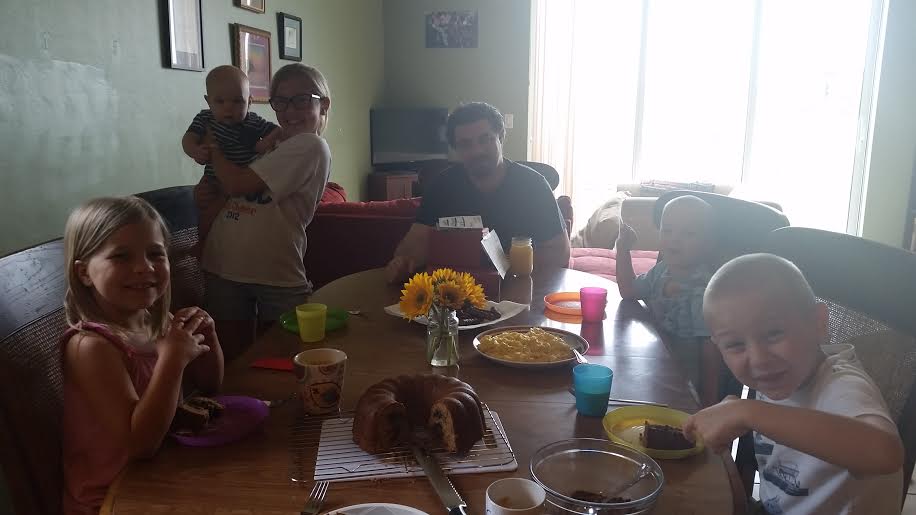
This picture may be only tangentially related to my post, but it is hilarious and your day is now better for having seen it
Yesterday evening, while I was lying on the floor next to eternally sleep-striking Lincoln, I decided to google myself.
Nothing good ever comes of googling yourself. Last night was no exception. I ran across a few posts about how I’m the worst person ever for slamming Michael Voris, and none about how, oh yeah, I pretty much admitted that I was the worst person ever for doing that and then apologized. I came across a few posts about crisis pregnancies. And then I came across this one little gem called “Lies, Damned Lies, and Deconstructionism.”
I got my literature degree at UD, as you all know, since I talk about it incessantly. UD’s literature department is not exactly keen on deconstructionism. If you walked into a classroom there and said, “I’m a deconstructionist,” you might as well have said, “I’m the embodiment of evil, here to destroy Christianity, Western Civilization, and puppies.” At UD, we’re shown the power of language. We’re not taught to believe that language has power; it does have power, and the Core Curriculum shows the students there how much power language wields. We got into reader-response criticism a little in my Junior Poet class, and I nearly had a fit in class when the suggestion was presented that if The Divine Comedy had been written and then immediately buried and never read, it would never mean anything, because no one would ever read it and give it meaning.
“That’s so wrong!” I argued, a little hysterically. Eight months pregnant at the time, I gestured to my belly and said, “if my daughter were born and died on the same day, would she not mean anything, since she didn’t live a life? Would she not have a soul that the world would always be poorer for having missed out on? If The Divine Comedy had never been read, that wouldn’t have detracted from the greatness and beauty of it. The world would have just been infinitely poorer for having not experienced it.”
I still believe that. Language is incredibly important. Words are powerful. Words can be terrible in their power, sometimes. And yet, in my post on swearing, I said this:
“[A]lthough God gave us the gift of language, he didn’t give us the languages we use. Those are all our creations. Every word I know in my native tongue and even the ones I mangle in French and Italian are man-made. They have no meaning in and of themselves, save the meaning we give to them.”
This is the statement that Jake at Roma locuta est took issue with, the one that the crux of his response is based on. Here’s the beginning of it:
“This seems to be the crux of Ms. Alexander’s argument. Unfortunately, she throws out the statement as flippantly as an undiscerned swear word itself with no regards to either its philosophical background or its inherent truth value. Such an argument is a small step away from full blown deconstructionism. No, my dear, Calah, it is not true that words themselves are empty of meaning. The formation of language is something considerably more complicated, and dare I say it, more cosmic than what you have taken to be mere convention. Words contain meaning in and of themselves, and what’s more, words contain power. They are efficacious. We need look no further than phrases such as “I love you,” or, “I hate you,” or even, “I baptize you,” and, “This is my Body,” to see that words can bring about precisely what they signify. Peter Kreeft has said, “These are not labels; they’re spiritual weapons. They’re arrows that pierce through flesh and into hearts.”
Like a sacrament, words may be a sign, but they are no mere symbol. They are formed form the downward pressure of objective reality. Language itself serves to disclose reality, and it is reality that gives language its form.”
(Read the rest here, and you really should, because it’s fascinating. Even if I hate being referred to as “Ms. Alexander.”)
I agree with almost everything he says here. Yes, yes, words have meaning in and of themselves! Yes, they contain power! Yes, they are in no way a mere symbol! Language absolutely discloses reality! Reality absolutely maybe gives language its form!
So, do I now retract my entire post and hang my head in shame, having once again been reminded by the Deity of the Blogosphere that I’m a blithering idiot?
No, I don’t think so. Not this time.
I’m not exactly sure that my original statements is actually at odds with what Jake says. I know it appears to be, but it might not be.
Words have power. But consider the phrase “Veni, vidi, vici“. That phrase is powerful. Very much so. It has reverberated down through history, resonating with the terrifying pride of Caesar and the dreadful might of the Roman empire. It’s a touchstone in Western literature and art. Variations of it are used everywhere. And yet, when I repeated it to my sister during a conversation, certain that it was the perfect pithy rejoinder that would prove the point I was trying to make, she looked at me doubtfully for a second and said, “Are you having an aneurysm or something?”
The power of those words is completely lost on someone who doesn’t know them. Does that mean that the words aren’t actually powerful? Well…not exactly. But it does suggest that for language to wield its power effectively, the listener must know the language. And even if my sister knew Latin, if she didn’t understand the historical and cultural significance of those words, she still wouldn’t have understood the point I was trying to make. The words are powerful, but they’re imbued with the power and meaning humans have ascribed to them over the last 2000 years of Western civilization.
Let’s take Jake’s example from his post, “amble.” As his daughter astutely pointed out, amble does indeed sound slow. But do you know what doesn’t sound slow? Scramble. Scramble sounds frenetic, chaotic, and messy, as if it were tumbling all over itself in its haste. Remarkably, that’s what the word means. And yet, it contains the word “amble” in it. Could the “scr” at the beginning be entirely responsible for changing that “amble” from something slow and relaxed into something chaotic? Well, I think it certainly plays into it. But what really makes the meaning of those two similar words so diametrically opposed to each other is our understanding of language, and our understanding of reality.
Words shape our understanding of the world around us from our earliest days. A baby’s first word is almost always “mama”, not because he knows that word means his mother, but because “ma” is the easiest sound for humans to make. That’s why almost all cultures have some variation of the “Ma” sound in their word for mother. Mothers over the centuries heard the “ma” and responded to it, in the beginning probably just because their attention was diverted by the baby making a sound that wasn’t crying. The baby sees the mother responding to the “ma” sound and begins to use it when he or she wants the mother. Eventually, “ma”, “mum,” “mommy,” “ama,” “mutter,” and so forth all begin to mean “mother.”
Does recognizing the human evolution of language, though, remove the meaning from the word “mother”? I hardly think so. Jake has this to say about the evolution of language:
“Words have objective meanings, and not simply because man said so. The very phonetic construction of a word makes it uniquely suitable to describe what it is that it describes. A writer that has mastery over a language understands this, for it is this understanding that gives him his mastery. Every sound, every word, every pause exists to serve the whole, and the alteration of any one part would cause the whole to be a different whole.”
This is where I get into shaky ground. I want to agree with him, but I don’t know if I can. I don’t know if anyone can actually know that “the very phonetic construction of a word makes it uniquely suitable to describe what it is that it describes.” Language is so very powerful for humans that it shapes our understanding of reality. So of course, when we see someone ambling and read the word “amble” we think, “it couldn’t have been any other way. That word perfectly expresses the action of ambling by its very sound.” Ramble, likewise, is the perfect expression of a quiet stroll in the countryside. But…but scramble also perfectly expresses that hasty, frantic jostling! So where does that leave us? Are words constructed according to the principles of reality, or is our reality constructed around the principles of language?
I don’t know. And I don’t know if my once sure-footed assertion that “there are no bad words” really stands. However language evolved, I don’t doubt that language does express the truths of reality, nor that words do possess a power. I’m not sure if that power is inherent to the word, or if it’s power that the word has been imbued with over centuries of human use. I tend to lean toward the latter, because language evolves so fluidly, sometimes from one generation to the next. Fifty years ago, no one used the word “cool” unless they were talking about the weather. Now, it’s become something entirely new, a word that describes something which, prior to the advent its use in such a way, did not have a descriptor. Either that, or it didn’t exist.
Think about it. “Cool.” Cool is not neat, or sweet, or the bee’s knees, or the cat’s pajamas. Cool is something totally unique. Maybe it’s not a coincidence that “cool” gained traction as a epithet right about the time adolescent pop culture became a force to contend with in the modern world. Maybe the teenagers of the 40’s needed a word to describe something that no other word could describe, and “cool” fit the bill. Or maybe after the word “cool” began to be used in the way it’s used today, the power of that word drove the whole teenage pop culture movement to heights it wouldn’t have otherwise attained. Or maybe language and culture and reality and human beings are so inextricably intertwined that all these things naturally evolved together in a way we will never be able to untangle.
I think that trying to decide whether reality shapes language or language shapes reality is something of a “which came first, the chicken or the egg?” argument. We’ll probably never know. The problem, though, is that if reality shapes language, then there are words that are inherently bad, because they express a concept that is inherently bad, and shouldn’t be treated lightly. On the other hand, if language shapes reality, then my original assertion stands, and those words that we consider “bad” are only bad because we consider them so.
In either case, I don’t think it’s a stretch to say that the power that swear words had 40 years ago has diminished considerably. Swear words are unquestionably evolving into commonly used and even acceptable words. So here’s something to consider: if reality shapes language, what does that say about our reality? Conversely, if language shapes reality, what does that say about what language is doing to our reality.
And with that, I may have just talked myself right out of my love for swear words. Crap.
Previous Post

April 9, 2013
Heads-Up
Next Post
April 11, 2013 The Chronicles of Henry
Browse Our Archives
Select a Category Uncategorized
Select a Month September 2016 August 2016 July 2016 June 2016 April 2016 March 2016 January 2016 December 2015 November 2015 October 2015 September 2015 August 2015 July 2015 June 2015 May 2015 April 2015 March 2015 February 2015 January 2015 December 2014 November 2014 October 2014 September 2014 August 2014 July 2014 June 2014 May 2014 April 2014 March 2014 February 2014 January 2014 December 2013 November 2013 October 2013 September 2013 August 2013 July 2013 June 2013 May 2013 April 2013 March 2013 February 2013 January 2013 December 2012 November 2012 October 2012 September 2012 August 2012 July 2012 June 2012 May 2012 April 2012 March 2012 February 2012 January 2012 December 2011 November 2011 October 2011 September 2011 August 2011 July 2011 June 2011 May 2011 April 2011 March 2011 February 2011 January 2011 December 2010 November 2010 October 2010 September 2010 August 2010 July 2010
Follow Us!
TAKE THE
Religious Wisdom Quiz
True or False: Solomon asked God for wisdom rather than wealth or long life.
Select your answer to see how you score.
FALSE TRUE
Related posts from Barefoot and Pregnant

How Pokemon Go Saved My Summer
TRENDING AT PATHEOS Catholic

The Parable Of The Sower And The Word...
One of Christ’s most famous parables is that of the sower who...

Rejecting Doom: Christian Hope And Human Action
Christianity is a religion of hope. We are to have hope and...

Why I Choose the Eucharist Over the Sermon
Choose the Eucharist, Not the Sermon What are we supposed to get...

5 Design Elements Found in Spiritually Rooted Homes
Putting Spirituality Into Home Decor Our homes are more than our living...

Credo: A Story of God Told with the...
About 10 years ago, I began to imagine a personal "Credo" that...

The Anatomy of Divine Revelation in Catholic Thought
The claim that God has made Himself known to human beings is...
view all Catholic blogs
Ad-Free & Subscriber Log-In Subscription Support
- About Us
- 2026 Calendar
- Videos
- Podcasts
- Library of World Religions
- Faith In Media Tracker
- Advertise With Us
- Write for Us
- Privacy Policy
- Terms of Service
- Do Not Sell My Data
- Contact Us
- Radiant Digital
- Manage Newsletter Subscriptions
- Unsubscribe From Notifications
- Sitemap
Copyright 2008-2026, Patheos. All rights reserved.
Subscription Support Ad-Free & Subscriber Log-In
Follow Patheos