
BuddhistCatholicContemplativeEvangelicalGeneral ChristianHinduJewishLatter-day SaintMuslimNew VisionsProgressive Christian
Beliefs
- Buddhist
- Catholic
- Contemplative
- Evangelical
- General Christian
- Hindu
- Jewish
- Latter-day Saint
- More Voices
- Muslim
- New Visions
- Pagan
- Progressive Christian
Topics
- Religion News
- Food and Religion
- Sports and Religion
- Religious Art
- Religious Music and Entertainment
- Religious Events
- History and Religion
- Style and Religion
- Politics and Religion
- Women in Religion
- Recreation Outdoors and Religion
- Business Finance and Religion
- Careers Workplace and Religion
- Education and Religion
- Family Parenting and Religion
- Health Fitness and Religion
- Home and Religion
- Relationships and Religion
- Technology and Religion
- Travel and Religion
Columnists
- Buddhist Columnists
- Business Finance and Religion Columnists
- Careers Workplace and Religion Columnists
- Catholic Columnists
- Contemplative Columnists
- Education and Religion Columnists
- Evangelists Columnists
- Family Parenting and Religion Columnists
- General Christian Columnists
- Health Fitness and Religion Columnists
- Hindu Columnists
- History and Religion Columnists
- Home and Religion Columnists
- Jewish Columnists
- More Voices Columnists
- Latter Day Columnists
- Muslim Columnists
- New Visions Columnists
- Nonreligious Columnists
- Pagan Columnists
- Politics and Religion Columnists
- Progressive Columnists
- Recreation Outdoors and Religion Columnists
- Relationships and Religion Columnists
- Religion News Columnists
- Religious Art Columnists
- Religious Events Columnists
- Religious Music and Entertainment Columnists
- Sports and Religion Columnists
- Style and Religion Columnists
- Technology and Religion Columnists
- Travel and Religion Columnists
- Women in Religion Columnists
Resource Library
- 2026 Calendar
- Library of World Religions
- The 100 Most Holy Places on Earth
- Patheos Answers
- Podcasts
- Videos
- Faith Leaders Database
- Anglican Episcopalian
- Bahai
- Baptist
- Buddhism
- Christianity
- Confucianism
- Eastern Orthodoxy
- Hinduism
- Holiness and Pentecostal
- ISKCON
- Islam
- Judaism
- Lutheran
- Methodist
- The Church of Jesus Christ of Latter-day Saints
- New Age
- Paganism
- Presbytarian and Reformed
- Protestantism
- Religion Behind the Scenes
- Roman Catholic
- Scientology
- Shia Islam
- Sikhism
- Sufism
- Sunni Islam
- Taoism
- Zen
- See all religions
Research Tools
 Ad-Free & Subscriber Log-In Subscription Support
Ad-Free & Subscriber Log-In Subscription Support
Follow Patheos 

- Trending:
- Forgiveness
- |
- Marriage
- |
- Consciousness
- |
- Death Penalty
- |
- Election
- |
- Halloween
 Barefoot and Pregnant
- Home
- Catholic
- Watch for Spears: New Life in an Old Poem
Watch for Spears: New Life in an Old Poem
Last updated on: October 10, 2016 at 11:54 am by Calah Alexander
Watch for Spears: New Life in an Old Poem 2016-10-10T11:54:40-04:00 Calah Alexander
Patheos Explore the world's faith through different perspectives on religion and spirituality! Patheos has the views of the prevalent religions and spiritualities of the world.
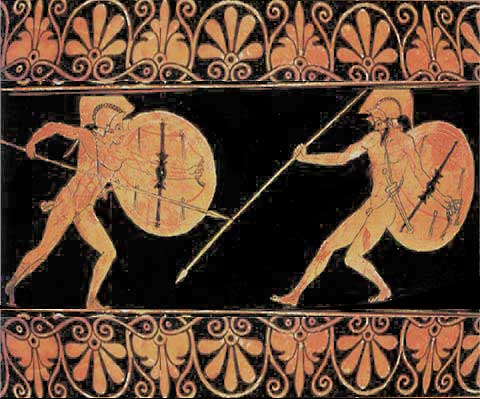
This post has been a long time coming. It’s actually been well over 2 months since the Homerathon, and my original intent was to write this post the day after the Homerathon, but alas. Various circumstances of life intervened.
All those various circumstances don’t account for the long, long time that elapsed, though. Here’s what that procrastination boils down to: I’m not a huge fan of Homer.
It’s a total English major faux pas for me to admit this, but the Iliad regularly put me straight to sleep during Lit Trad I. It was the first book in my entire scholastic career that I didn’t finish. (Don’t worry, it was soon joined by all of Henry James). For a war poem, it sure was boring as all hell. The only part I liked was Hector and Andromache’s emotional farewell.
But when I was reading book 18 for the Homerathon, I kept thinking, “I don’t remember this book being any good. But it is good! It’s really good, in fact, and not boring at all, and not nearly as clunky and cumbersome as I remember. It’s even poetic. I actually understand now why it’s considered epic poetry. I kind of want to read the whole thing again now. For the first time.”
And that, ladies and gentlemen, is the difference a translator can make.
Stanley Lombardo translated this version of the Iliad. Being utterly unfamiliar with both Greek and the Iliad, I can only surmise, based on his own admissions in the introduction and my surprise pleasure in reading it, that he took some liberties with the text to make it not mind-numbing to wade through. And thank God for that.
Poetry is important to me. Rhythm, meter, and word choice matter. And when I was presented with a book that is supposed to be the poem upon which all other poetry ever has been built, and it read like a non-native English speaker attempted to write it using the meter of his original language, and then just never stopped writing, I wasn’t impressed. I realize that every classics major and English major and anyone with a rudimentary grasp of Western Civilization is gasping in horror right now, and rightly so. I should probably brace myself for an unpleasant conversation with my father-in-law later. Granted, I should have looked beyond the prosaic and endlessly endless catalogue of ships to see the greatness, but I didn’t. Mostly because I was (am) a lazy reader. Also, because I was eighteen and had important 40’s nights to attend. In my defense, no less a critic than Horace claimed that, in the famous (translated) phrase, “even Homer nods.”
But this Iliad is something new. Something beautiful. Something-dare I say it?- glorious. Stanley Lombardo himself came to Ave Maria for the Homerathon and read the final book. I missed half of it (because Lincoln, that’s why), but I was there for the very beginning and the end. At the beginning, he walked up to the microphone with a hand-held drum and I inwardly cringed and readied my best “I’m genuinely enjoying this and not at all pretending because I don’t want you to feel embarrassed” face.
Shockingly, I didn’t need it. It was amazing. He completely captured the ragged, hypnotic, haunting rhythm that I imagine the original Greek had. And even if it didn’t have that (which it probably didn’t, because I’m given to understand that Greek is a much more fluid and musical language than ours), Lombardo used the unique cadence of modern American English to fashion something so remarkable that I understood for the first time how people could listen to someone tell and re-tell this poem, for centuries. I didn’t want him to stop reading. I could have listened to it for centuries.
(Unfortunately I couldn’t get the videos taken here at Ave formatted correctly, so this is a Youtube video of Stanley Lombardo reading from Book 12, I believe. It’s really long, but if you want to hear how effective the drum is, he starts using it around 37:30.)
At the end, he re-read the final lines in the Greek and I got chills up my spine. It was almost mystical, the way thousands of years seemed to fold together and I felt as I imagine the Greeks must have, listening to this blind poet weave an achingly magnificent tapestry of a poem using their own history and their own words.
http://www.youtube.com/watch?v=NssnanW93fI
(Here is Stanley Lombardo reading Book 1 in the original Greek.)
But what made it magnificent was that Stanley Lombardo had actually managed to bring it to life in a new language and a new time. Translating poetry has always seemed to me an impossibly tricky task, because poetry is an inextricable union of words and meter. A poem’s meaning cannot be found in the words alone. How those words are strung together is equally as important, if not more important. There is no single word in one language that will perfectly correspond to a single word in another language, nor can the way we speak those words, the inherent pauses and lengthened vowels and the everyday rhythm of our speech, easily be replicated in a foreign language. Trying to convey the poet’s meaning while also transmitting any sense of the rhythm and meter is not a task I envy anyone. I love what Stanley Lombardo says in the introduction about the way he managed this difficulty:
“Homer’s language does not correspond to any form of Greek ever spoken. It was a poetic dialect developed over generations of performance — rich, flexible, and capable of producing a wide variety of musical and semantic effects. It has often been observed that in the late twentieth century there is no longer available any traditional poetic language for translation of epic — or for writing English or American poetry for that matter — that we must content ourselves with the diction of prose cast into verse of some kind, and that we cannot therefore hope to achieve in translation the epic grandeur of Homer. I do not think there is much truth to this. What is true is that the use of an artificial poetic diction would serve to embalm Homer rather than bring him to life. But English and American poetry contains vast resources that are available to the translator; these resources include a modern poetics based on natural language that, far from being prosaic, is capable of great energy and beauty. A successful translation, especially of a work on the scale of the Iliad, must grow out of the poetic tradition of its own language and become one of its current embodiments.”
I’d say he managed an extremely successful translation. And organizing the Homerathon, a 24-hour-long reading of the Iliad, was a stroke of brilliance by Ave’s Dr. Travis Curtright. The students (and random professor’s wives like me) got to see and hear Homer in a way that made it alive to us. Not some clunky, inaccessible relic of a past age, but a living, breathing, thrilling poem of war and violence and the sins of man, all told in the familiar cadence of our own language.
One of the students stayed for the entire 24-hour reading (and yes, that was 24 consecutive hours). She had this to say about it:
So I never actually read the Iliad when I was supposed to freshman year… I was one of THOSE students who just barely passed by just because I was good at deductive reasoning and took good notes. The reason for this was because I found the Iliad so difficult to read. It was so dense that I didn’t see the point in my trying to keep up (I am a very slow reader). However, after staying up all night and hearing the entire book read aloud, I realized how very wrong I was. I actually enjoyed it! (Crazy! I know, but it’s true!) Hearing it and being able to follow along in Dr. Curtright’s copy made the whole thing come to life. It was like a play, which, I am told, was the point.
I can’t express how much I love things like this. A new translation that brings life to poem that has grown rusty in the effort to bring it from Greek to English. An unorthodox event that gets the students all giddy (because what college student doesn’t love all-nighters?) and then shows them what this poem was meant to be, what it was, and what it still is. Students who stay and listen to 24 hours of reading aloud. Students and professors who goof off and have fun with the reading, making it their own. These T-shirts:
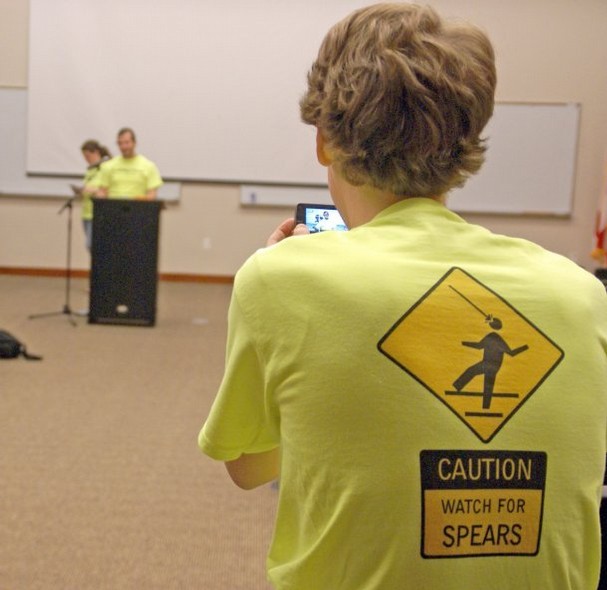
It’s just all so awesome. And it’s moments like these that really show students that this rich, amazing heritage of Western Literature that we’ve inherited is a whole lot more than dusty books on a shelf. It’s a living, breathing part of us, woven into the words we speak and the way we speak them, with the same eternal themes echoing again and again as we grapple with them. Whether it’s the Iliad or Platoon or The Things We Carried, war and violence are part of our inheritance as humans. But no other work of art has reflected on it as completely as the first. It’s remarkable to see it brought to life again after all this time, and to see a new generation of youth embrace it.
Previous Post

March 16, 2013
When Catholics Play Tug-of-War, the Church Loses
Next Post
March 19, 2013 A Dream So Big
Browse Our Archives
Select a Category Uncategorized
Select a Month September 2016 August 2016 July 2016 June 2016 April 2016 March 2016 January 2016 December 2015 November 2015 October 2015 September 2015 August 2015 July 2015 June 2015 May 2015 April 2015 March 2015 February 2015 January 2015 December 2014 November 2014 October 2014 September 2014 August 2014 July 2014 June 2014 May 2014 April 2014 March 2014 February 2014 January 2014 December 2013 November 2013 October 2013 September 2013 August 2013 July 2013 June 2013 May 2013 April 2013 March 2013 February 2013 January 2013 December 2012 November 2012 October 2012 September 2012 August 2012 July 2012 June 2012 May 2012 April 2012 March 2012 February 2012 January 2012 December 2011 November 2011 October 2011 September 2011 August 2011 July 2011 June 2011 May 2011 April 2011 March 2011 February 2011 January 2011 December 2010 November 2010 October 2010 September 2010 August 2010 July 2010
Follow Us!
TAKE THE
Religious Wisdom Quiz
True or False: The Israelites crossed the Red Sea by boat.
Select your answer to see how you score.
TRUE FALSE
Related posts from Barefoot and Pregnant


How Pokemon Go Saved My Summer

TRENDING AT PATHEOS Catholic

Creation, Preservation, and Teleology in Catholic Theology
As I write this, it is very early Monday morning. Like millions...

The Parable Of The Sower And The Word...
One of Christ’s most famous parables is that of the sower who...

Rejecting Doom: Christian Hope And Human Action
Christianity is a religion of hope. We are to have hope and...

Why I Choose the Eucharist Over the Sermon
Choose the Eucharist, Not the Sermon What are we supposed to get...

5 Design Elements Found in Spiritually Rooted Homes
Putting Spirituality Into Home Decor Our homes are more than our living...

Credo: A Story of God Told with the...
About 10 years ago, I began to imagine a personal "Credo" that...
view all Catholic blogs
Ad-Free & Subscriber Log-In Subscription Support
- About Us
- 2026 Calendar
- Videos
- Podcasts
- Library of World Religions
- Faith In Media Tracker
- Advertise With Us
- Write for Us
- Privacy Policy
- Terms of Service
- Do Not Sell My Data
- Contact Us
- Radiant Digital
- Manage Newsletter Subscriptions
- Unsubscribe From Notifications
- Sitemap
Copyright 2008-2026, Patheos. All rights reserved.
Subscription Support Ad-Free & Subscriber Log-In
Follow Patheos