
BuddhistCatholicContemplativeEvangelicalGeneral ChristianHinduJewishLatter-day SaintMuslimNew VisionsProgressive Christian
Beliefs
- Buddhist
- Catholic
- Contemplative
- Evangelical
- General Christian
- Hindu
- Jewish
- Latter-day Saint
- More Voices
- Muslim
- New Visions
- Pagan
- Progressive Christian
Topics
- Religion News
- Food and Religion
- Sports and Religion
- Religious Art
- Religious Music and Entertainment
- Religious Events
- History and Religion
- Style and Religion
- Politics and Religion
- Women in Religion
- Recreation Outdoors and Religion
- Business Finance and Religion
- Careers Workplace and Religion
- Education and Religion
- Family Parenting and Religion
- Health Fitness and Religion
- Home and Religion
- Relationships and Religion
- Technology and Religion
- Travel and Religion
Columnists
- Buddhist Columnists
- Business Finance and Religion Columnists
- Careers Workplace and Religion Columnists
- Catholic Columnists
- Contemplative Columnists
- Education and Religion Columnists
- Evangelists Columnists
- Family Parenting and Religion Columnists
- General Christian Columnists
- Health Fitness and Religion Columnists
- Hindu Columnists
- History and Religion Columnists
- Home and Religion Columnists
- Jewish Columnists
- More Voices Columnists
- Latter Day Columnists
- Muslim Columnists
- New Visions Columnists
- Nonreligious Columnists
- Pagan Columnists
- Politics and Religion Columnists
- Progressive Columnists
- Recreation Outdoors and Religion Columnists
- Relationships and Religion Columnists
- Religion News Columnists
- Religious Art Columnists
- Religious Events Columnists
- Religious Music and Entertainment Columnists
- Sports and Religion Columnists
- Style and Religion Columnists
- Technology and Religion Columnists
- Travel and Religion Columnists
- Women in Religion Columnists
Resource Library
- 2026 Calendar
- Library of World Religions
- The 100 Most Holy Places on Earth
- Patheos Answers
- Podcasts
- Videos
- Faith Leaders Database
- Anglican Episcopalian
- Bahai
- Baptist
- Buddhism
- Christianity
- Confucianism
- Eastern Orthodoxy
- Hinduism
- Holiness and Pentecostal
- ISKCON
- Islam
- Judaism
- Lutheran
- Methodist
- The Church of Jesus Christ of Latter-day Saints
- New Age
- Paganism
- Presbytarian and Reformed
- Protestantism
- Religion Behind the Scenes
- Roman Catholic
- Scientology
- Shia Islam
- Sikhism
- Sufism
- Sunni Islam
- Taoism
- Zen
- See all religions
Research Tools
 Ad-Free & Subscriber Log-In Subscription Support
Ad-Free & Subscriber Log-In Subscription Support
Follow Patheos 

- Trending:
- Forgiveness
- |
- Marriage
- |
- Consciousness
- |
- Death Penalty
- |
- Election
- |
- Halloween
 Bad Catholic
- Home
- Catholic
- What Will Save You
What Will Save You
Last updated on: November 26, 2016 at 12:38 pm by Marc
What Will Save You 2016-11-26T12:38:22-05:00 Marc
Patheos Explore the world's faith through different perspectives on religion and spirituality! Patheos has the views of the prevalent religions and spiritualities of the world.
The idea that our love can be bad makes us uncomfortable. Sure, we’ll enjoy a leering ode to “bad romance” or a woeful “addiction to love,” but these songs aren’t bold confessions of love’s ambiguity — they’re justifications of our own inability to keep our pants on. Their basic theme is one of erotic determinism: “I know you are bad for me” but I “just can’t stop,” I was “born this way,” I “can’t help myself,” for this love has “taken control of me.”
The last thing we want to hear about love is that it is an insufficient emotion that, far from justifying our behaviors, requires a transformation to achieve all our hapless pop songs hope for — salvation, redemption, communion, purpose, and all the rest.
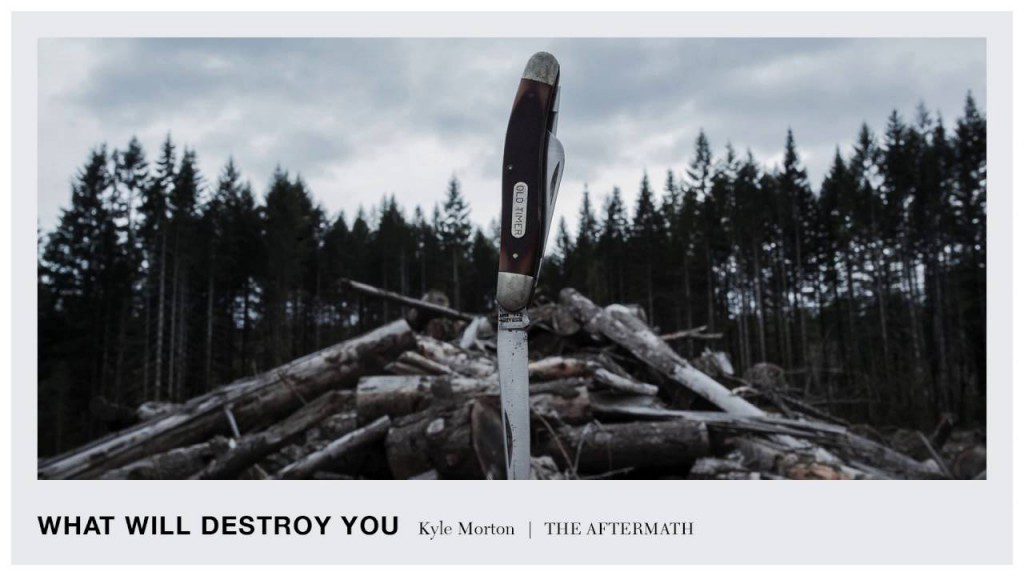
Because we don’t want to hear it, Kyle Morton’s first solo album will probably have little commercial success. His new album is called What Will Destroy You. The penultimate song is titled “What Will Save You.” He tracks, quite unabashedly, a journey from a destructive love to a salvific love. The work, then, is a backwards take on a pulp mystery — it starts with a destroyed man and ends with a saved one, and we, detectives all, look diligently, not for the poison, but the cure.
The love that destroys is all too familiar. Kyle gives us it in several doses. It is the love that does not stay:
Then the morning takes
The love away
Leaving only ashtrays
and broken bottles
It is a love that bears no fruit:
The truth settled down like a euthanized pet
It’s over there’s no need to repopulate
It is a love that can only ever actualize itself as a performance; a love that finds the beloved insufficient except insofar as she serves to make the lover appear as powerful and acceptable in the eyes of the world:
Now I’m the last man standing
you are woman’s paragon
The garden’s ours now we’re competitionless
But suppose a third party’s necessary
Just to get it on
That the rituals of love demand an audience
I went I found some mannequins
Set ’em up lining the bedroom
The safe words: eyes to God
It is the love that accepts substitutes, repetitions, imitations and replacements:
Now you are carving their names into your mattress
In an imitation of some obscure actress
And I don’t know why you keep me around
But I’m easy
Target practice
Right from the start, What Will Destroy You denies the basic premise of post-modernity — that love unequivocally justifies our lives. Here, love is not some secret garden kept unpolluted of humanity’s evils: “You changed out of me / As one would change to a new pair of shoes / And I see the fashions changing with the seasons / And no, love is not immune.” Small wonder, then, that Kyle sings:
I never learned to trust a love song
It was not because the words were trite
But I felt the love itself was trite
(What a radical critique! Where, in what space, and to what audience are politically-sensitive, modern humans allowed to call, not expression, but love itself trite? Can you imagine saying it to a friend? “The problem, Jim, is not that your words are trite, or that you are failing to properly express the some pure love you have in your heart, but that your love itself is trite. It’s grotesque. It’s attracted to nothing lasting. It’s beneath you and your beloved.” It occurs to me now, as it occurs to me listening to Kyle’s writing with Typhoon, that the indie-rock album may be the last place in which a genuine critique of self-experience is possible, in which we can genuinely question our own innermost heart and the purportedly innermost heart of our neighbors.)
The turn to an erotic love that does not destroy, but saves, is hard to pinpoint. For Kyle, good love appears as something like grace. It is not expected. It is not conceptualized. It does not come as an idea, but as a person who loves Kyle well*.* To understand this, the one who has the good fortune to be loved well need only ask: Could you have planned it? Did you know it would be her? The “breaking in” of good love can be comic. The song “Water Torture” describes the advent of a love that bears fruit as the afterthought of an obliterated mind:
Got that cataclysmic feeling
Babies crawling on the ceiling
And now I think
Maybe we should start a family
Love is either freely given or it is not love, and if it is freely given then it cannot be expected — we can only hope that it will break in upon our dim horizons. The person does not fit with what we know of love, but teaches us what we did not know, such that we can say: “I thought I knew what love was until I met you.” With this grace-like characteristic of good love in mind, it is no surprise that Kyle colors it as something divine. In “My Little Darlin’ Knows My Nature,” he sings:
Who could blame you being cynical
You’re right the world it is a crypt
It’s pitiless and cold
And though I remain skeptical
That you still love me
May be the only miracle
For those who have been following Kyle’s poetry with Typhoon for a while now, this album implies a further development of a basically Kierkegaardian adventure. Soren Kierkegaard paints life in a triptych — there is the aesthetic, the ethical and the religious life. The aesthetic life is the life lived according to what pleases. In Typhoon’s first album, Hunger and Thirst, we get to hear Kyle bear-wrestling with the inadequacy of this life, which, however pleasant, is haunted by death: “you take every year as it comes / but when your life is over / all those years fold up like an accordion.” The ethical life is characterized by the leap away from what one likes to do towards what one ought to do. It is characterized by the promise — the vow. White Lighter, Typhoon’s second is full of this radical commitment to the ethical, his answer to the problem of death is: “I will be good though my body be broken,” reminiscent of the last lines of Singrid Undset’s epic trilogy, Kristin Lavransdatter: “the good you have done cannot be undone; though all the hills should crash in ruin, yet it would stand.” White Lighter ends in a longing for an ultimate vow in the face of death: “I would never leave you broken-hearted / You’ll never be alone nor made to feel discarded / As long as I’m alive I’ll finish what I started.” The last lines of What Will Destroy You take this desire and actualize it — “I will be your witness if you’ll be wife.” Or rather, Kyle and his newly wedded actualized it — my warmest, most bubbling congratulations to them both.
Is this a leap into the religious sphere? We are given a certain amount of leeway to assume that marriage, for Kyle, is more than a merely ethical commitment. “My Little Darlin'” makes it clear: Marriage is a response to a warmth that challenges his skepticism. Love that is good pushes him to the edge of the ethical and has him consider the miraculous. In What Will Destroy You it is love, and not merely “being good,” that provides a satisfactory answer to the problem of death. The album begins with Kyle “inside a coffin.” He pops out with the hope that “eventually you’ll be reborn.” This hope is satisfied that hope in a life-affirming marriage directly opposed to death: “I used to want a fancy funeral / But now I’m just a sucker for your love.” As with most religiously-contorted indie-rock, the question the simpleton believer can’t help but pose, swimming in the midst of hints and indications, is — “but do you really believe it? Can love bring you resurrection? If so, how?” Kyle sang, in White Lighter, a line that should be tattooed to the modern consciousness: “You are sleeping together but you will die alone.” Does marriage overcome this tragedy? Or is it all destroyed in the end?
A few years ago, I asked Kyle about the religious sphere. He said:
I had a very secular upbringing (not atheist, but sort of this wishy-washy agnosticism — you know, “spiritual not religious”) where my only exposure to Christianity was what I saw on TV and an occasional born-again, evangelical-style church camping trip with schoolmates, which is to say, I was only exposed to a very reductionist, reactionary form of Christianity. Years later–while studying literature and philosophy in college and finding in my love-life the limits of modern romance–I had this unsettling realization that the modern world, far from succeeding in the project of moving “beyond religion,” had actually regressed to a twisted form of more primitive religions; idol worship, sacrifice, etc.
About this time, I went with a friend to live for a month at an Benedictine monastery in Michigan, St. Gregory’s Abbey. It seemed at the time like a whim, but looking back I think my subconscious intellect was rightly conspiring against my old prejudices. There I met a community of some of the most intelligent and brave men I have ever met and was introduced to Soren K. This all had an enormous impact on my ideas about God, Eternity and my relation to both.
Kyle’s new album mirrors in verse what he already described as formative part of his spiritual life: By transgressing the limits of modern love, he is forced into a strange contact with the religious sphere. What Will Destroy You pushes the limits of the ethical and describes good, erotic love as a window into the divine. Whether there really is a divine landscape outside of the window of human love answer is not provided. But thank God, or simply thank Kyle, that someone is posing the question — critiquing a stale, stationary, and self-justified love with a first-person experience of miraculous, or near-miraculous love that makes dead men and women “witnesses” and “wives.”
Previous Post

October 15, 2016
Christian Voting in a Time Near the Apocalypse
Next Post
December 28, 2016 How to Ethnically Spice Your Bland Ideology
Browse Our Archives
Select a Category Another Look Atheism Bad Catholics Beauty Communio Crookedhart Destupidification Exiting the Culture Wars Gender Theory That Doesn't Suck How To Language Liturgy! Love One Another Marriage Equality Modesty Music Objectification pop culture Poverty Sacraments Sex Technology The Best Religion in the World The Erotic Phenomenon Time Uncategorized Virtue Ethics That Don't Suck Winning the Culture Wars
Select a Month January 2017 December 2016 November 2016 October 2016 July 2016 June 2016 April 2016 March 2016 February 2016 January 2016 December 2015 November 2015 October 2015 September 2015 August 2015 July 2015 June 2015 May 2015 March 2015 February 2015 January 2015 June 2014 May 2014 April 2014 March 2014 February 2014 January 2014 December 2013 November 2013 October 2013 September 2013 August 2013 July 2013 June 2013 May 2013 April 2013 March 2013 February 2013 January 2013 December 2012 November 2012 October 2012 September 2012 August 2012 July 2012 June 2012 May 2012 April 2012 March 2012 February 2012 January 2012 December 2011 November 2011 October 2011 September 2011 August 2011 July 2011 June 2011 May 2011 April 2011 March 2011 February 2011 January 2011 December 2010 November 2010 October 2010 September 2010 August 2010
Follow Us!
TAKE THE
Religious Wisdom Quiz
Who was the mother of John the Baptist?
Select your answer to see how you score.
Hannah Elizabeth Mary Deborah
Related posts from Bad Catholic

Onward, Affectionate Scientist!

Who Said It About Sexuality, Slavoj Žižek or...

Cocaine/Communion: The Holy Contradictions of David Ramirez
TRENDING AT PATHEOS Catholic

Rejecting Doom: Christian Hope And Human Action
Christianity is a religion of hope. We are to have hope and...

It’s What Comes From Within Which Matters
One of the most difficult things for us to understand is why...

Why I Choose the Eucharist Over the Sermon
Choose the Eucharist, Not the Sermon What are we supposed to get...

5 Design Elements Found in Spiritually Rooted Homes
Putting Spirituality Into Home Decor Our homes are more than our living...

Credo: A Story of God Told with the...
About 10 years ago, I began to imagine a personal "Credo" that...

The Anatomy of Divine Revelation in Catholic Thought
The claim that God has made Himself known to human beings is...
view all Catholic blogs
Ad-Free & Subscriber Log-In Subscription Support
- About Us
- 2026 Calendar
- Videos
- Podcasts
- Library of World Religions
- Faith In Media Tracker
- Advertise With Us
- Write for Us
- Privacy Policy
- Terms of Service
- Do Not Sell My Data
- Contact Us
- Radiant Digital
- Manage Newsletter Subscriptions
- Unsubscribe From Notifications
- Sitemap
Copyright 2008-2026, Patheos. All rights reserved.
Subscription Support Ad-Free & Subscriber Log-In
Follow Patheos