
BuddhistCatholicContemplativeEvangelicalGeneral ChristianHinduJewishLatter-day SaintMuslimNew VisionsProgressive Christian
Beliefs
- Buddhist
- Catholic
- Contemplative
- Evangelical
- General Christian
- Hindu
- Jewish
- Latter-day Saint
- More Voices
- Muslim
- New Visions
- Pagan
- Progressive Christian
Topics
- Religion News
- Food and Religion
- Sports and Religion
- Religious Art
- Religious Music and Entertainment
- Religious Events
- History and Religion
- Style and Religion
- Politics and Religion
- Women in Religion
- Recreation Outdoors and Religion
- Business Finance and Religion
- Careers Workplace and Religion
- Education and Religion
- Family Parenting and Religion
- Health Fitness and Religion
- Home and Religion
- Relationships and Religion
- Technology and Religion
- Travel and Religion
Columnists
- Buddhist Columnists
- Business Finance and Religion Columnists
- Careers Workplace and Religion Columnists
- Catholic Columnists
- Contemplative Columnists
- Education and Religion Columnists
- Evangelists Columnists
- Family Parenting and Religion Columnists
- General Christian Columnists
- Health Fitness and Religion Columnists
- Hindu Columnists
- History and Religion Columnists
- Home and Religion Columnists
- Jewish Columnists
- More Voices Columnists
- Latter Day Columnists
- Muslim Columnists
- New Visions Columnists
- Nonreligious Columnists
- Pagan Columnists
- Politics and Religion Columnists
- Progressive Columnists
- Recreation Outdoors and Religion Columnists
- Relationships and Religion Columnists
- Religion News Columnists
- Religious Art Columnists
- Religious Events Columnists
- Religious Music and Entertainment Columnists
- Sports and Religion Columnists
- Style and Religion Columnists
- Technology and Religion Columnists
- Travel and Religion Columnists
- Women in Religion Columnists
Resource Library
- 2026 Calendar
- Library of World Religions
- The 100 Most Holy Places on Earth
- Patheos Answers
- Podcasts
- Videos
- Faith Leaders Database
- Anglican Episcopalian
- Bahai
- Baptist
- Buddhism
- Christianity
- Confucianism
- Eastern Orthodoxy
- Hinduism
- Holiness and Pentecostal
- ISKCON
- Islam
- Judaism
- Lutheran
- Methodist
- The Church of Jesus Christ of Latter-day Saints
- New Age
- Paganism
- Presbytarian and Reformed
- Protestantism
- Religion Behind the Scenes
- Roman Catholic
- Scientology
- Shia Islam
- Sikhism
- Sufism
- Sunni Islam
- Taoism
- Zen
- See all religions
Research Tools
 Ad-Free & Subscriber Log-In Subscription Support
Ad-Free & Subscriber Log-In Subscription Support
Follow Patheos 

- Trending:
- Forgiveness
- |
- Marriage
- |
- Consciousness
- |
- Death Penalty
- |
- Election
- |
- Halloween
 Bad Catholic
- Home
- Catholic
- The Radical Reverse Engineering of Pope Francis
The Radical Reverse Engineering of Pope Francis
Last updated on: April 11, 2016 at 6:05 pm by Marc
The Radical Reverse Engineering of Pope Francis 2016-04-11T18:05:31-04:00 Marc
Patheos Explore the world's faith through different perspectives on religion and spirituality! Patheos has the views of the prevalent religions and spiritualities of the world.
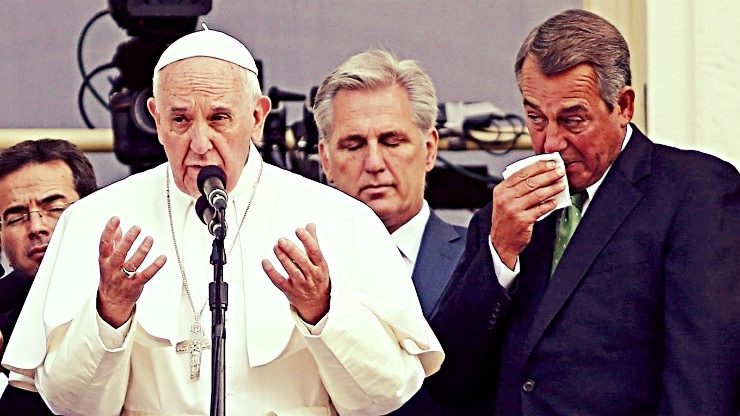
Public Domain
“Foolery, sir, does walk about the orb like the sun. It shines everywhere.”
Pope Francis writes too damn much. It really doesn’t matter how much pastoral wisdom and warmth one emanates, a 300-page document will only be read by those who have a career-interest in reading 300 pages — bloggers, ideologues, headline-hawkers and conspiracy theorists. Given that, for these careerists, What Anyone Says About Same-Sex Attraction will sell more effectively than What Anyone Says About the Divine Image Present in the Family, Amoris Laetitia is a recipe for reduction. (I, for instance, could write one of two posts: “Francis Changes Church Position on Sex, Gays, Divorce” or “Francis Appropriates John-Paul, Benedict in Creative Re-telling of Church Teaching.” Let’s not play about which one will make me money.)
And so Amoris Laetitia has been reduced. James Carroll, a writer God loves with an infinite passion, misreads the exhortation like he’s being paid for it. His work, The New Morality of Pope Francis, is so glutted with ambiguous nuggets of would-be-wisdom (“everybody in the Church knew that ‘Humanae Vitae’ was a moral teaching with no center”) it may as well have come from an ex-priest essay-generator. He takes the stance that, because of Frank’s change in “tone” and his emphasis on “individual cases” rather than “general rules,” the Church (who will not change her doctrines) will return to the moral underground of the 70’s. We will “quietly defy Vatican dogma when the situation [seems] to call for it” tacitly agreeing that “this nearly universal choice to disobey the Church not be spoken of.”
The Pope is framed as the guy who wants a new morality, but can’t change Church doctrines. Thus, impotent to be the American-style liberal that Carroll and the bulk of the Press slaver for, the New Pope encourages everyone to “figure it out for themselves.” The goal of “new” moral norms is achieved by a collective “meh” towards old ideals. The Catholic in the modern age is a man gently haunted but ultimately unconcerned with a 2000-year tradition of moral teaching, knowing that he can always engage in some minor-league casuistry with an almost-dead confessor and, walking out of his fading, suburban church, feel relieved by the new words of absolution: “Morality is complicated. The rules may not apply.”
There is a grotesque pessimism at the heart of these hopeful interpretations. Scratch the effort to ennoble man with grand democratisms like “moral discernment belongs to the people” and you’ll find a quiet despair that holds the human person incapable of genuine moral vision — of recognizing truth when it is proclaimed. For Carroll, this impotence to be inspired by a clear-sighted vision of an ideal is a step in the right direction: “The doctrine of the indissolubility of marriage, however much it is still held up as an ideal, will not grip the moral imagination of the Church as it once did.” That is to say, we will get what we want (divorce without consequence) not through any positive change in doctrine, but through the de-emphasis and dissolution of guiding ideals and values.
This, I would argue, is not the method of Pope Francis. His aim is not to dim the ideals of the Church, but to accentuate them in an age that abhors them with all the seedy bitterness of post-Christianity. Carroll may laud “Pope Francis’s emphasis on mercy toward the divorced and remarried” as detracting from the ideal of indissolubility, but the gaze of mercy either presupposes the actual failure of the recipient of mercy, or else it is no mercy at all. This is missed by a culture that conflates mercy with allowance and forgiveness with acceptance: An increase in mercy is an accentuation and not a cloaking of moral ideals. Mercy is a negative proof of moral guilt. We recognize our guilt more fully in the gaze that forgives us than the gaze that condemns us and has rush to make excuses. (To anyone who thinks an emphasis on mercy is a turn away from our encounter with objective moral values and the subsequent demands they place on the human heart, I can only recommend Crime & Punishment by Fyodor Dostoevsky — that or a more careful reading of Francis.)
When he first splashed into the pool of our ideological self-indulgence, Francis argued that the Church needed to check its undue attention towards abortion, homosexuality, and other pelvic issues — a window-opening declaration, by all accounts. This was predictably lauded as a step towards the New Morality — that is, a blurring of moral demands that will allow for exceptions without actual doctrinal change. But no one read what he said:
Proclamation in a missionary style focuses on the essentials, on the necessary things: this is also what fascinates and attracts more, what makes the heart burn, as it did for the disciples at Emmaus. We have to find a new balance; otherwise even the moral edifice of the church is likely to fall like a house of cards, losing the freshness and fragrance of the Gospel. The proposal of the Gospel must be more simple, profound, radiant. It is from this proposition that the moral consequences then flow.
Rather than begin with moral consequences, Francis realistically assumes that we have lost the groundwork for understanding why the Church makes the moral demands that she does. He is a reverse engineer, advocating a discovery of moral consequences by way of a return to an original encounter with that goodness from which all moral demands flow. He is not indulging a shamefaced shuffling of awkward doctrines — as if his papacy amounted to a desperate search for an out-of-the-way cupboard in which to hide Humanae Vitae, Casti Connubii and all the rest. (The Joy of Love quotes Humanae Vitae more than most documents.) No, Francis is concerned with making “the heart burn” again. He is educating a gaze which has become dim, fearful, and blind to the values expressed by the Church; stony-hearted and suspicious of her ideals; immensely hurt by a culture of sexual violence that renders all this “joy” stuff ridiculous. Francis is not dismissing Church teaching. He is exhorting us to live the kind of life that can comprehend it. He is spitting in the dirt and making a paste that will open the eyes of a squinting people — a pedagogical paste of practical activity.
Praxis as Education
Francis, our Chief Reverse Engineer, does not expect our culture to intuitively grasp the value of indissolubility, unity, mutual service, or procreation in their own right. It was an optimism, and not some dark moralism, that had John Paul II boldly lay out the sexual ethics of the Catholic Church in the hope that her people would perceive and respond in accordance with their content. It is a certain pessimism, or better yet, a Jesuit-style caution that stays Francis’ hand.
Francis does not explain as much as he exhorts the kind of life that enables the eyes to perceive and the heart to respond to the teachings of the Church. Disappointed schismatics, happy-go-lucky liberals, and vague people who delight in vague things like “a place at the table” are just as disappointed with this method as hard-line, Conservative Catholics. Like middle-schoolers who heard there was a sex scene in their reading assignment, we all skipped to the exciting bits about divorce and homosexuality, where we either bemoan that they represent no change in doctrine or bemoan that they do not impress the Church’s doctrine with enough oomph and vigor. Both moans express the following: The real message is buried in fluff. For the denizen of Basic American Morality, this amounts to the (assumedly pleasant) feeling of investigative journalism: “You think he’s all about loving others, but look, hidden away in paragraph 343, he denounces gay marriage! Follow the money! Expose the lies!” For the Very Concerned Conservative Catholic, this amounts to the (equally pleasant) feeling of the man who knows what’s really important: “What the world needs is clear instruction, but look, hidden away in paragraph 343, shamefully snuck in a muck-pile about eating dinner as a family — he finally denounces gay marriage.”
What no one is considering is that the perception of value requires a heart of flesh — an openness to the realm of values. This is achieved, not simply by an intellectual workout — as if anyone has ever changed their life on the basis of the logical realization that a utilitarian ethic is “bad for society” — but by a life which regularly encounters these values through upright actions. How can we perceive the child as a gift, and respond to this value by rejecting the logic of surrogacy and IVF that would commodify the gift, if our daily education in the parent-child relationship involves bitter family feuding, resentment over each other’s imperfections, and an individualism that sees the family as springboard for self-fulfillment? How can we affirm that the family is the original cell of society, a domestic Church, if “in many cases, parents come home exhausted, not wanting to talk…many families no longer share a common meal [and] distractions abound, including an addiction to television”? How can we see that, as the Pope quotes, “God hates divorce,” if we do not have the simple virtue of friendship with our spouses, a groundwork of praxis in which we realize “the other person is much more than the sum of the little things that annoy me”?
These bits of pastoral advice may be dismissed as fluff, but they seem to me like method. Amoris Laetitia leaves no evil in our laundry-list of sexual fashions free from criticism. But Francis’ primary purpose is to exhort the kind of life that frees us to encounter these truths — to grow hearts capable of perceiving and responding to the values the Church holds up. He is a chemist where previous Pope’s have acted as philosophers — he begins with the parts that we might see the whole.
This, I’ll admit, annoys me. I am looking for arguments to silence doubts, zingers to silence naysayers, and what I get from my Pope is the practical advice to “take time, quality time,” to avoid suspicion and envy, to apologize and make peace with my family at the end of every day. But even as I steep in my own vices, I know that a virtuous life enables me to perceive and participate in the values and truths revealed to the Church while a continuous praxis of incontinence obscures my vision. Francis’ advice to sinners like me seems to be this: Live well, and the proper horizons of understanding will follow.
Previous Post

April 11, 2016
The Joy of Love
Next Post
April 20, 2016 Against Suspicion
Browse Our Archives
Select a Category Another Look Atheism Bad Catholics Beauty Communio Crookedhart Destupidification Exiting the Culture Wars Gender Theory That Doesn't Suck How To Language Liturgy! Love One Another Marriage Equality Modesty Music Objectification pop culture Poverty Sacraments Sex Technology The Best Religion in the World The Erotic Phenomenon Time Uncategorized Virtue Ethics That Don't Suck Winning the Culture Wars
Select a Month January 2017 December 2016 November 2016 October 2016 July 2016 June 2016 April 2016 March 2016 February 2016 January 2016 December 2015 November 2015 October 2015 September 2015 August 2015 July 2015 June 2015 May 2015 March 2015 February 2015 January 2015 June 2014 May 2014 April 2014 March 2014 February 2014 January 2014 December 2013 November 2013 October 2013 September 2013 August 2013 July 2013 June 2013 May 2013 April 2013 March 2013 February 2013 January 2013 December 2012 November 2012 October 2012 September 2012 August 2012 July 2012 June 2012 May 2012 April 2012 March 2012 February 2012 January 2012 December 2011 November 2011 October 2011 September 2011 August 2011 July 2011 June 2011 May 2011 April 2011 March 2011 February 2011 January 2011 December 2010 November 2010 October 2010 September 2010 August 2010
Follow Us!
TAKE THE
Religious Wisdom Quiz
Which Christian denomination is led by the Pope?
Select your answer to see how you score.
Protestant Anglican Orthodox Catholic
Related posts from Bad Catholic

Towards a New Argument Against Pornography


Why Millennials Want to Change the World

The Communist That Lives With Me Responds: "Your...
TRENDING AT PATHEOS Catholic

The Parable Of The Sower And The Word...
One of Christ’s most famous parables is that of the sower who...

Rejecting Doom: Christian Hope And Human Action
Christianity is a religion of hope. We are to have hope and...

Why I Choose the Eucharist Over the Sermon
Choose the Eucharist, Not the Sermon What are we supposed to get...

5 Design Elements Found in Spiritually Rooted Homes
Putting Spirituality Into Home Decor Our homes are more than our living...

Credo: A Story of God Told with the...
About 10 years ago, I began to imagine a personal "Credo" that...

The Anatomy of Divine Revelation in Catholic Thought
The claim that God has made Himself known to human beings is...
view all Catholic blogs
Ad-Free & Subscriber Log-In Subscription Support
- About Us
- 2026 Calendar
- Videos
- Podcasts
- Library of World Religions
- Faith In Media Tracker
- Advertise With Us
- Write for Us
- Privacy Policy
- Terms of Service
- Do Not Sell My Data
- Contact Us
- Radiant Digital
- Manage Newsletter Subscriptions
- Unsubscribe From Notifications
- Sitemap
Copyright 2008-2026, Patheos. All rights reserved.
Subscription Support Ad-Free & Subscriber Log-In
Follow Patheos