
BuddhistCatholicContemplativeEvangelicalGeneral ChristianHinduJewishLatter-day SaintMuslimNew VisionsProgressive Christian
Beliefs
- Buddhist
- Catholic
- Contemplative
- Evangelical
- General Christian
- Hindu
- Jewish
- Latter-day Saint
- More Voices
- Muslim
- New Visions
- Pagan
- Progressive Christian
Topics
- Religion News
- Food and Religion
- Sports and Religion
- Religious Art
- Religious Music and Entertainment
- Religious Events
- History and Religion
- Style and Religion
- Politics and Religion
- Women in Religion
- Recreation Outdoors and Religion
- Business Finance and Religion
- Careers Workplace and Religion
- Education and Religion
- Family Parenting and Religion
- Health Fitness and Religion
- Home and Religion
- Relationships and Religion
- Technology and Religion
- Travel and Religion
Columnists
- Buddhist Columnists
- Business Finance and Religion Columnists
- Careers Workplace and Religion Columnists
- Catholic Columnists
- Contemplative Columnists
- Education and Religion Columnists
- Evangelists Columnists
- Family Parenting and Religion Columnists
- General Christian Columnists
- Health Fitness and Religion Columnists
- Hindu Columnists
- History and Religion Columnists
- Home and Religion Columnists
- Jewish Columnists
- More Voices Columnists
- Latter Day Columnists
- Muslim Columnists
- New Visions Columnists
- Nonreligious Columnists
- Pagan Columnists
- Politics and Religion Columnists
- Progressive Columnists
- Recreation Outdoors and Religion Columnists
- Relationships and Religion Columnists
- Religion News Columnists
- Religious Art Columnists
- Religious Events Columnists
- Religious Music and Entertainment Columnists
- Sports and Religion Columnists
- Style and Religion Columnists
- Technology and Religion Columnists
- Travel and Religion Columnists
- Women in Religion Columnists
Resource Library
- 2026 Calendar
- Library of World Religions
- The 100 Most Holy Places on Earth
- Patheos Answers
- Podcasts
- Videos
- Faith Leaders Database
- Anglican Episcopalian
- Bahai
- Baptist
- Buddhism
- Christianity
- Confucianism
- Eastern Orthodoxy
- Hinduism
- Holiness and Pentecostal
- ISKCON
- Islam
- Judaism
- Lutheran
- Methodist
- The Church of Jesus Christ of Latter-day Saints
- New Age
- Paganism
- Presbytarian and Reformed
- Protestantism
- Religion Behind the Scenes
- Roman Catholic
- Scientology
- Shia Islam
- Sikhism
- Sufism
- Sunni Islam
- Taoism
- Zen
- See all religions
Research Tools
 Ad-Free & Subscriber Log-In Subscription Support
Ad-Free & Subscriber Log-In Subscription Support
Follow Patheos 

- Trending:
- Forgiveness
- |
- Marriage
- |
- Consciousness
- |
- Death Penalty
- |
- Election
- |
- Halloween
 Bad Catholic
- Home
- Catholic
- That Good Ol’, Life-Affirming, Self-Inflicted Violence
That Good Ol’, Life-Affirming, Self-Inflicted Violence
Last updated on: February 16, 2016 at 3:16 pm by Marc
That Good Ol’, Life-Affirming, Self-Inflicted Violence 2016-02-16T15:16:07-05:00 Marc
Patheos Explore the world's faith through different perspectives on religion and spirituality! Patheos has the views of the prevalent religions and spiritualities of the world.
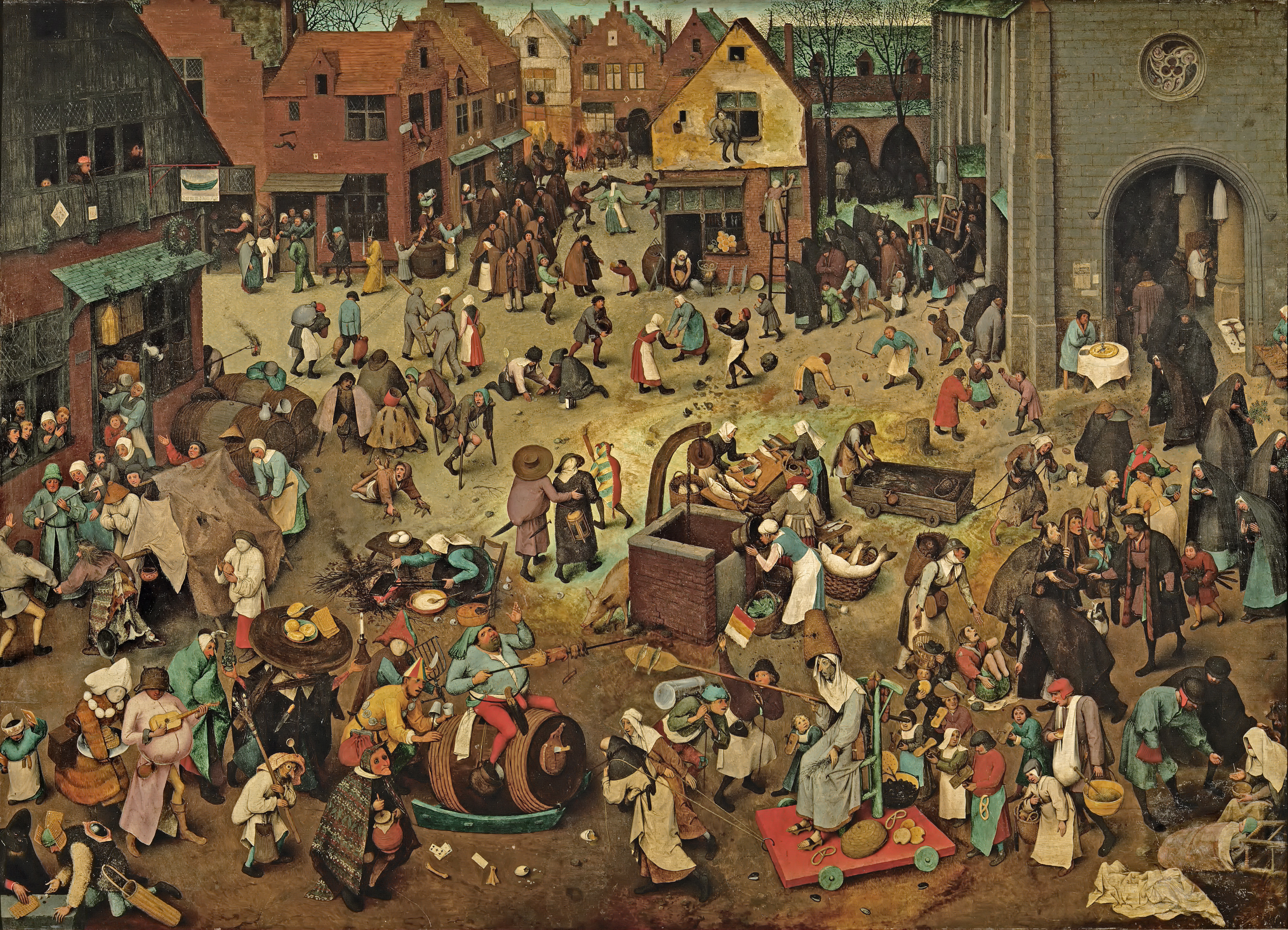
The Fight Between Carnival and Lent by Pieter Bruegel. CC Wikimedia.
I’ve found that, for all the glories of the Church, there are two which almost universally inspire envy in those outside of her folds: The Sacrament of Penance and the season of Lent. Speak on the life-changing effects of contemplation — you may get some interest from the Zen kid at the back. Pontificate on the papacy — you’ll be lucky to piss off a Presbyterian. But tell someone you’re going to confess your sins to a priest, or that, for the next forty days, you’re giving up coffee — voila, you’ve got interest.
It’s not hard to see why this is the case: When the ethical status quo is the timid mandate to “enjoy yourself without hurting others” Lent’s demand that you “deny yourself” takes on all the fascination of a forbidden fruit — a veritable of brothel of austerity and a compelling temptation towards virtue. In a world in which the ethical act par excellence is to “accept yourself” the ethics of Lent are have all the grand romanticism of a sin. She says, mocking the age: Do not accept yourself. There is, after all, something quite wrong with your self. She explodes the entire artifice of self-acceptance and self-love and musters up from some dark, medieval unconscious — the Anti-self. It demands from a pacifist people an incomparable inner violence, a civil war — a rebellion of self against self within the unity of a single person.
If it sounds gloomy, try telling any post-Christian denizen at any Bed, Bath and Beyond that you are giving up your mattress and taking the floor for the penitential season — stripping the rotten layers of comfort that have accumulated around your now-pasty, now-sensitive flesh. You’ll catch a gleam of longing in back of their retina. We are culturally deprived of any opportunities for mortification. We yearn for it as one yearns for plain bread after a week of sweets or as a man marinating in the warmth of his bed longs for cold air and consuming work. This convincing call to smash ourselves into pieces is present in every man who, stuffed with comfort, living pleasantly in a pleasant housing complex, begins to read books on Arctic explorations; begins to hate waking up; begins to emphasize with Walker Percy’s protagonists:
There at any rate stands Will Barret on the edge of a gorge in Old Carolina, a talented agreeable wealthy man living in as pleasant an environment as one can imagine and yet who is thinking of putting a bullet in his brain.
Asceticism — the voluntary taking on of pain, want, and suffering — is a natural breath of the human spirit, and the ban on asceticism is a deliberate reduction of life. Lest this devolve into some kind of sermon on chest-thumping manly-manliness, let me be quite clear: I am a limp and comfort-ridden invertebrate drifting to whatever warmth or pleasure tickles my consciousness. I have all the firmness and willpower of dropped ice-cream. I fear pain. But consider:
1. Suffering, want, and death are certainties of human existence. To live a life that actively avoids pain, suffering and want is only to make ourselves less and less capable of dealing with it when it comes — for indeed, the Iceman cometh. Far better to begin, even now, an active training in the inevitable vocation of the human race than to gradually neuter our capacity for the heroism that catastrophe and death will most certainly demand of us.
2. Suffering, want, and death, even when we are momentarily cushioned against them, are occurring, as we speak, to our neighbors. This may only concern those who blush to find themselves fed while others starve and warm while others freeze, but have it anyways: The insulated avoidance of suffering removes us from any kind of genuine solidarity with humanity, which, as a family, suffers, moans, labors and dies.
3. Deliberately comfortable people cannot affirm that God loves them, nor that life is worth living, nor that the universe is good. They are too busy avoiding large swaths of the universe, medicating the miserable parts of life, and thanking God only insofar as “What happens to those other people doesn’t happen to me.” William James has this to say about that:
Let a man who, by fortunate health and circumstances, escapes the suffering of any great amount of evil in his own person, also close his eyes to it as it exists in the wider universe outside of his private experience, and he will be quit of it altogether. But…it is but for the individual; and leaves the evil outside of him, unredeemed and unprovided for by his philosophy…It accepts, in lieu of a real deliverance, what is a lucky personal accident merely, a cranny to escape by. It leaves the general world unhelped…The real deliverance…must be of universal application.
If one has ever taken the fact of the prevalence of tragic death in this world’s history fairly into his mind–freezing, drowning, entombment alive, wild beasts, worst men, and hideous diseases–he can with difficulty, it seems to me, continue his own career of world prosperity without suspecting that he may all the while not really be inside the game, that he may lack the great initiation.
Well, this is exactly what asceticism thinks; and it voluntarily takes the initiation.
Like children around a chilly pool, we simultaneously long for and fear the great initiation into the totality of life. On the one hand, we see the goodness of self-inflicted suffering. Tell us that Christian Bale starved himself in order to lose enough weight to play the emaciated protagonist of The Machinist, or that Leonardo diCaprio choked down a raw liver for The Revenant, and we’ll go into IMDB-ecstasies — the sacrifices men make for Art! Tell us the excruciating workout routine of a professional athlete, and we’ll be similarly struck — what dedication to the Sport! But, tell us that Pope St. John Paul II whipped himself with a belt and, yup, there it is — a nice strong waft of moral disapproval. Self-inflicted suffering for Art — idyllic. Self-inflicted suffering for sport — Noble. Self-inflicted suffering for God, solidarity, and human flourishing — medieval, self-hating and vaguely pornographic.
But I wonder whether our modern, da-Vinci-Code inspired and titillated horror over fasts, ashes, deprivations, hair-shirts and flagellums is really an honest, healthy rejection of self-mutilation, as much as it is a reaction of a generation incapable of affirming the whole of life. For me, at least, it is the latter. I do not have a particular balanced view of the goodness of the body, or vivacious sense of “the good life” that the austerity of a St. Francis or the mortifications of the Desert Fathers threaten. The asceticism of the Saints horrifies me because the Saints are capable of giving their life-affirming “yes” even to suffering, saying: This too is good. This too comes from the open hand of the Father. This too should be sought for the sake of human flourishing. The Saints can declare the entire universe and the total humanity good and worthy of participation, while I am left affirming the life insofar as it doesn’t get too rough, giving my “yes” to a portion of existence wedged between the smothering constraints of comfort, happily absenting myself from the total humanity who groans on the outskirts.
Previous Post

February 11, 2016
Lent in the Age of the Smartphone
Next Post
February 16, 2016 A Brief Aside On the Broadness of the Heart That Fears Hell
Browse Our Archives
Select a Category Another Look Atheism Bad Catholics Beauty Communio Crookedhart Destupidification Exiting the Culture Wars Gender Theory That Doesn't Suck How To Language Liturgy! Love One Another Marriage Equality Modesty Music Objectification pop culture Poverty Sacraments Sex Technology The Best Religion in the World The Erotic Phenomenon Time Uncategorized Virtue Ethics That Don't Suck Winning the Culture Wars
Select a Month January 2017 December 2016 November 2016 October 2016 July 2016 June 2016 April 2016 March 2016 February 2016 January 2016 December 2015 November 2015 October 2015 September 2015 August 2015 July 2015 June 2015 May 2015 March 2015 February 2015 January 2015 June 2014 May 2014 April 2014 March 2014 February 2014 January 2014 December 2013 November 2013 October 2013 September 2013 August 2013 July 2013 June 2013 May 2013 April 2013 March 2013 February 2013 January 2013 December 2012 November 2012 October 2012 September 2012 August 2012 July 2012 June 2012 May 2012 April 2012 March 2012 February 2012 January 2012 December 2011 November 2011 October 2011 September 2011 August 2011 July 2011 June 2011 May 2011 April 2011 March 2011 February 2011 January 2011 December 2010 November 2010 October 2010 September 2010 August 2010
Follow Us!
TAKE THE
Religious Wisdom Quiz
What color is traditionally worn by priests during the season of Advent?
Select your answer to see how you score.
Red White Green Purple
Related posts from Bad Catholic

Towards a New Argument Against Pornography


Why Millennials Want to Change the World

The Communist That Lives With Me Responds: "Your...
TRENDING AT PATHEOS Catholic

Rejecting Doom: Christian Hope And Human Action
Christianity is a religion of hope. We are to have hope and...

It’s What Comes From Within Which Matters
One of the most difficult things for us to understand is why...

Why I Choose the Eucharist Over the Sermon
Choose the Eucharist, Not the Sermon What are we supposed to get...

5 Design Elements Found in Spiritually Rooted Homes
Putting Spirituality Into Home Decor Our homes are more than our living...

Credo: A Story of God Told with the...
About 10 years ago, I began to imagine a personal "Credo" that...

The Anatomy of Divine Revelation in Catholic Thought
The claim that God has made Himself known to human beings is...
view all Catholic blogs
Ad-Free & Subscriber Log-In Subscription Support
- About Us
- 2026 Calendar
- Videos
- Podcasts
- Library of World Religions
- Faith In Media Tracker
- Advertise With Us
- Write for Us
- Privacy Policy
- Terms of Service
- Do Not Sell My Data
- Contact Us
- Radiant Digital
- Manage Newsletter Subscriptions
- Unsubscribe From Notifications
- Sitemap
Copyright 2008-2026, Patheos. All rights reserved.
Subscription Support Ad-Free & Subscriber Log-In
Follow Patheos