
BuddhistCatholicContemplativeEvangelicalGeneral ChristianHinduJewishLatter-day SaintMuslimNew VisionsProgressive Christian
Beliefs
- Buddhist
- Catholic
- Contemplative
- Evangelical
- General Christian
- Hindu
- Jewish
- Latter-day Saint
- More Voices
- Muslim
- New Visions
- Pagan
- Progressive Christian
Topics
- Religion News
- Food and Religion
- Sports and Religion
- Religious Art
- Religious Music and Entertainment
- Religious Events
- History and Religion
- Style and Religion
- Politics and Religion
- Women in Religion
- Recreation Outdoors and Religion
- Business Finance and Religion
- Careers Workplace and Religion
- Education and Religion
- Family Parenting and Religion
- Health Fitness and Religion
- Home and Religion
- Relationships and Religion
- Technology and Religion
- Travel and Religion
Columnists
- Buddhist Columnists
- Business Finance and Religion Columnists
- Careers Workplace and Religion Columnists
- Catholic Columnists
- Contemplative Columnists
- Education and Religion Columnists
- Evangelists Columnists
- Family Parenting and Religion Columnists
- General Christian Columnists
- Health Fitness and Religion Columnists
- Hindu Columnists
- History and Religion Columnists
- Home and Religion Columnists
- Jewish Columnists
- More Voices Columnists
- Latter Day Columnists
- Muslim Columnists
- New Visions Columnists
- Nonreligious Columnists
- Pagan Columnists
- Politics and Religion Columnists
- Progressive Columnists
- Recreation Outdoors and Religion Columnists
- Relationships and Religion Columnists
- Religion News Columnists
- Religious Art Columnists
- Religious Events Columnists
- Religious Music and Entertainment Columnists
- Sports and Religion Columnists
- Style and Religion Columnists
- Technology and Religion Columnists
- Travel and Religion Columnists
- Women in Religion Columnists
Resource Library
- 2026 Calendar
- Library of World Religions
- The 100 Most Holy Places on Earth
- Patheos Answers
- Podcasts
- Videos
- Faith Leaders Database
- Anglican Episcopalian
- Bahai
- Baptist
- Buddhism
- Christianity
- Confucianism
- Eastern Orthodoxy
- Hinduism
- Holiness and Pentecostal
- ISKCON
- Islam
- Judaism
- Lutheran
- Methodist
- The Church of Jesus Christ of Latter-day Saints
- New Age
- Paganism
- Presbytarian and Reformed
- Protestantism
- Religion Behind the Scenes
- Roman Catholic
- Scientology
- Shia Islam
- Sikhism
- Sufism
- Sunni Islam
- Taoism
- Zen
- See all religions
Research Tools
 Ad-Free & Subscriber Log-In Subscription Support
Ad-Free & Subscriber Log-In Subscription Support
Follow Patheos 

- Trending:
- Forgiveness
- |
- Marriage
- |
- Consciousness
- |
- Death Penalty
- |
- Election
- |
- Halloween
 Bad Catholic
- Home
- Catholic
- Faking It in the Age of Identity
Faking It in the Age of Identity
Last updated on: February 5, 2016 at 6:22 pm by Marc
Faking It in the Age of Identity 2016-02-05T18:22:37-05:00 Marc
Patheos Explore the world's faith through different perspectives on religion and spirituality! Patheos has the views of the prevalent religions and spiritualities of the world.
In his article, “The Year We Obsessed About Identity“, Wesley Morris predicted that our bright, Trump-infested future will be ever more concerned with “defining ourselves.” Christianity Today agreed, and hoped that the faith would benefit from “this cultural importance of finding your “authentic self,” having others validate it, and fully living into it.”
In my article about identity, I practice using only legally-sourced stock photos like my boss told me — so you tell me who you’re gonna read.

If, in previous ages, we viewed identity as a gift from our community (our name from the church, our status as man or woman from our elders) now our identities well up from within. Whether one asserts a Caitlyn from a Bruce, a black NAACP leader from a white one, an inner man, an inner species, an inner class or an inner culture, the basic movement is the same: Identity comes from your chest. The validation of other homo sapiens is nice, but ultimately unnecessary. In the case of a complete contradiction between the “inner you” and “who you are unto your community,” “inner you” wins every time. Identity kicks community’s ass. The “true self” is the hero of the age — watch him rock at sports.

“Sports.” Free for unattributed use at morguefile.com
How marvelous! My peers drive to Best Buy, now to Starbucks, and all the while enjoy an intimate knowledge of their own identity. Half-witted and faking hipness in the New Humanity, I’m afraid I have no such luck. I searched within for my “true self” but only found a note that read: “Gone South. I took your truck.”
In fact, I am beginning to wonder whether I have a “true self” at all. The “individual” they assure me that I am eludes my loving grasp. I want to “express myself” and “be myself” and “love myself” and even “know myself,” but I keep having to ask other people who the hell this “self” guy is.
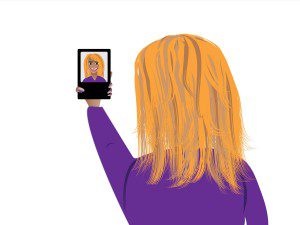
“Selfie” Free for unattributed use at morguefile.com
I could never castigate my neighbors as being “unable to understand my first-person narrative,” because I am forced to go to my neighbors to get the damn narrative. I have to go to a mother to ask what the first seven years of my life were like (which, right from the outset, excludes from ever being able to claim “only I know what it means to be me.”) I have to go to funerals and learn, from the mute wisdom of dead neighbors, that I’m going to die — nothing in my first-person, unrepeatable experience of consciousness tells me that. In fact, if I banned others from teaching me who I am and defined myself — I’d imagine myself as an eternal being without beginning or end. I would be God!
“Businessmen acting like superheroes and tearing their shirts off with c” Photo courtesy of and copyright Free Range Stock, www.freerangestock.com.
(You can imagine my depression. Not only does the dependence of my identity on the gaze of the Other make having a Tumblr account difficult — it prevents my deification.)
I’d like to think that, if I must be sickeningly dependent on mothers and fathers and friends-with-better-memory-of-me-than-me for my identity, at least only I can make value-judgments about this identity. This would give me back the capacity of grooving to the lyrics of most pop songs, which croon, and I quote: “Don’t listen to them / you’re beautiful, virtuous, and precious according to that inner sense of self you quietly nurse in your room.” But that’s never worked either: How many times have I been sure that I am a complete asshole, only to find, through the criticism of my neighbor, that such a self-identity wasn’t correct in the slightest — I have this or that likeable quality. Conversely, how many times have I self-identified as brilliant, only to find, through the criticism of my neighbor, that I’m a complete asshole?
As it turns out, not even my judgments about my identity are infallible. I’m wrong about myself as often as anything else. How I wish I could say with my fearless generation: “You can’t judge me.” In truth, you can — you’re usually better at it than me. How I wish I could growl “You have no right to tell me who I am!” like a strong protagonist in a tasteful, all-white, Oscar-nominated biopic. In truth, you do — often with more right than I’ll ever muster up.
Oh, what weakness! I confess, some of my more meaningful conversations during this hapless plod towards death have involved someone looking at me with loving eyes and saying, “That’s not who you are.” (Had I known the Ethics I know now I would have punched them in the face, leaned gently over their unconscious frame and whispered, “That’s my I-dentity — not a you-dentity,” put my sunglasses back on, and walked away in profound slow-motion.)

“Cool guy in a vest and top hat” Photo courtesy of and copyright Free Range Stock, www.freerangestock.com
We speak so easily of being “unable to judge” other people’s relationships. And I’ll admit it sounds lovely, what with every pairing-up of humanoids locked into itself, safe from outside praise or criticism, justified as an uninhabited planet — two darling identities making out in mutual contract. But I was born pathetic, needy, and frail. Time after time I find that my relationships don’t exist until they make themselves available to the possible observation, judgment and criticism of a community. I must always “define the relationship.” I must call it a definite something that can be recognized by those outside of the relationship. My peers get to “be themselves” with ease — I need the entire outside world to do the same.
Nor can I hop on board the gender-identity train. It’s defined as “a personal conception of oneself as male or female (or both or neither).” But try as I may, I have never managed to develop a personal concept of myself as male or female — the very terms are only meaningful in relation to each other. If I were the only man in existence, no amount of flexing, shaving, or gazing at myself in the mirror could ever give me the concept male any more than I could extract the concept of “eggshell white” in an entirely eggshell-white world. Nothing about my individual “inner self” says “male” or “female” or “neither male nor female” or “both male and female.” If I say I am a male it is only in and through a relation to the female, and if I identify as female, my concept is only possible as an appropriation of what I learn from the outside. Even if I negate gender and say I have none, my negation thrives only on the communal concept of “gender” that it negates!
“Male and Female Hula Dancers” Free for unattributed use at morguefile.com
In fact, the act of asserting my identity as coming from “me” is made possible only in and through a community. The very word “identity” is a linguistic meaning that I did not invent. The very understanding of being a ‘self’ that ‘asserts’ is something I learned through other people — and post-Enlightenment Western culture in general. My very existence as bipedal with the ability to scream “I’m a straight, biromantic, INFP with a learning disorder” comes from my parents. I didn’t name myself, raise myself, choose my sex or the shape of my chin. I’ve never even seen my face — only shadows and reflections. How then, can I claim to be the one who knows it best?
We live in the most machismo of ages. We have drunk deep from the moonshine of the self-made man and now sway schwasted with self-assertion. I wish I could stomach the liquor, face my community down with bloodshot eyes and roar (in a language they did not teach me) those wonderful words of Ayn Rand: “I am done with the monster of “We,” the word of serfdom, of plunder, of misery, falsehood and shame. And now I see the face of god, and I raise this god over the earth, this god whom men have sought since men came into being, this god who will grant them joy and peace and pride. This god, this one word: ‘I.'”
But I am too weak to follow the example of our national prophet. I don’t want to speak for others (and I would never try to define their first-person narrative) but I am a being-in-relation. There is no “real me” apart from my community, no “true self” apart from my neighbors. I only am in, through and with my other people, and the struggle for my identity is only ever resolved by the struggle for genuine family with them all.
Previous Post

February 2, 2016
Why The Saints Speak of Sex
Next Post
February 11, 2016 Lent in the Age of the Smartphone
Browse Our Archives
Select a Category Another Look Atheism Bad Catholics Beauty Communio Crookedhart Destupidification Exiting the Culture Wars Gender Theory That Doesn't Suck How To Language Liturgy! Love One Another Marriage Equality Modesty Music Objectification pop culture Poverty Sacraments Sex Technology The Best Religion in the World The Erotic Phenomenon Time Uncategorized Virtue Ethics That Don't Suck Winning the Culture Wars
Select a Month January 2017 December 2016 November 2016 October 2016 July 2016 June 2016 April 2016 March 2016 February 2016 January 2016 December 2015 November 2015 October 2015 September 2015 August 2015 July 2015 June 2015 May 2015 March 2015 February 2015 January 2015 June 2014 May 2014 April 2014 March 2014 February 2014 January 2014 December 2013 November 2013 October 2013 September 2013 August 2013 July 2013 June 2013 May 2013 April 2013 March 2013 February 2013 January 2013 December 2012 November 2012 October 2012 September 2012 August 2012 July 2012 June 2012 May 2012 April 2012 March 2012 February 2012 January 2012 December 2011 November 2011 October 2011 September 2011 August 2011 July 2011 June 2011 May 2011 April 2011 March 2011 February 2011 January 2011 December 2010 November 2010 October 2010 September 2010 August 2010
Follow Us!
TAKE THE
Religious Wisdom Quiz
What Christian group refers to their leaders as "General Superintendents"?
Select your answer to see how you score.
Catholic Methodist Orthodox Nazarene
Related posts from Bad Catholic
Towards a New Argument Against Pornography


Why Millennials Want to Change the World

The Communist That Lives With Me Responds: "Your...
TRENDING AT PATHEOS Catholic

The Parable Of The Sower And The Word...
One of Christ’s most famous parables is that of the sower who...

Rejecting Doom: Christian Hope And Human Action
Christianity is a religion of hope. We are to have hope and...

Why I Choose the Eucharist Over the Sermon
Choose the Eucharist, Not the Sermon What are we supposed to get...

5 Design Elements Found in Spiritually Rooted Homes
Putting Spirituality Into Home Decor Our homes are more than our living...

Credo: A Story of God Told with the...
About 10 years ago, I began to imagine a personal "Credo" that...

The Anatomy of Divine Revelation in Catholic Thought
The claim that God has made Himself known to human beings is...
view all Catholic blogs
Ad-Free & Subscriber Log-In Subscription Support
- About Us
- 2026 Calendar
- Videos
- Podcasts
- Library of World Religions
- Faith In Media Tracker
- Advertise With Us
- Write for Us
- Privacy Policy
- Terms of Service
- Do Not Sell My Data
- Contact Us
- Radiant Digital
- Manage Newsletter Subscriptions
- Unsubscribe From Notifications
- Sitemap
Copyright 2008-2026, Patheos. All rights reserved.
Subscription Support Ad-Free & Subscriber Log-In
Follow Patheos