
BuddhistCatholicContemplativeEvangelicalGeneral ChristianHinduJewishLatter-day SaintMuslimNew VisionsProgressive Christian
Beliefs
- Buddhist
- Catholic
- Contemplative
- Evangelical
- General Christian
- Hindu
- Jewish
- Latter-day Saint
- More Voices
- Muslim
- New Visions
- Pagan
- Progressive Christian
Topics
- Religion News
- Food and Religion
- Sports and Religion
- Religious Art
- Religious Music and Entertainment
- Religious Events
- History and Religion
- Style and Religion
- Politics and Religion
- Women in Religion
- Recreation Outdoors and Religion
- Business Finance and Religion
- Careers Workplace and Religion
- Education and Religion
- Family Parenting and Religion
- Health Fitness and Religion
- Home and Religion
- Relationships and Religion
- Technology and Religion
- Travel and Religion
Columnists
- Buddhist Columnists
- Business Finance and Religion Columnists
- Careers Workplace and Religion Columnists
- Catholic Columnists
- Contemplative Columnists
- Education and Religion Columnists
- Evangelists Columnists
- Family Parenting and Religion Columnists
- General Christian Columnists
- Health Fitness and Religion Columnists
- Hindu Columnists
- History and Religion Columnists
- Home and Religion Columnists
- Jewish Columnists
- More Voices Columnists
- Latter Day Columnists
- Muslim Columnists
- New Visions Columnists
- Nonreligious Columnists
- Pagan Columnists
- Politics and Religion Columnists
- Progressive Columnists
- Recreation Outdoors and Religion Columnists
- Relationships and Religion Columnists
- Religion News Columnists
- Religious Art Columnists
- Religious Events Columnists
- Religious Music and Entertainment Columnists
- Sports and Religion Columnists
- Style and Religion Columnists
- Technology and Religion Columnists
- Travel and Religion Columnists
- Women in Religion Columnists
Resource Library
- 2026 Calendar
- Library of World Religions
- The 100 Most Holy Places on Earth
- Patheos Answers
- Podcasts
- Videos
- Faith Leaders Database
- Anglican Episcopalian
- Bahai
- Baptist
- Buddhism
- Christianity
- Confucianism
- Eastern Orthodoxy
- Hinduism
- Holiness and Pentecostal
- ISKCON
- Islam
- Judaism
- Lutheran
- Methodist
- The Church of Jesus Christ of Latter-day Saints
- New Age
- Paganism
- Presbytarian and Reformed
- Protestantism
- Religion Behind the Scenes
- Roman Catholic
- Scientology
- Shia Islam
- Sikhism
- Sufism
- Sunni Islam
- Taoism
- Zen
- See all religions
Research Tools
 Ad-Free & Subscriber Log-In Subscription Support
Ad-Free & Subscriber Log-In Subscription Support
Follow Patheos 

- Trending:
- Forgiveness
- |
- Marriage
- |
- Consciousness
- |
- Death Penalty
- |
- Election
- |
- Halloween
 Bad Catholic
- Home
- Catholic
- Why The Saints Speak of Sex
Why The Saints Speak of Sex
Last updated on: June 26, 2016 at 3:46 pm by Marc
Why The Saints Speak of Sex 2016-06-26T15:46:37-04:00 Marc
Patheos Explore the world's faith through different perspectives on religion and spirituality! Patheos has the views of the prevalent religions and spiritualities of the world.
In his essay, “The Church Effeminate,” the late John W. Robbins (who linked all evils to effeminacy, all effeminacy to Rome, and Rome, in turn, to Satan) revives the tract-tradition that titillated Protestants with stories of de Sade style nunneries that would, given a foothold, inevitably crush the American public school system.

No such luck. Though we did try our best.
He recoils with horror that “in effeminate medieval Romanist devotions, Jesus is referred to as Mother. In the Eucharist Jesus nurses his children.” These he describes as “effeminate and sometimes pornographic,” and thus joins the great American pastime of debunking Catholic spirituality by pointing out its “hidden” sexuality.
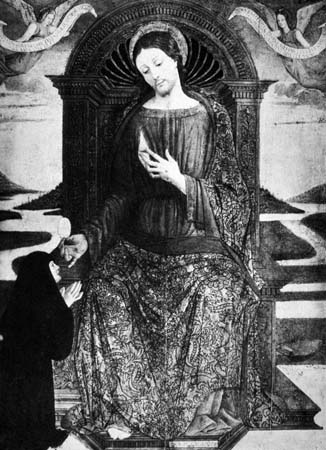
The Savior by Quirizio di Giovanni da Murano — Wikimedia
Really, it’s hardly hidden. There are erotic depictions of Jesus, Mary and the Saints. There are erotic poems in the Bible. There are profoundly sexual descriptions of the spiritual life. But before we dismiss the Church as a glorified fertility cult, let’s perform an academic exercise I like to call “Reasonably Assuming We are 19-times More Sexually Screwed-up Than Our Predecessors.” It’s modernity, after all, that indulges the habit of watching pixelated strangers scrupulously act out every bodily contortion the addict-brain can hanker for — perhaps we should doubt our indignation over, say, Mary painted as revealing Christ’s manhood before we doubt the purity of its painter.
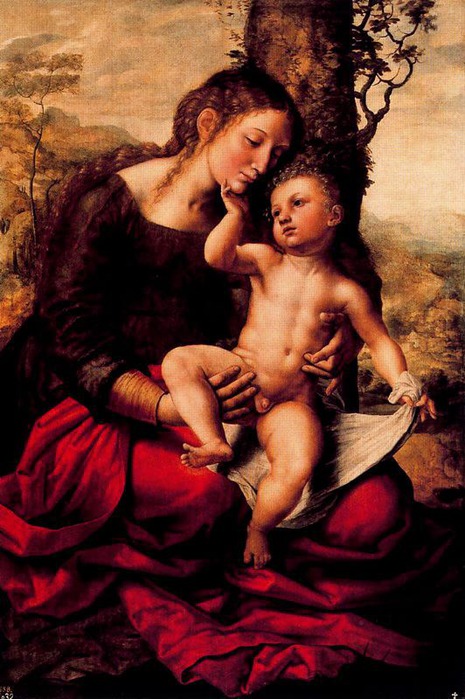
Madonna and Child by Jan van Hemessen — Wikiart
The mere presence of “sexuality” hardly indicates a perversion. The child who, in the spirit of anatomical accuracy, adds a penis to his finger-painted portrait may cause us to blush as much as the pornographer who, in a spirit of monetized lust, adds one to everything else. I suppose it could be some secret, Satanic underbelly that had the Vatican okay an obelisk for their front yard — but it could equally be a lack of fear and worship towards the phallic image that freed them to use it with such decorative pizzazz. “Sexually explicit” images come from innocence as much as perversion. A rigid silence towards sexuality could just as well indicate a fearful preoccupation with sex as a purity of heart. Is our age the arbiter of which is which?
Where, I wonder, would the pure, sexually-discerning Christian draw the line? At St. Dominic having visions of being breastfed by the Virgin Mary? The Angel Gabriel’s explanation of supernatural gestation to Mary: ‘The Holy Spirit will come upon you, and the power of the Most High will overshadow you’”? Christ resurrecting out of a womb in Eastern iconography? The Song of Songs’ description of the Savior: “Like an apple tree among the trees of the woods, / so is my lover among men. / In his shadow I delight to sit, / and his fruit is sweet to my taste”?
Back to the point: With his tacit assumption that the introduction of sexuality into spirituality maligns the latter, Robbins and the Christians of his ilk join unlikely hands with the Freudians and skeptical psychoanalysts who “debunk” spirituality by pointing out its “hidden” sexuality. In “The Cult of the Virgin Mary,” Michael Carroll — God bless his sparky scholarship — argued that religious apparitions are the manifestation of repressed sexual impulses:
“It is difficult, not to think of sexual sublimation when a female seer reports [a vision] in which Christ inserts a phallic-shaped object directly into her body, as when the Blessed Ossana reports that her Divine Spouse, Jesus Christ, plunged a “long and terrible nail” directly into her heart, or when the Blessed Catherine of Raconigi reports that her Divine Spouse, also Jesus Christ, plunges his arm (a long and narrow part of his body) into her body so that he can grasp her heart and wash it.”
First, if the saints don’t envision Christ as pushing a paint-can through their chest or penetrating their hearts by the forceful application of Tolstoy’s War and Peace, surely we might see an anatomical practicality in their visions before we see a phallus. Anything visualized as entering the body has to be “long and narrow.”
Secondly, and more to the point, images of sexual penetration only “debunk” claims of spiritual penetration if sexual penetration is more primordial than spiritual penetration. But they aren’t: Sexual penetration is conceptually learned through an (usually awkward) education. Spiritual penetration, on the other hand, rarely requires a didactic explanation. The child confused by The Talk may very well understand being shot with a ray of love or an arrow from Heaven. The Freudian suspicion — and indeed, any suspicion that spirituality is really just hidden sexuality — has the awkward task of explaining how the difficult, shocking, and conceptually figured-out is supposed to be the “real ground” of what is already intuitively graspable.
It seems far more likely that the facts of sexual penetration are incarnate metaphors for the primordial reality of spiritual penetration — a reality we understand and grasp long before we understand the slightest thing about sex.

And to be completely honest, I’ll take sexual sublimation that ends in statues like this over a purity that ends in suburban churches any day of the week.
This, then, is the Catholic backwardness that answers the forward-thinking skepticism of the psychoanalysts and the horror of the puritans: Sex is a created good. It points to its Creator as a piece of art points towards its artist. There can be no fear that an authentic use of sexual imagery could pervert spirituality any more than a creative use of botanical imagery could do the same.
Jesus can “nurse” his children, not because of some perverse and titillating gender-bending indulged by Romanists — as Robbins assumes — but because nursing is already an image of that greater, more primordial nourishment of grace. Saints can use frankly sexual imagery to describe the spiritual life, not because of repressed desire — as Carroll claims — but because it is already a communion that images that greater, more primordial Divine Communion. God is not threatened by sexuality. He created it. It is not a degradation but an idolatry of sexuality that would section it off as portion of humanity too strong and too difficult to serve God without supplanting Him.
Previous Post

January 28, 2016
Those Horribly Sappy Saints
Next Post
February 5, 2016 Faking It in the Age of Identity
Browse Our Archives
Select a Category Another Look Atheism Bad Catholics Beauty Communio Crookedhart Destupidification Exiting the Culture Wars Gender Theory That Doesn't Suck How To Language Liturgy! Love One Another Marriage Equality Modesty Music Objectification pop culture Poverty Sacraments Sex Technology The Best Religion in the World The Erotic Phenomenon Time Uncategorized Virtue Ethics That Don't Suck Winning the Culture Wars
Select a Month January 2017 December 2016 November 2016 October 2016 July 2016 June 2016 April 2016 March 2016 February 2016 January 2016 December 2015 November 2015 October 2015 September 2015 August 2015 July 2015 June 2015 May 2015 March 2015 February 2015 January 2015 June 2014 May 2014 April 2014 March 2014 February 2014 January 2014 December 2013 November 2013 October 2013 September 2013 August 2013 July 2013 June 2013 May 2013 April 2013 March 2013 February 2013 January 2013 December 2012 November 2012 October 2012 September 2012 August 2012 July 2012 June 2012 May 2012 April 2012 March 2012 February 2012 January 2012 December 2011 November 2011 October 2011 September 2011 August 2011 July 2011 June 2011 May 2011 April 2011 March 2011 February 2011 January 2011 December 2010 November 2010 October 2010 September 2010 August 2010
Follow Us!
TAKE THE
Religious Wisdom Quiz
Like a sheep led to slaughter, silent before shearers, this servant was pierced for our transgressions. What chapter foretells this suffering?
Select your answer to see how you score.
Isaiah 7 Isaiah 53 Isaiah 9 Isaiah 61
Related posts from Bad Catholic

Who Said It About Sexuality, Slavoj Žižek or...

Ayn Rand, Fairy Godmother of Sexual Orientation


Objectifying Soccer Players Probably Won't Help Fight Sexism
TRENDING AT PATHEOS Catholic

The Parable Of The Sower And The Word...
One of Christ’s most famous parables is that of the sower who...

Rejecting Doom: Christian Hope And Human Action
Christianity is a religion of hope. We are to have hope and...

Why I Choose the Eucharist Over the Sermon
Choose the Eucharist, Not the Sermon What are we supposed to get...

5 Design Elements Found in Spiritually Rooted Homes
Putting Spirituality Into Home Decor Our homes are more than our living...

Credo: A Story of God Told with the...
About 10 years ago, I began to imagine a personal "Credo" that...

The Anatomy of Divine Revelation in Catholic Thought
The claim that God has made Himself known to human beings is...
view all Catholic blogs
Ad-Free & Subscriber Log-In Subscription Support
- About Us
- 2026 Calendar
- Videos
- Podcasts
- Library of World Religions
- Faith In Media Tracker
- Advertise With Us
- Write for Us
- Privacy Policy
- Terms of Service
- Do Not Sell My Data
- Contact Us
- Radiant Digital
- Manage Newsletter Subscriptions
- Unsubscribe From Notifications
- Sitemap
Copyright 2008-2026, Patheos. All rights reserved.
Subscription Support Ad-Free & Subscriber Log-In
Follow Patheos