
BuddhistCatholicContemplativeEvangelicalGeneral ChristianHinduJewishLatter-day SaintMuslimNew VisionsProgressive Christian
Beliefs
- Buddhist
- Catholic
- Contemplative
- Evangelical
- General Christian
- Hindu
- Jewish
- Latter-day Saint
- More Voices
- Muslim
- New Visions
- Pagan
- Progressive Christian
Topics
- Religion News
- Food and Religion
- Sports and Religion
- Religious Art
- Religious Music and Entertainment
- Religious Events
- History and Religion
- Style and Religion
- Politics and Religion
- Women in Religion
- Recreation Outdoors and Religion
- Business Finance and Religion
- Careers Workplace and Religion
- Education and Religion
- Family Parenting and Religion
- Health Fitness and Religion
- Home and Religion
- Relationships and Religion
- Technology and Religion
- Travel and Religion
Columnists
- Buddhist Columnists
- Business Finance and Religion Columnists
- Careers Workplace and Religion Columnists
- Catholic Columnists
- Contemplative Columnists
- Education and Religion Columnists
- Evangelists Columnists
- Family Parenting and Religion Columnists
- General Christian Columnists
- Health Fitness and Religion Columnists
- Hindu Columnists
- History and Religion Columnists
- Home and Religion Columnists
- Jewish Columnists
- More Voices Columnists
- Latter Day Columnists
- Muslim Columnists
- New Visions Columnists
- Nonreligious Columnists
- Pagan Columnists
- Politics and Religion Columnists
- Progressive Columnists
- Recreation Outdoors and Religion Columnists
- Relationships and Religion Columnists
- Religion News Columnists
- Religious Art Columnists
- Religious Events Columnists
- Religious Music and Entertainment Columnists
- Sports and Religion Columnists
- Style and Religion Columnists
- Technology and Religion Columnists
- Travel and Religion Columnists
- Women in Religion Columnists
Resource Library
- 2026 Calendar
- Library of World Religions
- The 100 Most Holy Places on Earth
- Patheos Answers
- Podcasts
- Videos
- Faith Leaders Database
- Anglican Episcopalian
- Bahai
- Baptist
- Buddhism
- Christianity
- Confucianism
- Eastern Orthodoxy
- Hinduism
- Holiness and Pentecostal
- ISKCON
- Islam
- Judaism
- Lutheran
- Methodist
- The Church of Jesus Christ of Latter-day Saints
- New Age
- Paganism
- Presbytarian and Reformed
- Protestantism
- Religion Behind the Scenes
- Roman Catholic
- Scientology
- Shia Islam
- Sikhism
- Sufism
- Sunni Islam
- Taoism
- Zen
- See all religions
Research Tools
 Ad-Free & Subscriber Log-In Subscription Support
Ad-Free & Subscriber Log-In Subscription Support
Follow Patheos 

- Trending:
- Forgiveness
- |
- Marriage
- |
- Consciousness
- |
- Death Penalty
- |
- Election
- |
- Halloween
 Bad Catholic
- Home
- Catholic
- Fury and Catholicity
Fury and Catholicity
Last updated on: February 16, 2015 at 6:27 pm by Marc
Fury and Catholicity 2015-02-16T18:27:20-05:00 Marc
Patheos Explore the world's faith through different perspectives on religion and spirituality! Patheos has the views of the prevalent religions and spiritualities of the world.

ISIS beheaded 21 Coptic Christians. Surely it is time to dust off the war psalms in our breviaries, to pray the prayer to St. Michael, and to make those fervent supplications we usually tuck away to remain inoffensive within this Pluralistic Disneyland we call modernity — “Save me, my God! For you strike the jaws of all my foes; you break the teeth of the wicked.”
We need a violent stirring of the spirit, not for the sake of breathing life into some brutish, martial Christianity (which usually amounts to nothing more than a glorified tribalism), but to kindle in our far-removed, ‘observing’ hearts a little catholicity. The lack of creative fury and indignation among observing Christians is neither a sign of meekness, nor humility, nor patience, nor resignation to God’s will. It is a sign that the Church has forgotten she is Catholic, that is, a universal family. Through baptism and communion she effects lasting, sacramental bonds between the murdered Copt and the oblivious suburban pew-warmer, making them brothers in Christ. It is not the reasonable response of a man whose brother is beheaded, to post about it on Facebook and go about his day. The most reasonable response is the cry of the Psalmist: “As the smoke is dispersed, disperse them; as wax is melted by fire, so may the wicked perish before God.” To realize and re-cognize this family of love we call the Church, in whose arms we do not ‘observe,’ but know and feel the death of our brothers and sisters — that’s why we need a furious cry for justice.
But is a Christian fury possible? It is a common critique of that the Holy Faith saps the rebellious, life-preserving spirit from our limbs and encourages believers to blithely accept death, as if martyrdom were no more than an inability to stand up for ourselves, as if St. Lawrence, cooked over an open fire by his tormentors, said “turn me over, this side is done” in a spirit of sniveling servility. Nietzsche summarized the thought: “From the beginning, Christian faith has meant a sacrifice: the sacrifice of freedom, pride, spiritual self-confidence; it has meant subjugation and self-derision, self-mutilation.” Why, if the martyrs are to go meekly to their death, should we respond with fury? If martyrdom is such a coveted crown, why should the observing, American Christian do anything but thank ISIS for providing for the coronation?
But the meekness with which the martyrs are to face death is made difficult and incomprehensible by the fire with which they die. One need look no further than to the first martyr, St. Stephen, for an exemplar. He dies for love of Christ, in an excess of strength, compelled by a truth which he could not forsake. There are three moments in this Saint’s most glorious exit (Acts 7); three powerful rebuttals to the Nietzschean critique which instruct us in our proper response to the intolerable attacks of those who, with all the preening vanity of a middle-schooler with a Snapchat and a pathological addiction to selfies, post videos of their idiotic, sanctimonious murders.
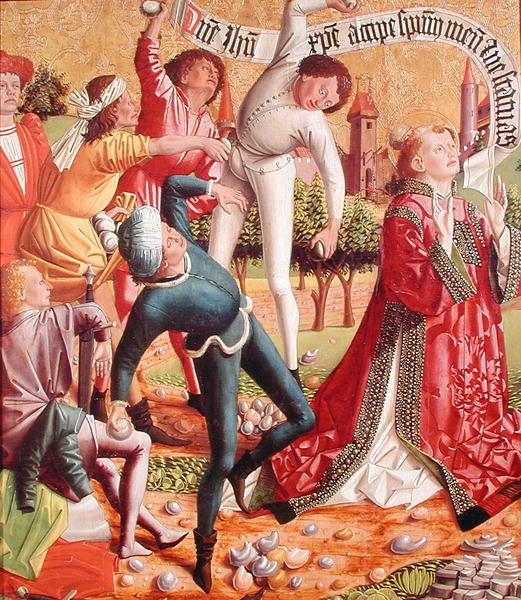
His martyrdom is, first, the condemnation of the very spiritual substance of his murderers. He cries: “You stiff-necked people, uncircumcised in heart and ears, you always oppose the holy Spirit; you are just like your ancestors. Which of the prophets did your ancestors not persecute?” By his death he holds his murderers accountable, not for their particular murder, but for the very state of their souls. He lifts them up to the very judgment seat of God. He speaks with fury — not without reason, nor without virtue — but with fierce passion nonetheless. All martyrs, whether silent or crying out, are an embodied conscience, a living witness against sin, and an incarnate cry for justice before Almighty God.
Secondly, his death is efficacious. “When they heard this, they were infuriated, and they ground their teeth at him.” His witness cuts them, and indeed, represents a victory of truth over error, as Socrates’ death was a victory. His martyrdom sets Saul, who was watching, on the road to persecute the Church, where he is converted by Jesus Christ to be the apostle to the Gentiles.
This is an obvious example of that pithy phrase from Tertullian: “The blood of the martyrs is the seed of the Church.” That is, the blood of the martyrs is victorious, convincing, and an effective means of converting souls to Christ, a victory which far outweighs the pain of death, making their death, not just meaningful, but so meaningful that one wonders if there is any other way to die. The Christian does not go to his death to waste himself, to mutilate his flesh, to abdicate his existence. He goes, with trembling or with courage, for the glory of God and for the Gospel. He achieves an end, a goal, and a victory — whereas the average death does not achieve, but merely arrives.
And finally, his death is forgiving. “Then he fell to his knees and cried out in a loud voice, “Lord, do not hold this sin against them”; and when he said this, he fell asleep.” The martyr’s death undercuts and renders void even the gratuitous sense of victory his enemies might receive from killing him, for he begs that they will enter into Heaven, where all will be as one. Thus he affirms that their murder, so seemingly vicious and frightening, is really the perverse and foolish tragedy of fratricide.
I think we might take an example from the martyr Stephen, to respond to the death of our brothers and sisters with an indignation, condemnation and terrible fury; with efficacious words, prayers and actions; with the forgiveness that the world cannot comprehend. We tend to speak much of the last two principles, of forgiveness and prayer, without practicing the first. But it is precisely our indignation and our cries for justice, our reasonable insults of the stiff-necked murderers, that makes our forgiveness and our prayer something Catholic — a real response of the heart to the murder of our family.
The Best Religion in the World
Previous Post

February 16, 2015
Insulting ISIS
Next Post
February 19, 2015 Worms, foul-smelling liquids, and filthy shreds of cloth
Browse Our Archives
Select a Category Another Look Atheism Bad Catholics Beauty Communio Crookedhart Destupidification Exiting the Culture Wars Gender Theory That Doesn't Suck How To Language Liturgy! Love One Another Marriage Equality Modesty Music Objectification pop culture Poverty Sacraments Sex Technology The Best Religion in the World The Erotic Phenomenon Time Uncategorized Virtue Ethics That Don't Suck Winning the Culture Wars
Select a Month January 2017 December 2016 November 2016 October 2016 July 2016 June 2016 April 2016 March 2016 February 2016 January 2016 December 2015 November 2015 October 2015 September 2015 August 2015 July 2015 June 2015 May 2015 March 2015 February 2015 January 2015 June 2014 May 2014 April 2014 March 2014 February 2014 January 2014 December 2013 November 2013 October 2013 September 2013 August 2013 July 2013 June 2013 May 2013 April 2013 March 2013 February 2013 January 2013 December 2012 November 2012 October 2012 September 2012 August 2012 July 2012 June 2012 May 2012 April 2012 March 2012 February 2012 January 2012 December 2011 November 2011 October 2011 September 2011 August 2011 July 2011 June 2011 May 2011 April 2011 March 2011 February 2011 January 2011 December 2010 November 2010 October 2010 September 2010 August 2010
Follow Us!
TAKE THE
Religious Wisdom Quiz
Who said, "Even though I walk through the valley of the shadow of death, I will fear no evil"?
Select your answer to see how you score.
David Moses Paul Job
Related posts from Bad Catholic

No, Christianity's Not Eurocentric (But You Kind Of...

The Difference Between a Renaming and a Baptism

TRENDING AT PATHEOS Catholic

The Parable Of The Sower And The Word...
One of Christ’s most famous parables is that of the sower who...

Rejecting Doom: Christian Hope And Human Action
Christianity is a religion of hope. We are to have hope and...

Why I Choose the Eucharist Over the Sermon
Choose the Eucharist, Not the Sermon What are we supposed to get...

5 Design Elements Found in Spiritually Rooted Homes
Putting Spirituality Into Home Decor Our homes are more than our living...

Credo: A Story of God Told with the...
About 10 years ago, I began to imagine a personal "Credo" that...

The Anatomy of Divine Revelation in Catholic Thought
The claim that God has made Himself known to human beings is...
view all Catholic blogs
Ad-Free & Subscriber Log-In Subscription Support
- About Us
- 2026 Calendar
- Videos
- Podcasts
- Library of World Religions
- Faith In Media Tracker
- Advertise With Us
- Write for Us
- Privacy Policy
- Terms of Service
- Do Not Sell My Data
- Contact Us
- Radiant Digital
- Manage Newsletter Subscriptions
- Unsubscribe From Notifications
- Sitemap
Copyright 2008-2026, Patheos. All rights reserved.
Subscription Support Ad-Free & Subscriber Log-In
Follow Patheos