
BuddhistCatholicContemplativeEvangelicalGeneral ChristianHinduJewishLatter-day SaintMuslimNew VisionsProgressive Christian
Beliefs
- Buddhist
- Catholic
- Contemplative
- Evangelical
- General Christian
- Hindu
- Jewish
- Latter-day Saint
- More Voices
- Muslim
- New Visions
- Pagan
- Progressive Christian
Topics
- Religion News
- Food and Religion
- Sports and Religion
- Religious Art
- Religious Music and Entertainment
- Religious Events
- History and Religion
- Style and Religion
- Politics and Religion
- Women in Religion
- Recreation Outdoors and Religion
- Business Finance and Religion
- Careers Workplace and Religion
- Education and Religion
- Family Parenting and Religion
- Health Fitness and Religion
- Home and Religion
- Relationships and Religion
- Technology and Religion
- Travel and Religion
Columnists
- Buddhist Columnists
- Business Finance and Religion Columnists
- Careers Workplace and Religion Columnists
- Catholic Columnists
- Contemplative Columnists
- Education and Religion Columnists
- Evangelists Columnists
- Family Parenting and Religion Columnists
- General Christian Columnists
- Health Fitness and Religion Columnists
- Hindu Columnists
- History and Religion Columnists
- Home and Religion Columnists
- Jewish Columnists
- More Voices Columnists
- Latter Day Columnists
- Muslim Columnists
- New Visions Columnists
- Nonreligious Columnists
- Pagan Columnists
- Politics and Religion Columnists
- Progressive Columnists
- Recreation Outdoors and Religion Columnists
- Relationships and Religion Columnists
- Religion News Columnists
- Religious Art Columnists
- Religious Events Columnists
- Religious Music and Entertainment Columnists
- Sports and Religion Columnists
- Style and Religion Columnists
- Technology and Religion Columnists
- Travel and Religion Columnists
- Women in Religion Columnists
Resource Library
- 2026 Calendar
- Library of World Religions
- The 100 Most Holy Places on Earth
- Patheos Answers
- Podcasts
- Videos
- Faith Leaders Database
- Anglican Episcopalian
- Bahai
- Baptist
- Buddhism
- Christianity
- Confucianism
- Eastern Orthodoxy
- Hinduism
- Holiness and Pentecostal
- ISKCON
- Islam
- Judaism
- Lutheran
- Methodist
- The Church of Jesus Christ of Latter-day Saints
- New Age
- Paganism
- Presbytarian and Reformed
- Protestantism
- Religion Behind the Scenes
- Roman Catholic
- Scientology
- Shia Islam
- Sikhism
- Sufism
- Sunni Islam
- Taoism
- Zen
- See all religions
Research Tools
 Ad-Free & Subscriber Log-In Subscription Support
Ad-Free & Subscriber Log-In Subscription Support
Follow Patheos 

- Trending:
- Forgiveness
- |
- Marriage
- |
- Consciousness
- |
- Death Penalty
- |
- Election
- |
- Halloween
 Bad Catholic
- Home
- Catholic
- Selling Our Sins
Selling Our Sins
Last updated on: June 26, 2014 at 5:04 pm by Marc
Selling Our Sins 2014-06-26T17:04:49-04:00 Marc
Patheos Explore the world's faith through different perspectives on religion and spirituality! Patheos has the views of the prevalent religions and spiritualities of the world.
There is a tragic aura to the young man driving around my neighborhood in Steubenville, Ohio, pushing heroin out to “customers” at street corners, his barely drivable car decked out with “playboy” stickers, rims, window-tint, and a rusted-out body going into seizures with the bass of a song produced in California, repeating “it’s all about the money.” The tragedy is not that he is poor, but that he is very, very rich.
Steinbeck says…
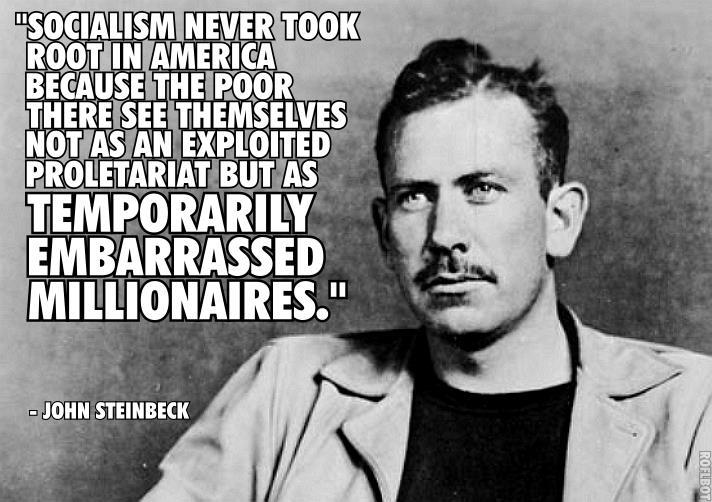
…and this sounds like a pleasant hurrah for American optimism and the theology of “lifting oneself up from one’s bootstraps” — until you’ve met a temporarily embarrassed millionaire, or seen him in yourself. The impotence, the rage, the resentment, the posturing, the shame, and the self-delusion that comes from devouring the values of a wealthy culture, becoming a millionaire of the heart, while simultaneously finding oneself always outside of the milk and honey, never a millionaire in the flesh…
Money as an end value is merely depressing when you can get it. This same greed preached to a poor community who can’t get it is utterly destructive. Our ingrained, individualistic capitalism that measures success by salary and sees all men and their projects in competition with each other, this “self-made man” stuff, enthroned as a dominant value in those who cannot and will not amass the wealth of a privileged college graduate — it’s not pretty. Drug-dealing is not some seedy underbelly of American culture — it’s a logical incarnation of our economic ideology.
But there’s another, more obvious way in which the rich sell their sins to the poor.

TV, Radio — and, to some extent, the Internet — are our cheapest forms of communication and entertainment. They are readily available to those suffering from poverty — even the poorest neighborhoods in America have satellite dishes. But watch MTV. Listen to any pop song. Indulge yourself in what is cheapest to put in the eye and the ears. You will be told to earn money, party gratuitously, spend indulgently, remain utterly independent, and have sex indiscriminately, usually in the space of a single song, music video, or TV show. From Jersey Shore to Miley Cyrus, cheap media sells an expensive life.
The problem is the same problem with preaching a capitalistic theology of wealth to individuals and communities that cannot live up to its standards. What is shiny in a wealthy community loses its gleam in the projects.
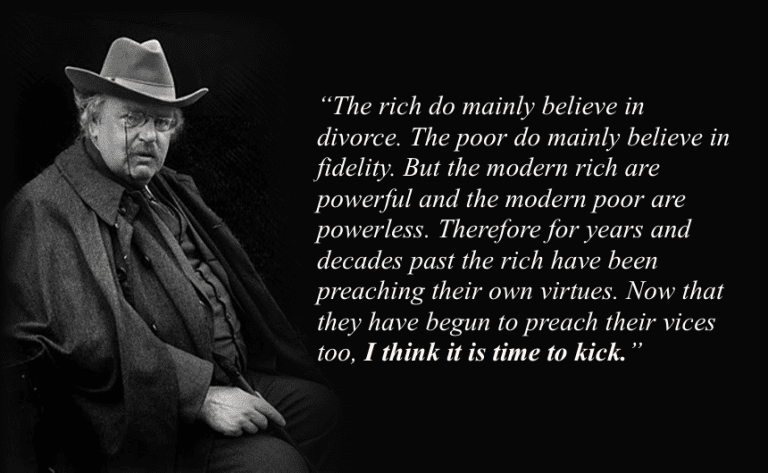
Sin is easier when you’re rich. This is most apparent in wobbly world of sexual ethics: When you can pay for regular birth-control, sterilizations, abortions, divorces, daycare, and all the rest, it’s easy enough to superficially glorify the freedom of sexuality from fertility, responsibility and family. The average sitcom or TV-drama involves a bunch of sexually-liberated yuppies, the plot-lines usually revolving the fascinating question of who will sleep with who next — from How I Met Your Mother to Friends. The average pop song is about a drinking at a party and sleeping with person A, B, and/or C. But when you can’t afford it, when you don’t have the money to help negate the material consequences of this preached and promoted individualistic sexual life — it gets sad.
It’s an ugly classism that looks at the sins of our poor communities — abortion, fatherlessness, addiction, etc. — and refuses to acknowledge that these sins are but repetitions of the sins preached by a wealthy culture — without the cushion of money that negates immediate consequences. Uncommitted marriage and the tacit approval of adultery are sins that can be absorbed by the ease in which the wealthy divorce — buy another house, far enough away, commute to see the kids. The spirit will never be assuaged, but our economic positions allow us to ease the material pain. Without this cushion of money, things aren’t so neat and pretty. There can be no “buy a new house,” no “commute to see the kids,” no paying money for lawyers — but this isn’t what we push through the media, that great portal of ideology from the rich to the poor.
 It’s not hard to visualize the problem. Just imagine any yuppy sitcom you’ve had the pleasure of seeing — and take away the constant availability of money. Have Ross’ wife divorce him for a woman, Rachel get pregnant and later leave Ross, all without the bumbling “oh isn’t this funny!” that comes from nothing ever changing, with the security of money and, yes, the friends that surround every one. Make a romantic-comedy more realistic: She gets pregnant after the third kooky get-together, he can’t afford a kid, leaves, and she starts calling abortion centers. Or take any pop song you like and try to imagine the same words coming from a woman who is about to be evicted from her apartment because she can’t pay the rent. Katy Perry, I dunno:
I ain’t no stripper but I work the pole
Bartender can you pour some more
And I’m so tipsy coming out my clothes
…
Then I wake up in the morn
I got a guy in my bed like hello good morn
Don’t remember how I got him home
It’s not just that it’s impossible to live up to without a plethora of money to cushion the consequences — it’s that it gets really sad, really fast, when you imagine this being the story of poverty and not of wealth.
Try to believe that the ethics and values preached by the wealthy on TV screens and across radios would lead to their same happy life if lived without the support of wealth — if you cannot, you are not alone. Yet these are precisely the values sold to the poorest in America. Of course, people struggling with poverty are not hapless victims of “media influence” — no one has to consume media, much less be influenced by it. But the connection is undeniable.
If we want to live in despair, fine. If commitment towards family and place, sexual irresponsibility, constant entertained escapism, excessive vanity, diversion after diversion, an ethos of acquisition, a vague and easy agnosticism, a remarkable displacement from community — if this is the mode we deem worthy of our bodies and souls, let’s live it. We can afford it. We can buy divorces, abortions, surgeries, xbox’s, and isolation. But let’s stop selling it to our neighbors.
Previous Post

June 25, 2014
Objectifying Soccer Players Probably Won't Help Fight Sexism
Next Post
June 28, 2014 How to Kill a Community: Lessons From Mediocre Rappers
Browse Our Archives
Select a Category Another Look Atheism Bad Catholics Beauty Communio Crookedhart Destupidification Exiting the Culture Wars Gender Theory That Doesn't Suck How To Language Liturgy! Love One Another Marriage Equality Modesty Music Objectification pop culture Poverty Sacraments Sex Technology The Best Religion in the World The Erotic Phenomenon Time Uncategorized Virtue Ethics That Don't Suck Winning the Culture Wars
Select a Month January 2017 December 2016 November 2016 October 2016 July 2016 June 2016 April 2016 March 2016 February 2016 January 2016 December 2015 November 2015 October 2015 September 2015 August 2015 July 2015 June 2015 May 2015 March 2015 February 2015 January 2015 June 2014 May 2014 April 2014 March 2014 February 2014 January 2014 December 2013 November 2013 October 2013 September 2013 August 2013 July 2013 June 2013 May 2013 April 2013 March 2013 February 2013 January 2013 December 2012 November 2012 October 2012 September 2012 August 2012 July 2012 June 2012 May 2012 April 2012 March 2012 February 2012 January 2012 December 2011 November 2011 October 2011 September 2011 August 2011 July 2011 June 2011 May 2011 April 2011 March 2011 February 2011 January 2011 December 2010 November 2010 October 2010 September 2010 August 2010
Follow Us!
TAKE THE
Religious Wisdom Quiz
Which Psalm opens with "Blessed is the man"?
Select your answer to see how you score.
Psalm 23 Psalm 1 Psalm 119 Psalm 51
Related posts from Bad Catholic

How to Kill a Community: Lessons From Mediocre...



Giving Your Money to Drug Addicts
TRENDING AT PATHEOS Catholic

Rejecting Doom: Christian Hope And Human Action
Christianity is a religion of hope. We are to have hope and...

It’s What Comes From Within Which Matters
One of the most difficult things for us to understand is why...

Why I Choose the Eucharist Over the Sermon
Choose the Eucharist, Not the Sermon What are we supposed to get...

5 Design Elements Found in Spiritually Rooted Homes
Putting Spirituality Into Home Decor Our homes are more than our living...

Credo: A Story of God Told with the...
About 10 years ago, I began to imagine a personal "Credo" that...

The Anatomy of Divine Revelation in Catholic Thought
The claim that God has made Himself known to human beings is...
view all Catholic blogs
Ad-Free & Subscriber Log-In Subscription Support
- About Us
- 2026 Calendar
- Videos
- Podcasts
- Library of World Religions
- Faith In Media Tracker
- Advertise With Us
- Write for Us
- Privacy Policy
- Terms of Service
- Do Not Sell My Data
- Contact Us
- Radiant Digital
- Manage Newsletter Subscriptions
- Unsubscribe From Notifications
- Sitemap
Copyright 2008-2026, Patheos. All rights reserved.
Subscription Support Ad-Free & Subscriber Log-In
Follow Patheos