
BuddhistCatholicContemplativeEvangelicalGeneral ChristianHinduJewishLatter-day SaintMuslimNew VisionsProgressive Christian
Beliefs
- Buddhist
- Catholic
- Contemplative
- Evangelical
- General Christian
- Hindu
- Jewish
- Latter-day Saint
- More Voices
- Muslim
- New Visions
- Pagan
- Progressive Christian
Topics
- Religion News
- Food and Religion
- Sports and Religion
- Religious Art
- Religious Music and Entertainment
- Religious Events
- History and Religion
- Style and Religion
- Politics and Religion
- Women in Religion
- Recreation Outdoors and Religion
- Business Finance and Religion
- Careers Workplace and Religion
- Education and Religion
- Family Parenting and Religion
- Health Fitness and Religion
- Home and Religion
- Relationships and Religion
- Technology and Religion
- Travel and Religion
Columnists
- Buddhist Columnists
- Business Finance and Religion Columnists
- Careers Workplace and Religion Columnists
- Catholic Columnists
- Contemplative Columnists
- Education and Religion Columnists
- Evangelists Columnists
- Family Parenting and Religion Columnists
- General Christian Columnists
- Health Fitness and Religion Columnists
- Hindu Columnists
- History and Religion Columnists
- Home and Religion Columnists
- Jewish Columnists
- More Voices Columnists
- Latter Day Columnists
- Muslim Columnists
- New Visions Columnists
- Nonreligious Columnists
- Pagan Columnists
- Politics and Religion Columnists
- Progressive Columnists
- Recreation Outdoors and Religion Columnists
- Relationships and Religion Columnists
- Religion News Columnists
- Religious Art Columnists
- Religious Events Columnists
- Religious Music and Entertainment Columnists
- Sports and Religion Columnists
- Style and Religion Columnists
- Technology and Religion Columnists
- Travel and Religion Columnists
- Women in Religion Columnists
Resource Library
- 2026 Calendar
- Library of World Religions
- The 100 Most Holy Places on Earth
- Patheos Answers
- Podcasts
- Videos
- Faith Leaders Database
- Anglican Episcopalian
- Bahai
- Baptist
- Buddhism
- Christianity
- Confucianism
- Eastern Orthodoxy
- Hinduism
- Holiness and Pentecostal
- ISKCON
- Islam
- Judaism
- Lutheran
- Methodist
- The Church of Jesus Christ of Latter-day Saints
- New Age
- Paganism
- Presbytarian and Reformed
- Protestantism
- Religion Behind the Scenes
- Roman Catholic
- Scientology
- Shia Islam
- Sikhism
- Sufism
- Sunni Islam
- Taoism
- Zen
- See all religions
Research Tools
 Ad-Free & Subscriber Log-In Subscription Support
Ad-Free & Subscriber Log-In Subscription Support
Follow Patheos 

- Trending:
- Forgiveness
- |
- Marriage
- |
- Consciousness
- |
- Death Penalty
- |
- Election
- |
- Halloween
 Bad Catholic
- Home
- Catholic
- Planned Parenthood and the Myth of the Sheepish, Dependent, Ethically Mono-chromed Woman
Planned Parenthood and the Myth of the Sheepish, Dependent, Ethically Mono-chromed Woman
Last updated on: April 15, 2014 at 11:13 am by Marc
Planned Parenthood and the Myth of the Sheepish, Dependent, Ethically Mono-chromed Woman 2014-04-15T11:13:06-04:00 Marc
Patheos Explore the world's faith through different perspectives on religion and spirituality! Patheos has the views of the prevalent religions and spiritualities of the world.
Planned Parenthood use the term “women” to demarcate a group they support, trust, and represent. Since not all women want to be supported, trusted or represented by Planned Parenthood, we must charitably assume that the organization is referring to an idea of women, and not to that actual, wonderful population — les personnes de sexe féminin*. As such, Planned Parenthood are responsible for defining the boundaries of their idea, i.e. when they say “women want _____” they implicitly exclude women who “don’t want _____” from their category of “women.” Our task is to answer the question: “How is Planned Parenthood’s category of “women” currently being defined?”*
Consider the current debates regarding the question of whether employers ethically opposed to acts of (non-medical) contraception ought to be required by the federal government to pay for their employees’ contraceptive devices via a health insurance plan. To convince the public that employers indeed ought to, Planned Parenthood have coined the slogan “Not my boss’ business” and encouraged women to subsume their thought under it.
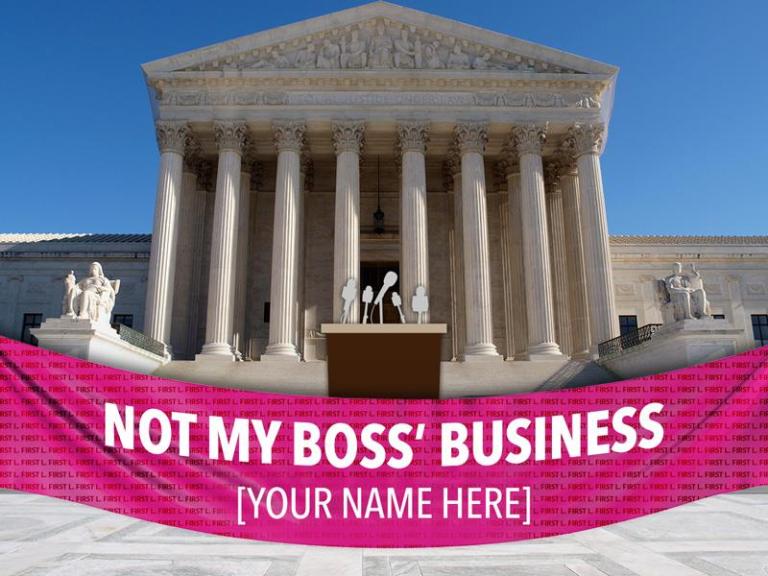
The conceptual transubstantiation required to get the phrase “Not my boss’ business” out of the demand that my “boss” pay for my contraceptive devices makes me tickle. It is akin to saying “Because you have nothing to do with my sex life, provide for the contraceptive devices that make up a crucial part of my sex life,” or “Because it is not your business if I have an IUD, pay for my IUD.” It occasions such sublime despair over our human capacity to make any damn sense that I find myself wishing Planned Parenthood would rise victorious — if only that they could move on to a better slogan. Add “provide contraception” to the list of fundamental duties an employer has to employees, fine — just don’t do it on the basis that your employer has nothing to do with contraception. By the actions of the HHS Mandate we are obviously, blindingly obviously giving our bosses a direct relation to our sex lives, an economic interest previously non-existent, and a business in our bedroom I promise will get creepy.
But it makes sense in its own way. To give it crowd-appeal, to make it Facebook-worthy, to craft a narrative in which ideological propositions achieve their highest level of you’d-have-to-be-an-inhuman-ball-of-mysogonistic-fire-hate-to-diasagee-with-this, the debate — which, in the courts, is being held over the complex issue of religious freedom — needs to be reduced to something of godlike simplicity: “Women need birth control and their bosses are denying them it.”
But we are interested in the effects political decision on Planned Parenthood’s idea of women. Having determined that the political battle will rage between “sex-involving-your-boss” and “sex-without-your-boss,” an aesthetic was created to promote and defend this construction — via graphics, videos, press releases, slogans, bumper-stickers and the whole abysmal slew of American politics. Since Planned Parenthood are using representations of women to craft this aesthetic — and if what we said is true, that in representing an idea of women over the diverse and disagreeable particular women they are also defining who fits and who doesn’t fit into their idea — then this aesthetic becomes a valuable tool in determining how Planned Parenthood define their category.
The first noticeable decision is that all women are represented as employees — and all their employers are men. To use a few examples from the media shared on Planned Parenthood Action’s Facebook page…

Shared March 15th

Shared March 20th
Of course, bosses are not only always men, they are also Monopoly Men — caricatures of obese, greedy, for-profit CEOs.


Shared March 30th
It is no matter that the majority of the organizations suing the federal government are non-profit organizations, many of whose oppressive force over their employees amounts to giving them one scoop instead of two from the leftovers of the soup-kitchen line — The Little Sisters of the Poor and Catholic Charities, to name a few. What matters is that the narrative presented effectively inspires the support of a media-consuming public.
But this political success — for it is an immense success — is simultaneously an ideological failure in terms of Planned Parenthood’s idea of women, who are never represented as holding positions of power. Women are the weak. Never mind that many of the “bosses” suing the federal government for forcing them to violate their ethical principles are women, like Lilli Johnson of Johnson Welded Products, Inc., Catherine A. Hartenbower of Hart Electric, LLC, Karen A. Mersino of Mersino Management Company, or Mary Jo Feltl of Feltl and Company Inc. A female boss refusing to conform with a “pro-contraception” law does not fit the narrative which will most effectively convince the public — a narrative which, to judge the media produced, amounts to that riveting bedtime story — “Bad Male Boss Oppresses Good Female Worker.” By ignoring female leaders for the sake of their political goals, Planned Parenthood unintentionally reinforce the gender inequality they rightly stand against. In representing their idea of the “women” they support and defend through the exclusion of the female boss and the over-accentuation of the male boss, Planned Parenthood have implicitly tended their idea of women towards the rank of the employee, and more than that, towards the victimized employee.
Again, this reduction of women to the category of the employed works extremely well. Who could give anything but support to a timid, bewildered-looking female employee being denied her fundamental needs by a male employer who looks like he just stepped off the set of Mad Men to steal hot chocolate from orphans?
But an argument might be made that within Planned Parenthood’s picture of women as employees is not so much the implication that she cannot or will not be a boss, but rather that — if she were a boss — she would not be opposed to paying for contraception. Now that this is factually false is obvious. Again, many of the employers suing the United States government are women. Many of the plaintiffs in general are women, like Stacy Molai or Sister Mary Catherine. And even if this were not the case, the mere fact that there are woman on this planet who are ethically opposed to paying for your non-medical contraceptive devices — who assumedly would not ditch such a conviction upon becoming a boss — this is enough to question the idea implicit in Planned Parenthood’s aesthetic, that “women — if they were employers — would have no problem paying for their employees’ contraceptives.” But again, the question is not whether Planned Parenthood are being factually accurate, but how they are defining their idea of women in their representation of “women” over against the diversity and disagreement of actual, particular women.
Here, women are incredibly mono-chromed. They are denied an ethical existence in the realm of sexuality. The Planned Parenthood idea of a woman is someone who could not possibly have an conflict between the precepts of an ethical code and the demand of employees that she pay for their contraception. “Having the proper views regarding contraception” has become a border which contains Planned Parenthood’s idea of a woman, and particular women must conform to this if they are cross the border and be included in the category.
Here we see a similarity in Planned Parenthood’s claim to represent “women” in their promotion of abortion access — despite the majority of women opposing legal abortion in all or most cases (20%, 37% respectively). Against all factual evidence, “women” are made synonymous with “pro-choice women.” “Women,” as Planned Parenthood uses the term, are synonymous with “pro-HHS-Mandate women.” In short, “women” are defined as those type of creatures who, by their very nature, agree with Planned Parenthood.
This is the logical consequence of speaking for “women” as a general category. Either your idea of women will conform to the truth about the views and positions of actual women — which will require it to become as detailed, descriptive and complex as the subject matter demands — or your idea will conform particular women unto itself. Since Planned Parenthood are speaking for “women” over and against the actual positions of particular women, I can only assume that the latter is true, that their use of the word refers to a certain category, the shape of which comes to light in their inability to represent “women” as leaders ethically-convicted against the ideology of Planned Parenthood. Women are those types of creatures who agree with Planned Parenthood, and thus they can be “stood for” and “spoken for” by the institution without contradiction.
Now while understand Planned Parenthood’s need to categorize for the sake of rhetoric — something I am certainly guilty of, as are most organizations who operate in a rhetorical mode — allow me a minor-league, existential table-flip against this impossibly paternalistic “speaking for women” that plagues America’s political scene. Women speak for themselves. Admitting this — which involves admitting that women are often your self-proclaimed enemies — is one of the most pro-woman moves a “pro-woman” institution can make. It is not an act of female treason to oppose Planned Parenthood, no, it is precisely an act of assertion that affirms “women” as neither this nor that pre-defined thing, there to be stood for, spoken for, and blithely represented. Women belong to themselves, thinking, acting and feeling out of a locus of personal interiority that no other can grasp, and on which no institution can claim a privileged access point. This incommunicable interiority is revealed in disagreement, which asserts the person against the paradigm, the ideology and the zeitgeist. The recognition of female opposition is one of the highest honors anyone who dares make the general statement “we support women” can bestow. If you believe that women are free, they must be free to disagree, free, even, to be detested by you — precisely as women. Denying this is the proposal of a universal feminine sheepishness that would never assert itself contrarily.
But this is what Planned Parenthood do in their easy, reductive schema that drives a media-consuming public from position to position. They present women as a type of being impossibly passive to their own ideology — as equatable with their ideology. The religious convictions, ethical decisions, and moral concerns that daily call all others to assert themselves in freedom — even if it is against the opinion of the entire world — these are expected to be quashed upon entry into Planned Parenthood’s category of “women.” There is no place for an ethically-convicted, independent woman within their aesthetic, simply because their narrative must remain one in which “good, female employees need contraception, and their bad, male employers are denying them it.”
Next Post

April 30, 2014 Netflix and Good Ol' American Despair
Browse Our Archives
Select a Category Another Look Atheism Bad Catholics Beauty Communio Crookedhart Destupidification Exiting the Culture Wars Gender Theory That Doesn't Suck How To Language Liturgy! Love One Another Marriage Equality Modesty Music Objectification pop culture Poverty Sacraments Sex Technology The Best Religion in the World The Erotic Phenomenon Time Uncategorized Virtue Ethics That Don't Suck Winning the Culture Wars
Select a Month January 2017 December 2016 November 2016 October 2016 July 2016 June 2016 April 2016 March 2016 February 2016 January 2016 December 2015 November 2015 October 2015 September 2015 August 2015 July 2015 June 2015 May 2015 March 2015 February 2015 January 2015 June 2014 May 2014 April 2014 March 2014 February 2014 January 2014 December 2013 November 2013 October 2013 September 2013 August 2013 July 2013 June 2013 May 2013 April 2013 March 2013 February 2013 January 2013 December 2012 November 2012 October 2012 September 2012 August 2012 July 2012 June 2012 May 2012 April 2012 March 2012 February 2012 January 2012 December 2011 November 2011 October 2011 September 2011 August 2011 July 2011 June 2011 May 2011 April 2011 March 2011 February 2011 January 2011 December 2010 November 2010 October 2010 September 2010 August 2010
Follow Us!
TAKE THE
Religious Wisdom Quiz
Who said, "I have been crucified with Christ and I no longer live, but Christ lives in me"?
Select your answer to see how you score.
John Paul James Peter
Related posts from Bad Catholic


Who Said It About Sexuality, Slavoj Žižek or...

Ayn Rand, Fairy Godmother of Sexual Orientation

5 Things We Should Think About Before We...
TRENDING AT PATHEOS Catholic

The Parable Of The Sower And The Word...
One of Christ’s most famous parables is that of the sower who...

Rejecting Doom: Christian Hope And Human Action
Christianity is a religion of hope. We are to have hope and...

Why I Choose the Eucharist Over the Sermon
Choose the Eucharist, Not the Sermon What are we supposed to get...

5 Design Elements Found in Spiritually Rooted Homes
Putting Spirituality Into Home Decor Our homes are more than our living...

Credo: A Story of God Told with the...
About 10 years ago, I began to imagine a personal "Credo" that...

The Anatomy of Divine Revelation in Catholic Thought
The claim that God has made Himself known to human beings is...
view all Catholic blogs
Ad-Free & Subscriber Log-In Subscription Support
- About Us
- 2026 Calendar
- Videos
- Podcasts
- Library of World Religions
- Faith In Media Tracker
- Advertise With Us
- Write for Us
- Privacy Policy
- Terms of Service
- Do Not Sell My Data
- Contact Us
- Radiant Digital
- Manage Newsletter Subscriptions
- Unsubscribe From Notifications
- Sitemap
Copyright 2008-2026, Patheos. All rights reserved.
Subscription Support Ad-Free & Subscriber Log-In
Follow Patheos