
BuddhistCatholicContemplativeEvangelicalGeneral ChristianHinduJewishLatter-day SaintMuslimNew VisionsProgressive Christian
Beliefs
- Buddhist
- Catholic
- Contemplative
- Evangelical
- General Christian
- Hindu
- Jewish
- Latter-day Saint
- More Voices
- Muslim
- New Visions
- Pagan
- Progressive Christian
Topics
- Religion News
- Food and Religion
- Sports and Religion
- Religious Art
- Religious Music and Entertainment
- Religious Events
- History and Religion
- Style and Religion
- Politics and Religion
- Women in Religion
- Recreation Outdoors and Religion
- Business Finance and Religion
- Careers Workplace and Religion
- Education and Religion
- Family Parenting and Religion
- Health Fitness and Religion
- Home and Religion
- Relationships and Religion
- Technology and Religion
- Travel and Religion
Columnists
- Buddhist Columnists
- Business Finance and Religion Columnists
- Careers Workplace and Religion Columnists
- Catholic Columnists
- Contemplative Columnists
- Education and Religion Columnists
- Evangelists Columnists
- Family Parenting and Religion Columnists
- General Christian Columnists
- Health Fitness and Religion Columnists
- Hindu Columnists
- History and Religion Columnists
- Home and Religion Columnists
- Jewish Columnists
- More Voices Columnists
- Latter Day Columnists
- Muslim Columnists
- New Visions Columnists
- Nonreligious Columnists
- Pagan Columnists
- Politics and Religion Columnists
- Progressive Columnists
- Recreation Outdoors and Religion Columnists
- Relationships and Religion Columnists
- Religion News Columnists
- Religious Art Columnists
- Religious Events Columnists
- Religious Music and Entertainment Columnists
- Sports and Religion Columnists
- Style and Religion Columnists
- Technology and Religion Columnists
- Travel and Religion Columnists
- Women in Religion Columnists
Resource Library
- 2026 Calendar
- Library of World Religions
- The 100 Most Holy Places on Earth
- Patheos Answers
- Podcasts
- Videos
- Faith Leaders Database
- Anglican Episcopalian
- Bahai
- Baptist
- Buddhism
- Christianity
- Confucianism
- Eastern Orthodoxy
- Hinduism
- Holiness and Pentecostal
- ISKCON
- Islam
- Judaism
- Lutheran
- Methodist
- The Church of Jesus Christ of Latter-day Saints
- New Age
- Paganism
- Presbytarian and Reformed
- Protestantism
- Religion Behind the Scenes
- Roman Catholic
- Scientology
- Shia Islam
- Sikhism
- Sufism
- Sunni Islam
- Taoism
- Zen
- See all religions
Research Tools
 Ad-Free & Subscriber Log-In Subscription Support
Follow Patheos 

- Trending:
- Advent
- |
- Forgiveness
- |
- Thanksgiving
- |
- Election
- |
- Seasonal Holidays
- |
- Marriage
 Bad Catholic
- Home
- Catholic
- Gratitude as Felt Poverty
Gratitude as Felt Poverty
Last updated on: December 21, 2013 at 3:15 pm by Marc
Gratitude as Felt Poverty 2013-12-21T15:15:00-05:00 Marc
Patheos Explore the world's faith through different perspectives on religion and spirituality! Patheos has the views of the prevalent religions and spiritualities of the world.
Gratitude responds to gift.
Consider our experience of the thing in its most obvious, most burning and urgent form, when we are acutely aware that we have nothing to offer the gift-giver but our thanks. How hard we feel this in the face of love, full of the wonderful, painful knowledge that there is nothing we could do or say to christen us its worthy candidates, no words or gestures to serve as love’s equalizing response — and yet we are loved. So we collapse with a profusion of thanksgiving and an upswell of gratitude — a “thank you,” whether of the tongue or the ache in the chest. But our “thank you” is neither the proper thing to say nor the adequate response, rather, it is our precise recognition that there is no adequate response. We give thanks when words fail, when we have nothing left to say, and the degree to which we realize the poverty of all possible words is the degree to which we are thankful.
Considered in this sense, the words “thank you” are anti-words, symbols that deliver the fact that we have nothing to deliver, a response that indicates the impossibility of a response. Considered in another, gratitude is felt poverty.

To give thanks is to admit that we are poor, for in the moment of giving thanks, we acknowledge that what we have comes entirely from another, that we are dependent as baby birds squawking tortuously for a giving mother. To give thanks is to relinquish any claim we have on what is given to us, maintaining within us the givenness of the gift.
If instead of saying “thank you,” we said, “I am filled with understanding that my having the salt is entirely dependent upon your willful passing of said salt, and as such I acknowledge and affirm that I am not alone in the universe, but that my life — in its quality and meaning — is full of your gift,” we’d be thrown from the table, but with a new understanding of what the hell I’m talking about. To say thank you has cosmic implications. It is the declaration of a contingent being, the happy chirp of a thing that finds his life and its content all tied up in others.
Parents, teach your children to say thank you. It is a primordial lesson in Christian self-annihilation.
Perhaps this is why it is harder to say “thank you” and mean it than to ask for something and mean it. When we ask we desire to attain, and this is easy. We are quite accustomed to wanting. When we really give thanks, we practice detachment from the very thing we have attained, and this hard. We recognize that it is of another, given unto us, not ours except by the will of a gift-giver. We recognize that we don’t really own what we own.
It occurs to me now that if you want to know the poor in spirit do not listen for the most urgent display of begging, for no one wants like the rich. Listen instead for urgency in gratitude, for it is precisely by being thankful that we admit our utter dependence on others, and on their generous love.
But in the realm of the merely polite, “thank you” has the misfortune of being a phrase that ends transactions. I glance above the head of the fast-food worker, order my meal, and when I get what I am owed, I mutter “thank you,” usually towards the counter, and leave. But if you let it bake your noodle — go on, let it — this commonplace makes no sense. If I am owed a meal, if I am owed anything at all, it is hardly expedient upon me to be grateful for it. The fact that my delicious chicken sandwich arrives has its origins in me, in my money. Why express dependence on another?
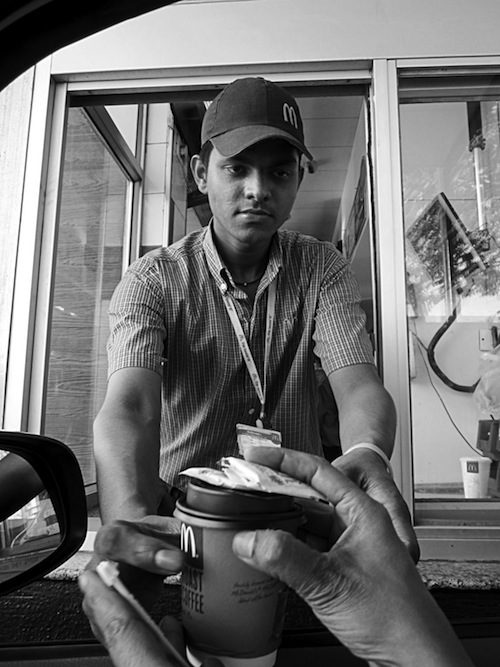 This mingling of the spheres of gratitude and economy is revealed all awkward by the fact that we hardly ever mean the gratitude we express when we receive our receipt, our sandwich, or our change at the coffee shop. It is our change. We own it. We paid for it. Why be grateful? And if we do believe we mean our muttered thanks, only let there be some difficulty, some delay in our getting what was owed, and we’ll reveal in our subsequent freak-out’s that our thanks has a lot more to do with a gratified expectation — much less to do with detachment.
Thanks has no place in the world of economy, where every give is completed by a take, every transaction finished when the deficit of being-owed is filled by getting what was owed, and the length and breadth of every personal encounter is exhausted when the tit becomes its tat.
We say it is polite to say “thank you,” but politeness without a reason for its own existence is rude. Thus I am far more offended by the meaningless “thank you” at the cash register than the thankless, hurried flee from human interaction which remains, at the very least, an honest expression of how we feel about the uniformed masses that serve us our food, clothes, tickets, parking spaces, and all the rest.
Thanks has no place in economy, but that’s okay, because neither does the person. The person transcends this sphere of use, getting, and giving-to-get. The “thank you” ought to complete the transaction, not because it is part of the transaction, but precisely because it is not. It is the absurd insertion of humanity into the inhuman.
To give thanks ennobles and personalizes us. It is a reminder, at the end of a give-and-take that makes as much sense to robots as to humans, to be flesh, bone and soul-stuff — to take this deserving-getting-consuming stuff lightly. The truth of the matter is that I am not owed anything. My very existence is dependent on others, as is my identity, as is the fact that I have money, as is the fact that I have the capacity to have money, as is my coming sandwich. To say thank you in the face of getting-what-I-was-owed is an acknowledgment of this final poverty. By meaning our thanks at the end of a mindless, daily transaction we escape this selfsame mindlessness and endow our situation with a cosmic view, reminding ourselves that every transaction we make in the space between non-existence and death depends upon a life was neither transacted, deserved, or asked for, but given. When the things I am owed are the content of a life I am not owed, everything I own becomes a gift received. So we give thanks.
And is this not part and parcel Christian life, the recognition of having nothing but the given? So to my readers — thank you, thank you all.
Previous Post

December 18, 2013
What We're Doing In Steubenville
Next Post
December 26, 2013 Drawing Stuff on the Pope's Face
Browse Our Archives
Select a Category Another Look Atheism Bad Catholics Beauty Communio Crookedhart Destupidification Exiting the Culture Wars Gender Theory That Doesn't Suck How To Language Liturgy! Love One Another Marriage Equality Modesty Music Objectification pop culture Poverty Sacraments Sex Technology The Best Religion in the World The Erotic Phenomenon Time Uncategorized Virtue Ethics That Don't Suck Winning the Culture Wars
Select a Month January 2017 December 2016 November 2016 October 2016 July 2016 June 2016 April 2016 March 2016 February 2016 January 2016 December 2015 November 2015 October 2015 September 2015 August 2015 July 2015 June 2015 May 2015 March 2015 February 2015 January 2015 June 2014 May 2014 April 2014 March 2014 February 2014 January 2014 December 2013 November 2013 October 2013 September 2013 August 2013 July 2013 June 2013 May 2013 April 2013 March 2013 February 2013 January 2013 December 2012 November 2012 October 2012 September 2012 August 2012 July 2012 June 2012 May 2012 April 2012 March 2012 February 2012 January 2012 December 2011 November 2011 October 2011 September 2011 August 2011 July 2011 June 2011 May 2011 April 2011 March 2011 February 2011 January 2011 December 2010 November 2010 October 2010 September 2010 August 2010
Follow Us!
TAKE THE
Religious Wisdom Quiz
Who was struck dead for lying about money in the early church?
Select your answer to see how you score.
Simon the Sorcerer Nicodemus Ananias and Sapphira Demas
Related posts from Bad Catholic

How to Kill a Community: Lessons From Mediocre...

Giving Your Money to Drug Addicts
TRENDING AT PATHEOS Catholic

Faith, Reason, and Transubstantiation
“It would be easier for the world to survive without the sun...
When The Letter Of The Law Misses Its...
Jesus cared about people. He never ignored their needs, whether they were...

The Kingdom Of God In Ordinary Life And...
The kingdom of God is all around us; it is in us...

If Baptism Washes Away Sin, Why Do Catholics...
The seven sacraments stand as the foundation of Catholic ecclesial life. The...

The Power of Setting a Good Example
Remember last August when the Chicago White Sox hosted a "Pope Hat...

How Grandma Tourism Helps Grandparents Live Their Vocation
Grandma, The New Travel Influencer What started as a nostalgia-inspired social media...
view all Catholic blogs
Ad-Free & Subscriber Log-In Subscription Support
- About Us
- 2026 Calendar
- Videos
- Podcasts
- Library of World Religions
- Faith In Media Tracker
- Advertise With Us
- Write for Us
- Privacy Policy
- Terms of Service
- Do Not Sell My Data
- Contact Us
- Radiant Digital
- Manage Newsletter Subscriptions
- Unsubscribe From Notifications
- Sitemap
Copyright 2008-2026, Patheos, part of the Radiant Digital network of media brands. All rights reserved.
Subscription Support Ad-Free & Subscriber Log-In
Follow Patheos