
BuddhistCatholicContemplativeEvangelicalGeneral ChristianHinduJewishLatter-day SaintMuslimNew VisionsProgressive Christian
Beliefs
- Buddhist
- Catholic
- Contemplative
- Evangelical
- General Christian
- Hindu
- Jewish
- Latter-day Saint
- More Voices
- Muslim
- New Visions
- Pagan
- Progressive Christian
Topics
- Religion News
- Food and Religion
- Sports and Religion
- Religious Art
- Religious Music and Entertainment
- Religious Events
- History and Religion
- Style and Religion
- Politics and Religion
- Women in Religion
- Recreation Outdoors and Religion
- Business Finance and Religion
- Careers Workplace and Religion
- Education and Religion
- Family Parenting and Religion
- Health Fitness and Religion
- Home and Religion
- Relationships and Religion
- Technology and Religion
- Travel and Religion
Columnists
- Buddhist Columnists
- Business Finance and Religion Columnists
- Careers Workplace and Religion Columnists
- Catholic Columnists
- Contemplative Columnists
- Education and Religion Columnists
- Evangelists Columnists
- Family Parenting and Religion Columnists
- General Christian Columnists
- Health Fitness and Religion Columnists
- Hindu Columnists
- History and Religion Columnists
- Home and Religion Columnists
- Jewish Columnists
- More Voices Columnists
- Latter Day Columnists
- Muslim Columnists
- New Visions Columnists
- Nonreligious Columnists
- Pagan Columnists
- Politics and Religion Columnists
- Progressive Columnists
- Recreation Outdoors and Religion Columnists
- Relationships and Religion Columnists
- Religion News Columnists
- Religious Art Columnists
- Religious Events Columnists
- Religious Music and Entertainment Columnists
- Sports and Religion Columnists
- Style and Religion Columnists
- Technology and Religion Columnists
- Travel and Religion Columnists
- Women in Religion Columnists
Resource Library
- 2026 Calendar
- Library of World Religions
- The 100 Most Holy Places on Earth
- Patheos Answers
- Podcasts
- Videos
- Faith Leaders Database
- Anglican Episcopalian
- Bahai
- Baptist
- Buddhism
- Christianity
- Confucianism
- Eastern Orthodoxy
- Hinduism
- Holiness and Pentecostal
- ISKCON
- Islam
- Judaism
- Lutheran
- Methodist
- The Church of Jesus Christ of Latter-day Saints
- New Age
- Paganism
- Presbytarian and Reformed
- Protestantism
- Religion Behind the Scenes
- Roman Catholic
- Scientology
- Shia Islam
- Sikhism
- Sufism
- Sunni Islam
- Taoism
- Zen
- See all religions
Research Tools
 Ad-Free & Subscriber Log-In Subscription Support
Ad-Free & Subscriber Log-In Subscription Support
Follow Patheos 

- Trending:
- Forgiveness
- |
- Marriage
- |
- Consciousness
- |
- Death Penalty
- |
- Election
- |
- Halloween
 Bad Catholic
- Home
- Catholic
- Unintentional Fetal Depersonalization
Unintentional Fetal Depersonalization
Last updated on: November 11, 2013 at 1:46 pm by Marc
Unintentional Fetal Depersonalization 2013-11-11T13:46:09-05:00 Marc
Patheos Explore the world's faith through different perspectives on religion and spirituality! Patheos has the views of the prevalent religions and spiritualities of the world.
To tell the truth poorly is to make a mockery of it, even if you’re right. – Sam Rocha
It is a self-proclaimed aim of the pro-life movement that the world recognize the unborn child as an unique life and a particular personality — and subsequently not kill him. Simple request, really, this not-killing-people business. Those supporting the conservation of abortion have yet to articulate a successful evasion of our ethical demand, though from what I understand, they’re working on it.
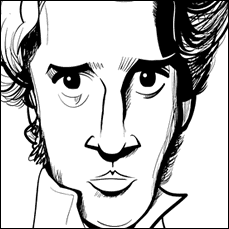 But Kierkegaard says “just as important as the truth, and of the two the even more important one, is the mode in which the truth is accepted, and it is of slight help if one gets millions to accept the truth if by the very mode of their acceptance they are transposed into untruth,” and it is precisely this transposition into untruth that I fear the pro-life movement guilty of. I fear — and perhaps I am wrong, but it is an honest fear — that we are depersonalizing the fetus in our efforts to personalize the fetus.
Consider a point most will agree on, so as to warm our noses for the coming controversy: The graphic display of aborted fetuses as a proclamation of the evils of abortion. The pros and cons of these displays have been debated to the point of no one caring. It drives home the reality of abortion, it gives pro-lifers a bad name, it shocks people out of their complacency, it numbs people to the truth of abortion, it looks fanatical, it tells people the truth, it’s scary for children, children should be scared, and so on and thus forth, in a debate largely centered around the possible consequences of these graphic displays.
But if we let consequences be consequences, that is, that which follows, (from consequentem, the present participle of consequi “to follow after”) we will have our faces pressed against that which does not follow, but is, instead, the thing itself. And I can’t help but see the thing itself, the very whatness of the graphic display of aborted fetuses, as depersonalization.
The aborted fetus, his or her limbs separated from the body, is not a testament against the evil of abortion. The fetus is a person, and thus the “choice” signs display the mutilated body of a particular person, a he or a she and even more so an I — a human existence of infinite value. Is this not our claim? Is this not the very motivation for holding the signs in the first place, that the fetus is a unique human life, and more than that, a particular person? But to make of him a sign is to reduce him to an argument. There is no semblance of respect for the personality of the slain on these signs, for we have reduced the person to a symbol, and this symbol is “the outrage of abortion.” But a person is not a symbol. A person is not an argument.
Surely, the first question that should spring from a picture of a dead person is — who is it? This question is appropriate, for the person is not a merely a thing identified in the question “what is it?” as rocks, trees and death-rays are identified. The person is a mystery we relate to by asking who, by asking who that person is beyond every other thing and every other person in existence.
You, for instance, are Daniel. You are not a Daniel like a tree is a tree. You are a self-relating existence, a you, referable to as such. Daniel.
But notice our language. Shudder at the semantics. How do we refer to these signs? How have I been referring to them in this post? They are pictures of aborted fetuses. The question regarding the identity of the person is answered by a what. That is an aborted fetus, as a tree is a tree.
I am not arguing that it is wrong to speak of the person as an object identified by a what. This, after all, is the nature of language. I am arguing that it is wrong, and awfully so, if our manner of speaking becomes our manner of relating, if we are holding “aborted fetuses” above our heads and not particular persons, identified by a who. And I fear it has become our manner of relating. For imagine the absurdity that would follow from recognizing, not in the haze and the abstract of ideological conviction, but in a real relation to the truth, that a fetus is a person as we are persons.
Would we not ask the mother of that person for permission to display the dead body of her daughter on our sign, as we ought for any other person? (But the mother had her daughter killed, an imaginary defendant might respond. But have we considered the possibility that the mother has been reconciled to God and man and now exists in a relationship of tragedy and love with her deceased child, with her child as a particular you identifiable by the question who? What I am trying to ask is whether “the aborted fetus” has a name, but more than that, whether we even considered the possibility of a name, a possible who-ness!) And if not the mother, did we ask the grandmother? The brother? These are only absurd questions to consider when plastering a dead body of a person on our signs if we are already involved in an act of unintentional depersonalization, by which what would be due to any other murdered person is not due to the aborted person.
If, however, you think that such decencies are not due to the human person, and that anyone who is killed by injustice immediately consents to having his dead body used as a testament against that injustice, then please, hear me now, in the authoritative gong of words decided upon and written down: No matter how I die, do not reduce my person to unidentified testament against injustice. The corpse is not a logo. The body of the human person is not a brand name through which we recognize that inglorious company — “the atrocity of abortion.”
“It is of slight help if one gets millions to accept the truth if by the very mode of their acceptance they are transposed into untruth.” What good is it if we convince a few people, if we convince millions of people, that abortion is affront to all that is good and wholesome and beautiful in this world, if the very mode by which they accept this truth is through the depersonalization of the fetus.
But the vast majority of people claiming the title “pro-life” agree to these sentiments, even if only by a felt and innate repulsion to the use of such graphic signs. So here I’d like to make myself a larger offense, for this same depersonalization exists in the cute as in the horrifying, and nobody talks about it.
Consider a few of the more generally adorable pro-life signs: A picture of a baby that reads “Please let me live.” An ultrasound of a fetus that says “I have a right to life.” I understand the sentiment. We propose to give a voice to the voiceless, to articulate the goodness of life over the skull-collapsing badness of abortion, and I hold nothing against those who see such signs as adequate expressions of this noble sentiment.
But what are we doing? What is the mode by which we convey the truth that the life of the fetus should not be snuffed at our will?
Quite simply, we are captioning a fetus. Now, to caption a fetus with a pro-life declaration is the establishment of a fiction — that a fetus could ever declare such a thing, or any thing at all. I have no illusions of some unspeakable ignorance on the part of those who make these signs, that they really think that the fetus is somehow voicing/thinking that “I have a right to life.” Rather I think we are involved, once again, in unintentional acts of depersonalization.
We are creating of the fetus an object over which we have power. We are rendering a particular person into an whiteboard on which to marker in our cause.
We are offended when the pro-choice sign reads “My baby is pro-choice,” but have we any real right, given that we have just put a rational declaration in the mouth of baby who cannot speak? Have we not, the both of us, taken a human person and made him or her an object to which we apply our ideological, religious or political views? Have we forgotten that the fetus we take pictures of and caption with “What about my right to choose?” is a person, a particular person, one who will grow and encounter the reality of abortion and make an intellectual, moral and spiritual choice in regards to it? Once again, the who is trans-mutated into the what, the particular person replaced with the idea of baby, a baby that would of course agree with our claims regarding abortion. We are using a particular person to achieve an end, and I can’t help but believe that the only reason we can stomach using people as a means to an end is because — on some level — we ourselves are denying the person of the fetus.
By fictionalizing the fetus, we contribute to the very evil we are fighting against — his or her depersonalization. We should not be surprised when our pro-choice brothers and sisters have their “fetus” asking, “Would you care about my rights if I was gay?” Giving a voice to the voiceless should not mean making a caricature out of the voiceless, making of the person a mere symbol. For even though what we are saying is true, even though the fetus does have a right to not be killed at the will of others, the mode by which we express this truth matters.
There’s much more to be said here. Until next time.
Previous Post

November 8, 2013
Repentance as Time Travel
Next Post
November 14, 2013 The Auschwitz Conflation
Browse Our Archives
Select a Category Another Look Atheism Bad Catholics Beauty Communio Crookedhart Destupidification Exiting the Culture Wars Gender Theory That Doesn't Suck How To Language Liturgy! Love One Another Marriage Equality Modesty Music Objectification pop culture Poverty Sacraments Sex Technology The Best Religion in the World The Erotic Phenomenon Time Uncategorized Virtue Ethics That Don't Suck Winning the Culture Wars
Select a Month January 2017 December 2016 November 2016 October 2016 July 2016 June 2016 April 2016 March 2016 February 2016 January 2016 December 2015 November 2015 October 2015 September 2015 August 2015 July 2015 June 2015 May 2015 March 2015 February 2015 January 2015 June 2014 May 2014 April 2014 March 2014 February 2014 January 2014 December 2013 November 2013 October 2013 September 2013 August 2013 July 2013 June 2013 May 2013 April 2013 March 2013 February 2013 January 2013 December 2012 November 2012 October 2012 September 2012 August 2012 July 2012 June 2012 May 2012 April 2012 March 2012 February 2012 January 2012 December 2011 November 2011 October 2011 September 2011 August 2011 July 2011 June 2011 May 2011 April 2011 March 2011 February 2011 January 2011 December 2010 November 2010 October 2010 September 2010 August 2010
Follow Us!
TAKE THE
Religious Wisdom Quiz
According to Titus, what appeared to all people, bringing salvation?
Select your answer to see how you score.
God's mercy The grace of God The gospel Jesus Christ
Related posts from Bad Catholic
Towards a New Argument Against Pornography


Why Millennials Want to Change the World

The Communist That Lives With Me Responds: "Your...
TRENDING AT PATHEOS Catholic

Rejecting Doom: Christian Hope And Human Action
Christianity is a religion of hope. We are to have hope and...

It’s What Comes From Within Which Matters
One of the most difficult things for us to understand is why...

Why I Choose the Eucharist Over the Sermon
Choose the Eucharist, Not the Sermon What are we supposed to get...

5 Design Elements Found in Spiritually Rooted Homes
Putting Spirituality Into Home Decor Our homes are more than our living...

Credo: A Story of God Told with the...
About 10 years ago, I began to imagine a personal "Credo" that...

The Anatomy of Divine Revelation in Catholic Thought
The claim that God has made Himself known to human beings is...
view all Catholic blogs
Ad-Free & Subscriber Log-In Subscription Support
- About Us
- 2026 Calendar
- Videos
- Podcasts
- Library of World Religions
- Faith In Media Tracker
- Advertise With Us
- Write for Us
- Privacy Policy
- Terms of Service
- Do Not Sell My Data
- Contact Us
- Radiant Digital
- Manage Newsletter Subscriptions
- Unsubscribe From Notifications
- Sitemap
Copyright 2008-2026, Patheos. All rights reserved.
Subscription Support Ad-Free & Subscriber Log-In
Follow Patheos