
BuddhistCatholicContemplativeEvangelicalGeneral ChristianHinduJewishLatter-day SaintMuslimNew VisionsProgressive Christian
Beliefs
- Buddhist
- Catholic
- Contemplative
- Evangelical
- General Christian
- Hindu
- Jewish
- Latter-day Saint
- More Voices
- Muslim
- New Visions
- Pagan
- Progressive Christian
Topics
- Religion News
- Food and Religion
- Sports and Religion
- Religious Art
- Religious Music and Entertainment
- Religious Events
- History and Religion
- Style and Religion
- Politics and Religion
- Women in Religion
- Recreation Outdoors and Religion
- Business Finance and Religion
- Careers Workplace and Religion
- Education and Religion
- Family Parenting and Religion
- Health Fitness and Religion
- Home and Religion
- Relationships and Religion
- Technology and Religion
- Travel and Religion
Columnists
- Buddhist Columnists
- Business Finance and Religion Columnists
- Careers Workplace and Religion Columnists
- Catholic Columnists
- Contemplative Columnists
- Education and Religion Columnists
- Evangelists Columnists
- Family Parenting and Religion Columnists
- General Christian Columnists
- Health Fitness and Religion Columnists
- Hindu Columnists
- History and Religion Columnists
- Home and Religion Columnists
- Jewish Columnists
- More Voices Columnists
- Latter Day Columnists
- Muslim Columnists
- New Visions Columnists
- Nonreligious Columnists
- Pagan Columnists
- Politics and Religion Columnists
- Progressive Columnists
- Recreation Outdoors and Religion Columnists
- Relationships and Religion Columnists
- Religion News Columnists
- Religious Art Columnists
- Religious Events Columnists
- Religious Music and Entertainment Columnists
- Sports and Religion Columnists
- Style and Religion Columnists
- Technology and Religion Columnists
- Travel and Religion Columnists
- Women in Religion Columnists
Resource Library
- 2026 Calendar
- Library of World Religions
- The 100 Most Holy Places on Earth
- Patheos Answers
- Podcasts
- Videos
- Faith Leaders Database
- Anglican Episcopalian
- Bahai
- Baptist
- Buddhism
- Christianity
- Confucianism
- Eastern Orthodoxy
- Hinduism
- Holiness and Pentecostal
- ISKCON
- Islam
- Judaism
- Lutheran
- Methodist
- The Church of Jesus Christ of Latter-day Saints
- New Age
- Paganism
- Presbytarian and Reformed
- Protestantism
- Religion Behind the Scenes
- Roman Catholic
- Scientology
- Shia Islam
- Sikhism
- Sufism
- Sunni Islam
- Taoism
- Zen
- See all religions
Research Tools
 Ad-Free & Subscriber Log-In Subscription Support
Ad-Free & Subscriber Log-In Subscription Support
Follow Patheos 

- Trending:
- Forgiveness
- |
- Marriage
- |
- Consciousness
- |
- Death Penalty
- |
- Election
- |
- Halloween
 Bad Catholic
- Home
- Catholic
- The Ethical Necessity of Time Travel
The Ethical Necessity of Time Travel
Last updated on: May 31, 2014 at 11:54 am by Marc
The Ethical Necessity of Time Travel 2014-05-31T11:54:06-04:00 Marc
Patheos Explore the world's faith through different perspectives on religion and spirituality! Patheos has the views of the prevalent religions and spiritualities of the world.
Part 2 of a series hardly worth talking about.
Sin is not religious. It is a theistic-atheistic, equal-opportunity steel-boot to the groin the entirety of humanity is doubled-over and groaning with. To be a sinner is not simply to have offended some brooding moral order which thereafter holds you in cosmic contempt. To be a sinner is to contain within yourself the reality of having done what you ought not have done. There is hardly a human alive — no matter how hip — who can coherently defend the non-existence of ethical experience, that is, the experience of our actions as things we either ought or ought not have done. It follows that no one really denies the experience of sin — the experience of that-which-we-ought-not-do — as much as everyone loves to deny that this experience could possibly mean anything so very grand as God, salvation, Heaven, Hell and all the rest. Which is fine.
But if there is such a thing as sin, there is such a thing as sinners, and to deny the existential state of being a sinner is as self-evidently ridiculous as denying the existence of my elbows, for we feel the state of sin. What we ought-not-have-done takes shape, taste and cringe-inducing color-schemes somewhere in the bowels of our interior life. It’s absurd to pretend otherwise, to pretend that we may experience doing that which we ought not do, but that this experience has no lasting effect, or rather, that it effects no change in our ontological status, our state of being. For what is the feeling of guilt but an almost bodily recognition of what ought-not-be lingering inside us? If our sins were simply to fade into the non-existent past the moment we committed them, as ethical feelings with no subsequent implications, why on earth would they continue torture us years later in the sheet-twisting hours of the night? Why are we beset by the constant possibility of being found out? Guilt is evidence of the stickiness of sin. That which we ought-not-do rips — then remains like a bullet-hole.
The idea that “the past is past,” that sins are merely “gotten over,” that they have no ultimate, lasting meaning and effect no ontological change stems from a misconception of the person’s relation to time. Personal time is not linear. The human person is not a bulldozer moving forward into the future, leaving behind him only the faded-away — shells and shadows apart from the actual life of the person. The human person summarizes his past in his present. When you meet a person, you meet a presence that is currently affected and presently informed by a past. To love a girl is to love the contents of a childhood that, in the moment of your loving her, shape who she is. When you shake my hand you shake a hand formed by my parents, a hand contingent — and contingent in the now — upon past events, past handshakes.
 The past is not past in the person, but present, tangible in his every touch, audible in his words, encountered at every moment of personal encounter. Indeed it is a mark of depersonalization to subtract from people their past, to view them as having come into existence at the moment of seeing them. We do not grant to the “face in the crowd” the possible past he offers to the world — a love-life, a car crash that made him believe in angels, a singular touch by his father at the age of 9 that even now gives him courage — no, we subtract this possibility from the person and limit him to a pastless present, a animate mask devoid of content — he is a face, nothing more. He is summed up as what he looks like and what he does before my eyes — his face passes me in the crowd, and therefore he is reduced to a face in the crowd. I do not marvel at his mystery.
We rarely consider the daughterhood of the porn-star or the childhood of the convicted rapist. The subtraction of the person’s past subtracts the person, for the person exists as a “summing-up” of a past in her presence. The addition of a person’s past, on the brighter side of things, is a heroic act of re-personalization. A solider contemplates the dead face of his enemy and wonders at the fact that this entity, this abstract “bad guy” and the object of his well-honed aggression had birthday parties and a childhood filled with incomprehensible thoughts, songs and attempts to avoid cracks in the sidewalk. Here personhood is restored, the thing becomes a you, the it another-I, and all by virtue of a heroic recognition of a past summed-up in a person’s presence.
Which brings us back to the point. If being a person means containing your past, then no sins are past sins. Sin is a present, lived reality. Guilt is not a wallowing in the past, though a perverse guilt may be. Guilt is the pain of a past-filled present, or rather, the felt experience of the presence of a sinful past — of a past that isn’t past at all. If each man introduces himself as a present which sums up and is currently informed by a past, then the difference between the sinner and the sinless is that the sinner presents himself partially. The sinner contains within himself that which ought not be. He delivers a past in his present and this past contains absurdities that ought-not exist, and thus he, presently, offers to the world an incoherence.
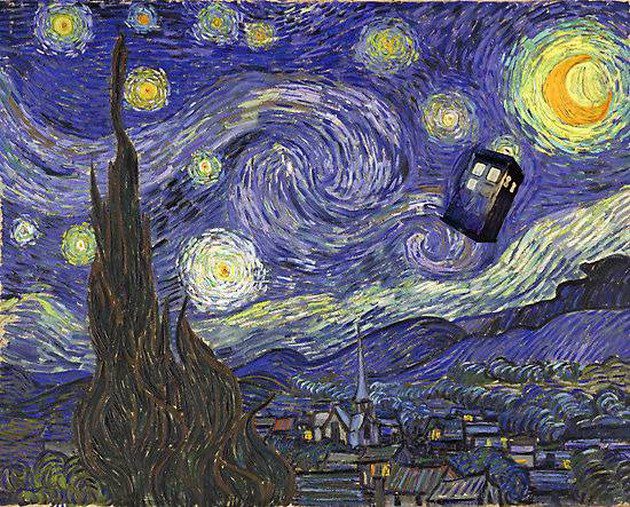
If we want to die damn good stories, to be whole, to have consistent, final meaning — then we’re going to have to be rid of sin. If being a sinner is to summarize within the present moment a past that contains that which ought-not-be, then the only possibility of becoming a story free from crappy writing — free from the irreconcilable absurdities that ought never have been part of our narrative — is to go back in time and change the past. We must, quite literally, time-travel, and having done so, alter the quality of our past, that our present might be informed coherently by that which ought be, free from that which ought not. Only then can we introduce ourselves fully, without gaps in our story.
I can only think of one method by which human person can change the quality of the past. Until tomorrow, then.
Previous Post

November 5, 2013
How to Die a Damn Good Story
Next Post
November 8, 2013 Repentance as Time Travel
Browse Our Archives
Select a Category Another Look Atheism Bad Catholics Beauty Communio Crookedhart Destupidification Exiting the Culture Wars Gender Theory That Doesn't Suck How To Language Liturgy! Love One Another Marriage Equality Modesty Music Objectification pop culture Poverty Sacraments Sex Technology The Best Religion in the World The Erotic Phenomenon Time Uncategorized Virtue Ethics That Don't Suck Winning the Culture Wars
Select a Month January 2017 December 2016 November 2016 October 2016 July 2016 June 2016 April 2016 March 2016 February 2016 January 2016 December 2015 November 2015 October 2015 September 2015 August 2015 July 2015 June 2015 May 2015 March 2015 February 2015 January 2015 June 2014 May 2014 April 2014 March 2014 February 2014 January 2014 December 2013 November 2013 October 2013 September 2013 August 2013 July 2013 June 2013 May 2013 April 2013 March 2013 February 2013 January 2013 December 2012 November 2012 October 2012 September 2012 August 2012 July 2012 June 2012 May 2012 April 2012 March 2012 February 2012 January 2012 December 2011 November 2011 October 2011 September 2011 August 2011 July 2011 June 2011 May 2011 April 2011 March 2011 February 2011 January 2011 December 2010 November 2010 October 2010 September 2010 August 2010
Follow Us!
TAKE THE
Religious Wisdom Quiz
Who was the first man created by God?
Select your answer to see how you score.
Moses Noah Adam Abraham
Related posts from Bad Catholic

Towards a New Argument Against Pornography


Why Millennials Want to Change the World

The Communist That Lives With Me Responds: "Your...
TRENDING AT PATHEOS Catholic

Rejecting Doom: Christian Hope And Human Action
Christianity is a religion of hope. We are to have hope and...

It’s What Comes From Within Which Matters
One of the most difficult things for us to understand is why...

Why I Choose the Eucharist Over the Sermon
Choose the Eucharist, Not the Sermon What are we supposed to get...

5 Design Elements Found in Spiritually Rooted Homes
Putting Spirituality Into Home Decor Our homes are more than our living...

Credo: A Story of God Told with the...
About 10 years ago, I began to imagine a personal "Credo" that...

The Anatomy of Divine Revelation in Catholic Thought
The claim that God has made Himself known to human beings is...
view all Catholic blogs
Ad-Free & Subscriber Log-In Subscription Support
- About Us
- 2026 Calendar
- Videos
- Podcasts
- Library of World Religions
- Faith In Media Tracker
- Advertise With Us
- Write for Us
- Privacy Policy
- Terms of Service
- Do Not Sell My Data
- Contact Us
- Radiant Digital
- Manage Newsletter Subscriptions
- Unsubscribe From Notifications
- Sitemap
Copyright 2008-2026, Patheos. All rights reserved.
Subscription Support Ad-Free & Subscriber Log-In
Follow Patheos